
Rapid Identification of Orange Juice Adulteration Using Voltammetric Profiling and Machine Learning
Article Sidebar
Main Article Content
Abstract
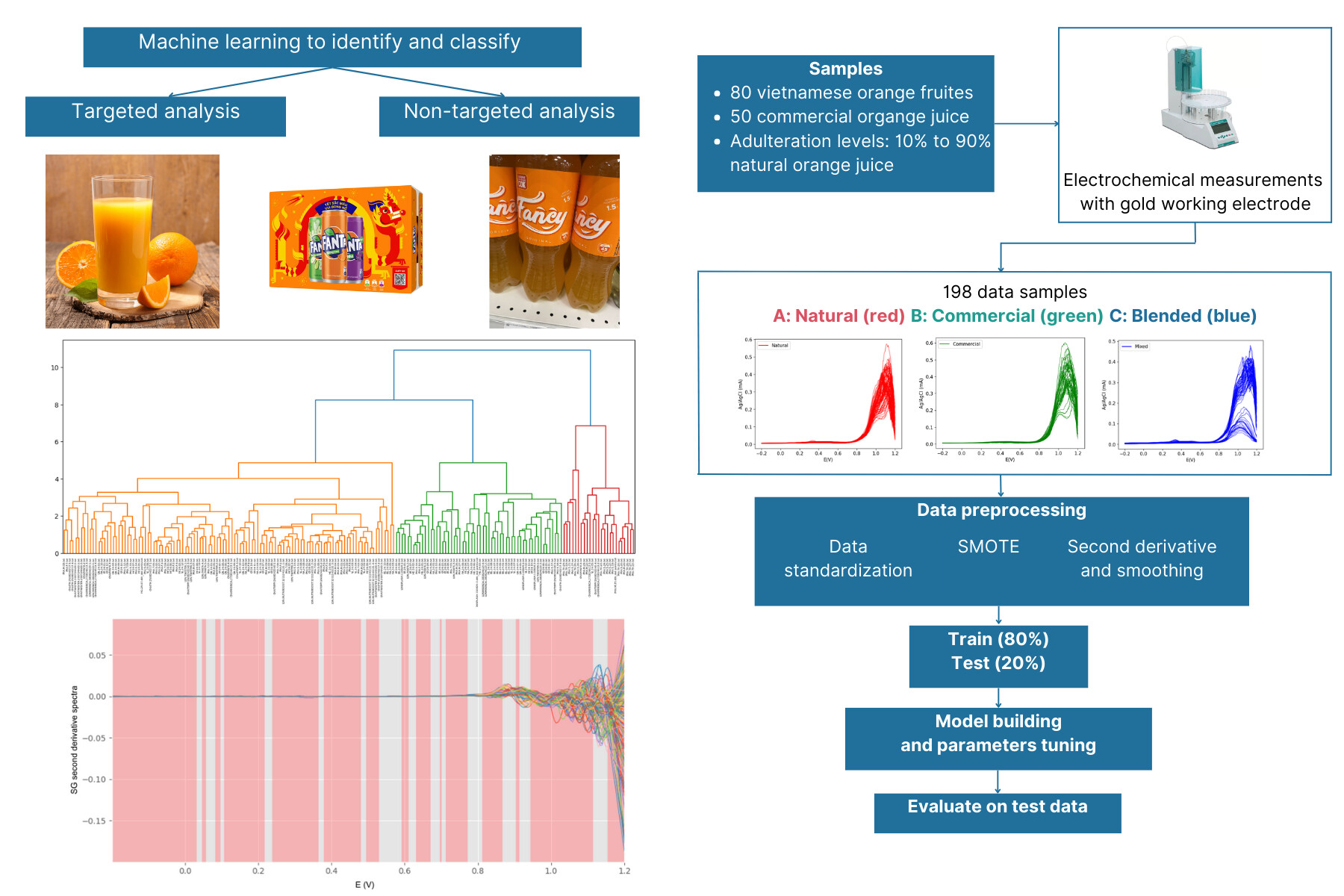
In this study, the differential pulse voltammetry with a gold electrode and machine learning was employed to detect adulteration in orange juices. The method assessed both natural and commercial juices, along with their mixtures containing known proportions of natural juice. Initially, an unsupervised machine learning algorithm, Cluster Analysis (CA), was used to highlight differences, demonstrating the ability to distinguish between natural and flavored orange juices. Subsequently, supervised machine learning methods, including Interval Partial Least Squares – Linear Discriminant Analysis (iPLS-LDA) and Interval Partial Least Squares – Random Forest (iPLS-RF), were applied for classification purposes. The RF model achieved up to 95% classification accuracy, greatly exceeding 67.5% of iPLS- LDA. This enables reliable detection of orange juice adulteration. The RF model struggled to accurately distinguish between the “Natural” and “Mixed” categories, particularly for samples containing a medium proportion of natural orange juice (around 45–50%). The integration of voltammetric fingerprints with machine learning enabled a fast, cost-effective classification method for on-site analysis with portable sensors. This approach proved more efficient than other complex analytical techniques.
Article Details

This work is licensed under a Creative Commons Attribution-NonCommercial-NoDerivatives 4.0 International License.
References
Pei, X.; Tandon, A.; Alldrick, A.; Giorgi, L.; Huang, W.; Yang, R. The China Melamine Milk Scandal and Its Implications for Food Safety Regulation. Food Policy 2011, 36, 412–420. https://doi.org/10.1016/j.foodpol.2011.03.008
Šejvl, J.; Šíma, J.; Rubešová, K.; et al. Public Health Response to Methanol Mass Poisoning in the Czech Republic in 2012: A Case Study. Cent. Eur. J. Public Health 2019, 27(Suppl.), 29–39. https://doi.org/10.21101/cejph.a5764
Feng, S.; Yi, L.; Wu, X.; et al. Differentiation between Flavors of Sweet Orange (Citrus sinensis) and Mandarin (Citrus reticulata). J. Agric. Food Chem. 2018, 66, 203–211. https://doi.org/10.1021/acs.jafc.7b04968
Mac, H. X.; Chen, Y.; Shao, Y.; et al. Current Techniques for Fruit Juice and Wine Adulterant Detection and Authentication. Beverages 2023, 9, 84. https://doi.org/10.3390/beverages9040084
Manikandan, V. S.; Adhikari, B.; Chen, A. Nanomaterial-Based Electrochemical Sensors for the Safety and Quality Control of Food and Beverages. Analyst 2018, 143, 4537–4554. https://doi.org/10.1039/C8AN00497H
Abad-García, B.; Berrueta, L. A.; López-Márquez, D. M.; et al. Polyphenolic Contents in Citrus Fruit Juices: Authenticity Assessment. Eur. Food Res. Technol. 2014, 238, 803–818. https://doi.org/10.1007/s00217-014-2160-9
Lozano-Sánchez, J.; Segura-Carretero, A.; Fernández-Gutiérrez, A. Chromatographic Technique: High-Performance Liquid Chromatography (HPLC). In Modern Techniques for Food Authentication; Elsevier: Amsterdam, 2018; pp 459–526. https://doi.org/10.1016/B978-0-12-814264-6.00013-X
Guccione, C.; Russo, M.; Cacciola, F.; et al. A Simple and Rapid HPLC–PDA–MS Method for the Profiling of Citrus Peels and Traditional Italian Liquors. Planta Med. 2016, 82, 1039–1045. https://doi.org/10.1055/s-0042-108735
Sun, R.; Yang, J.; Xia, Y.; et al. UPLC-QTOF-MS Coupled with Machine Learning to Discriminate between NFC and FC Orange Juice. Food Control 2023, 145, 109487. https://doi.org/10.1016/j.foodcont.2022.109487
Varnasseri, M.; Xu, Y.; Goodacre, R. Rapid Detection and Quantification of the Adulteration of Orange Juice with Grapefruit Juice Using Handheld Raman Spectroscopy and Multivariate Analysis. Anal. Methods 2022, 14, 1663–1670. https://doi.org/10.1039/D2AY00219A
Ehsani, S.; Yazdanpanah, H.; Parastar, H. An Innovative Screening Approach for Orange Juice Authentication Using Dual Portable/Handheld NIR Spectrometers and Chemometrics. Microchem. J. 2023, 194, 109304. https://doi.org/10.1016/j.microc.2023.109304
Marchetti, L.; Berrué, F.; Caro, Y.; et al. Use of ¹H NMR to Detect the Percentage of Pure Fruit Juices in Blends. Molecules 2019, 24, 2592. https://doi.org/10.3390/molecules24142592
Cuny, M.; Vigneau, E.; Le Gall, G.; et al. Fruit Juice Authentication by ¹H NMR Spectroscopy in Combination with Different Chemometrics Tools. Anal. Bioanal. Chem. 2008, 390, 419–427. https://doi.org/10.1007/s00216-007-1708-y
Ranbir; Kumar, R.; Singh, S.; et al. Machine Learning-Based Analytical Systems: Food Forensics. ACS Omega 2022, 7, 47518–47535. https://doi.org/10.1021/acsomega.2c05632
Islam, M.; Wahid, K.; Dinh, A. Assessment of Ripening Degree of Avocado by Electrical Impedance Spectroscopy and Support Vector Machine. J. Food Qual. 2018, 2018, 4706147. https://doi.org/10.1155/2018/4706147
Hassan, M. M.; El-Naggar, A. E.; Rodríguez-González, I.; et al. Recent Progress in Chemometrics-Driven Biosensors for Food Application. TrAC, Trends Anal. Chem. 2022, 156, 116707. https://doi.org/10.1016/j.trac.2022.116707
Silva, A. C.; Lourenço, A. S.; de Araujo, M. C. U. Simultaneous Voltammetric Determination of Four Organic Acids in Fruit Juices Using Multiway Calibration. Food Chem. 2018, 266, 232–239. https://doi.org/10.1016/j.foodchem.2018.06.005
Monago-Maraña, O.; Palenzuela, A. Z.; Crevillén, A. G. Untargeted Authentication of Fruit Juices Based on Electrochemical Fingerprints Combined with Chemometrics: Adulteration of Orange Juice as a Case Study. LWT 2024, 209, 116797. https://doi.org/10.1016/j.lwt.2024.116797
