
Development of Probiotic Soy Yogurt Containing Kale Powder: Evaluation of Functional and Plant-Based Properties
Article Sidebar
Main Article Content
Abstract
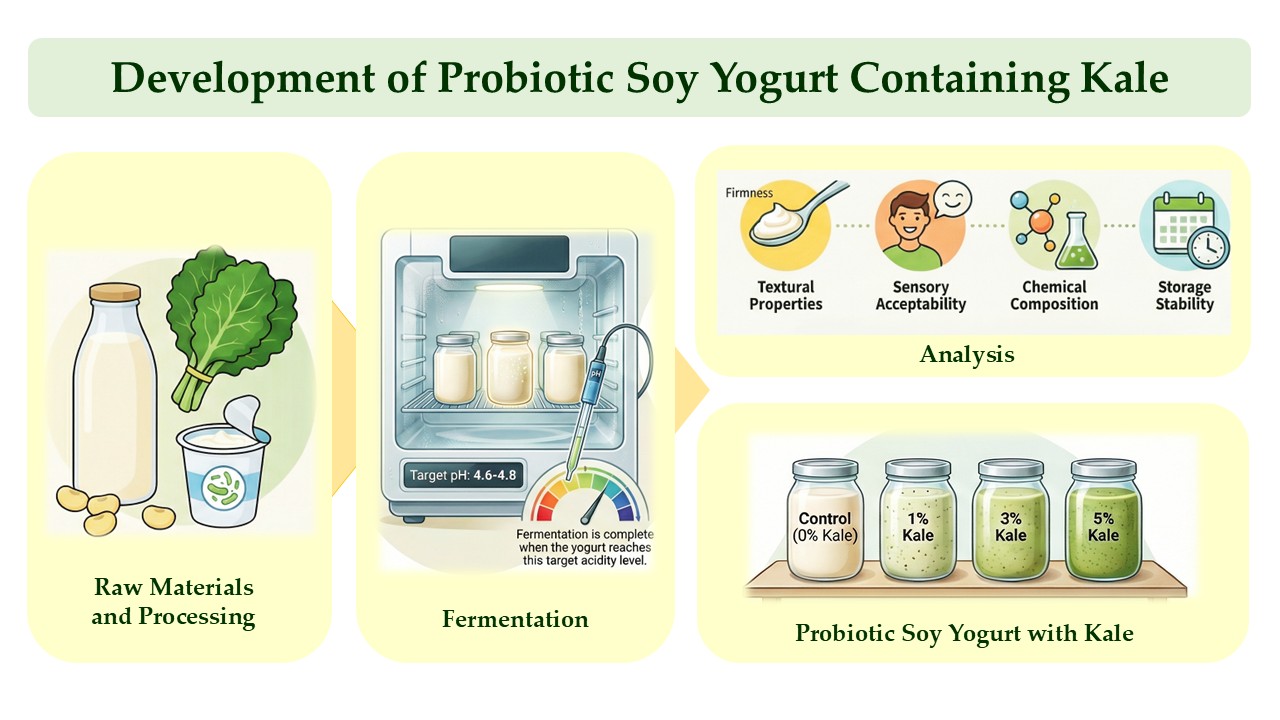
: Probiotic soy yogurt containing kale powder represents a promising plant-based functional product suitable for lactose-intolerant individuals and health-conscious consumers. This study aimed to develop and characterize soy-based probiotic yogurts containing kale powder at concentrations of 0%, 1%, 3%, and 5% (w/w). All formulations were standardized to an initial total soluble solids (TSS) content of 15 °Brix and fermented at 43 ± 1 °C for 8 hours using a commercial yogurt starter and probiotic culture. The yogurt containing 1% kale powder exhibited the most desirable physicochemical and functional properties, including favorable fermentation characteristics (pH 4.63, titratable acidity 0.75 ± 0.03%), the highest viable lactic acid bacteria (LAB) count (8.37 ± 0.05 log CFU/g), and optimal curd structure. Sensory evaluation using a 9-point hedonic scale with thirty untrained panelists confirmed its highest overall acceptability (7.93 ± 0.74). Chemical composition analysis revealed slight variations among formulations, with the 1% kale-containing yogurt showing relatively higher levels of protein (3.49 g/100 g), dietary fiber (0.95 g/100 g), carbohydrate (10.6 g/100 g), energy (65.6 Cal/100 g), and vitamin K1 (4.94 µg/100 g), reflecting the natural contribution of kale powder rather than fortification. During 21 days of storage at 4 ± 1 °C, the 1% kale-containing yogurt maintained probiotic viability above 7.0 log CFU/g, consistent with internationally recognized efficacy criteria for probiotic products. No yeast and mold growth was detected during storage. These findings highlight, for the first time, the feasibility of formulating probiotic soy yogurt containing kale powder with desirable product quality and functional potential, aligning with current trends in plant-based fermented foods.
Article Details

This work is licensed under a Creative Commons Attribution-NonCommercial-NoDerivatives 4.0 International License.
References
Fekete, M.; Lehoczki, A.; Kryczyk-Poprawa, A.; Zábó, V.; Varga, J. T.; Bálint, M.; Fazekas-Pongor, V.; Csípő, T.; Rząsa-Duran, E.; Varga, P. Functional Foods in Modern Nutrition Science: Mechanisms, Evidence, and Public Health Implications. Nutrients 2025, 17(13), 2153. https://doi.org/10.3390/nu17132153
Silva, A. R. A.; Silva, M. M. N.; Ribeiro, B. D. Health Issues and Technological Aspects of Plant-Based Alternative Milk. Food Res. Int. 2022, 152, 110936. https://doi.org/10.1016/j.foodres.2019.108972
Garza-Juárez, A.; Pérez-Carrillo, E.; Arredondo-Espinoza, E. U.; Islas, J. F.; Benítez-Chao, D. F.; Escamilla-García, E. Nutraceuticals and Their Contribution to Preventing Noncommunicable Diseases. Foods 2023, 12(17), 3262. https://doi.org/10.3390/foods12173262
Granato, D.; Nunes, D. S.; Barba, F. J. An Integrated Strategy between Food Chemistry, Biology, Nutrition, Pharmacology, and Statistics in the Development of Functional Foods: A Proposal. Trends Food Sci. Technol. 2017, 62, 13–22. https://doi.org/10.1016/j.tifs.2016.12.010
Arumugam, S.; Dioletis, E.; Paiva, R.; Fields, M. R.; Weiss, T. R.; Secor, E. R.; Ali, A. Fermented Soy Beverage Q CAN Plus Consumption Improves Serum Cholesterol and Cytokines. J. Med. Food 2020, 23(5), 560–563. https://doi.org/10.1089/jmf.2019.0116
Jung, S. M.; Haddad, E. H.; Kaur, A.; Sirirat, R.; Kim, A. Y.; Oda, K.; Fraser, G. E.; Sabaté, J. A Non-Probiotic Fermented Soy Product Reduces Total and LDL Cholesterol: A Randomized Controlled Crossover Trial. Nutrients 2021, 13(2), 535. https://doi.org/10.3390/nu13020535
Ranadheera, C. S.; Vidanarachchi, J. K.; Rocha, R. S.; Cruz, A. G.; Ajlouni, S. Probiotic Delivery through Fermentation: Dairy vs. Non-Dairy Beverages. Fermentation 2017, 3(4), 67. https://doi.org/10.3390/fermentation3040067
Kim, G. Y.; Kim, S. A.; Kong, S. Y.; Seong, H.; Bae, J. H.; Han, N. S. Synergistic Antioxidant and Anti-Inflammatory Activities of Kale Juice Fermented with Limosilactobacillus reuteri EFEL6901 or Limosilactobacillus fermentum EFEL6800. Antioxidants 2023, 12(10), 1850. https://doi.org/10.3390/antiox12101850
Mobility Foresights. Thailand Superfood Market Size and Forecasts 2030. Available online: https://mobilityforesights.com/product/thailand-superfood-market (accessed on 12 July 2025).
Rashwan, A. K.; Osman, A. I.; Chen, W. Natural Nutraceuticals for Enhancing Yogurt Properties: A Review. Environ. Chem. Lett. 2023, 21(3), 1907–1931. https://doi.org/10.1007/s10311-023-01588-0
Rasika, D. M. D.; Vidanarachchi, J. K.; Luiz, S. F.; Azeredo, D. R. P.; Cruz, A. G.; Ranadheera, C. S. Probiotic Delivery through Non-Dairy Plant-Based Food Matrices. Agriculture 2021, 11(7), 599. https://doi.org/10.3390/agriculture11070599
Ziarno, M.; Zaręba, D.; Ścibisz, I.; Kozłowska, M. Comprehensive Studies on the Stability of Yogurt Type Fermented Soy Beverages during Refrigerated Storage Using Dairy Starter Cultures. Front. Microbiol. 2023, 14, 1230025. https://doi.org/10.3389/fmicb.2023.1230025
Cheng, J.; Xie, S.; Yin, Y.; Feng, X.; Wang, S.; Guo, C.; Ni, C. Physiochemical, Texture Properties, and the Microstructure of Set Yogurt Using Whey Protein–Sodium Tripolyphosphate Aggregates as Thickening Agents. J. Sci. Food Agric. 2017, 97, 2819–2825. https://doi.org/10.1002/jsfa.8110
AOAC International. Official Methods of Analysis; 21st ed.; AOAC International: Gaithersburg, MD, 2023.
Keum, D. H.; Lee, H. J.; Ryoo, J. H.; Han, S. G. Enhancing the Texture of Fat-Free Yogurt with Panax ginseng Leaf-Stem Extract and Casein: Focusing on Their Softening Effect. Food Chem. 2025, 26, 102242. https://doi.org/10.1016/j.fochx.2025.102242
Abdelmoneim, A. H.; Sherif, A. M.; Sameh, K. A. Rheological Properties of Yoghurt Manufactured by Using Different Types of Hydrocolloids. Austin J. Nutr. Food Sci. 2016, 4(2), 1–6.
Mehaya, F. M.; El-Shazly, A. I.; El-Dein, A. N.; Farid, M. A. Evaluation of Nutritional and Physicochemical Characteristics of Soy Yogurt by Lactobacillus plantarum KU985432 and Saccharomyces boulardii CNCM I-745. Sci. Rep. 2023, 13(1), 13026. https://doi.org/10.1038/s41598-023-40207-4
Lee, W. J.; Lucey, J. A. Structure and Physical Properties of Yogurt Gels: Effect of Inoculation Rate and Incubation Temperature. J. Dairy Sci. 2004, 87(10), 3153–3164. https://doi.org/10.3168/jds.S0022-0302(04)73450-5
Thai Ministry of Public Health. Notification No. 353; Fermented Milk Products Standards; Ministry of Public Health: Nonthaburi, Thailand, 2023.
Deshpande, H. W.; Katke, S. D.; Kulkarni, A. S. Process Standardization and Quality Evaluation of Yogurt Fortified with Noni Juice. Int. J. Curr. Microbiol. Appl. Sci. 2019, 8(10), 179–186. https://doi.org/10.20546/ijcmas.2019.810.018
Mistry, V. V.; Hassan, H. N. Manufacture of Nonfat Yogurt from a High Milk Protein Powder. J. Dairy Sci. 1992, 75(4), 947–957. https://doi.org/10.3168/jds.S0022-0302(92)77835-7
Granato, D.; Branco, G. F.; Nazzaro, F.; Cruz, A. G.; Faria, J. A. F. Functional Foods and Nondairy Probiotic Food Development: Trends, Concepts, and Products. Compr. Rev. Food Sci. Food Saf. 2010, 9(3), 292–302. https://doi.org/10.1111/j.1541-4337.2010.00110.x
Arab, M.; Yousefi, M.; Khanniri, E.; Azari, M.; Ghasemzadeh-Mohammadi, V.; Mollakhalili-Meybodi, N. A Comprehensive Review on Yogurt Syneresis: Effect of Processing Conditions and Added Additives. J. Food Sci. Technol. 2023, 60(6), 1656–1665. https://doi.org/10.1007/s13197-022-05403-6
Fan, X.; Li, X.; Du, L.; Li, J.; Xu, J.; Shi, Z.; Pan, D. The Effect of Natural Plant-Based Homogenates as Additives on the Quality of Yogurt: A Review. Food Biosci. 2022, 49, 101953. https://doi.org/10.1016/j.fbio.2022.101953
Tripathi, M. K. ; Giri, S. K. Probiotic functional foods: Survival of probiotics during processing and storage. J. Funct. Foods. 2014, 9, 225–241. https://doi.org/10.1016/j.jff.2014.04.030
Mousavi, M.; Taheri, M.; Daraei Garmakhany, A.; Heshmati, A. The Effects of Flaxseed Powder on Physicochemical, Rheological, Microbiological and Sensory Properties of Yogurt. Brazilian Arch. Biol. Technol. 2022, 65, e22120705. https://doi.org/10.1590/1678-4324-2022210012
Güler-Akın, M.; Goncu, B.; Akın, M. Some Properties of Bio-Yogurt Enriched with Cellulose Fiber. Adv. Microbiol. 2018, 8, 54–64. https://doi.org/10.4236/aim.2018.81005
Khalesi, M.; Glenn-Davi, K.; Mohammadi, N.; FitzGerald, R. J. Key Factors Influencing Gelation in Plant vs. Animal Proteins: A Comparative Mini-Review. Gels 2024, 10(9), 575. https://doi.org/10.3390/gels10090575
Postolache, A. N.; Veleșcu, I. D.; Stoica, F.; Crivei, I. C.; Arsenoaia, V. N.; Usturoi, M. G.; Rațu, R. N. A Clean-Label Formulation of Fortified Yogurt Based on Rhododendron Flower Powder as a Functional Ingredient. Foods 2023, 12(23), 4365. https://doi.org/10.3390/foods12234365
Canazza, E.; Tessari, P.; Mayr Marangon, C.; Lante, A. Nutritional Profile and Chlorophyll Intake of Collard Green as a Convenience Food. Nutrients 2024, 16(23), 4015. https://doi.org/10.3390/nu16234015
Bankole, A. O.; Irondi, E. A.; Awoyale, W.; Ajani, E. O. Application of Natural and Modified Additives in Yogurt Formulation: Types, Production, and Rheological and Nutraceutical Benefits. Front. Nutr. 2023, 10, 1257439. https://doi.org/10.3389/fnut.2023.1257439
Plaskova, A.; Mlcek, J. New Insights of the Application of Water or Ethanol-Water Plant Extract Rich in Active Compounds in Food. Front. Nutr. 2023, 10, 1118761. https://doi.org/10.3389/fnut.2023.1118761
Sharafi, M.; Hayes, J. E.; Duffy, V. B. Masking Vegetable Bitterness to Improve Palatability Depends on Vegetable Type and Taste Phenotype. Chem. Percept. 2013, 6(1), 8–19. https://doi.org/10.1007/s12078-012-9137-5
Satheesh, N.; Fanta, S. W. Kale: Review on Nutritional Composition, Bio-Active Compounds, Anti-Nutritional Factors, Health Beneficial Properties and Value-Added Products. Cogent Food Agric. 2020, 6(1), 1811048. https://doi.org/10.1080/23311932.2020.1811048
Ortega-Hernández, E.; Antunes-Ricardo, M.; Jacobo-Velázquez, D. A. Improving the Health-Benefits of Kales (Brassica oleracea L. var. acephala DC) through the Application of Controlled Abiotic Stresses: A Review. Plants 2021, 10(12), 2629. https://doi.org/10.3390/plants10122629
Dabija, A.; Codină, G. G.; Gâtlan, A. M.; Sănduleac, E. T.; Rusu, L. Effects of Some Vegetable Proteins Addition on Yogurt Quality. Sci. Study Res. Chem. Chem. Eng. Biotechnol. Food Ind. 2018, 19(2), 181–192.
Mani-López, E.; Palou, E.; López-Malo, A. Probiotic Viability and Storage Stability of Yogurts and Fermented Milks Prepared with Several Mixtures of Lactic Acid Bacteria. J. Dairy Sci. 2014, 97(5), 2578–2590. https://doi.org/10.3168/jds.2013-7551
Zhang, W.; Al-Wraikata, M.; Shu, Q.; Hu, J.; Li, L.; Liu, Y. Enhancement Effect of Kale Fiber on Physicochemical, Rheological and Digestive Properties of Goat Yogurt. LWT 2024, 207, 116649. https://doi.org/10.1016/j.lwt.2024.116649
