
Edible Mushroom Extracts: Evaluating Phenolic Content, Antioxidant Capacity, and Anticancer Effects
Article Sidebar
Main Article Content
Abstract
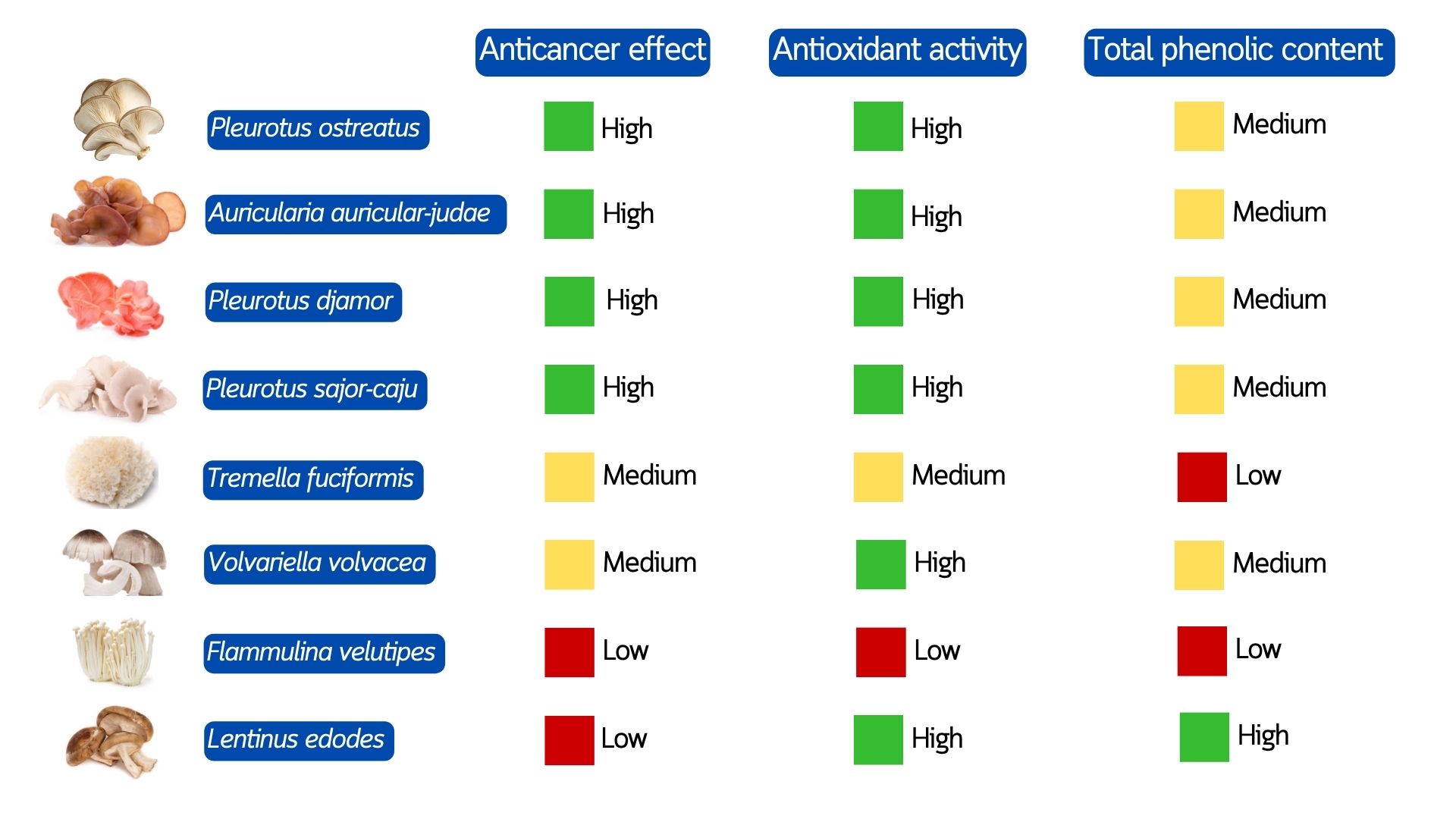
Edible mushrooms have also been recognized as valuable sources of bioactive compounds with potential therapeutic benefits. Although several edible mushrooms have demonstrated anticancer effects, limited studies have investigated their impact on colorectal cancer cells. Furthermore, it is of interest to further examine the relationship between the total phenolic content, antioxidant activity, and anticancer potential of edible mushroom extracts. Therefore, this study aimed to evaluate the anticancer effects of ethanolic extracts from eight edible mushrooms sourced from Wang Nam Khiao Farm on HT-29 cells and to investigate the relationship between their total phenolic content, antioxidant capacity, and anticancer activity. Total phenolic content was the highest in Lentinus edodes. The strongest antioxidant property was observed in Pleurotus ostreatus. Based on anticancer results, the mushrooms were classified into three groups: vigorous activity (P. ostreatus, Auricularia auricular-judae, Pleurotus djamor, and Pleurotus sajor-caju), moderate activity (Tremella fuciformis and Volvariella volvacea), and low activity (Flammulina velutipes and L. edodes). A positive relationship was generally observed between total phenolic content, antioxidant activity, and anticancer efficacy, suggesting that phenolic compounds may play a role in mediating anticancer effects. Interestingly, L. edodes was an exception, exhibiting elevated total phenolic content and antioxidant capacity, yet demonstrating low anticancer activity, indicating that additional bioactive compounds or mechanisms may contribute to its anticancer effects. These findings highlight the promising role of edible mushrooms as potential sources of natural antioxidants and anticancer agents for the prevention of colon cancer. Further chemical characterization and mechanistic studies are required to elucidate the compounds responsible for the biological activities.
Article Details

This work is licensed under a Creative Commons Attribution-NonCommercial-NoDerivatives 4.0 International License.
References
Kozarski, M.; Klaus, A.; Jakovljevic, D.; Todorovic, N.; Vunduk, J.; Petrović, P.; Niksic, M.; Vrvic, M. M.; Van Griensven, L. Antioxidants of Edible Mushrooms. Molecules 2015, 20(10), 19489. https://doi.org/10.3390/molecules201019489
Wasser, S. Medicinal Mushrooms as a Source of Antitumor and Immunomodulating Polysaccharides. Appl. Microbiol. Biotechnol. 2002, 60(1–2), 10–23. https://doi.org/10.1007/s00253-002-1076-7
Ferreira, I. C. F. R.; Barros, L.; Abreu, R. M. V. Antioxidants in Wild Mushrooms. Curr. Med. Chem. 2009, 16(12), 1543–1565. https://doi.org/10.2174/092986709787909587
Valverde, M. E.; Hernández-Pérez, T.; Paredes-López, O. Edible Mushrooms: Improving Human Health and Promoting Quality Life. Int. J. Microbiol. 2015, 2015, 376387. https://doi.org/10.1155/2015/376387
Wasser, S. P. Medicinal Mushroom Science: Current Perspectives, Advances, Evidences, and Challenges. Biomed. J. 2014, 37(6), 345–356. https://doi.org/10.4103/2319-4170.138318
Roupas, P.; Keogh, J.; Noakes, M.; Margetts, C.; Taylor, P. The Role of Edible Mushrooms in Health: Evaluation of the Evidence. J. Funct. Foods 2012, 4(4), 689–702. https://doi.org/10.1016/j.jff.2012.05.003
Boonsong, S.; Klaypradit, W.; Wilaipun, P. Antioxidant Activities of Extracts from Five Edible Mushrooms Using Different Extractants. Agric. Nat. Resour. 2016, 50(2), 89–93. https://doi.org/10.1016/j.anres.2015.07.002
Hirasawa, M.; Shouji, N.; Neta, T.; Fukushima, K.; Takada, K. Three Kinds of Antibacterial Substances from Lentinus Edodes (Berk.) Sing. (Shiitake, an Edible Mushroom). Int. J. Antimicrob. Agents 1999, 11(2), 151–157. https://doi.org/10.1016/S0924-8579(98)00084-3
Jeong, S. C.; Jeong, Y. T.; Yang, B. K.; Islam, R.; Koyyalamudi, S. R.; Pang, G.; Cho, K. Y.; Song, C. H. White Button Mushroom (Agaricus Bisporus) Lowers Blood Glucose and Cholesterol Levels in Diabetic and Hypercholesterolemic Rats. Nutr. Res. 2010, 30(1), 49–56. https://doi.org/10.1016/j.nutres.2009.12.003
Mau, J. L.; Chao, G. R.; Wu, K. T. Antioxidant Properties of Methanolic Extracts from Several Ear Mushrooms. J. Agric. Food Chem. 2001, 49(11), 5461–5467. https://doi.org/10.1021/jf010637h
Moradali, M. F.; Mostafavi, H.; Ghods, S.; Hedjaroude, G. A. Immunomodulating and Anticancer Agents in the Realm of Macromycetes Fungi (Macrofungi). Int. Immunopharmacol. 2007, 7(6), 701–724. https://doi.org/10.1016/j.intimp.2007.01.008
Ren, L.; Perera, C.; Hemar, Y. Antitumor Activity of Mushroom Polysaccharides: A Review. Food Funct. 2012, 3(5), 473–490. https://doi.org/10.1039/c2fo10279j
Boonsong, S.; Klaypradit, W.; Wilaipun, P. Antioxidant Activities of Extracts from Five Edible Mushrooms Using Different Extractants. Agric. Nat. Resour. 2016, 50(2), 89–93. https://doi.org/10.1016/j.anres.2015.07.002
Cheung, L. M.; Cheung, P. C. K.; Ooi, V. E. C. Antioxidant Activity and Total Phenolics of Edible Mushroom Extracts. Food Chem. 2003, 81 (2), 249–255. https://doi.org/10.1016/S0308-8146(02)00419-3
Mwangi, R. W.; Macharia, J. M.; Wagara, I. N.; Bence, R. L. The Antioxidant Potential of Different Edible and Medicinal Mushrooms. Biomed. Pharmacother. 2022, 154, 112621. https://doi.org/10.1016/j.biopha.2022.112621
Puttaraju, N. G.; Venkateshaiah, S. U.; Dharmesh, S. M.; Urs, S. M. N.; Somasundaram, R. Antioxidant Activity of Indigenous Edible Mushrooms. J. Agric. Food Chem. 2006, 54(26), 9764–9772. https://doi.org/10.1021/jf0615707
Abdelshafy, A. M.; Belwal, T.; Liang, Z.; Wang, L.; Li, D.; Luo, Z.; Li, L. A Comprehensive Review on Phenolic Compounds from Edible Mushrooms: Occurrence, Biological Activity, Application and Future Prospective. Crit. Rev. Food Sci. Nutr. 2022, 62(7), 1775–1799. https://doi.org/10.1080/10408398.2021.1898335
Becker, E. M.; Nissen, L. R.; Skibsted, L. H. Antioxidant Evaluation Protocols: Food Quality or Health Effects. Eur. Food Res. Technol. 2004, 219 (1), 2–11. https://doi.org/10.1007/s00217-004-1012-4
Li, X.; Wu, Q.; Xie, Y.; Ding, Y.; Du, W. W.; Sdiri, M.; Yang, B. B. Ergosterol Purified from Medicinal Mushroom Amauroderma Rude Inhibits Cancer Growth in Vitro and in Vivo by Up-Regulating Multiple Tumor Suppressors. Oncotarget 2015, 6 (19), 17208–17223. https://doi.org/10.18632/oncotarget.4026
Deng, G.; Lin, H.; Seidman, A.; Fornier, M.; D’Andrea, G.; Wesa, K.; Yeung, S.; Cunningham-Rundles, S.; Vickers, A. J.; Cassileth, B. A Phase I/II Trial of a Polysaccharide Extract from Grifola Frondosa (Maitake Mushroom) in Breast Cancer Patients: Immunological Effects. J. Cancer Res. Clin. Oncol. 2009, 135 (9), 1215–1221. https://doi.org/10.1007/s00432-009-0562-z
Elbatrawy, E. N.; Ghonimy, E. A. A.; Alassar, M. M.; Wu, F. S. Medicinal Mushroom Extracts Possess Differential Antioxidant Activity and Cytotoxicity to Cancer Cells. Int. J. Med. Mushrooms 2015, 17(5), 449–455. https://doi.org/10.1615/IntJMedMushrooms.v17.i5.70
Fang, N.; Li, Q.; Yu, S.; Zhang, J.; He, L.; Ronis, M. J. J.; Badger, T. M. Inhibition of Growth and Induction of Apoptosis in Human Cancer Cell Lines by an Ethyl Acetate Fraction from Shiitake Mushrooms. J. Altern. Complement. Med. 2006, 12(2), 125–132. https://doi.org/10.1089/acm.2006.12.125
Hu, H.; Ahn, N. S.; Yang, X.; Lee, Y. S.; Kang, K. S. Ganoderma Lucidum Extract Induces Cell Cycle Arrest and Apoptosis in MCF-7 Human Breast Cancer Cell. Int. J. Cancer 2002, 102(3), 250–253. https://doi.org/10.1002/ijc.10707
Israilides, C.; Kletsas, D.; Arapoglou, D.; Philippoussis, A.; Pratsinis, H.; Ebringerová, A.; Hříbalová, V.; Harding, S. E. In Vitro Cytostatic and Immunomodulatory Properties of the Medicinal Mushroom Lentinula Edodes. Phytomedicine 2008, 15(6–7), 512–519. https://doi.org/10.1016/j.phymed.2007.11.029
Jiang, J.; Sliva, D. Novel Medicinal Mushroom Blend Suppresses Growth and Invasiveness of Human Breast Cancer Cells. Int. J. Oncol. 2010, 37(6), 1529–1536. https://doi.org/10.3892/ijo-00000806
Li, X.; Wu, Q.; Xie, Y.; Ding, Y.; Du, W. W.; Sdiri, M.; Yang, B. B. Ergosterol Purified from Medicinal Mushroom Amauroderma Rude Inhibits Cancer Growth in Vitro and in Vivo by Up-Regulating Multiple Tumor Suppressors. Oncotarget 2015, 6(19), 17208–17223. https://doi.org/10.18632/oncotarget.4026
Shin, A.; Kim, J.; Lim, S. Y.; Kim, G.; Sung, M. K.; Lee, E. S.; Ro, J. Dietary Mushroom Intake and the Risk of Breast Cancer Based on Hormone Receptor Status. Nutr. Cancer 2010, 62(4), 476–483. https://doi.org/10.1080/01635580903441212
Soares, R.; Meireles, M.; Rocha, A.; Pirraco, A.; Obiol, D.; Alonso, E.; Joos, G.; Balogh, G. Maitake (D Fraction) Mushroom Extract Induces Apoptosis in Breast Cancer Cells by BAK-1 Gene Activation. J. Med. Food 2011, 14(6), 563–572. https://doi.org/10.1089/jmf.2010.0095
Xue, Z.; Li, J.; Cheng, A.; Yu, W.; Zhang, Z.; Kou, X.; Zhou, F. Structure Identification of Triterpene from the Mushroom Pleurotus Eryngii with Inhibitory Effects Against Breast Cancer. Plant Foods Hum. Nutr. 2015, 70(3), 324–328. https://doi.org/10.1007/s11130-015-0492-7
Min, Z.; Jian, H.; Xing, X.; Holman, C. D. A. J. Dietary Intakes of Mushrooms and Green Tea Combine to Reduce the Risk of Breast Cancer in Chinese Women. Int. J. Cancer 2009, 124(6), 1435–1439. https://doi.org/10.1002/ijc.24047
Durgo, K.; Koncar, M.; Komes, D.; Belscak-Cvitanovic, A.; Franekic, J.; Jakopovich, I.; Jakopovich, N.; Jakopovich, B. Cytotoxicity of Blended versus Single Medicinal Mushroom Extracts on Human Cancer Cell Lines: Contribution of Polyphenol and Polysaccharide Content. Int. J. Med. Mushrooms 2013, 15(5), 459–472. https://doi.org/10.1615/IntJMedMushr.v15.i5.20
Lee, H. S.; Kim, E. J.; Kim, S. H. Ethanol Extract of Innotus Obliquus (Chaga Mushroom) Induces G1 Cell Cycle Arrest in HT-29 Human Colon Cancer Cells. Nutr. Res. Pract. 2015, 9(2), 111–115. https://doi.org/10.4162/nrp.2015.9.2.111
Šeklić, D. S.; Stanković, M. S.; Milutinović, M. G.; Topuzović, M. D.; Štajn, A.; Marković, S. D. Cytotoxic, Antimigratory, pro-and Antioxidative Activities of Extracts from Medicinal Mushrooms on Colon Cancer Cell Lines. Arch. Biol. Sci. 2016, 68 (1), 131–141. https://doi.org/10.2298/ABS150427131S
Yoshikawa, R.; Yanagi, H.; Hashimoto-Tamaoki, T.; Morinaga, T.; Nakano, Y.; Noda, M.; Fujiwara, Y.; Okamura, H.; Yamamura, T. Gene Expression in Response to Anti-Tumour Intervention by Polysaccharide-K (PSK) in Colorectal Carcinoma Cells. Oncol. Rep. 2004, 12(6), 1287–1292. https://doi.org/10.3892/or.12.6.1287
Hall, I. R.; Buchanan, P. K.; Stephenson, S. L.; Yun, W. Edible and Poisonous Mushrooms of the World; Timber Press: Portland, OR, USA, 2022.
Sawangwan, T.; Wansanit, W.; Pattani, L.; Noysang, C. Study of Prebiotic Properties from Edible Mushroom Extraction. Agric. Nat. Resour. 2018, 52(6), 572–578. https://doi.org/10.1016/j.anres.2018.11.020
Seephonkai, P.; Samchai, S.; Thongsom, A.; Sunaart, S.; Kiemsanmuang, B.; Chakuton, K. DPPH Radical Scavenging Activity and Total Phenolics of Phellinus Mushroom Extracts Collected from Northeast of Thailand. Chin. J. Nat. Med. 2011, 9(6), 441–446. https://doi.org/10.3724/SP.J.1009.2011.00441
Loypimai, P.; Moonggarm, A.; Chottanom, P. Effects of Ohmic Heating on Lipase Activity, Bioactive Compounds and Antioxidant Activity of Rice Bran. Aust. J. Basic Appl. Sci. 2009, 3(4), 3824–3831.
Mradu, G.; Saumyakanti, S.; Sohini, M.; Arup, M. HPLC Profiles of Standard Phenolic Compounds Present in Medicinal Plants. Int. J. Pharmacogn. Phytochem. Res. 2012, 4(3), 114–119.
Yoon, K. N.; Alam, N.; Lee, K. R.; Shin, P. G.; Cheong, J. C.; Yoo, Y. B.; Lee, T. S. Antioxidant and Antityrosinase Activities of Various Extracts from the Fruiting Bodies of Lentinus Lepideus. Molecules 2011, 16(3), 2334–2347. https://doi.org/10.3390/molecules16032334
Becker, E. M.; Nissen, L. R.; Skibsted, L. H. Antioxidant Evaluation Protocols: Food Quality or Health Effects. Eur. Food Res. Technol. 2004, 219(1), 2–11. https://doi.org/10.1007/s00217-004-1012-4
Hussein, J. M.; Tibuhwa, D. D.; Mshandete, A. M.; Kivaisi, A. K. Antioxidant Properties of Seven Wild Edible Mushrooms from Tanzania. Afr. J. Food Sci. 2015, 9(9), 488–493. https://doi.org/10.5897/ajfs2015.1328
Oke, F.; Aslim, B. Protective Effect of Two Edible Mushrooms against Oxidative Cell Damage and Their Phenolic Composition. Food Chem. 2011, 128 (3), 675–680. https://doi.org/10.1016/j.foodchem.2011.03.036
lkay Koca, A. K. İ.; Gençcelep, H. Antioxidant Properties of Wild Edible Mushrooms. J. Food Process Technol. 2011, 02(06). https://doi.org/10.4172/2157-7110.1000130
Heleno, S. A.; Ferreira, R. C.; Antonio, A. L.; Queiroz, M. J. R. P.; Barros, L.; Ferreira, I. C. F. R. Nutritional Value, Bioactive Compounds and Antioxidant Properties of Three Edible Mushrooms from Poland. Food Biosci. 2015, 11, 135–141. https://doi.org/10.1016/j.fbio.2015.04.006
Elhusseiny, S. M.; El-Mahdy, T. S.; Awad, M. F.; Elleboudy, N. S.; Farag, M. M. S.; Yassein, M. A.; Aboshanab, K. M. Proteome Analysis and in Vitro Antiviral, Anticancer and Antioxidant Capacities of the Aqueous Extracts of Lentinula Edodes and Pleurotus Ostreatus Edible Mushrooms. Molecules 2021, 26(15), 4623. https://doi.org/10.3390/molecules26154623
Nam, M.; Choi, J. Y.; Kim, M. S. Metabolic Profiles, Bioactive Compounds, and Antioxidant Capacity in Lentinula Edodes Cultivated on Log versus Sawdust Substrates. Biomolecules 2021, 11(11), 1654. https://doi.org/10.3390/biom11111654
Roszczenko, P.; Szewczyk-Roszczenko, O. K.; Gornowicz, A.; Iwańska, I. A.; Bielawski, K.; Wujec, M.; Bielawska, A. The Anticancer Potential of Edible Mushrooms: A Review of Selected Species from Roztocze, Poland. Nutrients 2024, 16(17), 2849. https://doi.org/10.3390/nu16172849
Silva, G. B. da; Rocha, K. G.; Bagatini, M. D.; Kempka, A. P. Anticancer Properties of Phenolic Acids and Cell Death Signaling Pathways: A 20-Year Bibliometric Analysis (2003–2023). Food Biosci. 2025, 64, 105741. https://doi.org/10.1016/j.fbio.2024.105741
Jedinak, A.; Sliva, D. Pleurotus Ostreatus Inhibits Proliferation of Human Breast and Colon Cancer Cells through P53-Dependent as Well as P53-Independent Pathway. Int. J. Oncol. 2008, 33(6), 1307–1313. https://doi.org/10.3892/ijo00000122
Reza, M. A.; Hossain, M. A.; Lee, S. J.; Yohannes, S. B.; Damte, D.; Rhee, M. H.; Jo, W. S.; Suh, J. W.; Park, S. C. Dichlormethane Extract of the Jelly Ear Mushroom Auricularia Auricula-Judae (Higher Basidiomycetes) Inhibits Tumor Cell Growth in Vitro. Int. J. Med. Mushrooms 2014, 16(1), 77–84. https://doi.org/10.1615/IntJMedMushr.v16.i1.40
Arora, S.; Tandon, S. Mushroom Extracts Induce Human Colon Cancer Cell (COLO-205) Death by Triggering the Mitochondrial Apoptosis Pathway and Go/G1-Phase Cell Cycle Arrest. Arch. Iran. Med. 2015, 18 (5), 329–335. https://doi.org/0151805/AIM.006
Jagadeesh, R.; Babu, G.; Lakshmanan, H.; Oh, O. M.-J.; Jang, J. K.-Y.; Kong, K. W.-S.; Raaman, N. Bioactive Sterol Derivatives Isolated from the Pleurotus Djamor Var. Roseus Induced Apoptosis in Cancer Cell Lines. Cardiovasc. Hematol. Agents Med. Chem. 2020, 18(2), 127–134. https://doi.org/10.2174/1871525718666200303123557
Kamel, I. M.; Khalil, N. M.; Atalla, S. M. M.; Seleem, S. M. Purification, Molecular And Biochemical Characterization And Biological Applications Of Hemagglutinating Lectin With Anticancer Activities From Pleurotus Ostreatus. Plant Arch. 2021, 21(Suppliment-1), 384–391. https://doi.org/10.51470/plantarchives.2021.v21.s1.065
Park, G. S.; Shin, J.; Hong, S.; Gopal, J.; Oh, J. W. Anticarcinogenic Potential of the Mushroom Polysaccharide Lentinan on Gastric and Colon Cancer Cells: Antiproliferative, Antitumorigenic, Mu-2-Related Death-Inducing Gene, MUDENG Ramifications. J. Ind. Eng. Chem. 2024, 135, 36–47. https://doi.org/10.1016/j.jiec.2024.01.024
Permana, S.; Nabilahasna, E. A.; Meilany, F. A.; Ilmiyah, S. Z.; Widodo, E.; Norahmawati, E.; Kawamoto, Y.; Endrawati, H.; Endharti, A. T. Enhanced Anticancer Effect of Cetuximab Combined with Ethanol Extract of Volvariella Volvacea in Colorectal Cancer Targeted TOP2A and PPARγ. J. Pharm. Pharmacogn. Res. 2024, 12(6), 1129–1142. https://doi.org/10.56499/jppres23.189512.6.1129
Palacios, I.; Lozano, M.; Moro, C.; D’Arrigo, M.; Rostagno, M. A.; Martínez, J. A.; García-Lafuente, A.; Guillamón, E.; Villares, A. Antioxidant Properties of Phenolic Compounds Occurring in Edible Mushrooms. Food Chem. 2011, 128(3), 667–674. https://doi.org/10.1016/j.foodchem.2011.03.085
Kim, M. Y.; Seguin, P.; Ahn, J. K.; Kim, J. J.; Chun, S. C.; Kim, E. H.; Seo, S. H.; Kang, E. Y.; Kim, S. L.; Park, Y. J.; Ro, H. M.; Chung, I. M. Phenolic Compound Concentration and Antioxidant Activities of Edible and Medicinal Mushrooms from Korea. J. Agric. Food Chem. 2008, 56(16), 7265–7270. https://doi.org/10.1021/jf8008553
Miles, P. G.; Chang, S. T. Mushroom Biology Concise Basics and Current Development; World Scientific: Singapore, 1997; 193.
Ismail, M.; Bagalkotkar, G.; Iqbal, S.; Adamu, H. A. Anticancer Properties and Phenolic Contents of Sequentially Prepared Extracts from Different Parts of Selected Medicinal Plants Indigenous to Malaysia. Molecules 2012, 17(5), 5745–5756. https://doi.org/10.3390/molecules17055745
Wang, X.; Sankarapandian, K.; Cheng, Y.; Woo, S. O.; Kwon, H. W.; Perumalsamy, H.; Ahn, Y. J. Relationship between Total Phenolic Contents and Biological Properties of Propolis from 20 Different Regions in South Korea. BMC Complement. Altern. Med. 2016, 16(1), 108. https://doi.org/10.1186/s12906-016-1043-y
Milella, R. A.; De Rosso, M.; Gasparro, M.; Gigante, I.; Debiase, G.; Forleo, L. R.; Marsico, A. D.; Perniola, R.; Tutino, V.; Notarnicola, M.; Velasco, R.; Flamini, R. Correlation between Antioxidant and Anticancer Activity and Phenolic Profile of New Apulian Table Grape Genotypes (V. Vinifera L.). Front. Plant Sci. 2023, 13, 1064023. https://doi.org/10.3389/fpls.2022.1064023
Rao, Y. K.; Geethangili, M.; Fang, S. H.; Tzeng, Y. M. Antioxidant and Cytotoxic Activities of Naturally Occurring Phenolic and Related Compounds: A Comparative Study. Food Chem. Toxicol. 2007, 45(9), 1727–1736. https://doi.org/10.1016/j.fct.2007.03.012.
