
Growth and Yield Response of Lettuce (Lactuca sativa) Using MykoPlus and Bio-N Biofertilizers
Article Sidebar
Main Article Content
Abstract
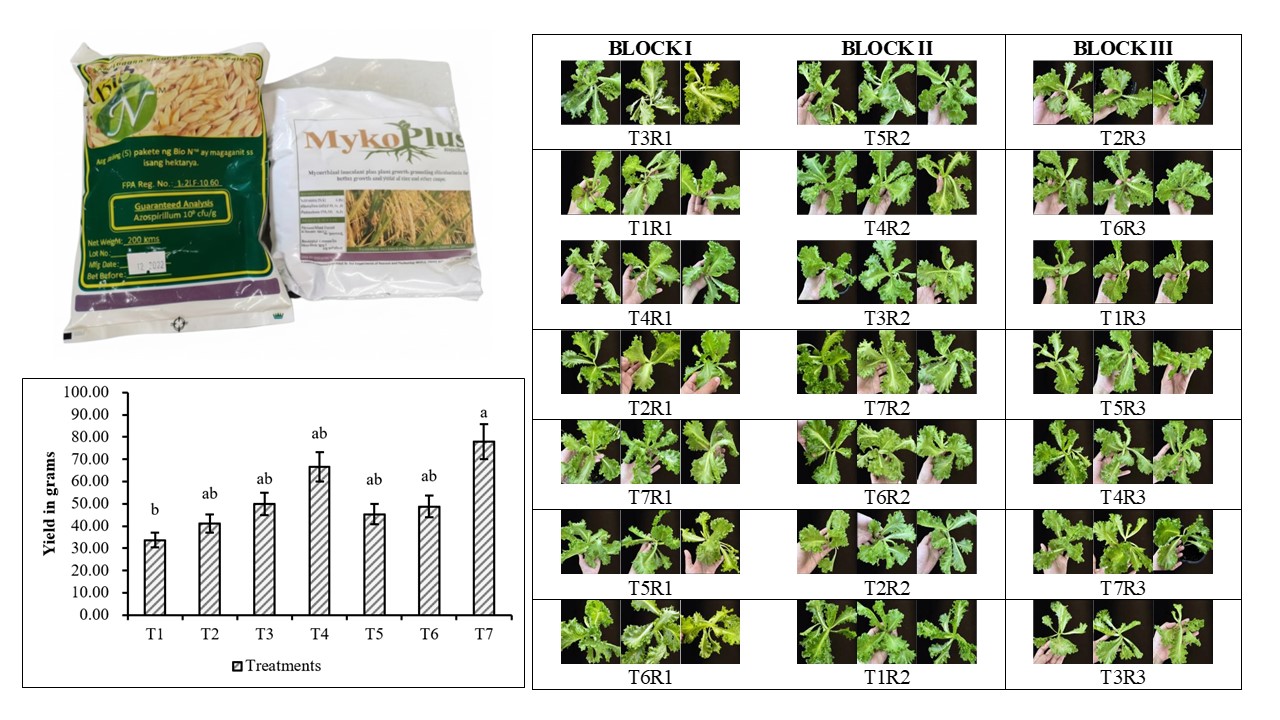
This study was conducted to determine the growth and yield response of lettuce (Lactuca sativa), variety ‘Black Simpson’, using different amounts of MykoPlus and Bio-N biofertilizer. The experiment consisted of seven treatments: T1 (control), T2 (MykoPlus), T3 (Bio-N), T4 (50% MykoPlus and Bio-N), T5 (MykoPlus + ½ Recommended Rate or RR of synthetic fertilizer), T6 (Bio-N + ½ RR of synthetic fertilizer), and T7 (50% MykoPlus and Bio-N + ½ RR of synthetic fertilizer), arranged in a Randomized Complete Block Design (RCBD) from July to September 2022. Results revealed that T3 (Bio-N), T5 (MykoPlus + ½ RR of synthetic fertilizer), and T6 (Bio-N + ½ RR of synthetic fertilizer) had the best initial plant height response; however, in the final plant height gathered, T3, T4, T6, and T7 gave the best response. In terms of the initial leaf length and leaf width, T5 and T6 had the best responses and were comparable to T3, T4, and T7. In the final leaf length and width of lettuce, T6 and T7 showed the best results and were comparable with T2, T3, T4, and T5. No significant difference was observed in the number of leaves. On the yield parameter, T7 (50% MykoPlus and Bio-N + ½ RR of synthetic fertilizer) provided the highest weight of lettuce at harvest, comparable with T2, T3, T4, T5, and T6. The most feasible biofertilizer combination suitable for lettuce production in terms of growth parameters was T6 and T7, whereas in the yield parameter, application of T7 was recommended.
Article Details

This work is licensed under a Creative Commons Attribution-NonCommercial-NoDerivatives 4.0 International License.
References
Department of Agriculture, Bureau of Plant Industry – National Crop Research and Development Center. Lettuce Production Guide; Department of Agriculture: Philippines, 2021; pp 1–3. https://www.coursehero.com/file/44173227/BPI-Lettuce-Production-Guidepdf/ (accessed 2021-05-08).
Ausveg. Top 10 Most Popular Fresh Vegetables Revealed. https://ausveg.com.au/media-releases/top-10-most-popular-fresh-vegetable-revealed/ (accessed 2021-06-22).
Kim, M. J.; Moon, Y. Y.; Tou, J. C.; Mou, B.; Waterland, N. L. Nutritional value, bioactive compounds and health benefits of lettuce (Lactuca sativa L.). J. Food Compos. Anal. 2016, 49, 19–34. https://doi.org/10.1016/j.jfca.2016.03.004
Singh, K. P.; Singh, R. P.; Umesha, S. Microbial biotechnology and sustainable agriculture. In Emerging Approaches and Strategies; Singh, K. P., Singh, R. P., Umesha, S., Eds.; Elsevier, 2018; p 185. https://doi.org/10.1016/B978-0-12-812160-3.00006-4
Macik, M.; Gryta, A.; Frac, M. Biofertilizers in agriculture: An overview on concepts, strategies and effects on soil microorganisms. Adv. Agron. 2020, 162, 31–87. https://doi.org/10.1016/bs.agron.2020.02.001
Zarate, J. MykoPlus. https://aim.edu/sites/default/files/2017-08/mykoplus.pdf (accessed 2021-06-22).
Rossouw, M. J. Arbuscular Mycorrhizal Fungi. https://www.sanbi.org/animal-of-the-week/arbuscular-mycorrhizal-fungi/ (accessed 2021-06-26).
Berruti, A.; Lumini, E.; Balestrini, R.; Bianciotto, V. Arbuscular mycorrhizal fungi as natural biofertilizers: Let's benefit from past successes. Front. Microbiol. 2016, 6, 1559. https://doi.org/10.3389/fmicb.2015.01559
UPLB BIOTECH. Bio-N. https://biotech.uplb.edu.ph/products/bio-n/ (accessed 2025-10-01).
Balog, R. M. FNCA (Forum for Nuclear Cooperation in Asia) Biofertilizer Project. FNCA Biofertilizer News Lett. 2007, 7, 2–3. https://www.fnca.mext.go.jp/english/bf/news_img/nl07.pdf.
Mehnaz, S. Azospirillum: A biofertilizer for every crop. In Plant Microbes Symbiosis: Applied Facets; Arora, N., Ed.; Springer: New Delhi, 2014; pp 317–338. https://doi.org/10.1007/978-81-322-2068-8_15
Malone, M. The Disadvantages of Inorganic Fertilizer. https://homeguides.sfgate.com/disadvantages-inorganic-fertilizer-64756.html (accessed 2021-06-26).
Agapito, A. J. I.; Mercado, S. M. Use Bio-N Today, Keep High Farm Costs Away. https://horizon.uplb.edu.ph/uplb-features/use-bio-n-today-keep-high-farm-costs (accessed 2022-10-16).
Núñez, J. A. D.; Lobo, M. B. Application of microorganisms in forest plant biofertilizers. In Advances in Bio-inoculants; Elsevier, 2021; Vol. 1, pp 265–287. https://doi.org/10.1016/b978-0-12-821667-5.00026-9
SFS. Bio-N. https://www.soilfertilityservices.co.uk/bio-n (accessed 2022-11-17).
Ersek, K. What Are Plant Auxins and How Do They Affect Plant Growth? https://www.holganix.com/blog/what-are-plant-auxins-and-how-do-they-affect-plant-growth (accessed 2022-10-02).
Hasan, M. R. M. D.; Ali, A.; Tahsin, A. K. M. M.; Islam, M. N. Growth and Yield of Lettuce (Lactuca sativa L.) Influenced as Nitrogen Fertilizer and Plant Spacing. IOSR J. Agric. Vet. Sci. 2017, 10(6), 62–71. https://doi.org/10.9790/2380-1006016271
Opeña, J. M.; Sotto, R. Growth response and leaf chlorophyll concentration of romaine lettuce plants (Lactuca sativa L. var. Longifolia) applied with Mykoplus under varying saline conditions. JNS 2020, 19(2), 40–51. https://www.researchgate.net/publication/345918141
BioAg Products. Plant Types That Benefit from Endomycorrhizae Fungi. http://bioagproducts.com/benefit-endomycorrhizae-fungi/ (accessed 2022-10-18).
Fukami, J.; Cerezini, P.; Hungria, M. Azospirillum: benefits that go far beyond biological nitrogen fixation. AMB Express 2018, 8, 73. https://doi.org/10.1186/s13568-018-060
Chamangasht, S.; Ardakani, M. R.; Khavazi, K.; Abbaszadeh, B.; Mafakheri, F. Improving lettuce (Lactuca sativa L.) growth and yield by the application of biofertilizers. Ann. Biol. Res. 2012, 3 (4), 1876–1879.
Sarian, Z. Mykoplus, The Latest Biofertilizer from Los Banos. https://www.agriculture.com.ph/2018/09/12/mykoplus-the-latest-biofertilizer-from-los-banos/ (accessed 2021-06-28).
Wu, W.; Du, K.; Kang, X.; Wei, H. The diverse roles of cytokinins in regulating leaf development. Hortic. Res. 2021, 8, 558. https://doi.org/10.1038/s41438-021-00558-3
Mcrae, M. The Reason Why Some Leaves Can Grow So Huge Is Totally Not What We Thought. https://www.sciencealert.com/now-we-understand-why-some-leaves-can-grow-so-damn-huge (accessed 2022-10-18).
Impello. Role of Biofertilizer to Organic Farming. https://impellobio.com/blogs/inoculants/role-of-biofertilizer-in-organic-farming (accessed 2022-10-19).
Vos, J. P. E. L.; Van Der Putten, P. E. L.; Birch, C. J. Effect of nitrogen supply on leaf appearance, leaf growth, leaf nitrogen economy and photosynthetic capacity in maize (Zea mays L.). Field Crops Res. 2005, 93(1), 64–73. https://doi.org/10.1016/j.fcr.2004.09.013
Pagcaliwagan, A. Beneficial Microorganisms Makes Soil Healthier and Increases Yield. http://www.pcaarrd.dost.gov.ph/home/portal/index.php/quick-information-dispatch/2435-beneficial-microorganisms-makes-soil-healthier-and-increases-yield (accessed 2022-10-22).
Department of Agriculture. PIA - DA Promotes Cheaper Bio-Fertilizer to Help Farmers Save on Cost, Attain Optimum Crop Yield. https://pia.gov.ph/press-releases/2022/06/07/da-promotes-cheaper-bio-fertilizer-to-help-farmers-save-on-cost-attain-optimum-crop-yield (accessed 2022-10-02).
Araguas, K. Biotech's Bio N May Help Ease Ph Farmers' Fertilizer Woes, UPLB. https://uplb.edu.ph/all-news/uplb-biotechs-bio-n-may-help-ease-ph-farmers-fertilizer-woes/ (accessed 2022-10-19).
Kumar, S.; Diksha; Satyavir, S.; Kumar, R. Biofertilizers: An ecofriendly technology for nutrient recycling and environmental sustainability. Curr. Res. Microb. Sci. 2022, 3, 100094. https://doi.org/10.1016/j.crmicr.2021.100094
