
Optimizing Brown Rice Drying With Modified LSU Systems For Energy Efficiency, Carbon Reduction, and 2AP Preservation
Article Sidebar
Main Article Content
Abstract
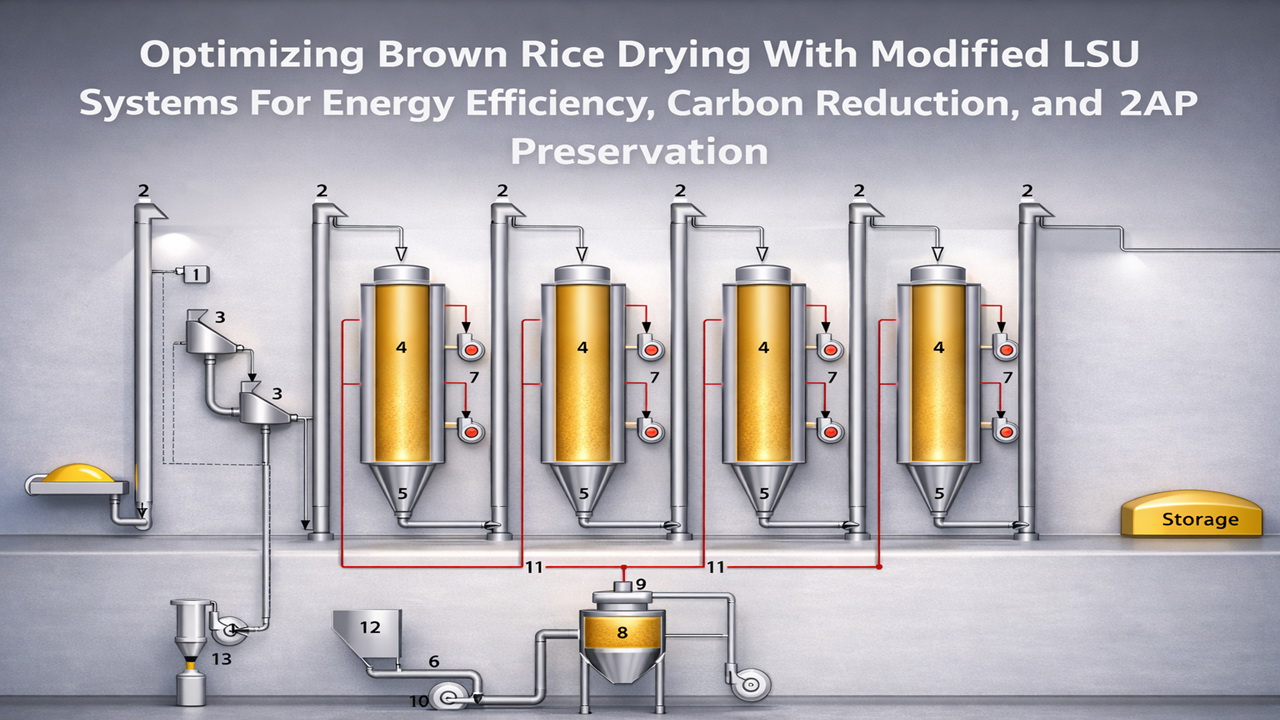
This research examines how the quality of 2AP in Thai fragrant brown rice is affected by non-continuous LSU drying, emphasizing thermal energy management, moisture content, and aroma retention, which exhibit significant interrelationships and nonlinear responses across drying conditions and carbon emissions. The drying system employed an LSU-type dryer, a cyclone hot-air furnace, and a paddle mixer, using 4 tons of coal daily. This is equivalent to 26,680 kWh daily or an average power of 1,112 kW. The experiment took place in two stages: the first used 16,008 kWh/day to bring rice moisture down to 24.3-29.3%, averaging 26.5%, while the second used 10,672 kWh/day to reduce moisture to 10.9-12.4%, averaging 12.0%. During the 33.3% (stage-2 saving), energy use decreased the total system saving by 54.71%. In line with this, CO₂ emissions dropped from 13,337 kg.CO₂/day to 8,003 kg.CO₂/day a decrease of 5,334 kg.CO₂/day. Drying was meticulously controlled, with furnace temperatures maintained below 145°C and hot-air temperatures kept below 120°C. The research, conducted at a commercial rice mill operated by Maejaitana Chotiwat Co., Ltd., documented 2AP levels ranging from 1.83 to 2.67 µg/g, averaging 2.14 µg/g, with a mean drying temperature of 37.8°C. The results suggest that energy management, moisture control, and aroma retention are positively correlated. The study underscores the promise of low-emission, energy-efficient drying methods for improving product quality and promoting sustainability in the agro-industrial sector, with potential applications for crops such as cassava and corn.
Article Details

This work is licensed under a Creative Commons Attribution-NonCommercial-NoDerivatives 4.0 International License.
References
Bryant, R.; McClung, A.; Champagne, E. Aromatic Rice Formation and Sensory Evaluation. Cereal Chem. 2010, 87(4), 292–299.
Buttery, R. G.; Ling, L. C.; Juliano, B. O. 2-Acetyl-1-pyrroline: An Important Aroma Component of Cooked Rice. Chem. Ind. 1983, 12, 958–959.
Laohakunjit, N.; Noomhorm, A. Supercritical Carbon Dioxide Extraction of 2-Acetyl-1-pyrroline and Volatile Components from Aromatic Rice. J. Agric. Food Chem. 2004, 52(19), 6053–6059. https://doi.org/10.1002/ffj.1297.
Soponronnarit, S. Engineering Principles of Agricultural Drying; King Mongkut's University of Technology Thonburi: Bangkok, Thailand, 1997.
Chungcharoen, S.; Prachayawarakorn, S.; Soponronnarit, S. Effect of Initial Moisture Content and Bed Thickness on Fluidized Bed Drying Characteristics of Glutinous Rice. Kasetsart J. Nat. Sci. 2017, 51, 1033–1043.
Wongpichet, S.; Thongpan, M. Effect of Tempering Temperature on Drying Rate and Head Rice Yield of Paddy. Kasetsart J. Nat. Sci. 2002, 36, 276–284.
Laokuldilok, T.; Kanha, N. Effects of Drying Conditions on Anthocyanin Content and Antioxidant Capacity of Black Rice. Int. Food Res. J. 2015, 22, 1452–1458.
Jittanit, W.; Saeteaw, T.; Charoenchaisri, P. Energy Analysis and Improvement of Rice Drying Systems. Dry. Technol. 2010, 28, 900–910. https://doi.org/10.1080/07373937.2010.485081
Sarker, A.; Islam, M. N.; Rashid, M. H. Simulation and Validation of Paddy Drying in Fluidized Bed Dryers. J. Food Eng. 2014, 143, 115–123.
Thailand Greenhouse Gas Management Organization. Electricity Grid Mix Emission Factor 2016–2018; Thailand National Life Cycle Inventory Database; Bangkok, Thailand, 2018.
Lertworasirikul, S.; Prachayawarakorn, S. Optimization of Parboiled Brown Rice Drying Using Fluidized Bed Technique. J. Food Eng. 2007, 85, 573–582.
Treeamnuk, K.; Treeamnuk, S.; Soponronnarit, S. Performance of Hot Air Drying System for Jasmine Rice. Energy Sustain. Dev. 2017, 39, 68–75.
Kaensup, W.; Kulwong, S.; Wongwises, S. Development of Small-Scale Pneumatic Dryer for Household Use. Renew. Energy 2006, 31, 2324–2335.
Jaisut, D.; Prachayawarakorn, S.; Varanyanond, W.; Tungtrakul, P. Effects of Intermittent Drying and Storage Conditions on Physicochemical Properties and Cooking Quality of Thai Fragrant Rice. J. Food Eng. 2008, 89, 289–296.
Moongngarm, A.; Saetung, N. Comparison of Chemical Compositions and Bioactive Compounds of Germinated Rough Rice and Brown Rice. Food Chem. 2010, 122, 782–788. https://doi.org/10.1016/j.foodchem.2010.03.053
Tian, S.; Nakamura, K.; Kayahara, H. Analysis of Phenolic Compounds in White Rice, Brown Rice, and Germinated Brown Rice. J. Agric. Food Chem. 2004, 52, 4808–4813. https://doi.org/10.1021/jf049446f
Somta, P.; Kongsuwan, A.; Wongpornchai, S. Effect of Drying Temperature on GABA and Phenolics in Germinated Rice. Kasetsart J. Nat. Sci. 2007, 41, 40–45.
Phetnamkhiew, K.; Thongsawatwong, S.; Soponronnarit, S. Effect of Hot Air Velocity on Drying Time of Rice. J. Stored Prod. Res. 2008, 44, 217–223.
Meesukchaosumran, S.; Chitsomboon, T. Effect of Resting Period on Head Rice Yield in High-Temperature Drying. Biosyst. Eng. 2018, 172, 11–19.
Calingacion, M.; Laborte, R.; Nelson, A. Diversity of Global Rice Markets and the Science Required for Consumer-Targeted Rice Breeding. PLoS One 2014, 9, e85106. https://doi.org/10.1371/journal.pone.0085106
American Society of Agricultural Engineers. ASAE Standards S358.2: Moisture Measurement—Grain and Seeds; St. Joseph, MI, USA, 2002.
Fungpongpan, P.; Prachayawarakorn, S.; Soponronnarit, S. Energy Consumption Analysis of Pneumatic Dryers. Energy Procedia 2016, 100, 377–382.
Mujumdar, A. S. Handbook of Industrial Drying, 4th ed.; CRC Press: Boca Raton, FL, USA, 2014.
Brooker, D. B.; Bakker-Arkema, F. W.; Hall, C. W. Drying and Storage of Grains and Oilseeds; Springer: New York, NY, USA, 1992.
Poomsa-ad, N.; Soponronnarit, S. Study of Enthalpy in Drying Air for Parboiled Rice. J. Sci. Technol. 2005, 27, 483–489.
Zhao, Y.; Flugstad, B. Freeze Drying and Microwave Drying of Rice: Effects on Structure and Texture. Food Res. Int. 1997, 30, 519–526.
Nimmol, C. Development of a Spiral Pneumatic Dryer for Paddy. Dry. Technol. 2012, 30, 1377–1384. https://doi.org/10.1080/07373937.2012.713070
