
Physicochemical and Microbiological Evaluation of Reverse Osmosis Drinking Water Quality in Babylon Province, Iraq
Article Sidebar
Main Article Content
Abstract
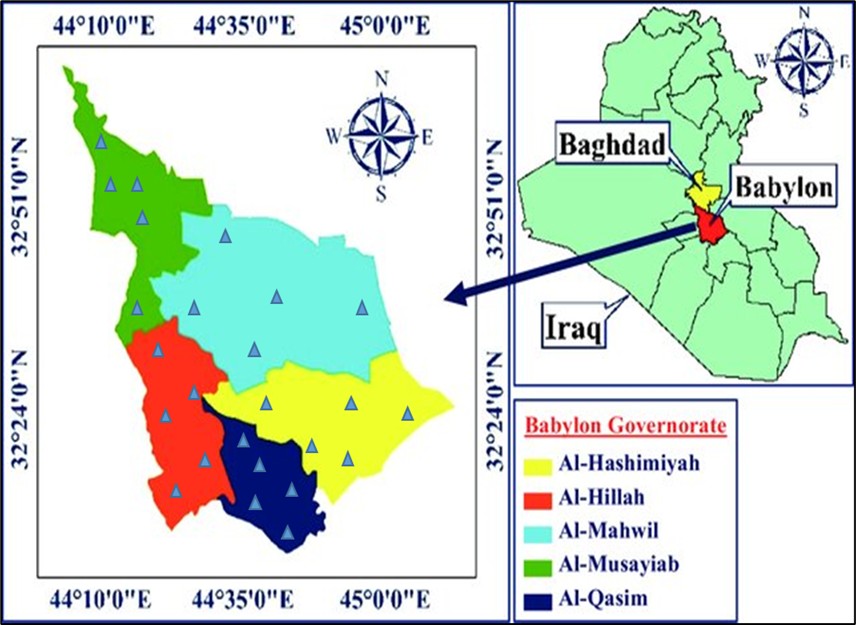
The physical, chemical and microbiological quality of drinking water produced from 25 reverse osmosis (RO) plants in five districts of Babylon Province, Iraq was assessed by applying the Canadian Water Quality Index (WQI). Systematic sampling of water for water quality assessment was undertaken from October 2024 to February 2025. Results showed that pH was between 6.1 to 7.8. Conductivity difference was noted to be large, between 10 and 360 μS/cm, whereas TDS exhibited between 6.14 and 225 mg/L, indicating the outstanding salt rejection in range of from ~90–99.5%. Total hardness showed a significant decrease (10-270 mg/L) with calcium hardness and magnesium hardness decreasing from 1 to 28 mg/L, and 1.458 to 62.694 mg/L, respectively; the concentrations of ions significantly decreased: chloride (11.85-49.98 mg/L), nitrate (0-0.024 mg/), sulfate (0.698-15.938 mg/). Counts of the total bacteria and coliforms were ranging from 177-301CFU/mL and 0-27CFU/100mL respectively in the sites based on microbial test. Based on WQI evaluation, 64% (n=16) of the samples were ranked to be excellent quality(0-25), 24%(n=6) good quality (26-50) and 12% (n=3) was poor quality(51-75). This integrated approach of the great extent study clearly verifies that RO technology has an outstanding performance to remove physicochemical contaminants, while presenting ongoing mastering difficulties such as microbiological safety and aluminum contamination to require more specific applicable guidelines in monitoring actions and regular maintenance works for their optimal operations.
Article Details

This work is licensed under a Creative Commons Attribution-NonCommercial-NoDerivatives 4.0 International License.
References
Nicolaidis, S. Physiology of thirst. In Hydration Throughout Life; Arnaud, M. J., Ed.; John Libbey Eurotext: Montrouge, France, 1998; p 247.
Mishra, R. K. Fresh water availability and its global challenge. Br. J. Multidiscip. Adv. Stud. 2023, 4, 1–78. https://doi.org/10.37745/bjmas.2022.0208
WHO. Guidelines for Drinking-Water Quality: Incorporating the First and Second Addenda, 4th ed. World Health Organization: Geneva, Switzerland, 2022.
Akhai, S.; Taneja, T. Liquid gold: safeguarding our health through pure drinking water and rigorous water testing. In Natural Resource Management Issues in Human-Influenced Landscapes; IGI Global: Hershey, PA, USA, 2024; pp 129–148. https://doi.org/10.4018/978-1-6684-7051-0.ch007
Ritt, C. L.; Stassin, T.; Davenport, D. M.; DuChanois, R. M.; Nulens, I.; Yang, Z.; Elimelech, M.; Verbeke, R. The open membrane database: Synthesis–structure–performance relationships of reverse osmosis membranes. J. Membr. Sci. 2022, 641, 119927. https://doi.org/10.1016/j.memsci.2021.119927
Dirisu, G. B.; Okonkwo, U. C.; Okokpujie, I. P.; Fayomi, O. S. Comparative analysis of the effectiveness of reverse osmosis and ultraviolet radiation of water treatment. J. Ecol. Eng. 2019, 20(3), 61–75. https://doi.org/10.12911/22998993/95266
Soliman, M. N.; Guen, F. Z.; Ahmed, S. A.; Saleem, H.; Khalil, M. J.; Zaidi, S. J. Energy consumption and environmental impact assessment of desalination plants and brine disposal strategies. Process Saf. Environ. Prot. 2021, 147, 589–608. https://doi.org/10.1016/j.psep.2020.12.038
Poirier, K.; Lotfi, M.; Garg, K.; Patchigolla, K.; Anthony, E. J.; Faisal, N. H.; Al Mhanna, N. A comprehensive review of pre-and post-treatment approaches to achieve sustainable desalination for different water streams. Desalination 2023, 566, 116944. https://doi.org/10.1016/j.desal.2023.116944
Greenlee, L. F.; Lawler, D. F.; Freeman, B. D.; Marrot, B.; Moulin, P. Reverse osmosis desalination: water sources, technology, and today's challenges. Water Res. 2009, 43(9), 2317–2348. https://doi.org/10.1016/j.watres.2009.03.010
Garabedian, S. A. K. The quality of reverse osmosis water in storage tanks in Basrah city—Iraq. Basrah J. Sci. 2011, 6(1), 1–8.
Hadi, A. M. Isolation and identification of Cryptosporidium sp. by reverse osmosis system of tap water in Baghdad. Baghdad Sci. J. 2014, 11(3), 894–899. https://doi.org/10.21123/bsj.11.2.894-899
Sabtie, N. H. A.; Kariem, N. N. O.; Sachit, D. E. Application of RO system to desalinate brackish surface water in Southern Iraq. Civ. Environ. Res. 2018, 10(1), 19–34.
Abbas, H.; Lateef, K. H.; Abdeljabbar, A. T.; Abbas, F. S. Desalination of groundwater for several districts in Baghdad-Iraq using reverse osmosis membrane. In Nucleation and Atmospheric Aerosols; AIP Publishing: Melville, NY, USA, 2022. https://doi.org/10.1063/5.0113443
Al-Gayyim, A. S.; Al-asady, R. K. A. Evaluation of reverse osmosis water quality in Diwaniyah Governorate/Iraq. MJPS 2023, 10(2), 2. https://doi.org/10.52113/2/10.02.2023/9-26
Wang, X.; Zhang, F.; Ding, J. Evaluation of water quality based on a machine learning algorithm and water quality index for the Ebinur Lake Watershed, China. Sci. Rep. 2017, 7, 12858. https://doi.org/10.1038/s41598-017-12853-y
Al Yousif, M. A.; Chabuk, A. Assessment water quality indices of surface water for drinking and irrigation applications—A comparison review. J. Ecol. Eng. 2023, 24(5), 40–55. https://doi.org/10.12911/22998993/161194
Chidiac, S.; El Najjar, P.; Ouaini, N.; El Rayess, Y.; El Azzi, D. A comprehensive review of water quality indices (WQIs): history, models, attempts and perspectives. Rev. Environ. Sci. Biotechnol. 2023, 22(2), 349–395. https://doi.org/10.1007/s11157-023-09650-7
Brown, R. M.; McClelland, N. I.; Deininger, R. A.; Tozer, R. G. A water quality index—Do we dare? Water Sewage Work. 1970, 117(10), 339–343.
CCME. Canadian Water Quality Guidelines for the Protection of Aquatic Life: CCME Water Quality Index 1.0 User's Manual; Canadian Council of Ministers of the Environment: Winnipeg, MB, Canada, 2001.
APHA. Standard Methods for the Examination of Water and Wastewater, 23rd ed.; American Public Health Association: Washington, DC, USA, 2017.
Anis, S. F.; Hashaikeh, R.; Hilal, N. Reverse osmosis pretreatment technologies and future trends: A comprehensive review. Desalination 2019, 452, 159–195. https://doi.org/10.1016/j.desal.2018.11.006
Honarparvar, S.; Zhang, X.; Chen, T.; Alborzi, A.; Afroz, K.; Reible, D. Frontiers of membrane desalination processes for brackish water treatment: A review. Membranes 2021, 11(4), 246. https://doi.org/10.3390/membranes11040246
Liu, Y.; Zhu, M.; Ji, X.; Tan, Z.; He, Z. Removal of calcium and magnesium ions from reverse osmosis concentrate using a two-stage precipitation with carbonation process. Environ. Sci. Pollut. Res. 2024, 31(33), 45495–45506. https://doi.org/10.1007/s11356-024-34186-4
Keen, M. Evaluation of the Impact of Membrane Change at a Membrane Softening Water Treatment Plant; University of Waterloo: Waterloo, ON, Canada, 2009.
Nyoman Widiasa, I.; Sinaga, N.; Ariyanti, D. Improving performance of low reverse osmosis pressure systems by intermittent autoflushing. Water Sci. Technol. 2010, 61(12), 3103–3109. https://doi.org/10.2166/wst.2010.934
Zhao, Y.; Wang, D. Membrane scaling mechanisms in RO desalination. Desalination 2017, 403, 165–174. https://doi.org/10.1016/j.desal.2016.10.025
Ayoub, G. M.; Korban, L.; Al-Hindi, M.; Zayyat, R. Removal of fouling species from brackish water reverse osmosis reject stream. Environ. Technol. 2018, 39(7), 804–813. https://doi.org/10.1080/09593330.2017.1310938
Lee, K. P.; Arnot, T. C.; Mattia, D. A review of reverse osmosis membrane materials for desalination—Development to date and future potential. J. Membr. Sci. 2011, 370(1-2), 1–22. https://doi.org/10.1016/j.memsci.2010.12.036
Safia, A. I.; Salima, A.; Ibrahim, B. Zero liquid discharge management: optimizing sustainable reverse osmosis desalination practices. Stud. Eng. Exact Sci. 2024, 5(2), 1–15. https://doi.org/10.54021/seesv5n2-040
Abascal, E.; Gómez-Coma, L.; Ortiz, I.; Ortiz, A. Global diagnosis of nitrate pollution in groundwater and review of removal technologies. Sci. Total Environ. 2022, 810, 152233. https://doi.org/10.1016/j.scitotenv.2021.152233
Sewak, R.; Sewak, P.; Singh, P. S. Nitrate contamination in groundwater and preferred treatment technology in rural India. Water Secur. 2023, 20, 100149. https://doi.org/10.1016/j.wasec.2023.100149
Zirrahi, F.; Hadi, M.; Nodehi, R. N.; Milan, E. G.; Bashardoust, P.; Abolli, S.; Alimohammadi, M. A systematic review on the investigation of optimal operating conditions of the reverse osmosis process in nitrate removal from drinking water. Results Eng. 2025, 21, 101947. https://doi.org/10.1016/j.rineng.2024.101947
Al Mehrate, J.; Shaban, S.; Henni, A. A review of sulfate removal from water using polymeric membranes. Membranes 2025, 15(1), 17. https://doi.org/10.3390/membranes15010017
Tran, T.; Bolto, B.; Gray, S.; Hoang, M.; Ostarcevic, E. An autopsy study of a fouled reverse osmosis membrane element used in a brackish water treatment plant. Water Res. 2007, 41(17), 3915–3923. https://doi.org/10.1016/j.watres.2007.06.008
Ohno, K.; Matsui, Y.; Itoh, M.; Oguchi, Y.; Kondo, T.; Konno, Y.; Sato, T.; Fujiwara, T.; Matsushita, T.; Magara, Y. NF membrane fouling by aluminum and iron coagulant residuals after coagulation–MF pretreatment. Desalination 2010, 254(1-3), 17–22. https://doi.org/10.1016/j.desal.2009.12.011
Adel, M.; Nada, T.; Amin, S.; Anwar, T.; Mohamed, A. A. Characterization of fouling for a full-scale seawater reverse osmosis plant on the Mediterranean sea: membrane autopsy and chemical cleaning efficiency. Groundw. Sustain. Dev. 2022, 16, 100704. https://doi.org/10.1016/j.gsd.2021.100704
Kherraf, S.; Ennouhi, M.; El Mansouri, A.; El Hajjaji, S.; Nasrellah, H.; Bensemlali, M.; Aarfane, A.; Cherrat, A.; Labjar, N. Autopsy results and inorganic fouling prediction modeling using artificial neural networks for reverse osmosis membranes in a desalination plant. Eng. 2025, 6(5), 98. https://doi.org/10.3390/eng6050098
Brown, S. L.; Leonard, K. M.; Messimer, S. L. Evaluation of ozone pretreatment on flux parameters of reverse osmosis for surface water treatment. Ozone Sci. Eng. 2008, 30(2), 152–164. https://doi.org/10.1080/01919510801892932
Hayward, C.; Ross, K. E.; Brown, M. H.; Bentham, R.; Whiley, H. The presence of opportunistic premise plumbing pathogens in residential buildings: A literature review. Water 2022, 14(7), 1129. https://doi.org/10.3390/w14071129
Türker, R. K.; Ekici, H.; Aydınalp, C. Design and analysis of flow channels in reverse osmosis systems: A preliminary study. In Proceedings of the 2025 7th International Congress on Human-Computer Interaction, Optimization and Robotic Applications (ICHORA); IEEE: Piscataway, NJ, USA, 2025; pp 1–5. https://doi.org/10.1109/ICHORA65333.2025.11017183
Fikri, E.; Muhammad Ramdhanny, F.; Nurhayati, A.; Sharaf Eldin, K. A. Total coliform reduction in drinking water based on variations in reverse osmosis membrane pressure. Glob. NEST J. 2022, 24 (4), 569–575. https://doi.org/10.30955/gnj.004295
Rbeida, O.; Eteer, S. Quality control evaluation of the microbial contamination of bottled drinking water and house hold reverse osmosis water in Tripoli, Libya. AlQalam J. Med. Appl. Sci. 2023, 6(2), 867–872.
Baba, T.; Matsumoto, R.; Yamaguchi, N.; Nasu, M. Bacterial population dynamics in a reverse-osmosis water purification system determined by fluorescent staining and PCR-denaturing gradient gel electrophoresis. Microbes Environ. 2009, 24(2), 163–167. https://doi.org/10.1264/jsme2.me09120
