
Colonization of Potassium-Solubilizing Purple Nonsulfur Bacteria and Their Role in Promoting the Growth of Hybrid Maize
Article Sidebar
Main Article Content
Abstract
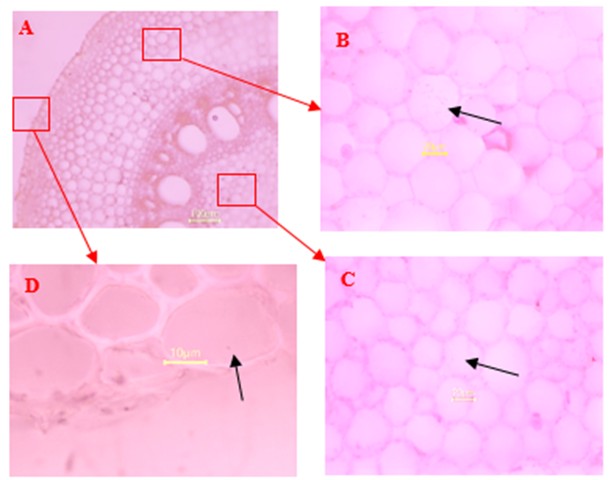
The use of biofertilisers to replace conventional chemical fertilisers has been widely investigated. However, the colonization of microbes in plants and their effects on plant growth are still unclear. The experiment aimed to (i) determine the ability of potassium-solubilizing purple nonsulfur bacteria (Ksol-PNSB) to colonize in hybrid maize and (ii) measure their capacity to promote plant growth. A randomised complete block design experiment was conducted in undeposited alluvial soil collected from An Phu, An Giang, under nethouse conditions with five treatments and six replications. The treatments were: (i) the control, (ii) Cereibacter sphaeroides M-Sl-09, (iii) Rhodopseudomonas thermotolerans M-So-11, (iv) Rhodospeudomonas palustris M-So-14, and (v) a combination of the three strains. Results revealed the presence of bacteria in soft tissues of the cortex and medulla in the root hair region of hybrid maize plants. Supplying one or three strains of Ksol-PNSB increased crop height (20.7–34.4%), root length (17.0–40.5%), root biomass (20.9–154.0%), and stem-leaf biomass (73.8–173.8%) compared to the control. The current study has successfully revealed the inhabitation locations of the beneficial bacteria within plant tissues, along with the improved growth characteristics of the hybrid maize. The current study is a good reference for studies investigating the works of beneficial microbes in plants. However, further molecular investigations should explore the potassium-solubilizing traits of the bacteria.
Article Details

This work is licensed under a Creative Commons Attribution-NonCommercial-NoDerivatives 4.0 International License.
References
Reddy, V.R.; Seshu, G.; Jabeen, F.; Rao, A.S. Specialty maize types with reference to quality protein maize (Zea mays L.)—A review. Int. J. Agric. Environ. Biotechnol. 2012, 5, 393–400.
Tran, A.T.M.; Eitzinger, J.; Manschadi, A.M. Response of maize yield under changing climate and production conditions in Vietnam. Ital. J. Agrometeorol. 2020, 1, 73–84. https://doi.org/10.13128/ijam-764
Sandhu, H.; Scialabba, N.E.H.; Warner, C.; Behzadnejad, F.; Keohane, K.; Houston, R.; Fujiwara, D. Evaluating the holistic costs and benefits of maize production systems in Minnesota US. Sci. Rep. 2020, 10, 3922. https://doi.org/10.1038/s41598-020-60826-5
Peñuelas, J.; Coello, F.; Sardans, J. A better use of fertilizers is needed for global food security and environmental sustainability. Agric. Food Secur. 2023, 12, 9. https://doi.org/10.1186/s40066-023-00409-5
Rawat, J.; Pandey, N.; Saxena, J. Role of potassium in plant photosynthesis transport growth and yield. In Role of Potassium in Abiotic Stress; Iqbal, N., Umar, S., Eds.; Springer: Singapore, 2022; pp. 1–14. https://doi.org/10.1007/978-981-16-4461-0_1
Nguyen, H.K.; Le, V.Q.; Tran, H.T.; Van Tra, T.; Nguyen, T.V.; Tran, K.T.; Ho, T.T.T. Reuse shrimp pond sedimentation to produce organic fertilizer in industrial scale. Sci. Technol. Dev. J. Sci. Earth Environ. 2021, 5, 273–283. https://doi.org/10.32508/stdjsee.v5i1.536
Sardans, J.; Peñuelas, J. Potassium control of plant functions: Ecological and agricultural implications. Plants 2021, 10, 419. https://doi.org/10.3390/plants10020419
Adnan, M. Role of potassium in maize production: A review. Open Access J. Biol. Sci. Res. 2020, 3, 1–4. https://dx.doi.org/10.46718/JBGSR.2020.03.000083
Azadi, A.; Shakeri, S. Effect of different land use on potassium forms and some soil properties in Kohgiluyeh and Boyer-Ahmad Province, Southwest Iran. Iran Agric. Res. 2020, 39, 121–133. https://doi.org/10.22099/iar.2020.36758.1387
Sun, F.; Ou, Q.; Wang, N.; Guo, Z.X.; Ou, Y.; Li, N.; Peng, C. Isolation and identification of potassium-solubilizing bacteria from Mikania micrantha rhizospheric soil and their effect on M. micrantha plants. Glob. Ecol. Conserv. 2020, 23, e01141. https://doi.org/10.1016/j.gecco.2020.e01141
Gao, C.; El-Sawah, A.M.; Ali, D.F.I.; Alhaj Hamoud, Y.; Shaghaleh, H.; Sheteiwy, M.S. The integration of bio and organic fertilizers improve plant growth, grain yield, quality and metabolism of hybrid maize (Zea mays L.). Agronomy 2020, 10, 319. https://doi.org/10.3390/agronomy10030319
Nosheen, S.; Ajmal, I.; Song, Y. Microbes as biofertilizers: A potential approach for sustainable crop production. Sustainability 2021, 13, 1868. https://doi.org/10.3390/su13041868
Verma, P.; Yadav, A.N.; Khannam, K.S.; Saxena, A.K.; Suman, A. Potassium-solubilizing microbes: Diversity, distribution and role in plant growth promotion. In Microorganisms for Green Revolution: Volume 1: Microbes for Sustainable Crop Production; Panpatte, D., Jhala, Y., Vyas, R., Shelat, H., Eds.; Springer: Singapore, 2017; pp. 125–149. https://doi.org/10.1007/978-981-10-6241-4_7
Jiao, H.; Wang, R.; Qin, W.; Yang, J. Screening of rhizosphere nitrogen-fixing, phosphorus- and potassium-solubilizing bacteria of Malus sieversii (Ldb.) Roem. and the effect on apple growth. J. Plant Physiol. 2024, 292, 154142. https://doi.org/10.1016/j.jplph.2023.154142
Hamid, B.; Zaman, M.; Farooq, S.; Fatima, S.; Sayyed, R.Z.; Baba, Z.A.; Suriani, N.L. Bacterial plant biostimulants: A sustainable way towards improving growth, productivity and health of crops. Sustainability 2021, 13, 2856. https://doi.org/10.3390/su13052856
Khatoon, Z.; Huang, S.; Rafique, M.; Fakhar, A.; Kamran, M.A.; Santoyo, G. Unlocking the potential of plant growth-promoting rhizobacteria on soil health and the sustainability of agricultural systems. J. Environ. Manag. 2020, 273, 111118. https://doi.org/10.1016/j.jenvman.2020.111118
Khuong, N.Q.; Sakpirom, J.; Oanh, T.O.; Thuc, L.V.; Thu, L.T.M.; Xuan, D.T.; Quang, L.T.; Xuan, L.N.T. Isolation and characterization of novel potassium-solubilizing purple nonsulfur bacteria from acidic paddy soils using culture-dependent and culture-independent techniques. Braz. J. Microbiol. 2023, 54, 2333–2348. https://doi.org/10.1007/s42770-023-01069-0
Koh, R.H.; Song, H.G. Effects of application of Rhodopseudomonas sp. on seed germination and growth of tomato under axenic conditions. J. Microbiol. Biotechnol. 2007, 17, 1805–1810.
Thu, L.T.M.; Xuan, L.N.T.; Nhan, T.C.; Quang, L.T.; Trong, N.D.; Thuan, V.M.; Nguyen, T.T.K.; Nguyen, P.C.; Thuc, L.V.; Khuong, N.Q. Characterization of novel species of potassium-dissolving purple nonsulfur bacteria isolated from in-dyked alluvial upland soil for maize cultivation. Life 2024, 14, 1461. https://doi.org/10.3390/life14111461
Khuong, N.Q.; Huu, T.N.; Nhan, T.C.; Tran, H.N.; Tien, P.D.; Xuan, L.N.T.; Kantachote, D. Two strains of Luteovulum sphaeroides (purple nonsulfur bacteria) promote rice cultivation in saline soils by increasing available phosphorus. Rhizosphere 2021, 20, 100456. https://doi.org/10.1016/j.rhisph.2021.100456
Mondolot, L.; Roussel, J.L.; Andary, C. New applications for an old lignified element staining reagent. Histochem. J. 2001, 33, 379–385. https://doi.org/10.1023/A:1013798426161
Yuan, D.Q.; Wang, Y. Effects of solution conditions on the physicochemical properties of stratification components of extracellular polymeric substances in anaerobic digested sludge. J. Environ. Sci. 2013, 25, 155–162. https://doi.org/10.1016/S1001-0742(12)60038-2
Porra, R.J.; Thompson, W.A.; Kriedemann, P.E. Determination of accurate extinction coefficients and simultaneous equations for assaying chlorophylls a and b extracted with four different solvents: Verification of the concentration of chlorophyll standards by atomic absorption spectroscopy. Biochim. Biophys. Acta - Bioenerg. 1989, 975, 384–394. https://doi.org/10.1016/S0005-2728(89)80347-0
Bates, L.S.; Waldren, R.P.A.; Teare, I.D. Rapid determination of free proline for water-stress studies. Plant Soil 1973, 39, 205–207. https://doi.org/10.1007/BF00018060
Xu, J.; Feng, Y.; Wang, Y.; Luo, X.; Tang, J.; Lin, X. The foliar spray of Rhodopseudomonas palustris grown under Stevia residue extract promotes plant growth via changing soil microbial community. J. Soils Sediments 2016, 16, 916–923. https://doi.org/10.1007/s11368-015-1269-1
Xu, J.; Feng, Y.; Wang, Y.; Lin, X. Effect of rhizobacterium Rhodopseudomonas palustris inoculation on Stevia rebaudiana plant growth and soil microbial community. Pedosphere 2018, 28, 793–803. https://doi.org/10.1016/S1002-0160(18)60043-8
Batool, K.; Tuz Zahra, F.; Rehman, Y. Arsenic‐redox transformation and plant growth promotion by purple nonsulfur bacteria Rhodopseudomonas palustris CS2 and Rhodopseudomonas faecalis SS5. BioMed Res. Int. 2017, 2017, 6250327. https://doi.org/10.1155/2017/6250327
Iwai, R.; Uchida, S.; Yamaguchi, S.; Sonoda, F.; Tsunoda, K.; Nagata, H.; Miyasaka, H. Effects of seed bio-priming by purple non-sulfur bacteria (PNSB) on the root development of rice. Microorganisms 2022, 10, 2197. https://doi.org/10.3390/microorganisms10112197
Dat, L.T.; Tran, N.V.N.B.; Xuan, D.T.; Xuan, L.N.T.; Quang, L.T.; Khuong, N.Q. Effects of P-solubilizing bacteria Cereibacter sphaeroides ST16 and ST26 on soil fertility, P uptake and rice yield grown on salt-affected soils under greenhouse conditions. J. Crop Sci. Biotechnol. 2024, 27, 509–523. https://doi.org/10.1007/s12892-024-00247-2
Anh, N.H.; Hai, T.T.; Duc, N.V.; Xuan, D.T.; Quang, L.T.; Khuong, N.Q. Use of nitrogen-fixing purple nonsulfur bacteria to produce available nitrogen for rice (Oryza sativa L.) cultivated in saline acidic soil. Geomicrobiol. J. 2024, 42, 64–72. https://doi.org/10.1080/01490451.2024.2433202
Sarikhani, M.R.; Ebrahimi, M. Potassium Releasing Bacteria (KRB): Role of KRB in Horticultural Crops. In Bio-Inoculants in Horticultural Crops; Woodhead Publishing: Cambridge, UK, 2024; pp. 175–195. https://doi.org/10.1016/B978-0-323-96005-2.00004-0
Sharma, R.; Sindhu, S.S.; Glick, B.R. Potassium Solubilizing Microorganisms as Potential Biofertilizer: A Sustainable Climate-Resilient Approach to Improve Soil Fertility and Crop Production in Agriculture. J. Plant Growth Regul. 2024, 43, 2503–2535. https://doi.org/10.1007/s00344-024-11297-9
Wu, J.Y.; Chen, H.W.; Sundar, L.S.; Tu, Y.K.; Chao, Y.Y. Exploring the Potential of Purple Non-Sulfur Bacteria Strains A3-5 and F3-3 in Sustainable Agriculture: A Study on Nutrient Solubilization, Plant Growth Promotion, and Acidic Stress Tolerance. J. Soil Sci. Plant Nutr. 2025, 25, 2294–2313. https://doi.org/10.1007/s42729-025-02268-4
Maeda, I. Potential of Phototrophic Purple Nonsulfur Bacteria to Fix Nitrogen in Rice Fields. Microorganisms 2021, 10, 28. https://doi.org/10.3390/microorganisms10010028
IRRI (2000) ‘Adaptation of the chlorophyll meter technology for N management in rice.’ (IRRI: Manila, Philippines).
Ghosh, M.; Swain, D.K.; Jha, M.K.; Tewari, V.K. Precision Nitrogen Management Using Chlorophyll Meter for Improving Growth Productivity and N Use Efficiency of Rice in Subtropical Climate. J. Agric. Sci. 2013, 5(2), 253. https://doi.org/10.5539/jas.v5n2p253
Sundar, L.S.; Chao, Y.Y. Potential of Purple Non-Sulfur Bacteria in Sustainably Enhancing the Agronomic and Physiological Performances of Rice. Agronomy 2022, 12, 2347. https://doi.org/10.3390/agronomy12102347
Khanna-Chopra, R.; Semwal, V.K.; Lakra, N.; Pareek, A. Proline—A Key Regulator Conferring Plant Tolerance to Salinity and Drought. In Plant Tolerance to Environmental Stress; Hasanuzzaman, M., Fujita, M., Oku, H., Islam, M.T., Eds.; CRC Press: Boca Raton, FL, USA, 2019; pp. 59–80. https://doi.org/10.1201/9780203705315
Ghosh, U.K.; Islam, M.N.; Siddiqui, M.N.; Cao, X.; Khan, M.A. Proline, a Multifaceted Signalling Molecule in Plant Responses to Abiotic Stress: Understanding the Physiological Mechanisms. Plant Biol. 2022, 24(2), 227–239.
Kishor, P.K.; Sangam, S.; Amrutha, R.N.; Laxmi, P.S.; Naidu, K.R.; Rao, K.S.; Rao, S.; Reddy, K.J.; Theriappan, P.; Sreenivasulu, N. Regulation of Proline Biosynthesis, Degradation, Uptake and Transport in Higher Plants: Its Implications in Plant Growth and Abiotic Stress Tolerance. Curr. Sci. 2005, 88, 424–438.
Khan, M.Y.; Nadeem, S.M.; Sohaib, M.; Waqas, M.R.; Alotaibi, F.; Ali, L.; Zahir, Z.A.; Al-Barakah, F.N. Potential of Plant Growth Promoting Bacterial Consortium for Improving the Growth and Yield of Wheat under Saline Conditions. Front. Microbiol. 2022, 13, 958522. https://doi.org/10.3389/fmicb.2022.958522
Khan, P.; Abdelbacki, A.M.; Albaqami, M.; Jan, R.; Kim, K.M. Proline Promotes Drought Tolerance in Maize. Biology 2025, 14, 41. https://doi.org/10.3390/biology14010041
