
In Silico Mining of Potential Anti-cancer Liver X Receptor β Agonists
Article Sidebar
Main Article Content
Abstract
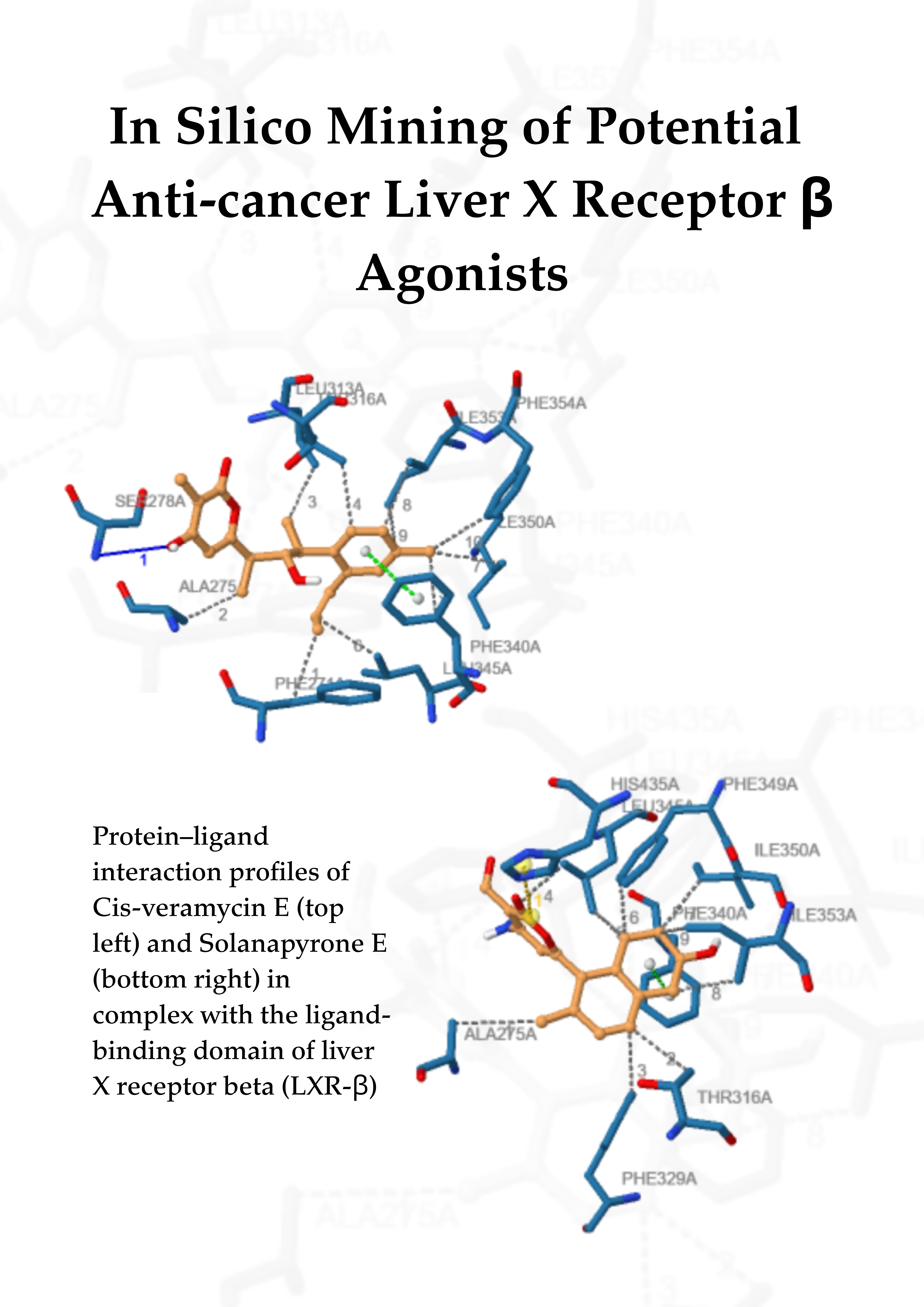
Cancer continues to be a leading cause of mortality worldwide, with the most common treatments such as chemotherapy and radiotherapy producing severe off-target effects. This study aims to identify potential therapeutic compounds by screening the Natural Products Atlas (NPAtlas) for potential agonists of the Liver X Receptor Beta (LXR-β). LXR-β is a nuclear receptor involved in lipid metabolism and is known to induce apoptosis in cancer cells when acted upon by an agonist. Screening of 36,310 compounds from the NPAtlas database was performed using molecular docking, pharmacokinetic filtering, absorption, distribution, metabolism, excretion, and toxicity (ADMET) profiling, and confirmatory molecular dynamics simulations. From the initial dataset, 9 candidates passed the docking and ADMET criteria, and molecular dynamics simulations successfully validated 7 of them. Among these, Cis-veramycin E (NPA033420) and Solanapyrone E (NPA010954) emerged as top candidates. Cis-veramycin E demonstrated a high docking score (–9.31 kcal/mol), low root mean square deviation (RMSD) of <1.0 nm, minimal root mean square fluctuation (RMSF) of <0.3 nm, and a favorable ADMET profile, including Ames safety, good absorption, and moderate clearance. Protein–ligand interaction profiling revealed a binding profile similar to known LXR-β agonists, including hydrogen bonding with Ser278, π–π stacking with Phe340, and hydrophobic contacts across core residues. Solanapyrone E exhibited comparable binding stability and engaged the critical His435–Trp457 electrostatic switch via a salt bridge, but was flagged as Ames toxic, indicating a need for structural optimization. The results support the recommendation to identify the compounds as lead candidates for LXR-β-targeted cancer therapy.
Article Details

This work is licensed under a Creative Commons Attribution-NonCommercial-NoDerivatives 4.0 International License.
References
American Cancer Society. Global Cancer Facts & Figures, 5th ed.; American Cancer Society: Atlanta, GA, 2024.
Saijo, N.; Tamura, T.; Nishio, K. Strategy for the Development of Novel Anticancer Drugs. Cancer Chemother. Pharmacol. 2003, 52, 97–101. https://doi.org/10.1007/s00280-003-0596-x
Peet, D. J.; Turley, S. D.; Ma, W.; Janowski, B. A.; Lobaccaro, J.-M. A.; Hammer, R. E.; Mangelsdorf, D. J. Cholesterol and Bile Acid Metabolism Are Impaired in Mice Lacking the Nuclear Oxysterol Receptor LXRα. Cell 1998, 93(5), 693–704. https://doi.org/10.1016/S0092-8674(00)81432-4
Schulman, I. G. Liver X Receptors Link Lipid Metabolism and Inflammation. FEBS Lett. 2017, 591(19), 2978–2991. https://doi.org/10.1002/1873-3468.12702
Guo, D.; Reinitz, F.; Youssef, M.; Hong, C.; Nathanson, D.; Akhavan, D.; Kuga, D.; Amzajerdi, A. N.; Soto, H.; Zhu, S.; et al. An LXR Agonist Promotes Glioblastoma Cell Death through Inhibition of an EGFR/AKT/SREBP-1/LDLR-Dependent Pathway. Cancer Discov. 2011, 1(5), 442–456. https://doi.org/10.1158/2159-8290.CD-11-0102
Gong, H.; Guo, P.; Zhai, Y.; Zhou, J.; Uppal, H.; Jarzynka, M. J.; Song, W.-C.; Cheng, S.-Y.; Xie, W. Estrogen Deprivation and Inhibition of Breast Cancer Growth In Vivo through Activation of the Orphan Nuclear Receptor Liver X Receptor. Mol. Endocrinol. 2007, 21(8), 1781–1790. https://doi.org/10.1210/me.2007-0187
Vedin, L.-L.; Lewandowski, S. A.; Parini, P.; Gustafsson, J.-Å.; Steffensen, K. R. The Oxysterol Receptor LXR Inhibits Proliferation of Human Breast Cancer Cells. Carcinogenesis 2009, 30(4), 575–579. https://doi.org/10.1093/carcin/bgp029
Pencheva, N.; Buss, C. G.; Posada, J.; Merghoub, T.; Tavazoie, S. F. Broad-Spectrum Therapeutic Suppression of Metastatic Melanoma through Nuclear Hormone Receptor Activation. Cell 2014, 156(5), 986–1001. https://doi.org/10.1016/j.cell.2014.01.038
Fessler, M. B. The Challenges and Promise of Targeting the Liver X Receptors for Treatment of Inflammatory Disease. Pharmacol. Ther. 2018, 181, 1–12. https://doi.org/10.1016/j.pharmthera.2017.07.010
Uno, S.; Endo, K.; Jeong, Y.; Kawana, K.; Miyachi, H.; Hashimoto, Y.; Makishima, M. Suppression of β-Catenin Signaling by Liver X Receptor Ligands. Biochem. Pharmacol. 2009, 77(2), 186–195. https://doi.org/10.1016/j.bcp.2008.10.007
Chen, H.; Liu, H.; Qing, G. Targeting Oncogenic Myc as a Strategy for Cancer Treatment. Signal Transduct. Target. Ther. 2018, 3, 5. https://doi.org/10.1038/s41392-018-0008-7
Chen, W.; Miao, C. KRT15 Promotes Colorectal Cancer Cell Migration and Invasion through β-Catenin/MMP-7 Signaling Pathway. Med. Oncol. 2022, 39(6), 68. https://doi.org/10.1007/s12032-021-01619-2
Kalluri, R.; Weinberg, R. A. The Basics of Epithelial–Mesenchymal Transition. J. Clin. Invest. 2009, 119(6), 1420–1428. https://doi.org/10.1172/JCI39104
Fukuchi, J.; Kokontis, J. M.; Hiipakka, R. A.; Chuu, C.; Liao, S. Anti-Proliferative Effect of Liver X Receptor Agonists on LNCaP Human Prostate Cancer Cells. Cancer Res. 2004, 64(21), 7686–7689. https://doi.org/10.1158/0008-5472.CAN-04-2332
Pommier, A. J. C.; Alves, G.; Viennois, E.; Bernard, S.; Communal, Y.; Sion, B.; Marceau, G.; Damon, C.; Mouzat, K.; Caira, F.; et al. Liver X Receptor Activation Downregulates AKT Survival Signaling in Lipid Rafts and Induces Apoptosis of Prostate Cancer Cells. Oncogene 2010, 29(18), 2712–2723. https://doi.org/10.1038/onc.2010.30
Moradi, M.; Golmohammadi, R.; Najafi, A.; Moosazadeh Moghaddam, M.; Fasihi-Ramandi, M.; Mirnejad, R. A Contemporary Review on the Important Role of In Silico Approaches for Managing Different Aspects of COVID-19 Crisis. Inform. Med. Unlocked 2022, 28, 100862. https://doi.org/10.1016/j.imu.2022.100862
Lin, C.-Y.; Gustafsson, J.-Å. Targeting Liver X Receptors in Cancer Therapeutics. Nat. Rev. Cancer 2015, 15(4), 216–224. https://doi.org/10.1038/nrc3912
Sengupta, M.; Griffett, K.; Flaveny, C. A.; Burris, T. P. Inhibition of Hepatotoxicity by a LXR Inverse Agonist in a Model of Alcoholic Liver Disease. ACS Pharmacol. Transl. Sci. 2018, 1(1), 50–60. https://doi.org/10.1021/acsptsci.8b00003
Lian, Y.-E.; Wang, M.; Ma, L.; Yi, W.; Liao, S.; Gao, H.; Zhou, Z. Identification of Novel PPARγ Partial Agonists Based on Virtual Screening Strategy: In Silico and In Vitro Experimental Validation. Molecules 2024, 29(20), 4881. https://doi.org/10.3390/molecules29204881
Qin, T.; Gao, X.; Lei, L.; Feng, J.; Zhang, W.; Hu, Y.; Shen, Z.; Liu, Z.; Huan, Y.; Wu, S.; et al. Machine Learning- and Structure-Based Discovery of a Novel Chemotype as FXR Agonists for Potential Treatment of Nonalcoholic Fatty Liver Disease. Eur. J. Med. Chem. 2023, 252, 115307. https://doi.org/10.1016/j.ejmech.2023.115307
Watanabe, M.; Kakuta, H. Retinoid X Receptor Antagonists. Int. J. Mol. Sci. 2018, 19(8), 2354. https://doi.org/10.3390/ijms19082354
Dallakyan, S.; Olson, A. J. Small-Molecule Library Screening by Docking with PyRx. In Methods in Molecular Biology; Humana Press: New York, NY, 2015; Vol. 1263, pp 243–250. https://doi.org/10.1007/978-1-4939-2269-7_19
Eberhardt, J.; Santos-Martins, D.; Tillack, A. F.; Forli, S. AutoDock Vina 1.2.0: New Docking Methods, Expanded Force Field, and Python Bindings. J. Chem. Inf. Model. 2021, 61(8), 3891–3898. https://doi.org/10.1021/acs.jcim.1c00203
Humphrey, W.; Dalke, A.; Schulten, K. VMD: Visual Molecular Dynamics. J. Mol. Graph. 1996, 14(1), 33–38. https://doi.org/10.1016/0263-7855(96)00018-5
Schrödinger, LLC. The PyMOL Molecular Graphics System, Version 2.0; Schrödinger, LLC: New York, 2015.
Myung, Y.; de Sá, A. G. C.; Ascher, D. B. Deep-PK: Deep Learning for Small Molecule Pharmacokinetic and Toxicity Prediction. Nucleic Acids Res. 2024, 52(W1), W469–W475. https://doi.org/10.1093/nar/gkae254
Abraham, M. J.; Murtola, T.; Schulz, R.; Páll, S.; Smith, J. C.; Hess, B.; Lindahl, E. GROMACS: High Performance Molecular Simulations through Multi-Level Parallelism from Laptops to Supercomputers. SoftwareX 2015, 1–2, 19–25. https://doi.org/10.1016/j.softx.2015.06.001
Gordon, J. C.; Myers, J. B.; Folta, T.; Shoja, V.; Heath, L. S.; Onufriev, A. H++: A Server for Estimating pKa Values and Adding Missing Hydrogens to Macromolecules. Nucleic Acids Res. 2005, 33 (Web Server issue), W368–W371. https://doi.org/10.1093/nar/gki464
van Santen, J. A.; Jacob, G.; Singh, A. L.; Aniebok, V.; Balunas, M. J.; Bunsko, D.; Neto, F. C.; Castaño-Espriu, L.; Chang, C.; Clark, T. N.; et al. The Natural Products Atlas: An Open Access Knowledge Base for Microbial Natural Products Discovery. ACS Cent. Sci. 2019, 5(11), 1824–1833. https://doi.org/10.1021/acscentsci.9b00806
O’Boyle, N. M.; Banck, M.; James, C. A.; Morley, C.; Vandermeersch, T.; Hutchison, G. R. Open Babel: An Open Chemical Toolbox. J. Cheminf. 2011, 3(1), 33. https://doi.org/10.1186/1758-2946-3-33
Heller, S. R.; McNaught, A.; Pletnev, I.; Stein, S.; Tchekhovskoi, D. InChI, the IUPAC International Chemical Identifier. J. Cheminf. 2015, 7(1), 23. https://doi.org/10.1186/s13321-015-0068-4
Wong, F.; Krishnan, A.; Zheng, E. J.; Stärk, H.; Manson, A. L.; Earl, A. M.; Jaakkola, T.; Collins, J. J. Benchmarking AlphaFold-Enabled Molecular Docking Predictions for Antibiotic Discovery. Mol. Syst. Biol. 2022, 18(9), e11081. https://doi.org/10.15252/msb.202211081
Nath, O.; Singh, A.; Singh, I. K. In Silico Drug Discovery Approach Targeting Receptor Tyrosine Kinase-Like Orphan Receptor 1 for Cancer Treatment. Sci. Rep. 2017, 7, 1029. https://doi.org/10.1038/s41598-017-01254-w
Sakkiah, S.; Thangapandian, S.; Park, C.; Son, M.; Lee, K. W. Molecular Docking and Dynamics Simulation, Receptor-Based Hypothesis: Application to Identify Novel Sirtuin 2 Inhibitors. Chem. Biol. Drug Des. 2012, 80(2), 315–327. https://doi.org/10.1111/j.1747-0285.2012.01406.x
Hollingsworth, S. A.; Dror, R. O. Molecular Dynamics Simulation for All. Neuron 2018, 99(6), 1129–1143. https://doi.org/10.1016/j.neuron.2018.08.011
Farmer, J.; Kanwal, F.; Nikulsin, N.; Tsilimigras, M. C. B.; Jacobs, D. J. Statistical Measures to Quantify Similarity between Molecular Dynamics Simulation Trajectories. Entropy 2017, 19(12), 646. https://doi.org/10.3390/e19120646
Kumari, A.; Mittal, L.; Srivastava, M.; Pathak, D.; Asthana, S. Conformational Characterization of the Co-Activator Binding Site Revealed the Mechanism to Achieve the Bioactive State of FXR. Front. Mol. Biosci. 2021, 8, 658312. https://doi.org/10.3389/fmolb.2021.658312
Bassani, D. Application, Evaluation, and Improvement of Computational Methodologies in Drug Discovery; Doctoral Dissertation, Università degli Studi di Padova, Padova, Italy, 2023. https://hdl.handle.net/20.500.14242/79604
Persson, L. J.; Sahin, C.; Landreh, M.; Marklund, E. G. High-Performance Molecular Dynamics Simulations for Native Mass Spectrometry of Large Protein Complexes with the Fast Multipole Method. Anal. Chem. 2024, 96(37), 15023–15030. https://doi.org/10.1021/acs.analchem.4c03272
Anandakrishnan, R.; Drozdetski, A.; Walker, R. C.; Onufriev, A. Speed of Conformational Change: Comparing Explicit and Implicit Solvent Molecular Dynamics Simulations. Biophys. J. 2015, 108(5), 1153–1164. https://doi.org/10.1016/j.bpj.2014.12.047
[41] Yang, T.; Wu, J. C.; Yan, C.; Wang, Y.; Luo, R.; Gonzales, M. B.; Dalby, K. N.; Ren, P. Virtual Screening Using Molecular Simulations. Proteins 2011, 79(6), 1940–1951. https://doi.org/10.1002/prot.23018
Guterres, H.; Im, W. Improving Protein–Ligand Docking Results with High-Throughput Molecular Dynamics Simulations. J. Chem. Inf. Model. 2020, 60(4), 2189–2198. https://doi.org/10.1021/acs.jcim.0c00057
Yang, S.-C.; Chang, S.-S.; Chen, C. Y.-C. Identifying HER2 Inhibitors from Natural Products Database. PLoS One 2011, 6(12), e28793. https://doi.org/10.1371/journal.pone.0028793
Schake, P.; Bolz, S. N.; Linnemann, K.; Schroeder, M. PLIP 2025: Introducing Protein–Protein Interactions to the Protein–Ligand Interaction Profiler. Nucleic Acids Res. 2025, 53(W1), W463–W465. https://doi.org/10.1093/nar/gkaf361
García-Báez, E.; Martínez-Martínez, F.; Höpfl, H.; Padilla-Martínez, I. π-Stacking Interactions and CH···X (X = O, Aryl) Hydrogen Bonding as Directing Features of the Supramolecular Self-Association in 3-Carboxy and 3-Amido Coumarin Derivatives. Cryst. Growth Des. 2003, 3(1), 35–45. https://doi.org/10.1021/cg0255826
Charlton, N. C.; Mastyugin, M.; Török, B.; Török, M. Structural Features of Small Molecule Antioxidants and Strategic Modifications to Improve Potential Bioactivity. Molecules 2023, 28(3), 1057. https://doi.org/10.3390/molecules28031057
Lopez-Escalera, S.; Wellejus, A. Evaluation of Caco-2 and Human Intestinal Epithelial Cells as In Vitro Models of Colonic and Small Intestinal Integrity. Biochem. Biophys. Rep. 2022, 31, 101314. https://doi.org/10.1016/j.bbrep.2022.101314
Cheng, F.; Li, W.; Zhou, Y.; Shen, J.; Wu, Z.; Liu, G.; Lee, P. W.; Tang, Y. admetSAR: A Comprehensive Source and Free Tool for Assessment of Chemical ADMET Properties. J. Chem. Inf. Model. 2012, 52(11), 3099–3105. https://doi.org/10.1021/ci300367a
Zhang, Y.; Wang, Z.; Wang, Y.; Jin, W.; Zhang, Z.; Jin, L.; Qian, J.; Zheng, L. CYP3A4 and CYP3A5: The Crucial Roles in Clinical Drug Metabolism and the Significant Implications of Genetic Polymorphisms. PeerJ 2024, 12, e18636. https://doi.org/10.7717/peerj.18636
Xiong, G.; Wu, Z.; Yi, J.; Fu, L.; Yang, Z.; Hsieh, C.; Yin, M.; Zeng, X.; Wu, C.; Lu, A.; et al. ADMETlab 2.0: An Integrated Online Platform for Accurate and Comprehensive Predictions of ADMET Properties. Nucleic Acids Res. 2021, 49(W1), W5–W14. https://doi.org/10.1093/nar/gkab255
Mortelmans, K.; Zeiger, E. The Ames Salmonella/Microsome Mutagenicity Assay. Mutat. Res. 2000, 455(1–2), 29–60. https://doi.org/10.1016/S0027-5107(00)00064-6
Quiroga, I.; Scior, T. Induced Fit for Cytochrome P450 3A4 Based on Molecular Dynamics. ADMET DMPK 2019, 7(4), 252–266. https://doi.org/10.5599/admet.729
Arteca, G. A.; Tapia, O. Structural Transitions in Neutral and Charged Proteins In Vacuo. J. Mol. Graph. Model. 2001, 19(1), 102–118. https://doi.org/10.1016/S1093-3263(00)00130-3
[54] Hassan, A. M.; Gattan, H. S.; Faizo, A. A.; Alruhaili, M. H.; Alharbi, A. S.; Bajrai, L. H.; Al-Zahrani, I. A.; Dwivedi, V. D.; Azhar, E. I. Evaluating the Binding Potential and Stability of Drug-like Compounds with the Monkeypox Virus VP39 Protein Using Molecular Dynamics Simulations and Free Energy Analysis. Pharmaceuticals 2024, 17(12), 1617. https://doi.org/10.3390/ph17121617
Fatriansyah, J. F.; Rizqillah, R. K.; Yandi, M. Y.; Fadilah; Sahlan, M. Molecular Docking and Dynamics Studies on Propolis Sulabiroin-A as a Potential Inhibitor of SARS-CoV-2. J. King Saud Univ. Sci. 2022, 34(1), 101707. https://doi.org/10.1016/j.jksus.2021.101707
Forrey, C.; Douglas, J. F.; Gilson, M. K. The Fundamental Role of Flexibility on the Strength of Molecular Binding. Soft Matter 2012, 8(23), 6385–6392. https://doi.org/10.1039/C2SM25160D
Bagewadi, Z. K.; Yunus Khan, T. M.; Gangadharappa, B.; Kamalapurkar, A.; Mohamed Shamsudeen, S.; Yaraguppi, D. A. Molecular Dynamics and Simulation Analysis against Superoxide Dismutase (SOD) Target of Micrococcus luteus with Secondary Metabolites from Bacillus licheniformis Recognized by Genome Mining Approach. Saudi J. Biol. Sci. 2023, 30(9), 103753. https://doi.org/10.1016/j.sjbs.2023.103753
Lou, R.; Cao, H.; Dong, S.; Shi, C.; Xu, X.; Ma, R.; Wu, J.; Feng, J. Liver X Receptor Agonist T0901317 Inhibits the Migration and Invasion of Non-Small-Cell Lung Cancer Cells In Vivo and In Vitro. Anti-Cancer Drugs 2019, 30 (5), 495–500. https://doi.org/10.1097/CAD.0000000000000758
Namjoshi, D. R.; Martin, G.; Donkin, J.; Wilkinson, A.; Stukas, S.; Fan, J.; Carr, M.; Tabarestani, S.; Wuerth, K.; Hancock, R. E. W.; Wellington, C. L. The Liver X Receptor Agonist GW3965 Improves Recovery from Mild Repetitive Traumatic Brain Injury in Mice Partly through Apolipoprotein E. PLoS One 2013, 8(1), e53529. https://doi.org/10.1371/journal.pone.0053529
[60] Grefhorst, A.; Elzinga, B. M.; Voshol, P. J.; Plösch, T.; Kok, T.; Bloks, V. W.; van der Sluijs, F. H.; Havekes, L. M.; Romijn, J. A.; Verkade, H. J.; Kuipers, F. Stimulation of Lipogenesis by Pharmacological Activation of the Liver X Receptor Leads to Production of Large, Triglyceride-Rich Very Low Density Lipoprotein Particles. J. Biol. Chem. 2002, 277(37), 34182–34190. https://doi.org/10.1074/jbc.M204887200
Färnegårdh, M.; Bonn, T.; Sun, S.; Ljunggren, J.; Ahola, H.; Wilhelmsson, A.; Gustafsson, J.-Å.; Carlquist, M. The Three-Dimensional Structure of the Liver X Receptor β Reveals a Flexible Ligand-Binding Pocket That Can Accommodate Fundamentally Different Ligands. J. Biol. Chem. 2003, 278(40), 38821–38828. https://doi.org/10.1074/jbc.M304842200
Williams, S.; Bledsoe, R. K.; Collins, J. L.; Boggs, S.; Lambert, M. H.; Miller, A. B.; Moore, J.; McKee, D. D.; Moore, L.; Nichols, J.; et al. X-ray Crystal Structure of the Liver X Receptor β Ligand Binding Domain. J. Biol. Chem. 2003, 278(29), 27138–27143. https://doi.org/10.1074/jbc.M302260200
von Grafenstein, S.; Mihaly-Bison, J.; Wolber, G.; Bochkov, V. N.; Liedl, K. R.; Schuster, D. Identification of Novel Liver X Receptor Activators by Structure-Based Modeling. J. Chem. Inf. Model. 2012, 52(5), 1391–1400. https://doi.org/10.1021/ci300096c
