
Fish Diversity and Fish Community Structure in Wang Nong Reservoir, Nakhon Phanom Province, Thailand
Article Sidebar
Main Article Content
Abstract
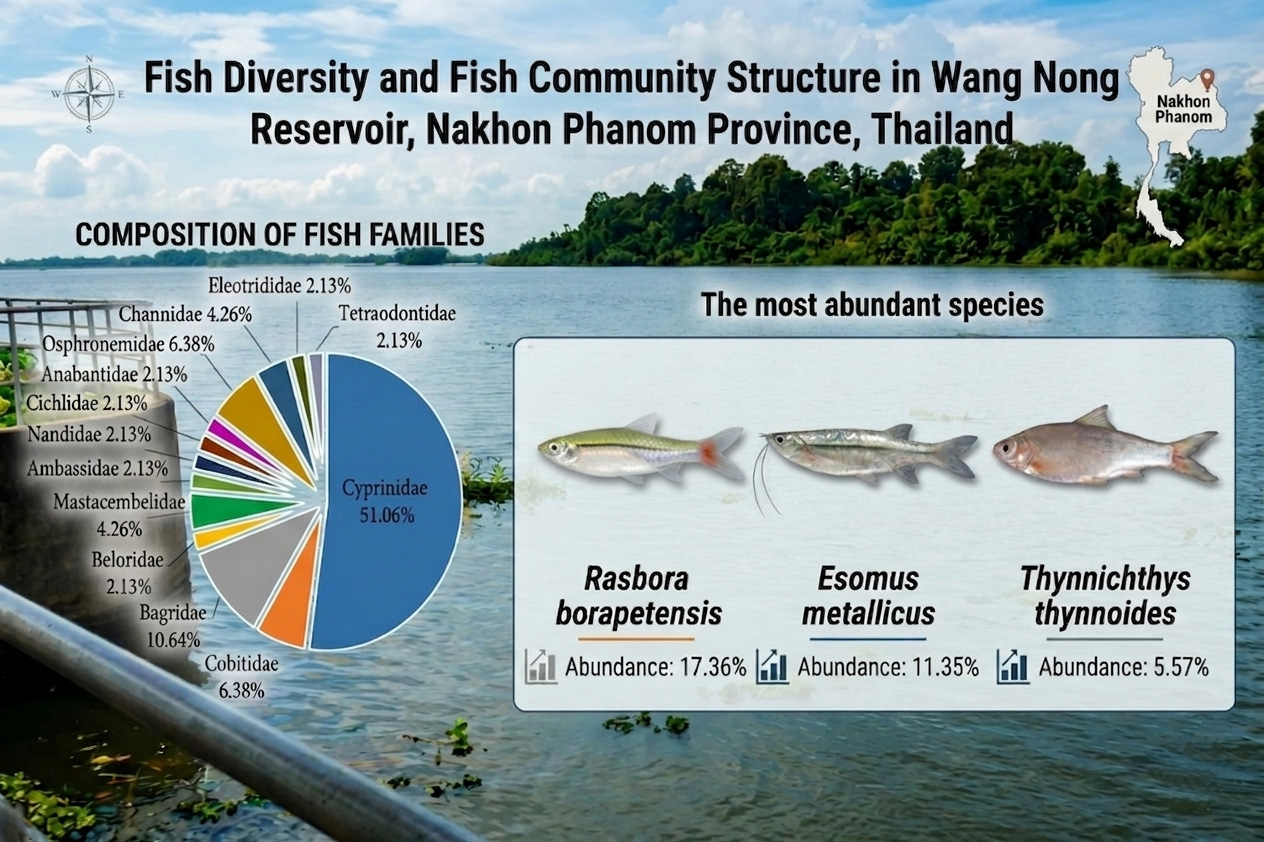
Fish diversity in reservoirs is vital for sustaining food security and livelihoods in rural communities. Wang Nong Reservoir, in Nakhon Phanom Province, northeastern Thailand, supports local fisheries but has remained scientifically unexplored until now. This study presents the first comprehensive assessment of fish community diversity and structure from January to December 2024. Monthly samples were collected at four stations using gill nets and a beach seine. A total of 8,294 specimens representing 47 species from 14 families were recorded. Dominant families included Cyprinidae (51.06%), Bagridae (10.64%), Cobitidae (6.38%), and Osphronemidae (6.38%). The most abundant species were Rasbora borapetensis (17.36%), Esomus metallicus (11.35%), Thynnichthys thynnoides (5.57%), Cyclocheilichthys repasson (4.77%), and Puntius brevis (4.46%), with twelve species occurring in all samples. Most species were classified as Least Concern on the IUCN Red List, while two were Vulnerable and one was Data Deficient. Seasonal variation was evident, with peak abundance and species richness in summer. The average Shannon-Wiener diversity (H'), richness (R), and evenness (E) indices were 3.12, 4.46, and 0.87, respectively. Water temperature and dissolved oxygen were positively correlated with H', R, and E (p < 0.01), whereas transparency showed a negative correlation; other parameters (TDS, pH, NH₃, NO₂, and NO₃) were not significantly related. These findings provide the first baseline dataset on fish diversity in Wang Nong Reservoir, filling a critical knowledge gap for inland fisheries in northeastern Thailand and offering a robust scientific foundation for site-specific conservation planning and evidence-based sustainable fisheries management.
Article Details

This work is licensed under a Creative Commons Attribution-NonCommercial-NoDerivatives 4.0 International License.
References
Water Crisis Prevention Center (WCPC). Criteria for Management of Medium Sized Reservoirs; Department of Water Resources: Bangkok, Thailand, 2022.
Hayes, N. M.; Deemer, B. R.; Corman, J. R.; Razavi, N. R.; Strock, K. E. Key differences between lakes and reservoirs modify climate signals: A case for a new conceptual model. Limnol. Oceanogr. Lett. 2017, 2, 47–62. https://doi.org/10.1002/lol2.10036
Abobi, S. M.; Kluger, L. C.; Wolff, M. Comparative assessment of food web structure and fisheries productivity of three reservoirs in Ghana. Fish. Manag. Ecol. 2021, 28, 573–591. https://doi.org/10.1111/fme.12506
Sarkar, U. K.; Sandhya, K. M.; Mishal, P.; Karnatak, G.; Lianthuamluaia; Kumari, S.; Das, B. K. Status, prospects, threats, and the way forward for sustainable management and enhancement of the tropical Indian reservoir fisheries: An overview. Rev. Fish. Sci. Aquac. 2018, 26, 155–175.
Sricharoendham, B.; Leelapatra, W.; Ratanachamnong, D.; Kaewjaroon, P.; Aimsab, M. Variation on Fish Community and Catch of Sirindhorn Reservoir, Ubon Ratchathani Province; Technical Paper No. 206; National Inland Fisheries Institute, Department of Fisheries: Thailand, 2000.
Jantharachit, P.; Sanitchon, A.; Chunchom, C.; Jaengkij, M.; Phomisawat, R. Water Quality and Fish Community in Bung Klua Reservoir, Roi Et Province; Technical Paper No. 14; National Inland Fisheries Institute, Department of Fisheries: Thailand, 2006.
Nachaipherm, J.; Musikaew, B. Structure and Distribution of Fish Community in Ubolratana Reservoir; Technical Paper No. 59; National Inland Fisheries Institute, Department of Fisheries: Thailand, 2006.
Nachaipherm, J.; Chunchom, C. Fish Community Distribution and Gillnet Efficiency in Lam Pao Reservoir; Technical Paper No. 84; National Inland Fisheries Institute, Department of Fisheries: Thailand, 2008.
Panchan, R. Fish assemblage patterns in littoral zone of Nam Oun Reservoir, Sakon Nakhon Province, Thailand. J. Fish. Environ. 2010, 34, 27–39.
Rayan, S.; Rungsiwiwat, A.; Chartchumni, B.; Rayan, W. Structure of fish community in Huay Huat Reservoir, Sakon Nakhon Province. Burapha Sci. J. 2017, 34, 340–352.
Khowhit, S.; Tanee, T.; Khowhit, D. Species diversity and distribution of fish in Huai Kao Reservoir, Na Chauk District, Maha Sarakham Province, Thailand. J. Surv. Fish. Sci. 2023, 10, 2363–2377. https://doi.org/10.53555/sfs.v10i1.214
Smith, H. M. The Freshwater Fishes of Siam, or Thailand; Bulletin of the United States National Museum, No. 188; Smithsonian Institution: Washington, DC, 1945.
Rainboth, W. J. FAO Species Identification Field Guide for Fishery Purposes: Fishes of the Cambodian Mekong; FAO: Rome, Italy, 1996.
Doi, A. A review of taxonomic studies of cypriniform fishes in Southeast Asia. Jpn. J. Ichthyol. 1997, 44, 1–33. https://doi.org/10.11369/jji1950.44.1
Kottelat, M. Fishes of Laos; WHT Publications: Colombo, Sri Lanka, 2001.
Vidthayanon, C. Field Guide to Fishes of the Mekong Delta; Mekong River Commission: Vientiane, Lao PDR, 2008.
Nelson, J. S.; Grande, T. C.; Wilson, M. V. H. Fishes of the World, 5th ed.; John Wiley & Sons: New Jersey, USA, 2016.
Taki, Y.; Ohtsuka, R.; Komodo, M.; Natori, Y.; Utsugi, K.; Shibukawa, K.; Tran, L. X. Fishes of the Indochinese Mekong; Nagao Natural Environment Foundation: Tokyo, Japan, 2021.
International Union for Conservation of Nature (IUCN). The IUCN Red List of Threatened Species; 2025. https://www.iucnredlist.org (accessed May 16, 2025).
American Public Health Association (APHA); American Water Works Association (AWWA); Water Environment Federation (WEF). Standard Methods for the Examination of Water and Wastewater, 21st ed.; APHA: Washington, DC, 1998.
Shannon, C. E.; Wiener, W. The Mathematical Theory of Communication; University of Illinois Press: Urbana, USA, 1963.
Margalef, R. Information theory in ecology. Gen. Syst. 1958, 3, 36–71.
Pielou, E. C. Mathematical Ecology; Wiley: New York, USA, 1977.
Berra, T. M. Freshwater Fish Distribution; Academic Press: California, USA, 2001.
Jutagate, T.; Srichareondham, B.; Lek, S.; Amarasinghe, U. S.; De Silva, S. S. Variations, trends and patterns of fish landings in large tropical reservoirs. Lakes Reserv.: Res. Manag. 2012, 17, 35–53.
Jutagate, T.; Rattanachai, A.; Udduang, S.; Lek-Ang, S.; Lek, S. Spatio-temporal variations in abundance and assemblage patterns of fish larvae and their relationships to environmental variables in Sirindhron Reservoir of the Lower Mekong Basin, Thailand. Indian J. Fish. 2016, 63, 11–23.
Mishra, A.; Chakraborty, S. K.; Jaiswar, A. K.; Sharma, A. P. Comparative biodiversity of two medium reservoirs of North India. Natl. Acad. Sci. Lett. 2014, 37, 423–430.
Zare-Shahraki, M.; Ebrahimi-Dorche, E.; Bruder, A.; Flotemersch, J.; Blocksom, K.; Bănăduc, D. Fish species composition, distribution and community structure in relation to environmental variation in a semi-arid mountainous river basin, Iran. Water 2022, 14, 2226. https://doi.org/10.3390/w14142226
Welcomme, R.; Vidthayanon, C. The Impacts of Introductions and Stocking of Exotic Species in the Mekong Basin and Policies for Their Control; MRC Technical Paper No. 9; Mekong River Commission: Cambodia, 2003.
Yakupitiyage, A.; Bhujel, R. C. Role of exotic species in aquaculture: Problems and prospects in Indochina. In International Mechanisms for the Control and Responsible Use of Alien Species in Aquaculture Ecosystems; Bartley, D. M.; Bhujel, R. C.; Funge-Smith, S.; Olin, P. G.; Phillips, M. J., Eds.; FAO: Rome, 2005.
Copp, G. H.; Fox, M. G. Can invasiveness in freshwater fishes be predicted from life-history traits? Front. Ecol. Evol. 2020, 8, 605287.
Bunn, S. E.; Arthington, A. H. Basic principles and ecological consequences of altered flow regimes for aquatic biodiversity. Environ. Manage. 2002, 30, 492–507.
Arthington, A. H.; Bunn, S. E.; Poff, N. L.; Naiman, R. J. The challenge of providing environmental flow rules to sustain river ecosystems. Ecol. Appl. 2006, 16, 1311–1318.
Dolloff, C. A.; Warren, M. L., Jr. Fish relationships with large wood in small streams. Am. Fish. Soc. Symp. 2003, 37, 179–193.
Maday, A.; Matern, S.; Monk, C. T.; Klefoth, T.; Wolter, C.; Arlinghaus, R. Seasonal and diurnal patterns of littoral microhabitat use by fish in gravel pit lakes, with special reference to supplemented deadwood brush piles. Hydrobiologia 2023, 850, 1557–1581. https://doi.org/10.1007/s10750-023-05152-3
Pechsiri, J.; Chainapong, T.; Yooyen, T.; Manksang, N. The restoration of freshwater fish in the Papayom Canal by community participation. ASEAN J. Sci. Technol. Rep. 2018, 21, 59–68.
Seifert, R. E.; Moore, J. W. Floodgate operations and fish communities in tidal creeks of the Lower Fraser River (British Columbia, Canada). Estuaries Coasts 2018, 41, 1206–1221. https://doi.org/10.1007/s12237-017-0313-3
Bouchard, C.; Boutron, O.; Lambremon, J.; Drouineau, H.; Lambert, P.; Nicolas, D. Impacts of environmental conditions and management of sluice gates on glass eel migration. Estuar. Coast. Shelf Sci. 2022, 279, 108139. https://doi.org/10.1016/j.ecss.2022.108139
Shuter, B. J.; Finstad, A. G.; Helland, I. P.; Zweimüller, I.; Hölker, F. The role of winter phenology in shaping the ecology of freshwater fish and their sensitivities to climate change. Aquat. Sci. 2012, 74, 637–657. https://doi.org/10.1007/s00027-012-0274-3
Patel, P. A study on the relationship between water quality parameters and fish diversity in freshwater bodies in Chhattisgarh, Central India. Asian J. Res. Biosci. 2025, 7, 86–98. https://doi.org/10.56557/ajorib/2025/v7i1113
Setyono, P.; Himawan, W. Analyses of bioindicators and physicochemical parameters of water of Lake Tondano, North Sulawesi Province, Indonesia. Biodiversitas 2018, 19, 867–874. https://doi.org/10.13057/biodiv/d190315
Bayemi, O. E.; Komolafe, O. O.; Ayodeji, O. A.; Ajayi, O.; Adewumi, P. O.; Adeniran, I. I.; Oladimeji, T. K. Assessment of climatic and environmental parameters on fish abundance of an Afro-tropical reservoir. Sci. Rep. 2024, 14, 23991. https://doi.org/10.1038/s41598-024-75181-y
Alam, A.; Kumar, J.; Sarkar, U. K.; Jha, D. N.; Sahu, S. K.; Sukla Das, S. C.; Das, B. K. Linking ecological characteristics with fish diversity, assemblage patterns and feeding guilds, and GIS applications along temporal and spatial gradients in a large subtropical reservoir, India, for sustainable management. J. Water Clim. Change 2024, 15, 607–627. https://doi.org/10.2166/wcc.2023.513
Fischer, J. R.; Quist, M. C. Gear and seasonal bias associated with abundance and size structure estimates for lentic freshwater fishes. J. Fish Wildl. Manag. 2014, 5, 394–412.
Mehdi, H.; Lau, S. C.; Synyshyn, C.; Salena, M. G.; Morphet, M. E.; Hamilton, J.; Balshine, S. A comparison of passive and active gear in fish community assessments in summer versus winter. Fish. Res. 2021, 242, 106016.
Magurran, A. E.; McGill, B. J. Biological Diversity: Frontiers in Measurement and Assessment; Oxford University Press: New York, USA, 2011.
Shengchun, Z.; Zhiqiang, W.; Liangliang, H.; Wenli, F.; Ruidan, S.; Yang, D.; Xianzhi, C. Species composition and diversity of fish in Qingshitan Reservoir in Guilin, Guangxi. South China Fish. Sci. 2017, 13, 36–42. https://doi.org/10.3969/j.issn.2095-0780.2017.02.005
Das, S. K.; Srinivasan, N. T.; Sarang, N.; Das, S. K.; Jawahar, A. T.; Canciyal, J.; Panda, K. Effect of environmental drivers on fish assemblage and diversity patterns in temporal scale in Mongra Reservoir. Ecohydrology 2023, 16, e2599. https://doi.org/10.1002/eco.2599
