
Molecular Characterization and Integron Gene Prevalence in Bacterial Pathogens from Neonatal Omphalitis
Article Sidebar
Main Article Content
Abstract
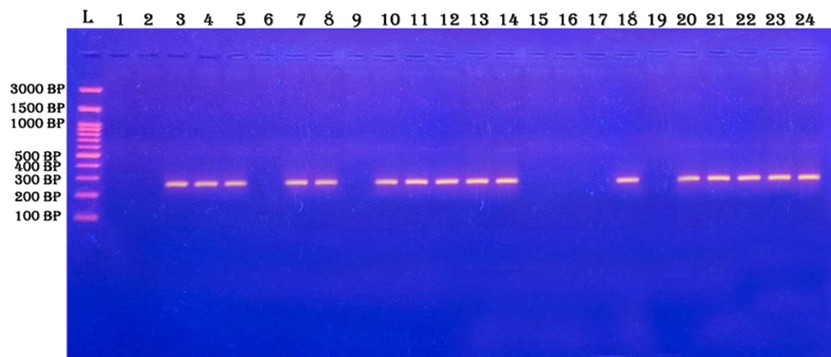
Neonatal umbilical cord infections (omphalitis) remain a significant cause of morbidity and mortality in developing countries. This study aimed to characterize bacterial pathogens associated with neonatal omphalitis using both phenotypic and molecular methods, and to determine the prevalence of integron genes. One hundred umbilical swabs were collected from neonates (3-28 days old) with clinical omphalitis. Bacterial identification was performed using conventional culture, the Vitek 2 Compact system, and 16S rRNA gene PCR sequencing. PCR detected integron genes (intI1, intI2, intI3). Phylogenetic analysis was conducted using MEGA X software. Bacterial growth occurred in 48/100 (48%) samples. The predominant isolates were Staphylococcus aureus (14/48, 29.16%), Escherichia coli (14/48, 29.16%), and Pseudomonas aeruginosa (14/48, 29.16%), followed by Enterococcus spp. (4/48, 8.33%) and Bacteroides spp. (2/48, 4.16%). All 24 tested isolates yielded 1500 bp 16S rRNA amplicons. Sequenced P. aeruginosa isolates showed 99-100% identity with GenBank references. Phylogenetic analysis revealed bootstrap values of 63-100% for P. aeruginosa, 99-100% for Enterococcus faecalis and Bacteroides sp., and 32-70% for E. coli. Integron gene prevalence varied significantly, with intI1 being the highest in E. coli (85.71%) and Enterococcus spp. (100%); intI2 predominated in P. aeruginosa (75%) and S. aureus (71.42%); intI3 was detected only in S. aureus (57.14%) and E. coli (28.57%). Gram-positive and Gram-negative bacteria equally contributed to neonatal omphalitis. High integron prevalence, particularly classes 1 and 2, indicates a significant potential for antimicrobial resistance, requiring enhanced surveillance and stewardship strategies.
Article Details

This work is licensed under a Creative Commons Attribution-NonCommercial-NoDerivatives 4.0 International License.
References
Painter, K.; Anand, S.; Philip, K. Omphalitis. In StatPearls; StatPearls Publishing: Treasure Island, FL, USA, 2022.
Wogabaga, J.; Ndeezi, G.; Tumuhamye, J.; Waiswa, P.; Kizito, S. Incidence and risk factors for clinical omphalitis among neonates in Eastern Uganda. BMC Pediatr. 2025, 25, 143.
Kaplan, R.L. Omphalitis: Clinical presentation and approach to evaluation and management. Pediatr. Int. 2023, 65, 287–294. https://doi.org/10.1186/s12887-025-05428-8
Gumaa, M.A.; Idris, A.B.; Bilal, N.E.; Hassan, M.A. First insights into molecular basis identification of 16S ribosomal RNA gene of Staphylococcus aureus isolated from Sudan. BMC Res. Notes 2021, 14, 240. https://doi.org/10.1186/s13104-021-05569-w
Hussein, S.A. Bacteriological profile in blood culture proven neonatal sepsis. Iraqi Natl. J. Med. 2024, 6, 39–44.
Agudelo-Pérez, S.; Moreno, A.M.; Martínez-Garro, J.; Salazar, J.; Lopez, R.; Perdigón, M.; Peláez, R. 16S rDNA sequencing for bacterial identification in preterm infants with suspected early-onset neonatal sepsis. Trop. Med. Infect. Dis. 2024, 9, 152. https://doi.org/10.3390/tropicalmed9070152
Zaker, N.; Lertzman, J.; Embree, J. Neonatal and maternal postpartum Bacteroides bacteremia. Can. J. Infect. Dis. Med. Microbiol. 1999, 10, 358–361. https://doi.org/10.1155/1999/739380
Lim, P.P.C.; Stempak, L.M.; Malay, S.; Moore, L.N.; Cherian, S.S.S.; Desai, A.P. Determining the clinical utility of 16S rRNA sequencing in the management of culture-negative pediatric infections. Antibiotics 2022, 11, 159. https://doi.org/10.3390/antibiotics11020159
Youssef, N.; Gad, Y.; Abdelrahman, H.; El-Sayed, A. The clinical impact of 16S ribosomal RNA PCR and sequencing in diagnosis of neonatal sepsis. J. Clin. Lab. Anal. 2025, 39, e25399.
Kadhim, M.M.; AlMousawi, J.K. The role of PCR amplification of 16S rRNA in early diagnosis of neonatal sepsis. Thi-Qar Med. J. 2011, 5, 18–24.
Botan, A.; Campisciano, G.; Zerbato, V.; Di Bella, S.; Simonetti, O.; Busetti, M.; Comar, M. Performance of 16S rRNA gene next-generation sequencing and the culture method in the detection of bacteria in clinical specimens. Diagnostics 2024, 14, 1318. https://doi.org/10.3390/diagnostics14131318
Jiang, H.; Zhang, W.; Wei, L.; Zhang, J.; Chen, H. Prevalence and characterization of class I integrons in Escherichia coli isolates from hospitalized patients. BMC Microbiol. 2025, 25, 37. https://doi.org/10.1186/s12866-025-03794-y
Zomorodi, A.R.; Motamedifar, M.; Rahmanian, K.; Shakeri, M.; Hajikhani, B.; Heidari, H.; Mansury, D.; Sotoodeh Jahromi, A. Investigation of integron classes 1, 2, and 3 among multidrug-resistant Staphylococcus aureus isolates in Iran: A multi-center study. BMC Infect. Dis. 2024, 24, 1430. https://doi.org/10.1186/s12879-024-10311-5
Hegazy, E.E.; Elsharawy, N.T.; Ibrahim, M.A. Study of class 1, 2, and 3 integrons, antibiotic resistance, and biofilm formation in Staphylococcus aureus clinical isolates from hospital-acquired infections. Pathogens 2025, 14, 705. https://doi.org/10.3390/pathogens14070705
Tumuhamye, J.; Sommerfelt, H.; Tumwine, J.K.; Mukunya, D.; Ndeezi, G.; Namugga, O.; Nankabirwa, V. Umbilical cord stump infections in central Uganda: Incidence, bacteriological profile, and risk factors. Int. J. Environ. Res. Public Health 2022, 19, 16055. https://doi.org/10.3390/ijerph192316055
Turyasiima, M.; Nduwimana, M.; Kiconco, G.; Egesa, W.I.; Manuel, S.A.; Kalubi, P.; Ortiz, Y.E.A. Bacteriology and antibiotic susceptibility patterns among neonates diagnosed of omphalitis at a tertiary special care baby unit in western Uganda. Int. J. Pediatr. 2020, 2020, 4131098. https://doi.org/10.1155/2020/4131098
Ye, C.; Hou, F.; Xu, D.; Huang, Q.; Chen, X.; Zeng, Z.; Fang, R. Prevalence and characterisation of class 1 and 2 integrons in multi-drug resistant Staphylococcus aureus isolates from pig farms in Chongqing, China. J. Vet. Res. 2020, 64, 381–389. https://doi.org/10.2478/jvetres-2020-0061
Abdul-Rahman, S.M.; Khider, A.K. Neonatal sepsis: Bacteriological profile, molecular detection and antimicrobial susceptibility test among pre-term pediatrics in Erbil city, Iraq. Zanco J. Med. Sci. 2020, 24, 256–273. https://doi.org/10.15218/zjms.2020.030
Ahmed, R.Z.T.; Abdullah, R.M. Detection of integron classes and agr group in Staphylococcus aureus isolated from different clinical samples. Ibn AL-Haitham J. Pure Appl. Sci. 2024, 37, 111–127.
Al-Azawi, I.H. The molecular identification of agg and hyl genes of Enterococcus faecalis isolated from different clinical samples: Molecular detection of agg and hyl genes in Enterococcus faecalis isolates. AL-Qadisiyah Med. J. 2023, 19, 65–68.
Emamgholitabar Malekshah, F.; Gholami, M.; Pahlavanian, M.; Goli, H.R. Investigating the prevalence of class 1, 2, and 3 integrons in carbapenem-resistant Acinetobacter baumannii isolated from burn wound infections. Sci. Rep. 2025, 15, 31857. https://doi.org/10.1038/s41598-025-17577-y
Hamza, H.J.; Al-Hasnawy, H.H.; Judi, M.R.; Al-Shirifi, H.M. Detection of newly identified phylogenetic lineages in uropathogenic Escherichia coli isolates in Iraq. Hilla Univ. Coll. J. Med. Sci. 2024, 2, 10–18. https://doi.org/10.62445/2958-4515.1026
Mahon, C.R.; Lehman, D.C.; Manuselis, G. Textbook of Diagnostic Microbiology, 6th ed.; Elsevier: Philadelphia, PA, USA, 2018.
Mohammed, E.J.; Hasan, K.C.; Allami, M. Phylogenetic groups, serogroups and virulence factors of uropathogenic Escherichia coli isolated from patients with urinary tract infection in Baghdad, Iraq. Iran. J. Microbiol. 2022, 14, 445–452. https://doi.org/10.18502/ijm.v14i4.10230
Pincus, D.H. Microbial identification using the bioMérieux Vitek® 2 system. In Encyclopedia of Rapid Microbiological Methods; Parenteral Drug Association: Bethesda, MD, USA, 2006; pp. 1–32.
Sabbagh, P.; Rajabnia, M.; Maali, A.; Ferdosi-Shahandashti, E. Integron and its role in antimicrobial resistance: A literature review on some bacterial pathogens. Iran. J. Basic Med. Sci. 2021, 24, 136–143. https://doi.org/10.29252/JoMMID.8.1.24
Samir, P.; El-Baz, A.M.; Kenawy, H.I. The linkage between prevalence of integron I and reduced susceptibility to biocides in MDR Klebsiella pneumoniae isolated from neonates. Iran. J. Microbiol. 2023, 15, 27–34. https://doi.org/10.18502/ijm.v15i1.11915
Reyes, J.; Carvajal, L.P.; García, K.; Conde, M.; Rojas, L.J.; Van der Bij, A.K.; Sánchez, M. Pseudomonas aeruginosa nosocomial infections in Latin America: High prevalence of multidrug resistance and mortality in neonatal intensive care units. J. Hosp. Infect. 2023, 139, 78–85.
Murray, B.E.; Weinstock, G.M. Enterococci: New aspects of an old organism. Clin. Microbiol. Rev. 2023, 36, e00058-22.
Brook, I. The role of anaerobic bacteria in neonatal infections: A comprehensive review. Anaerobe 2024, 85, 102678.
Chan, K.Y.; Lam, H.S.; Cheung, H.M.; Chan, A.K.; Li, K.; Fok, T.F.; Ng, P.C. Rapid identification and differentiation of Gram-negative and Gram-positive bacterial bloodstream infections by quantitative polymerase chain reaction in preterm infants. Crit. Care Med. 2022, 50, 1096–1105.
Pammi, M.; Flores, A.; Versalovic, J.; Leeflang, M.M. Molecular assays for the diagnosis of sepsis in neonates. Cochrane Database Syst. Rev. 2023, 2, CD011926.
Oliver, A.; Mulet, X.; López-Causapé, C.; Juan, C. The increasing threat of Pseudomonas aeruginosa high-risk clones. Drug Resist. Updat. 2023, 66, 100805.
Denamur, E.; Clermont, O.; Bonacorsi, S.; Gordon, D. The population genetics of pathogenic Escherichia coli. Nat. Rev. Microbiol. 2023, 21, 37–54. https://doi.org/10.1038/s41579-020-0416-x
Karimi, A.; Mohammadi, S.; Shafiee, F.; Ghaffarifar, S. Prevalence and characterization of class 1 integrons among multidrug-resistant Escherichia coli isolates from hospitalized patients in Iran. Microb. Drug Resist. 2023, 29, 456–465.
Deng, Y.; Bao, X.; Ji, L.; Chen, L.; Liu, J.; Miao, J.; Chen, D.; Bian, H.; Li, Y.; Yu, G. Resistance integrons: Class 1, 2 and 3 integrons. Ann. Clin. Microbiol. Antimicrob. 2023, 22, 45.
Goudarzi, M.; Mohammadi, A.; Amirpour, A.; Fazeli, M.; Nasiri, M.J.; Hashemi, A.; Goudarzi, H. Genetic diversity and biofilm formation analysis of Staphylococcus aureus causing urinary tract infections in Tehran, Iran. J. Infect. Dev. Ctries. 2023, 17, 1230–1237.
Partridge, S.R.; Kwong, S.M.; Firth, N.; Jensen, S.O. Mobile genetic elements associated with antimicrobial resistance. Clin. Microbiol. Rev. 2024, 37, e00088-23.
Xu, Z.; Li, L.; Shirtliff, M.E.; Alam, M.J.; Yamasaki, S.; Shi, L. Occurrence and characteristics of class 1 and 2 integrons in Pseudomonas aeruginosa isolates from patients in southern China. J. Clin. Microbiol. 2023, 61, e01892-22.
Wu, K.; Wang, F.; Sun, J.; Wang, Q.; Chen, Q.; Yu, S.; Rui, Y. Class 1 integron gene cassettes in multidrug-resistant Gram-negative bacteria in East Asia. Int. J. Antimicrob. Agents 2023, 61, 106714.
Rowe, W.P.M.; Baker-Austin, C.; Verner-Jeffreys, D.W.; Ryan, J.J.; Micallef, C.; Maskell, D.J.; Pearce, G.P. Overexpression of antibiotic resistance genes in hospital effluents over time. J. Antimicrob. Chemother. 2023, 78, 1471–1478.
Flannery, D.D.; Puopolo, K.M.; Hansen, N.I.; Sánchez, P.J.; Stoll, B.J. Neonatal early-onset sepsis: Trends in management and outcomes. Pediatrics 2024, 153, e2023062967.
