
SUMO-Based Optimization of Intersection Performance under Heterogeneous Traffic
Article Sidebar
Main Article Content
Abstract
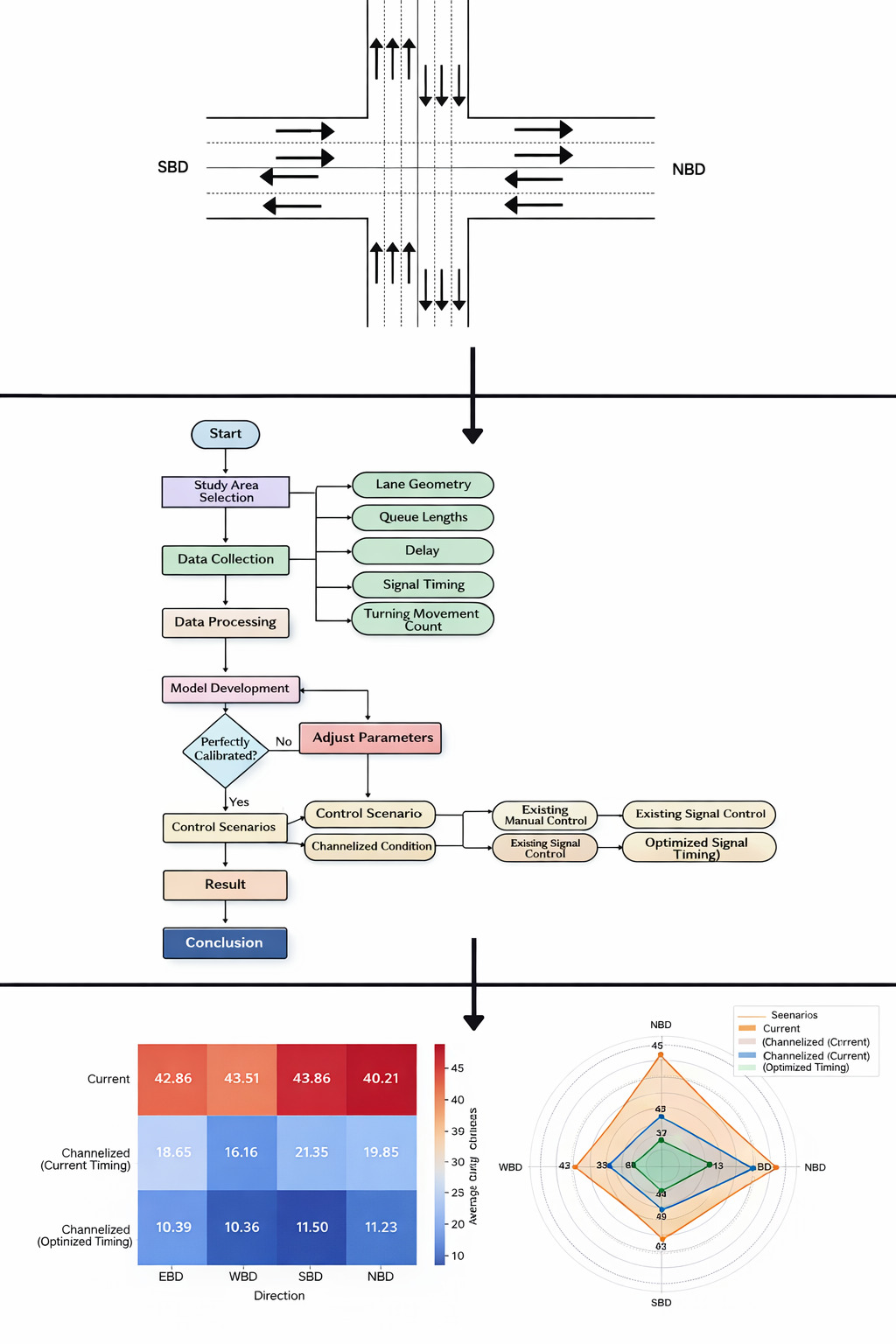
Traffic congestion is one of the most critical challenges in metropolitan cities, where intersections often experience long queues, high delays, and increased emissions due to mixed traffic and reliance on manual police control. This study examined how geometric improvements and signal timing optimization can improve the performance of a busy four-arm intersection in Uttara, Dhaka. Traffic data were collected through field surveys during peak hours and used to build a detailed microsimulation model in SUMO, calibrated with local driving behavior. Three scenarios were tested: the existing manual police control, channelization of turning lanes with current timings, and channelization with optimized fixed-time signals using Webster’s method. Results showed that under current conditions, delays and queues were extremely high, corresponding to the lowest service level. Channelization alone reduced delays by up to 40% and improved overall flow, while the combination of channelization and optimized signals achieved the best outcomes, cutting delays to less than 40 seconds per vehicle, reducing queues by more than 70%, and improving the level of service to stable and acceptable conditions. Environmental analysis confirmed that the optimized scenario lowered fuel consumption and carbon emissions by 25–35% compared to current operations. These findings demonstrate that integrating physical improvements with evidence-based signal control can substantially enhance traffic efficiency, reduce energy use, and improve air quality in rapidly growing cities. The study provides practical insights for policymakers and planners seeking sustainable, low-cost solutions to congestion in Dhaka and other megacities facing similar challenges.
Article Details

This work is licensed under a Creative Commons Attribution-NonCommercial-NoDerivatives 4.0 International License.
References
Subree, M. I. H.; Hasan, M. R.; Sayma, M. H. Design and Implementation of an Unreal Engine 4-Based Smart Traffic Control System for Smart City Applications. Int. J. Adv. Comput. Sci. Appl. 2022, 13(12). https://doi.org/10.14569/IJACSA.2022.01312100
Rahman, M. M.; Jahan, J.; Zhou, Y. Alleviating Traffic Congestion by the Strategy of Modal Shift from Private Cars to Public Transports: A Case of Dhaka City, Bangladesh. In Proc. Conf. Comput. Soc. Sci. Soc. Am.; Carmichael, T., Yang, Z., Eds.; Springer: Cham, 2020; pp 101–115. https://doi.org/10.1007/978-3-030-35902-7_7
Arif, T.; Muhammad Mussa, A. S.; Rahman, M.; Joarder, M. A. Vision-Based Real-Time Traffic Flow Monitoring System for Road Intersections in Dhaka City. Appl. Intell. 2025, 55(11), 800. https://doi.org/10.1007/s10489-025-06631-x
Klobučar, M.; Deluka-Tibljaš, A.; Šurdonja, S.; Ištoka Otković, I. A Theoretical Model for Optimizing Signalized Intersection and Roundabout Distance Using Microsimulations. Future Transp. 2025, 5(1), 28. https://doi.org/10.3390/futuretransp5010028
El Mokhi, C.; Erguig, H.; Hmina, N.; Hachimi, H. Intelligent Traffic Management Systems: A Literature Review on AI-Based Traffic Light Control. In The Future of Urban Living: Smart Cities and Sustainable Infrastructure Technologies; El Mokhi, C., Hachimi, H., Nayyar, A., Eds.; Springer Nature Switzerland: Cham, 2025; pp 154–171. https://doi.org/10.1007/978-3-031-98334-4_15
Riaz, M. S.; et al. Strategic Utilization of Microsimulation for Sustainable Traffic Analysis and Intersection Improvement. Open Transp. J. 2023, 17(1), e26671212281061. https://doi.org/10.2174/0126671212281061231123113624
Hassan, S. A.; Hamzani, I. N. S.; Sabli, A. R.; Sukor, N. S. A. Bus Rapid Transit System Introduction in Johor Bahru: A Simulation-Based Assessment. Sustainability 2021, 13(8), 4437. https://doi.org/10.3390/su13084437
Abedian, S.; Mirsanjari, M. M.; Salmanmahiny, A. Investigating the Effect of Suburban Buses on Traffic Flow and Carbon Monoxide Emission by Aimsun Simulation Software. J. Indian Soc. Remote Sens. 2021, 49(6), 1319–1330. https://doi.org/10.1007/s12524-020-01289-z
Vertegaal, A. C. O. Signalling Mechanisms and Cellular Functions of SUMO. Nat. Rev. Mol. Cell Biol. 2022, 23(11), 715–731. https://doi.org/10.1038/s41580-022-00500-y
Hassan, M.; et al. Mapping the Machine Learning Landscape in Autonomous Vehicles: A Scientometric Review of Research Trends, Applications, Challenges, and Future Directions. IEEE Access 2025, 13, 182036–182077. https://doi.org/10.1109/ACCESS.2025.3620637
Modi, R. N.; Patel, C. G. Data-Driven Microscopic Simulation for Analyzing Traffic Volume, Road Geometry, and Speed: A Case Study of Palanpur Aroma Circle. In Recent Advancements in Sustainable and Safe Transportation Infrastructure; Jain, U., Srinivasan, V., Anjaneyulu, M. V. L. R., Parida, M., Eds.; Springer Nature: Singapore, 2025; Vol. 622; pp 285–297. https://doi.org/10.1007/978-981-96-1988-7_21
Chowdhury, M. M. H.; Chakraborty, T. Calibration of SUMO Microscopic Simulation for Heterogeneous Traffic Condition: The Case of the City of Khulna, Bangladesh. Transp. Eng. 2024, 18, 100281. https://doi.org/10.1016/j.treng.2024.100281
Bodkhe, U.; Tanwar, S. Indian SUMO Traffic Scenario-Based Misbehaviour Detection Dataset for Connected Vehicles. Multimodal Transp. 2025, 4(1), 100148. https://doi.org/10.1016/j.multra.2024.100148
Phan, T. C.; Le, V. D.; Nguyen, T. Application of Dueling Double Deep Q-Network for Dynamic Traffic Signal Optimization: A Case Study in Danang City, Vietnam. Mach. Learn. Knowl. Extr. 2025, 7(3), 65. https://doi.org/10.3390/make7030065
Mutambik, I. IoT-Enabled Adaptive Traffic Management: A Multiagent Framework for Urban Mobility Optimisation. Sensors 2025, 25(13), 4126. https://doi.org/10.3390/s25134126
Skoropad, V. N.; et al. Dynamic Traffic Flow Optimization Using Reinforcement Learning and Predictive Analytics: A Sustainable Approach to Improving Urban Mobility in the City of Belgrade. Sustainability 2025, 17(8), 3383. https://doi.org/10.3390/su17083383
Hassan, M.; Kabir, M. E.; Jusoh, M.; An, H. K.; Negnevitsky, M.; Li, C. Large Language Models in Transportation: A Comprehensive Bibliometric Analysis of Emerging Trends, Challenges, and Future Research. IEEE Access 2025, 13, 132547–132598. https://doi.org/10.1109/ACCESS.2025.3589319
Yaibok, C.; Suwanno, P.; Pornbunyanon, T.; Kanjanakul, C.; Luathep, P.; Fukuda, A. Improving Urban Intersection Safety: Insights from Simulation Analysis. IATSS Res. 2024, 48(4), 523–536. https://doi.org/10.1016/j.iatssr.2024.10.005
Bindzar, P.; Marasova, D.; Brodny, J.; Tutak, M.; Ulewicz, R.; Sliva, A. Modeling the Impact of Intersection Design Configurations on Traffic Flow during Peak Hour in Smart Cities: A Case Study on Urban Roads in Slovakia. IEEE Access 2024, 12, 83072–83090. https://doi.org/10.1109/ACCESS.2024.3412709
Rahimi, M. R.; Vala, M.; Patel, B. N. Evaluation of Capacity and Level of Service for Selected Urban Arterial Roads—A Case Study of Rajkot City. In Recent Advances in Traffic Engineering; Arkatkar, S. S., Velmurugan, S., Verma, A., Eds.; Springer: Singapore, 2020; Vol. 69; pp 23–41. https://doi.org/10.1007/978-981-15-3742-4_2
Saldivar-Carranza, E.; Li, H.; Mathew, J.; Hunter, M.; Sturdevant, J.; Bullock, D. M. Deriving Operational Traffic Signal Performance Measures from Vehicle Trajectory Data. Transp. Res. Rec. 2021, 2675(9), 1250–1264. https://doi.org/10.1177/03611981211006725
Labib, S. M.; Mohiuddin, H.; Hasib, I. M. A.; Sabuj, S. H.; Hira, S. Integrating Data Mining and Microsimulation Modelling to Reduce Traffic Congestion: A Case Study of Signalized Intersections in Dhaka, Bangladesh. Urban Sci. 2019, 3(2), 41. https://doi.org/10.3390/urbansci3020041
Gunarathne, D.; Amarasingha, N.; Wickramasighe, V. Traffic Signal Controller Optimization through VISSIM to Minimize Traffic Congestion, CO and NOx Emissions, and Fuel Consumption. Sci. Eng. Technol. 2023, 3(1). https://doi.org/10.54327/set2023/v3.i1.56
