
Surveillance of Rotavirus A Genotypes in Diarrheal Cases from Humans and Bovine in Basra Province, Iraq
Article Sidebar
Main Article Content
Abstract
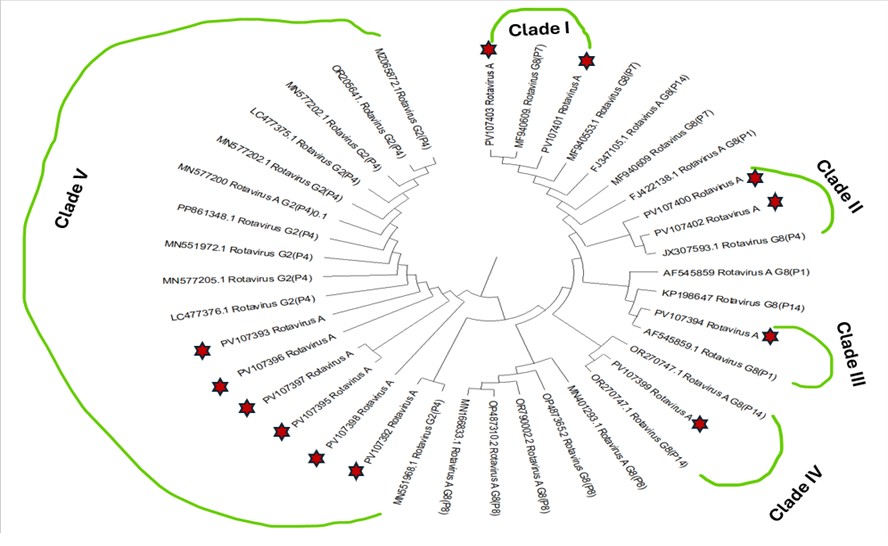
Rotavirus A (RVA) remains a leading cause of acute gastroenteritis in humans and animals, with potential for zoonotic transmission. Limited molecular surveillance data exist from Iraq regarding circulating genotypes in both populations. This cross-sectional study investigated the prevalence and genotype distribution of RVA in human and bovine diarrheal cases in Basra Province, Iraq. Fifty-four fecal samples, each from humans and bovines with acute diarrhea (≥3 episodes/day within 72 hours), were collected from January to September 2024. A partial VP7 gene segment (897 bp) was amplified using RT-PCR, followed by sequencing and phylogenetic analysis for G-genotype determination. Statistical analysis was employed to assess the relationships between demographic factors and infection rates. RVA prevalence was 22.22% (12/54) in humans and 25.92% (14/54) in bovines. Neither age nor sex showed a significant association with infection rates (P > 0.05, chi-square < 3.841). Based on VP7 sequencing of 26 positive samples, predominant G-genotypes were G6 (38%), G8 (38%), and G2 (23%). Binomial classification revealed G6(P11) (30.8%), G2(P4) (23%), and G8(P8) (15%) as most frequent combinations. In humans, G2 and G8 predominated with P-genotypes P2>P7=P4>P1=P14. In bovines, G6 and G8 were most common, with P11 > P1> P4 = P5 = P8. Notably, G8(P4) was identified as a shared genotype between species, suggesting potential zoonotic transmission. This study demonstrates comparable RVA prevalence in human and bovine populations, with an overlapping genotype distribution, particularly G8 and its associated P-genotypes. These findings support the need for integrated One Health surveillance approaches and consideration of circulating animal genotypes in vaccine formulation strategies for Iraq.
Article Details

This work is licensed under a Creative Commons Attribution-NonCommercial-NoDerivatives 4.0 International License.
References
Khuffash, F. A.; Sethi, S. K.; Shaltout, A. A. Acute gastroenteritis: Clinical features according to etiologic agents. Clin. Pediatr. 1988, 27(8), 365–368. https://doi.org/10.1177/000992288802700802
Esona, M. D.; Gautam, R.; Tam, K. I.; Williams, A.; Mijatovic-Rustempasic, S.; Bowen, M. D. Multiplexed one-step RT-PCR VP7 and VP4 genotyping assays for rotaviruses using updated primers. J. Virol. Methods 2015, 223, 96–104. https://doi.org/10.1016/j.jviromet.2015.07.012
World Health Organization. Meeting Report: Global Rotavirus and Paediatric Diarrhea Surveillance, Laboratory, and Disease Burden Meetings, 28–30 November 2018; WHO.
World Health Organization. Meeting Report: Global Rotavirus and Pediatric Diarrheal Surveillance Network Meeting, 19–20 November 2019; WHO.
Alfieri, A. A.; Parazzi, M. E.; Takiuchi, E.; Médici, K. C.; Alfieri, A. F. Frequency of group A rotavirus in diarrhoeic calves in Brazilian cattle herds, 1998–2002. Trop. Anim. Health Prod. 2006, 38, 521. https://doi.org/10.1007/s11250-006-4349-9
Barrington, G. M.; Gay, J. M.; Evermann, J. F. Biosecurity for neonatal gastrointestinal diseases. Vet. Clin. North Am. Food Anim. Pract. 2002, 18(1), 7–34. https://doi.org/10.1016/s0749-0720(02)00005-1
Cook, N.; Bridger, J.; Kendall, K.; Gomara, M. I.; El-Attar, L.; Gray, J. The zoonotic potential of rotavirus. J. Infect. 2004, 48(4), 289–302. https://doi.org/10.1016/j.jinf.2004.01.018
Argüelles, M. H.; Villegas, G. A.; Castello, A.; Abrami, A.; Ghiringhelli, P. D.; Semorile, L.; Glikmann, G. VP7 and VP4 genotyping of human group A rotavirus in Buenos Aires, Argentina. J. Clin. Microbiol. 2000, 38(1), 252–259. https://doi.org/10.1128/JCM.38.1.252-259.2000
Matthijnssens, J.; Bilcke, J.; Ciarlet, M.; et al. Rotavirus disease and vaccination: Impact on genotype diversity. Future Microbiol. 2009, 4, 1303–1316. https://doi.org/10.2217/fmb.09.96
Matthijnssens, J.; Ciarlet, M.; McDonald, S. M.; et al. Uniformity of rotavirus strain nomenclature proposed by the Rotavirus Classification Working Group (RCWG). Arch. Virol. 2011, 156(8), 1397–1413. https://doi.org/10.1007/s00705-011-1006-z
Trojnar, E.; Sachsenroder, J.; Twardziok, S.; Reetz, J.; Otto, P. H.; Johne, R. Identification of an avian group A rotavirus with a novel VP4 gene. J. Gen. Virol. 2013, 94, 136–142. https://doi.org/10.1099/vir.0.047381-0
Iturriza-Gomara, M.; Dallman, T.; Banyai, K.; et al. Rotavirus genotypes co-circulating in Europe, 2006–2009. Epidemiol. Infect. 2011, 139, 895–909.
Gentsch, J. R.; Laird, A. R.; Bielfelt, B.; et al. Serotype diversity and reassortment: Implications for vaccine programs. J. Infect. Dis. 2005, 192, S146–S159. https://doi.org/10.1086/431499
Gichile, A. G. Review on the epidemiology of bovine rotavirus. Int. J. Vet. Sci. Res. 2022, 8(1), 5–10.
Geletu, U. S.; Usmael, M. A.; Bari, F. D. Rotavirus in calves and its zoonotic importance. Vet. Med. Int. 2021, 6639701. https://doi.org/10.1155/2021/6639701
Bwogi, J.; Karamagi, C.; Byarugaba, D. K.; et al. Co-surveillance of rotaviruses in humans and domestic animals in Central Uganda. Viruses 2023, 15, 738. https://doi.org/10.3390/v15030738
Midgley, S. E.; Banyai, K.; Buesa, J.; et al. Diversity and zoonotic potential of rotaviruses in swine and cattle across Europe. Vet. Microbiol. 2012, 156, 238–245. https://doi.org/10.1016/j.vetmic.2011.10.027
Mahmoud, A. E.; Zaki, M. E. S.; Mohamed, E. H.; et al. Study of rotavirus genotypes in Egypt. Ital. J. Pediatr. 2024, 50, 247. https://doi.org/10.1186/s13052-024-01810-x
Hussein, A. A.; Hussein, R. A.; Shaker, M. J. Enteric virus co-infection in Iraq. J. Pure Appl. Microbiol. 2018, 12(2), 793–799. https://doi.org/10.22207/JPAM.12.2.40
Nasser, A. T.; Hasan, A. S.; Saleh, A. K.; Saleh, M. K. Rotavirus detection in children with gastroenteritis. GSC Adv. Res. Rev. 2021, 6(3), 194–208.
Abdul Sattar, B. A. A.; Al-Kareemi, K. K.; Jassim, A. A. Rotavirus infection in pediatric patients. J. Fac. Med. Baghdad 2012, 54(4), 349–352. https://doi.org/10.32007/jfacmedbagdad.544702
Abood, W. S. Molecular epidemiology of rotavirus in Mid Iraq. Al-Qadisiyah J. Vet. Med. Sci. 2013, 12(1), 121–127. https://doi.org/10.29079/vol12iss1art240
Hassan, H. A. A.; Al-Kader, R. A. A. Rotavirus diarrhea in Basrah. MJBU 2016, 34(2).
Abdulla, M. M.; Maatook, M. A.; Mahmoud, R. A. Diarrheal disease in Basra during COVID-19. Ann. R. S. C. B. 2021, 25(6), 9759–9863.
Yaqoob, M. M.; Mahdi, K. H.; Al-Hmudi, H. A.; Mohammed-Ali, M. N. Detection of rotavirus A and E. coli. Int. J. Curr. Microbiol. Appl. Sci. 2016, 5 (4), 68–83. https://doi.org/10.20546/ijcmas.2016.504.011
Habash, S. H.; Habeeb, S. I. Rotavirus diarrhea in children under five in Basrah. Pediatr. Infect. Dis. 2018, 3(2), 6. https://doi.org/10.21767/2573-0282.100062
Tarik, A. S.; Muhsen, R. K. Rotavirus group A alterations in newborn buffalo calves. Adv. Life Sci. 2024, 11(2). https://doi.org/10.62940/als.v11i3.2051
Ahmed, S. K.; Atheer, A. A. Rotavirus diversity in cow and buffalo calves. EZS 2017, 5(6), 1206–1211.
Al-Robaiee, I. A.; Al-Farwachi, M. I. Rotaviral infection in neonatal calves in Mosul. World 2013, 6(8), 538–540. https://doi.org/10.5455/vetworld.2013.538-540
Rotavirus Classification Working Group (RCWG). Virus Classification. 2021.
Antoni, S.; Nakamura, T.; Cohen, A. L.; et al. Rotavirus genotypes in LMICs. PLOS Glob. Public Health 2023, 3(11), e0001358.
Banyai, K.; Laszlo, B.; Duque, J.; et al. Global rotavirus strain diversity: A systematic review. Vaccine 2012, 30 (Suppl 1), A122–A130. https://doi.org/10.1016/j.vaccine.2011.09.111
Tapisiz, A.; Bedir Demirdag, T.; Cura Yayla, B. C.; et al. Rotavirus infections in Turkey: Systematic review. Rev. Med. Virol. 2019, 29(1), e2020. https://doi.org/10.1002/rmv.2020
Khai, Q.; Tran, H. H.; Tuan, N. V.; et al. Rotavirus and co-infection in Vietnam. Arch. Pediatr. Infect. Dis. 2024, 12(1), e140509.
Campanha, J.; Possatti, F.; Lorenzetti, E.; et al. Rotavirus C VP6 genotype I6 in piglets. Braz. J. Microbiol. 2020, 51, 1–7. https://doi.org/10.1007/s42770-020-00234-z
Jaff, D. O.; Tariq, A. G. A.; Natalie, R. S. Rotavirus infections in Sulaimani. JBM 2016, 4(1), 124–131. https://doi.org/10.4236/jbm.2016.41015
Zaman, N. A.; Al-Tae, A. A.; Saadoon, I. H. Rotavirus and adenovirus in Kirkuk children. Second Scientific Conference – Tikrit University 2012.
Ahmed, H. M.; Coulter, J. B. S.; Nakagomi, O.; et al. Rotavirus strains in Kurdistan. Emerg. Infect. Dis. 2006, 12(5), 824. https://doi.org/10.3201/eid1205.051422
Duman, R.; Aycan, A. E. Rotavirus infection in calves in Konya. J. Anim. Vet. Adv. 2010, 9(1), 136–139. https://doi.org/10.3923/javaa.2010.136.138
Almalky, M. A.; Amer, R. E.; Abd Elraouf, H. A. Rotavirus genotyping in Egypt. Egypt. J. Hosp. Med. 2022, 88, 2710–2715. https://doi.org/10.21608/ejhm.2022.241123
Bawa, F. K.; Mutocheluh, M.; Dassah, S. D.; et al. Genetic diversity of rotavirus in Ghana. Pan Afr. Med. J. 2023, 44, 148. https://doi.org/10.11604/pamj.2023.44.148.36783
Temori, A.; Mehrpoor, A. J.; Niazi, A.; et al. Rotavirus prevalence in Afghanistan. Afgh. J. Infect. Dis. 2023, 1, 9–13. https://doi.org/10.58342/ajid/ghalibuni.v.1.I.1.3
Martinez-Gutierrez, M.; Arcila-Quiceno, V.; Trejos-Suarez, J.; Ruiz-Saenz, J. Rotavirus typing in Colombia. Rev. Inst. Med. Trop. São Paulo 2019, 61, e34. https://doi.org/10.1590/s1678-9946201961034
Anderson, E. J.; Weber, S. D. Rotavirus infection in adults. Lancet Infect. Dis. 2004, 4(2), 91–99. https://doi.org/10.1016/S1473-3099(04)00928-4
Barua, S. R. Clinico-Pathology and Molecular Characterization of Bovine Rotavirus in Bangladesh; 2019.
Santos, Y.; Hoshino. Global distribution of rotavirus serotypes. Rev. Med. Virol. 2005, 15(1), 29–56. https://doi.org/10.1002/rmv.448
Kuang, X.; Gong, X.; Zhang, X.; Pan, H.; Teng, Z. Genetic diversity of rotavirus in Shanghai. BMC Infect. Dis. 2020, 20, 1–11. https://doi.org/10.1186/s12879-020-05279-x
