
Upgrading the Characterization of Spent Fluid Catalytic Cracking Catalyst into Functional Adsorbent via Hybrid Ultrasonic-Chemical Approach
Article Sidebar
Main Article Content
Abstract
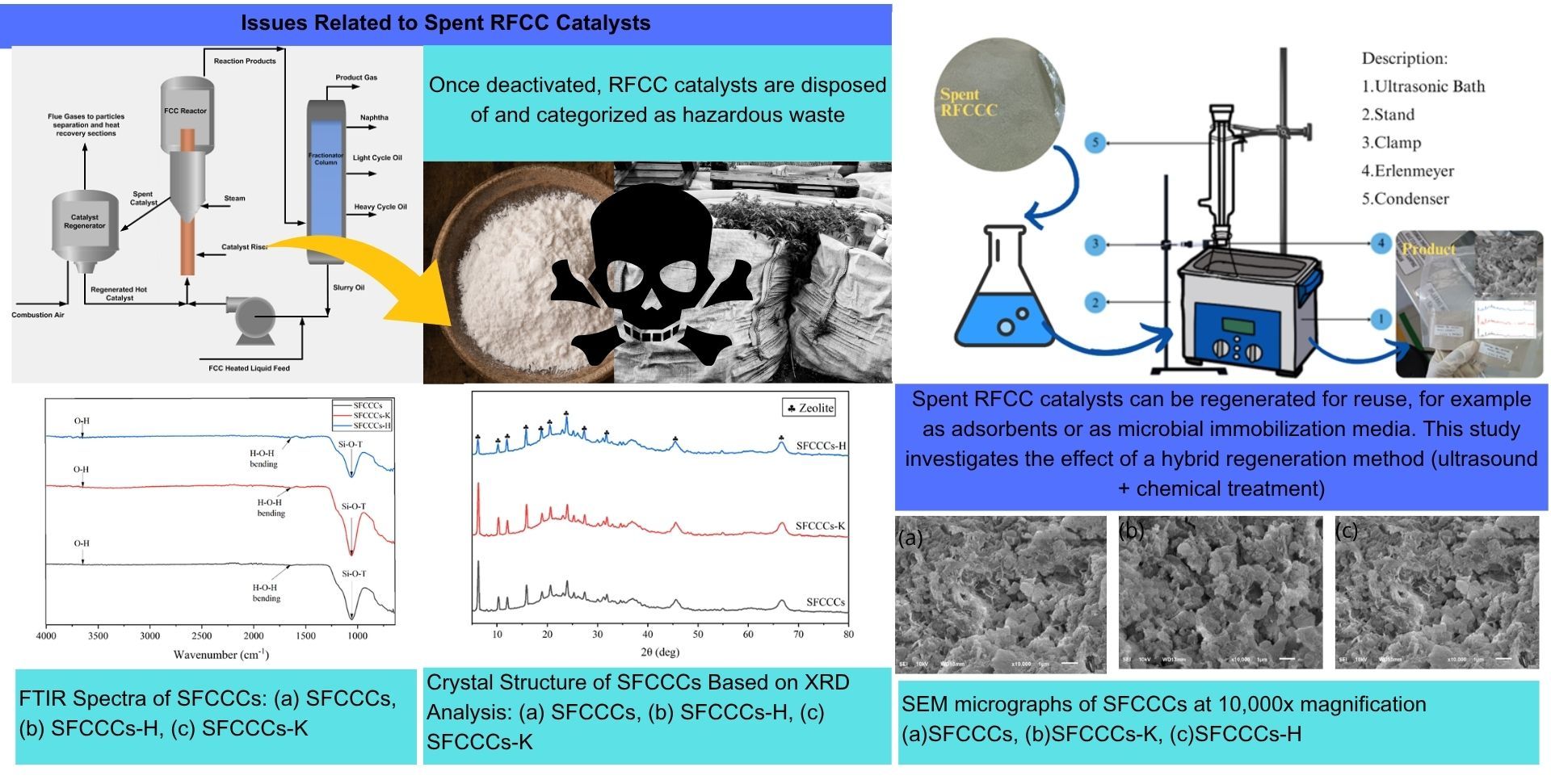
Fluid catalytic cracking catalysts (FCCCs) are essential in petroleum refining but become hazardous spent materials after deactivation due to heavy metal and coke deposition. Regenerating spent FCC catalysts (SFCCCs) is necessary to reduce hazardous waste and restore physicochemical properties. Conventional regeneration methods face limitations, such as high energy demand or potential structural damage, leaving a gap for more efficient and sustainable approaches. This study shows that a hybrid ultrasonic-chemical method can effectively regenerate SFCCCs, improving surface morphology, pore structure, and crystallinity, as evidenced by characterization using XRD, FTIR, BET, and SEM-EDS. The untreated SFCCCs exhibited a surface area of 27.255 m²/g, which increased to 33.508 m²/g after hybrid treatment and 34.344 m²/g after chemical treatment, indicating pore reopening and enhanced surface activity. FTIR analysis showed clearer Si-O-Si and –OH bands in hybrid-treated samples, suggesting improved recovery of the zeolite structure and reduced coke formation. XRD patterns showed sharper peaks in the 2θ = 22–30° range, indicating greater crystallinity in hybrid regeneration than in untreated samples. SEM-EDS showed cleaner, more porous morphologies with reduced Fe (3.25%) and exposure of hidden Ni (9.49%) after hybrid treatment. These findings underscore the effectiveness of ultrasonic-assisted chemical regeneration, which offers a promising pathway for sustainable catalyst waste management and potential future reuse applications.
Article Details

This work is licensed under a Creative Commons Attribution-NonCommercial-NoDerivatives 4.0 International License.
References
Rodríguez, E.; Félix, G.; Ancheyta, J.; Trejo, F. Modeling of Hydrotreating Catalyst Deactivation for Heavy Oil Hydrocarbons. Fuel 2018, 225, 118–133. https://doi.org/10.1016/j.fuel.2018.02.085
Pathak, A.; Srichandan, H.; Kim, D. J. Column Bioleaching of Metals from Refinery Spent Catalyst by Acidithiobacillus thiooxidans: Effect of Operational Modifications on Metal Extraction, Metal Precipitation, and Bacterial Attachment. J. Environ. Manage. 2019, 242, 372–383. https://doi.org/10.1016/j.jenvman.2019.04.081
Chiranjeevi, T.; Pragya, R.; Gupta, S.; Gokak, D. T.; Bhargava, S. Minimization of Waste Spent Catalyst in Refineries. Procedia Environ. Sci. 2016, 35, 610–617. https://doi.org/10.1016/j.proenv.2016.07.047
Zhao, B.; Wang, C.; Bian, H. A “Wastes-Treat-Wastes” Technology: Role and Potential of Spent Fluid Catalytic Cracking Catalysts Assisted Pyrolysis of Discarded Car Tires. Polymers (Basel) 2021, 13(16), 2732. https://doi.org/10.3390/polym13162732
Wang, Q.; et al. Spent Fluid Catalytic Cracking (FCC) Catalyst Enhances Pyrolysis of Refinery Waste Activated Sludge. J. Clean. Prod. 2021, 295, 126382. https://doi.org/10.1016/j.jclepro.2021.126382.
Lei, Z.; Pavia, S. Potential of Spent Fluid Cracking Catalyst (FCC) Waste for Low-Carbon Cement Production: Effect of Treatments to Enhance Reactivity. Cement 2023, 14, 100081. https://doi.org/10.1016/j.cement.2023.100081
Gameiro, T.; Costa, C.; Labrincha, J.; Novais, R. M. Reusing Spent Fluid Catalytic Cracking Catalyst as an Adsorbent in Wastewater Treatment Applications. Mater. Today Sustain. 2023, 24, 100555. https://doi.org/10.1016/j.mtsust.2023.100555
Yoo, J. S. Metal Recovery and Rejuvenation of Metal-Loaded Spent Catalysts. Catal. Today 1998, 44(1–4), 27–46. https://doi.org/10.1016/S0920-5861(98)00171-0.
Waba, I. E.; Abubakar, A.; Yunusa, S.; Audu, N. H2O2 Oxidation. 2020, 1, 22–34. https://doi.org/10.9734/ajaar/2020/v12i330085
Wang, T.; Le, T.; Ravindra, A. V.; Jue, H.; Zhang, L.; Wang, S. Enhanced Regeneration of Spent FCC Catalyst by Using Oxalic Acid–Sulfuric Acid Mixture under Ultrasonic Irradiation. J. Mater. Res. Technol. 2021, 15, 7085–7099. https://doi.org/10.1016/j.jmrt.2021.11.126
Amalia, R.; Riyanto, T.; Istadi, I. Reactivation of the Spent Residue Fluid Catalytic Cracking (RFCC) Catalyst through Acid Treatment for Palm Oil Cracking to Biofuels. Teknik 2021, 42(2), 218–225. https://doi.org/10.14710/teknik.v42i2.39642
Cho, S. I.; Jung, K. S.; Woo, S. I. Regeneration of Spent RFCC Catalyst Irreversibly Deactivated by Ni, Fe, and V Contained in Heavy Oil. Appl. Catal. B Environ. 2001, 33(3), 249–261. https://doi.org/10.1016/S0926-3373(01)00180-1
Pu, X.; Luan, J. N.; Shi, L. Reuse of Spent FCC Catalyst for Removing Trace Olefins from Aromatics. Bull. Korean Chem. Soc. 2012, 33(8), 2642–2646. https://doi.org/10.5012/bkcs.2012.33.8.2642
Gao, S.; et al. Regeneration of Activated Carbon by Combined Ultrasound and Persulfate Treatment. Arab. J. Chem. 2024, 17(9), 105929. https://doi.org/10.1016/j.arabjc.2024.105929
Bunaciu, A. A.; Udriştioiu, E. G.; Aboul-Enein, H. Y. X-Ray Diffraction: Instrumentation and Applications. Crit. Rev. Anal. Chem. 2015, 45(4), 289–299. https://doi.org/10.1080/10408347.2014.949616
Dutta, A. Fourier Transform Infrared Spectroscopy. In Reference Module in Chemistry, Molecular Sciences and Chemical Engineering; Elsevier Inc., 2017. https://doi.org/10.1016/B978-0-323-46140-5.00004-2
Chen, X.; et al. Synthesis, Characterization and Activity Performance of Nickel-Loaded Spent FCC Catalyst for Pine Gum Hydrogenation. RSC Adv. 2019, 9(12), 6515–6525. https://doi.org/10.1039/C8RA07943A
Lu, G.; Lu, X.; Liu, P. Reactivation of Spent FCC Catalyst by Mixed Acid Leaching for Efficient Catalytic Cracking. J. Ind. Eng. Chem. 2020, 92, 236–242. https://doi.org/10.1016/j.jiec.2020.09.011
Miletto, I.; et al. In Situ FT-IR Characterization of CuZnZr/Ferrierite Hybrid Catalysts for One-Pot CO2-to-DME Conversion. Materials (Basel) 2018, 11(11), 2275. https://doi.org/10.3390/ma11112275
Dewes, R. M.; Mendoza, H. R.; Pereira, M. V. L.; Lutz, C.; Van Gerven, T. Experimental and Numerical Investigation of the Effect of Ultrasound on the Growth Kinetics of Zeolite A. Ultrason. Sonochem. 2022, 82, 105909. https://doi.org/10.1016/j.ultsonch.2022.105909
Thommes, M.; et al. Physisorption of Gases, with Special Reference to the Evaluation of Surface Area and Pore Size Distribution (IUPAC Technical Report). Pure Appl. Chem. 2015, 87(9–10), 1051–1069. https://doi.org/10.1515/pac-2014-1117
Cychosz, K. A.; Thommes, M. Progress in the Physisorption Characterization of Nanoporous Gas Storage Materials. Engineering 2018, 4 (4), 559–566. https://doi.org/10.1016/j.eng.2018.06.001
Le, T.; Wang, Q.; Ravindra, A. V.; Li, X.; Ju, S. Microwave Intensified Synthesis of Zeolite-Y from Spent FCC Catalyst after Acid Activation. J. Alloys Compd. 2019, 776, 437–446. https://doi.org/10.1016/j.jallcom.2018.10.316
Marafi, M.; Stanislaus, A. Waste Catalyst Utilization: Extraction of Valuable Metals from Spent Hydroprocessing Catalysts by Ultrasonic-Assisted Leaching with Acids. Ind. Eng. Chem. Res. 2011, 50(16), 9495–9501. https://doi.org/10.1021/ie200789u
Cordero-Lanzac, T.; Bilbao, J. Deactivation Kinetic Models for the Fluid Catalytic Cracking (FCC): A Review. Chem. Eng. J. 2025, 514, 162856. https://doi.org/10.1016/j.cej.2025.162856
Zheng, X.; Li, S.; Liu, B.; Zhang, L.; Ma, A. A Study on the Mechanism and Kinetics of Ultrasound-Enhanced Sulfuric Acid Leaching for Zinc Extraction from Zinc Oxide Dust. Materials (Basel) 2022, 15(17), 5969. https://doi.org/10.3390/ma15175969
Ihli, J.; et al. A Three-Dimensional View of Structural Changes Caused by Deactivation of Fluid Catalytic Cracking Catalysts. Nat. Commun. 2017, 8(1), 809. https://doi.org/10.1038/s41467-017-00789-w
Shi, L.; Zhang, Z.; Wang, R.; Zhou, C.; Sun, C. Study on Ultrasound-Assisted Precipitation for Preparing Ni/Al2O3 Catalyst. Ultrason. Sonochem. 2020, 67, 105107. https://doi.org/10.1016/j.ultsonch.2020.105107
Heard, C. J.; et al. Fast Room Temperature Lability of Aluminosilicate Zeolites. Nat. Commun. 2019, 10 (1), 4690. https://doi.org/10.1038/s41467-019-12752-y.
Ferella, F.; D’Adamo, I.; Leone, S.; Innocenzi, V.; De Michelis, I.; Vegliò, F. Spent FCC E-Cat: Towards a Circular Approach in the Oil Refining Industry. Sustainability 2019, 11(1), 113. https://doi.org/10.3390/su11010113
Rodríguez, E. D.; et al. Geopolymers Based on Spent Catalyst Residue from a Fluid Catalytic Cracking (FCC) Process. Fuel 2013, 109, 493–502. https://doi.org/10.1016/j.fuel.2013.02.053
Mishra, M.; Török, B. Sonocatalysis. In Encyclopedia of Green Chemistry; 2025; pp 288–306. https://doi.org/10.1016/B978-0-443-15742-4.00062-4
Sariman, S. Synthesis of Na-A Zeolite from Natural Zeolites. Indones. Min. J. 2005, 8(1), 37–51.
Sulman, M. G. Effects of Ultrasound on Catalytic Processes. Russ. Chem. Rev. 2000, 69(2), 173–186. https://doi.org/10.1070/RC2000v069n02ABEH000543
