
Energy, Protein and Fiber Digestibility of Arrowroot Plant (Maranta arundinacea L.) as Feed for Native Pigs
Article Sidebar
Main Article Content
Abstract
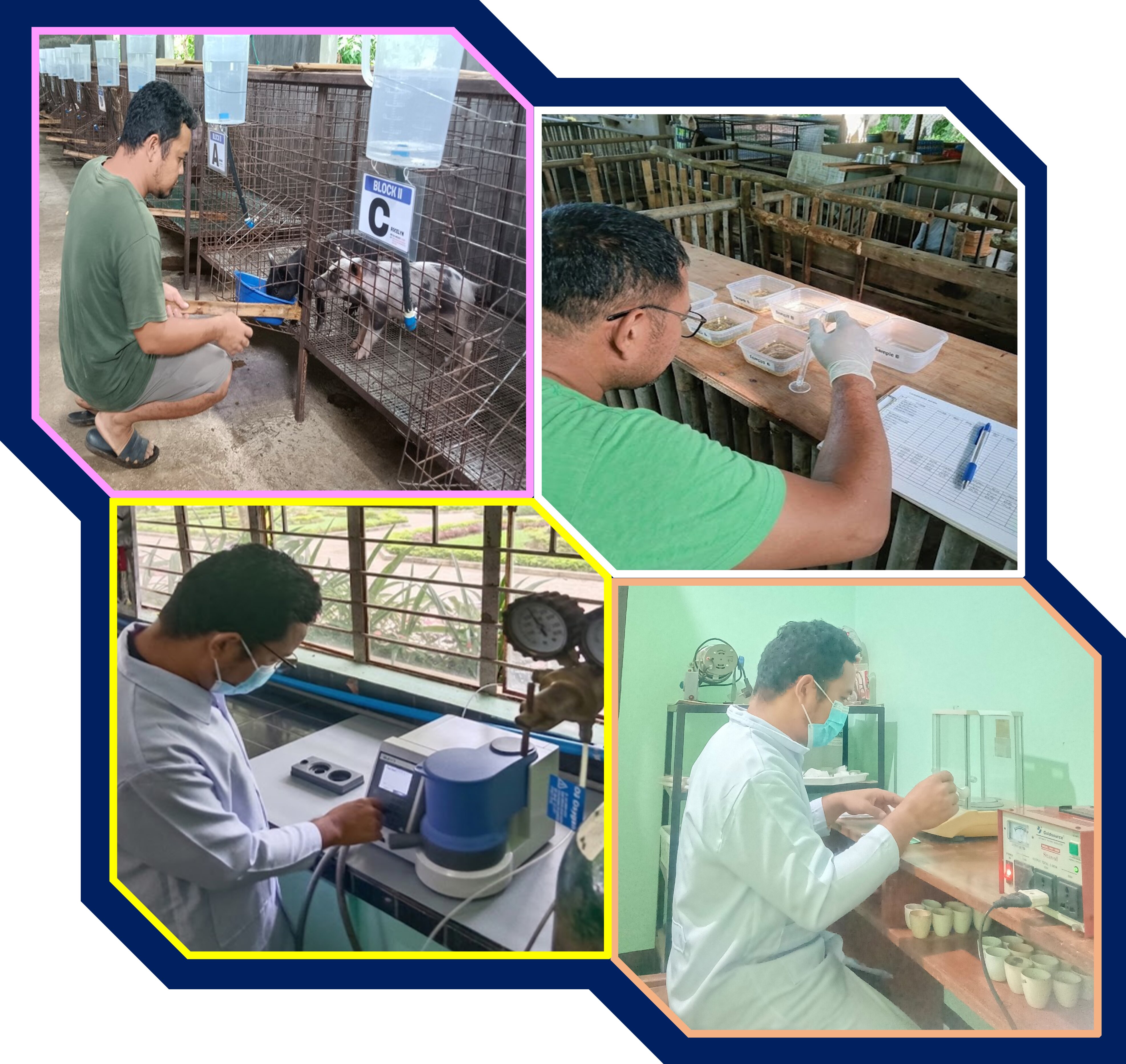
Arrowroot is an underutilized tuber crop with high starch content and potential as an alternative feed ingredient for swine. This study evaluated the energy, protein, and fiber metabolizability of arrowroot-based feedstuffs in native pigs. Fifteen native pigs representing three age groups (2, 4, and 7 months) were assigned to five treatments in a randomized complete block design: fasted pigs for endogenous loss determination (control), commercial feed, ensiled arrowroot whole plant, arrowroot tuber meal, and fresh arrowroot whole plant. Commercial feed recorded the highest true CODenergy (92.54%), followed by fresh arrowroot whole plant (90.42%), arrowroot tuber meal (89.51%), and ensiled arrowroot whole plant (86.94%), although differences were not significant (p=0.1779). True CODprotein differed significantly (p=0.0034), with commercial feed (93.61%) and fresh arrowroot whole plant (88.27%) showing higher values compared with arrowroot tuber meal (72.50%) and ensiled arrowroot whole plant (68.27%). Fiber digestibility was generally high, with fresh arrowroot whole plant exhibiting the highest neutral detergent fiber (94.69%) and acid detergent fiber (96.07%) utilization. Voluntary feed intake was significantly higher in pigs fed commercial feed (304.17 g/day) compared with arrowroot-based diets, although fresh whole plant (232.08 g/day) and tuber meal (202.08 g/day) showed acceptable intake levels. These findings suggest that arrowroot, particularly in its fresh whole-plant form, has potential as an alternative energy and fiber source for native pigs under controlled digestibility conditions. However, since this study focused only on coefficient of digestibility (energy, protein, fiber), further research is needed to evaluate growth performance, feed efficiency, carcass characteristics, and economic feasibility.
Article Details

This work is licensed under a Creative Commons Attribution-NonCommercial-NoDerivatives 4.0 International License.
References
Prehaten, D.; Hardiwinoto, S.; Na'iem, M.; Supriyo, H.; Widiyatno, W.; Rodiana, D. Productivity of Arrowroots and Taro Grown under Superior Teak Clones with Several Levels of Stand Density. Biosaintifika: Journal of Biology & Biology Education 2021, 13(1), 51–57. https://doi.org/10.15294/biosaintifika.v13i1.26428
Faridah, D. N.; Fardiaz, D.; Andarwulan, N.; Sunarti, T. Physicochemical Characterisation of Arrowroot Starch (Maranta arundinacea). Agritech 2014, 34(1), 14–21.
Malki, M. K. S.; Wijesinghe, J. A. A. C.; Ratnayake, R. H. M. K.; Thilakarathna, G. C. Characterization of Arrowroot (Maranta arundinacea) Starch as a Potential Starch Source for the Food Industry. Heliyon 2023, 9(9), e20033. https://doi.org/10.1016/j.heliyon.2023.e20033
Kumari, S.; Singh, A.; Tamrakar, P. Arrowroot—Gluten-Free, Multipurpose Crops. Int. J. Multidiscip. Res. 2022, 4(4), 179–190. https://doi.org/10.36948/ijfmr.2022.v04i04.021
Erdman, M. D.; Erdman, B. A. Arrowroot (Maranta arundinacea): Food, Feed, Fuel, and Fiber Resource. Econ. Bot. 1984, 38 (3), 332–341. https://doi.org/10.1007/BF02859011
Heuzé, V.; Tran, G. Arrowroot (Maranta arundinacea). Feedipedia, 2022. https://www.feedipedia.org/node/545 (accessed 2026-06-07).
Tarique, J.; Sapuan, S. M.; Khalina, A.; Sherwani, S. F. K.; Yusuf, J.; Ilyas, R. A. Recent Developments in Sustainable Arrowroot (Maranta arundinacea Linn) Starch Biopolymers, Fibres, Biopolymer Composites and Their Potential Industrial Applications: A Review. J. Mater. Res. Technol. 2021, 13, 1191–1219. https://doi.org/10.1016/j.jmrt.2021.05.047
Jayakumar, A.; Suganthi, A. Biochemical and Phytochemical Analysis of Maranta arundinacea (L.) Rhizome. Int. J. Res. Pharm. Pharm. Sci. 2017, 2(3), 26–30.
Iamkeng, S.; Santibenchakul, S.; Sooksawat, N. Potential of Maranta arundinacea Residues for Recycling: Analysis of Total Phenolic, Flavonoid, and Tannin Contents. Biodiversitas 2022, 23(3). https://doi.org/10.13057/biodiv/d230303
Samtiya, M.; Aluko, R. E.; Dhewa, T. Plant Food Antinutritional Factors and Their Reduction Strategies: An Overview. Food Prod. Process. Nutr. 2020, 2(1), 2–14. https://doi.org/10.1186/s43014-020-0020-5
Coulibaly, A.; Kouakou, B.; Chen, J. Phytic Acid in Cereal Grains: Structure, Healthy or Harmful Ways to Reduce Phytic Acid in Cereal Grains and Their Effects on Nutritional Quality. Am. J. Plant Nutr. Fertil. Technol. 2011, 1(1), 1–22. https://doi.org/10.3923/ajpnft.2011.1.22
Simwaka, J. E.; Chamba, M. V. M.; Huiming, Z.; Masamba, K. G.; Luo, Y. Effect of Fermentation on Physicochemical and Antinutritional Factors of Complementary Foods from Millet, Sorghum, Pumpkin and Amaranth Seed Flours. Int. Food Res. J. 2017, 24(5), 1869–1879.
Falculan, K. N. Phenotypic Characterization of Native Pig in Romblon Province, Philippines. Technium BioChemMed 2021, 2(3), 1–17. https://doi.org/10.47577/biochemmed.v2i3.4373
Muth, P. C.; Pohlmann, I. K.; Bae, S.; Reiber, C.; Bondoc, O. L.; Valle Zárate, A. Does Backyard-Keeping of Native Sows by Smallholders in Quezon, Philippines, Offer Sustainability Benefits Compared to More Intensive Management of Exotic Sow Breeds? J. Agric. Rural Dev. Trop. Subtrop. 2020, 121(1), 43–55. https://doi.org/10.17170/KOBRA-202002281033
Santiago, R.; Palima, C.; Rosales, B. O. Native Pigs: A Climate Resilient Business Enterprise. BAI-NSPRDC Bulletin 2020, 8–11.
Hang, L.; Preston, T.; Ba, N.; Dung, D. Effect of Biochar on Growth and Methane Emissions of Goats Fed Fresh Cassava Foliage. Livest. Res. Rural Dev. 2019, 31(5).
Lan, L.; Hung, L.; Thu, N.; Loc, H.; Liang, J.; Thiet, N.; Ngu, N. Effects of Substituting Taro (Colocasia esculenta) Wastes Silage in Diets on Growth and Nutrient Digestibility in Pigs. J. Anim. Health Prod. 2021, 9(2), 112–118. https://doi.org/10.17582/journal.jahp/2021/9.2.112.118
Bai, J.; Ding, Z.; Su, R.; Wang, M.; Cheng, M.; Xie, D.; Guo, X. Storage Temperature Is More Effective than Lactic Acid Bacteria Inoculations in Manipulating Fermentation and Bacterial Community Diversity, Co-Occurrence, and Functionality of Whole-Plant Corn Silage. Microbiol. Spectr. 2022, 10(2), e00101-22. https://doi.org/10.1128/spectrum.00101-22
Moughan, P. J.; Smith, W. C.; Schrama, J.; Smits, C. Chromic Oxide and Acid-Insoluble Ash as Fecal Markers in Digestibility Studies with Young Growing Pigs. N. Z. J. Agric. Res. 1991, 34(1), 85–88. https://doi.org/10.1080/00288233.1991.10417796
Dong, W.; Wang, Q.; Chen, J.; Liu, L.; Zhang, S. Apparent Total Tract Digestibility of Nutrients and the Digestible and Metabolizable Energy Values of Five Unconventional Feedstuffs Fed to Growing Pigs. J. Appl. Anim. Res. 2019, 47(1), 273–279. https://doi.org/10.1080/09712119.2019.1625778
AOAC International. Official Methods of Analysis, 22nd ed.; AOAC International: Gaithersburg, MD, USA, 2023.
Hellström, D.; Johansson, E.; Grennberg, K. Storage of Human Urine: Acidification as a Method to Inhibit Decomposition of Urea. Ecol. Eng. 1999, 12(3–4), 253–269. https://doi.org/10.1016/S0925-8574(98)00074-3
Napalinga, C. P. Plant-Based Feed and Forage Research for Livestock: A Bibliometric Review. ASEAN J. Sci. Technol. Rep. 2025, 28(5). https://doi.org/10.55164/ajstr.v28i5.259394
Jirawattanasomkul, N.; Roschat, W.; Leelatam, T.; Phanphli, S.; Chaipikun, W.; Thammayod, A.; Khotsuno, N.; Yeemin, P.; Wongma, N.; Phewphong, S. Evaluation of the Nutritional, Mineral, and Estimated Metabolizable Energy Values of Agricultural Biomass Raw Materials Used for the Development of Concentrated Fermented Feed for Beef Cattle in Mukdahan Province, Northeast Thailand. ASEAN J. Sci. Technol. Rep. 2026, 29(4). https://doi.org/10.55164/ajstr.v29i4.262452
Ngoc, T. T. B.; Oanh, N. C.; Hong, T. T. T.; Dang, P. K. Effects of Dietary Fiber Sources on Bacterial Diversity in Separate Segments of the Gastrointestinal Tract of Native and Exotic Pig Breeds Raised in Vietnam. Vet. World 2021, 14(10), 2579–2587. https://doi.org/10.14202/vetworld.2021.2579-2587
