
Experimental Investigation of Ozone Generation in Multi-Cell Dielectric Barrier Discharge Reactors
Article Sidebar
Main Article Content
Abstract
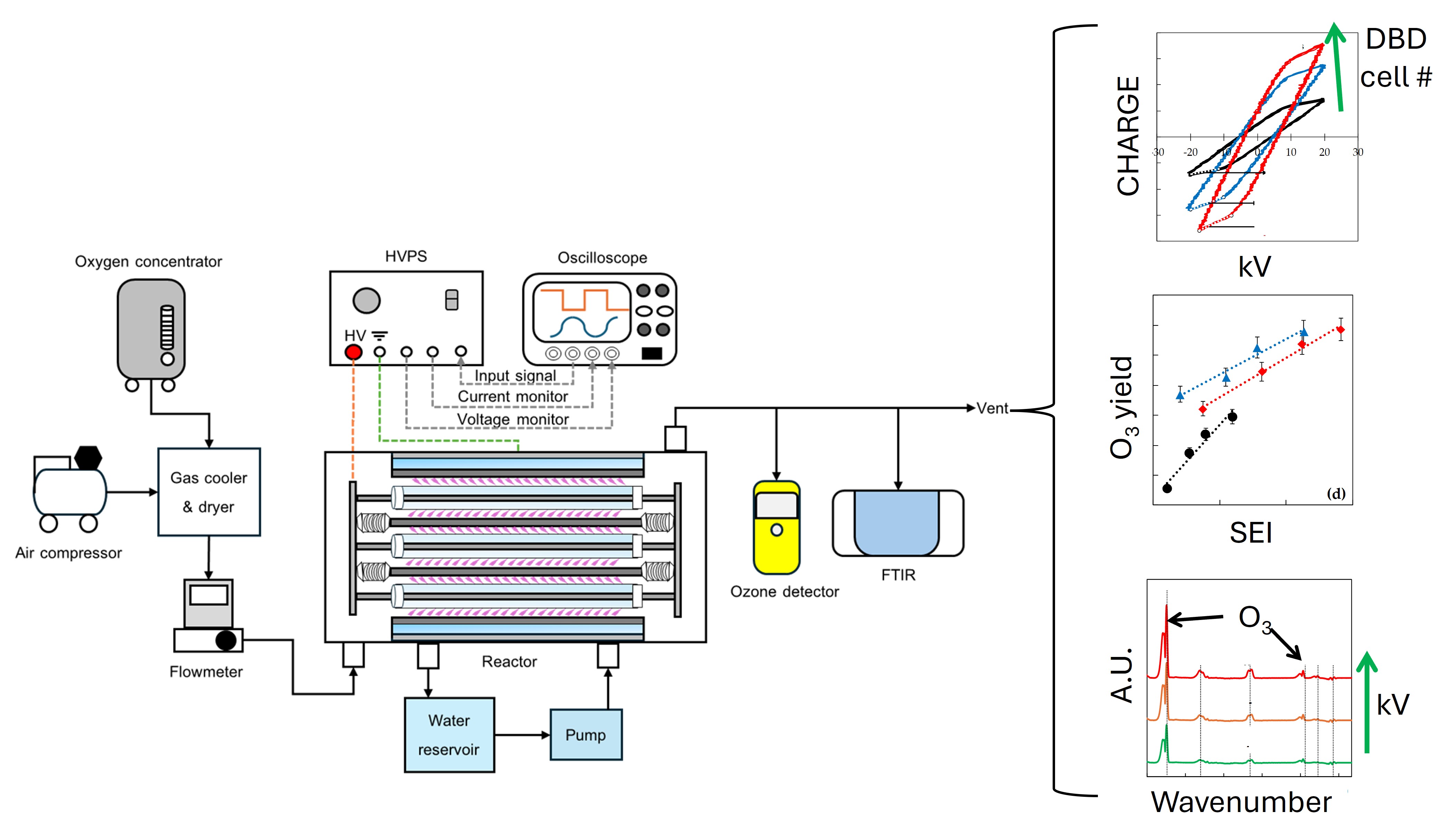
Ozone is a sustainable oxidant with applications in water treatment, air purification, and food sterilisation. Dielectric barrier discharge (DBD) reactors are attractive for ozone generation because of their simplicity and scalability. Performance depends on both plasma processes and power supply characteristics. This research examined single-, two-, and three-cell dielectric tubes DBD reactor operated under varying voltages and frequencies to assess ozone yield and energy efficiency. FTIR spectroscopy confirmed ozone as the main product and enabled extended quantification beyond portable ozone detector saturation through calibration with detector readings (R² = 0.9997). Reactor scaling-up enhanced ozone generation, with the three-cell reactor achieving 11946 ppm and 17.25 g/h at 40 kVpp and 100 Hz, for discharge voltage and frequency, respectively. However, ozone concentrations from the two- and three-cell reactors were nearly identical across the SEI (Specific Energy Input) range due to high-voltage power supply (HVPS) limitations rather than reactor design. Efficiency analysis revealed two perspectives, based on discharge power, the ozone production efficiency (OPE) peaked at 396 g/kWh in a two-cell configuration at low SEI but declined at higher SEI owing to non-productive energy losses. Conversely, the overall ozone production efficiency (OOPE), referenced to system input power, increased with SOEI (specific overall energy input), with the two-cell reactor outperforming (16.0–22.3 g/kWh). These findings highlight the combined influence of plasma on ozone generation, offering guidance for scaling DBD reactors in industrial applications.
Article Details

This work is licensed under a Creative Commons Attribution-NonCommercial-NoDerivatives 4.0 International License.
References
Epelle, E. I.; Macfarlane, A.; Cusack, M.; Burns, A.; Okolie, J. A.; Mackay, W.; Rateb, M.; Yaseen, M. Ozone Application in Different Industries: A Review of Recent Developments. Chem. Eng. J. 2023, 454, 140188. https://doi.org/10.1016/j.cej.2022.140188
Ghaitaoui, E. A.; Nassour, K.; Nemmich, S.; Oulad Naoui, B. E. K.; Ghaitaoui, T.; Tilmatine, A.; Ramdani, N. Experimental Comparative Study between Simple and Multi-Tube DBD Ozone Generator with Same Volume Discharge for Wastewater Treatment. J. Korean Phys. Soc. 2024, 85(10), 798–809. https://doi.org/10.1007/s40042-024-01179-4
Chen, T.; Delgado, A. G.; Yavuz, B. M.; Proctor, A. J.; Maldonado, J.; Zuo, Y.; Westerhoff, P.; Krajmalnik-Brown, R.; Rittmann, B. E. Ozone Enhances Biodegradability of Heavy Hydrocarbons in Soil. J. Environ. Eng. Sci. 2016, 11(1), 7–17. https://doi.org/10.1680/jenes.16.00002
Powell, A.; Scolding, J. W. S. Direct Application of Ozone in Aquaculture Systems. Rev. Aquacult. 2018, 10(2), 424–438. https://doi.org/10.1111/raq.12169
Niveditha, A.; Pandiselvam, R.; Prasath, V. A.; Singh, S. K.; Gul, K.; Kothakota, A. Application of Cold Plasma and Ozone Technology for Decontamination of Escherichia coli in Foods: A Review. Food Control 2021, 130, 108338. https://doi.org/10.1016/j.foodcont.2021.108338
Xue, W.; Macleod, J.; Blaxland, J. The Use of Ozone Technology to Control Microorganism Growth, Enhance Food Safety and Extend Shelf Life: A Promising Food Decontamination Technology. Foods 2023, 12(4), 814. https://doi.org/10.3390/foods12040814
Sumaiyah, S.; Nugraha, R.; Suhartono, S.; Yulianto, E.; Fuskhah, E.; Al-Baarri, A. N.; Usman, A.; Nur, M. Analysis of Low Frequency on Dielectric Barrier Discharge Plasma Reactor for Ozone Production. Trends Sci. 2025, 22(4). https://doi.org/10.48048/tis.2025.9335
Soyluoglu, M.; Williams, C. F.; Karanfil, T. Advancing Water Treatment: Ozone Nanobubbles for Geosmin and 2-Methylisoborneol Control. Chem. Eng. J. 2025, 513, 162892. https://doi.org/10.1016/j.cej.2025.162892
Asilevi, P. J.; Boakye, P.; Oduro-Kwarteng, S.; Fei-Baffoe, B.; Sokama-Neuyam, Y. A. Indoor Air Quality Improvement and Purification by Atmospheric Pressure Non-Thermal Plasma (NTP). Sci. Rep. 2021, 11(1), 22830. https://doi.org/10.1038/s41598-021-02276-1
Varga, L.; Szigeti, J. Use of Ozone in the Dairy Industry: A Review. Int. J. Dairy Technol. 2016, 69(2), 157–168. https://doi.org/10.1111/1471-0307.12302
Joseph, C. G.; Farm, Y. Y.; Taufiq-Yap, Y. H.; Pang, C. K.; Nga, J. L. H.; Li Puma, G. Ozonation Treatment Processes for the Remediation of Detergent Wastewater: A Comprehensive Review. J. Environ. Chem. Eng. 2021, 9(5), 106099. https://doi.org/10.1016/j.jece.2021.106099
Guzel-Seydim, Z. B.; Greene, A. K.; Seydim, A. C. Use of Ozone in the Food Industry. LWT–Food Sci. Technol. 2004, 37 (4), 453–460. https://doi.org/10.1016/j.lwt.2003.10.014
Fu, P.; Feng, J.; Yang, H.; Yang, T. Degradation of Sodium n-Butyl Xanthate by Vacuum UV–Ozone (VUV/O₃) in Comparison with Ozone and VUV Photolysis. Process Saf. Environ. Prot. 2016, 102, 64–70. https://doi.org/10.1016/j.psep.2016.02.010
Cleland, M. R.; Galloway, R. A. Ozone Generation in Air during Electron Beam Processing. Phys. Procedia 2015, 66, 586–594. https://doi.org/10.1016/j.phpro.2015.05.078
Zhu, Z.; Song, Q.; Jiang, L.; Yan, M.; Chen, S.; Duan, J. Perspective of Water Electrolysis to Ozone Production: Electrocatalyst Design and Development. Mater. Horiz. 2025. https://doi.org/10.1039/D5MH01341K
Feng, C.; Zheng, Y.; Zhang, R.; Tian, E.; Zou, X.; Liu, K. Characterizing the Pin-to-Ring Direct-Current Air Corona Discharge by Its Ultrasonic Signal and Ozone Production. Appl. Acoust. 2025, 237, 110738. https://doi.org/10.1016/j.apacoust.2025.110738
Liu, P.; Song, Y.; Zhang, Z. A Novel Dielectric Barrier Discharge (DBD) Reactor with Streamer and Glow Corona Discharge for Improved Ozone Generation at Atmospheric Pressure. Micromachines 2021, 12(11), 1287. https://doi.org/10.3390/mi12111287
Hyun-Ha, K.; Abdelaziz, A. A.; Yoshiyuki, T.; Tomohiro, N.; Dae-Young, K.; Brandenburg, R.; Schiorlin, M.; Hensel, K.; Young-Hoon, S.; Dae-Hoon, L.; Woo-Seok, K.; Akira, M. Revisiting Why DBDs Can Generate O₃ against the Thermodynamic Limit. Int. J. Plasma Environ. Sci. Technol. 2023, 17(2), 1–20.
Li, S.; Dang, X.; Yu, X.; Abbas, G.; Zhang, Q.; Cao, L. The Application of Dielectric Barrier Discharge Non-Thermal Plasma in VOCs Abatement: A Review. Chem. Eng. J. 2020, 388, 124275. https://doi.org/10.1016/j.cej.2020.124275
Sharma, M.; Alhashmialameer, D.; Ali, S. K.; Alzahrani, A.; Khan, M. S.; Sowjanya, M.; Rashid, M. S.; BaQais, A.; Khleefa, F. A.; Shariq, M. Enhancement of Ozone Production by Increasing Number Density of Plasma Channels in Volume DBD Using Ceramic Foam for Water Treatment and Industrial Applications. J. Electrostat. 2025, 135, 104088. https://doi.org/10.1016/j.elstat.2025.104088
Xie, L.; Yuan, D.; Jin, C.; Xu, H.; Li, Y.; Wei, L.; Wu, W.; Ling, Z. Characteristics of Dielectric Barrier Discharge and Ozone Production in Synthetic Air. Vacuum 2024, 226, 113359. https://doi.org/10.1016/j.vacuum.2024.113359
Sun, S.; Chen, Y.; Yuan, P.; Xu, L.; Zhang, Y.; Wei, L. Effect of Magnetic Field on Multi-Parameters of Needle–Plate DBD Ozone Generator. Ozone: Sci. Eng. 2022, 44(4), 384–397. https://doi.org/10.1080/01919512.2021.1960146
Bang, S.; Snoeckx, R.; Cha, M. S. Temperature-Dependent Kinetics of Ozone Production in Oxygen Discharges. Plasma Chem. Plasma Process. 2023, 43(6), 1453–1472. https://doi.org/10.1007/s11090-023-10370-7
Siriprom, W.; Teanchai, K.; Jitchot, N.; Chamchoi, N. The Comparison of Ozone Production with Oxygen Concentration and Feed Gas Flow Rate at Atmospheric Pressure. Mater. Today Proc. 2022, 65, 2336–2339. https://doi.org/10.1016/j.matpr.2022.05.225
Huang, C.-L.; Liao, T.-Y.; He, Y.-T.; Lin, G.-J.; Lai, W.-H.; Chen, Y.-C.; Lin, K.-M. Characterization of OH Species in kHz Air/H₂O Atmospheric Pressure Dielectric Barrier Discharges. Plasma Sources Sci. Technol. 2024, 33(6). https://doi.org/10.1088/1361-6595/ad4ddd
Petruci, J. F. d. S.; Barreto, D. N.; Dias, M. A.; Felix, E. P.; Cardoso, A. A. Analytical Methods Applied for Ozone Gas Detection: A Review. TrAC Trends Anal. Chem. 2022, 149, 116552. https://doi.org/10.1016/j.trac.2022.116552
Han, P.; Mei, H.; Liu, D.; Zeng, N.; Tang, X.; Wang, Y.; Pan, Y. Calibrations of Low-Cost Air Pollution Monitoring Sensors for CO, NO₂, O₃, and SO₂. Sensors 2021, 21(1), 256. https://doi.org/10.3390/s21010256
Guragain, R. P.; Baniya, H. B.; Pradhan, S. P.; Pandey, B. P.; Subedi, D. P. Influence of Plasma-Activated Water (PAW) on the Germination of Radish, Fenugreek, and Pea Seeds. AIP Adv. 2021, 11(12), 125214. https://doi.org/10.1063/5.0070800
Tang, X.; Liang, T.; Zhou, Y.; Li, J.; Li, X.; Zhang, M. A Parameter Measurement Method for DBD-Type Ozone Generators Based on Data Fitting. Measurement 2025, 256, 118127. https://doi.org/10.1016/j.measurement.2025.118127
Hegemann, D. Plasma Activation Mechanisms Governed by Specific Energy Input: Potential and Perspectives. Plasma Process. Polym. 2023, 20(5), e2300010. https://doi.org/10.1002/ppap.202300010
Chen, Y.; Wang, Q.; Wang, Y. Analysis and Comparison of DBD Power Supplies with Different Control Methods. IEEE Trans. Plasma Sci. 2024, 52(5), 1747–1757. https://doi.org/10.1109/TPS.2024.3381748
Kogelschatz, U. Dielectric-Barrier Discharges: Their History, Discharge Physics, and Industrial Applications. Plasma Chem. Plasma Process. 2003, 23(1), 1–46. https://doi.org/10.1023/A:1022470901385
Shaban, M.; Merkert, N.; van Duin, A. C. T.; van Duin, D.; Weber, A. P. Advancing DBD Plasma Chemistry: Insights into Reactive Nitrogen Species Such as NO₂, N₂O₅, and N₂O Optimization and Species Reactivity through Experiments and MD Simulations. Environ. Sci. Technol. 2024. https://doi.org/10.1021/acs.est.4c04894
Yuan, D.; Wang, Z.; Ding, C.; He, Y.; Whiddon, R.; Cen, K. Ozone Production in Parallel Multichannel Dielectric Barrier Discharge from Oxygen and Air: The Influence of Gas Pressure. J. Phys. D: Appl. Phys. 2016, 49(45), 455203. https://doi.org/10.1088/0022-3727/49/45/455203
