
The Development of a Web Application for Tracking Bedridden Patients by Village Health Volunteers
Article Sidebar
Main Article Content
Abstract
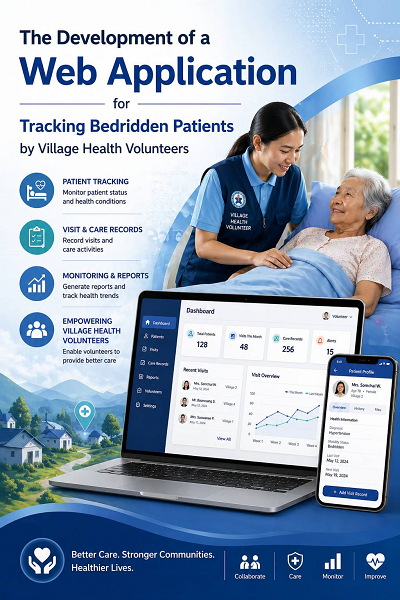
This study aims to develop and evaluate a web-based application for monitoring bedridden patients in a rural community in Loei Province, Thailand. The system was designed to support Village Health Volunteers (VHVs) in recording patient data, monitoring health conditions, and coordinating care with healthcare providers more efficiently. A research and development (R&D) approach was employed, following the System Development Life Cycle (SDLC), including requirement analysis, system design, development, testing, and deployment. The system was evaluated using a structured questionnaire based on information system quality dimensions. A total of 37 VHVs participated in the study. Data were collected before and after implementation and analyzed using descriptive statistics (mean and standard deviation) and paired-samples t-tests. The results showed that overall system quality was rated at the highest level (𝑥̄ = 4.51, S.D. = 0.49). The highest-rated dimensions included ease of use (𝑥̄ = 4.60), usefulness (𝑥̄ = 4.58), and system security (𝑥̄ = 4.55). User satisfaction was also high (𝑥̄ = 4.39), with system performance receiving the highest rating (𝑥̄ = 4.66). Paired-samples t-test results indicated statistically significant improvements after implementation (t = 8.41–10.34, p < 0.001). These findings demonstrate that the application improves monitoring efficiency, enhances data accuracy, and supports effective communication in community healthcare settings, providing a practical, scalable digital health solution to strengthen primary healthcare services in rural areas.
Article Details

This work is licensed under a Creative Commons Attribution-NonCommercial-NoDerivatives 4.0 International License.
References
Kaewsombat, K.; Khunphilik, I.; Wijitpanya, A.; Chaimueang, P.; Channam, P. Development of a psychiatric patient care system through the provincial network in Loei Province. J. Environ. Health Community Health 2024, 9(5), 549–560. (in Thai).
Sumner, J.; Tan, S.; Wang, Y.; Keck, C.; Xin Lee, E.; Chew, E.; Yip, A. Co-designing remote patient monitoring technologies for inpatients: Systematic review. J. Med. Internet Res. 2024, 16. https://doi.org/10.2196/58144
Cao, M.; Ramezani, R.; Katakwar, V. K.; Zhang, W.; Boda, D.; Wani, M.; Naeim, A. Developing remote patient monitoring infrastructure using commercially available cloud platforms. Front. Digit. Health 2024. https://doi.org/10.3389/fdgth.2024.1399461
Das, M. K.; Deb, P.; De, I. Remote patient health monitoring frameworks using IoT and ML: A comparative study. Int. J. Intell. Syst. Appl. Eng. 2024, 12, 367–372.
Khembubpha, S. Development of a service linkage system from intermediate care to long-term care in Ban Dan District, Buriram Province. Reg. Health Promot. Cent. 9 J. 2021, 16(3), 939–956. (in Thai).
Majeed, M.; Chaudhary, A.; Chadha, R. Digital Transformation in the Customer Experience; Apple Academic Press, 2025. https://doi.org/10.1201/9781003560449
Alam, M. Z.; Hoque, M. R.; Hu, W.; Barua, Z. Factors influencing the adoption of mHealth services in a developing country: A patient-centric study. Int. J. Inf. Manage. 2020, 50, 128–143.
Dwivedi, Y. K.; Hughes, D. L.; Rana, N. P.; Baabdullah, A. M.; Ribeiro-Navarrete, S.; Giannakis, M.; Al-Debei, M. M.; Dennehy, D.; Metri, B.; Buhalis, D.; et al. Metaverse beyond the hype: Multidisciplinary perspectives on emerging challenges, opportunities, and agenda for research, practice and policy. Int. J. Inf. Manage. 2022, 66, 102542. https://doi.org/10.1016/j.ijinfomgt.2022.102542
Na Khaem Subdistrict Administrative Organization. https://nakhamloei.go.th/public/ (accessed Jan 14, 2025).
Krejcie, R. V.; Morgan, D. W. Determining sample size for research activities. Educ. Psychol. Meas. 1970, 30(3), 607–610. https://doi.org/10.1177/001316447003000308
Maita, K. C.; Maniaci, M. J.; Haider, C. R.; Avila, F. R.; Torres-Guzman, R. A.; Borna, S.; Lunde, J. J.; Coffey, J. D.; Demaerschalk, B. M.; Forte, A. J. The impact of digital health solutions on bridging the healthcare gap in rural areas: A scoping review. Int. J. Med. Inform. 2024, 28(3), 130–143. https://doi.org/10.7812/TPP/23.134
Maramba, I.; Chatterjee, A.; Newman, C. Methods of usability testing in the development of eHealth applications: A scoping review. Int. J. Med. Inform. 2019, 126, 95–104. https://doi.org/10.1016/j.ijmedinf.2019.03.018
Luitel, N. P.; Neupane, V.; Lamichhane, B.; Koirala, G. P.; Gautam, K.; Karki, E.; Adhikari, S.; Votruba, N.; Jordans, M. J. D.; Kohrt, B. A.; Carswell, K.; Thornicroft, G.; Lempp, H. Experience of primary healthcare workers in using the mobile app-based WHO mhGAP intervention guide in detection and treatment of people with mental disorders: A qualitative study in Nepal. SSM Ment. Health 2023, 4, 100278. https://doi.org/10.1016/j.ssmmh.2023.100278
Aitken, M.; Tully, M. P.; Porteous, C.; Denegri, S.; Cunningham-Burley, S.; Banner, N.; Black, C.; Burgess, M.; Cross, L.; van Delden, J. J.; et al. Consensus statement on public involvement and engagement with data-intensive health research. Int. J. Popul. Data Sci. 2019, 4(1), 586. https://doi.org/10.23889/ijpds.v4i1.586
Lee, J.; Park, S.; Cho, M.-H.; Kang, J.-W.; Kim, M.; Choi, S.; Kim, S.-G.; Han, K.; Kim, C.-O.; Moon, I.-C.; Jang, S.-N. Development of a web-based care networking system to support visiting healthcare professionals in the community. BMC Health Serv. Res. 2023, 23, 10434. https://doi.org/10.1186/s12913-023-10434-6
