
Process Optimization and Quality Characteristics of Sheet-Type Puffed Rice from Glutinous and Pathum Thani Rice Flour
Article Sidebar
Main Article Content
Abstract
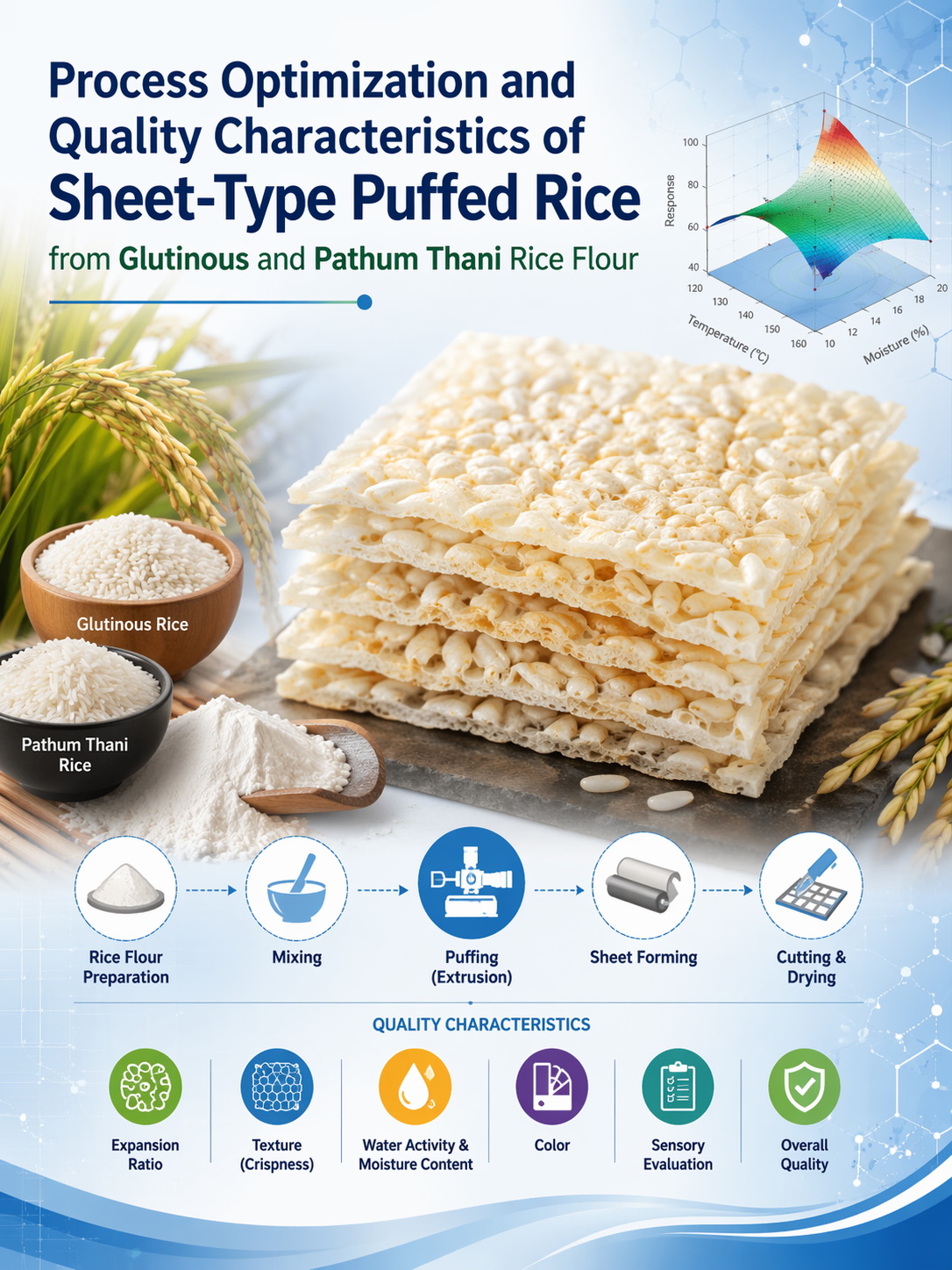
This study investigated the optimal conditions for producing sheet-type puffed rice using glutinous rice and Pathum Thani rice flour with a dual-head puffing machine. Two formulations—S1 (glutinous rice: rice flour, 40:60) and S2 (50:50)—were processed at 220 °C for 1 minute and 15 seconds. Rice samples with adjusted moisture content (13–19%, w.b.) were evaluated for physical and textural properties, including color (L*, a*, b*), moisture content, water activity (aw), expansion ratio, hardness, adhesiveness, and fracturability. Results showed that all processing parameters significantly influenced puffing characteristics (P<0.05). S1 produced puffed rice with slightly higher brightness (L*), moisture content, and hardness (average 28.32 N), but negligible adhesiveness and fracturability. In contrast, S2 showed lower hardness (average 18.48 N), minor adhesiveness in some samples, and greater fracturability. Both formulas exhibited similar expansion ratios (3.87 for S1 and 3.96 for S2) and a.w. values within acceptable ranges (0.243–0.268). The findings suggest that formula S1 yields a firmer and more stable puffed rice sheet, while S2 offers a softer texture. These insights contribute to optimizing puffed rice production for various market preferences and advancing value-added rice processing technologies.
Article Details

This work is licensed under a Creative Commons Attribution-NonCommercial-NoDerivatives 4.0 International License.
References
Hsieh, H.; Hsieh, S. L.; Luh, C. H. Rice puffing mechanism. Cereal Chem. 1989, 66(3), 179–183.
Hsieh, H.; Luh, C. H. Puffing process of rice. J. Food Sci. 1991, 56(3), 830–833. https://doi.org/10.3917/comm.056.0851
Murugesan, A.; Bhattacharya, K. R. Effect of moisture content on puffing of rice. J. Food Eng. 1986, 5(1), 15–20.
Huff, M. R.; Brown, P. R.; Smith, S. S. Optimal temperature range for rice puffing. J. Agric. Food Chem. 1992, 40(6), 981–984.
Maisont, S.; Narkrugsa, W. Effect of heating time on rice puffing quality. Food Res. Int. 2009, 42(2), 211–215.
El-Salam, S.; El-Beltagy, A. A. H.; Mostafa, A. M. The effect of moisture absorption on puffing quality of rice. J. Cereal Sci. 2015, 62(1), 40–46.
Malee, T. Fat content and rancidity in deep-fried rice products. J. Food Sci. Technol. 1992, 29(1), 56–60. https://doi.org/10.1109/6.144538
Hoseney, W.; Bailey, M. A.; Hough, F. A. Mechanism of puffed rice production: Similarities with popcorn. Cereal Chem. 1983, 60(4), 317–322.
Srinivas, P.; Desikachar, R. S. Rice puffing: Influence of rice varieties and moisture content. Food Sci. Technol. Int. 1973, 1(2), 125–128.
Dofing, R.; Hareland, P. A.; McClung, T. J. Rice puffing behavior: Grain type and moisture effects. Cereal Foods World 1990, 35(2), 132–137.
Zhang, X.; Hoseney, W. Influence of moisture content and temperature on puffing rice. Cereal Chem. 1998, 75(6), 776–781. https://doi.org/10.1094/CCHEM.1998.75.6.863
Moraru, C. I.; Kokini, J. L. Nucleation and expansion during extrusion and microwave heating of cereal foods. Compr. Rev. Food Sci. Food Saf. 2003, 2(4), 147–165. https://doi.org/10.1111/j.1541-4337.2003.tb00020.x
Lin, C.; Anantheswaran, A. Microwave heating effects on rice puffing. J. Food Eng. 1988, 34(3), 187–194.
Sumnu, O. The impact of microwave heating on the puffing process of cereals. J. Food Process. Preserv. 2001, 25(5), 427–437.
Juliano, R. A. Rice Chemistry and Technology, 2nd ed.; AACC: St. Paul, MN, 1971.
Juliano, R. A.; Hicks, J. L. Amylose content and its influence on rice texture and expansion potential. Cereal Chem. 1996, 73(4), 415–419.
Singh, R.; Gough, N. J.; Barham, M. A. Varietal differences in cooking and textural properties of rice. Food Chem. 2005, 98(1), 78–84.
Mercier, A.; Feillet, P. Extrusion cooking of cereals: Effects on carbohydrate structures and puffability. Cereal Chem. 1975, 52(5), 464–468. https://doi.org/10.1007/BF02689477
Mariotti, M.; Alamprese, C.; Pagani, M. A.; Lucisano, M. Effect of puffing on ultrastructure and physical characteristics of cereal grains. Food Res. Int. 2006, 39(4), 395–400.
Simsrisakul, A. Physical characteristics of puffed rice: Volume and color. Food Biophys. 1991, 7(3), 312–319. https://doi.org/10.15358/0935-0381-1991-6-312
Zhang, H.; Hoseney, R. C. Physical properties of puffed rice and their relationship to puffing performance. Cereal Chem. 1998, 75(5), 585–590. https://doi.org/10.1094/CCHEM.1998.75.5.585
Seal, P.; McClements, P. L.; Smith, S. S. Whole grain labeling and health implications in puffed rice products. J. Nutr. Sci. 2006, 13, 183–192.
U.S. Food and Drug Administration. Food Labeling Guide; Washington, DC, 2006.
AOAC. Official Methods of Analysis, 16th ed.; Association of Official Analytical Chemists: Arlington, VA, 1990.
