
The Corn Stalks as a Novel Source of Functional Dietary Fiber: Process Optimization and Product Characterization
Article Sidebar
Main Article Content
Abstract
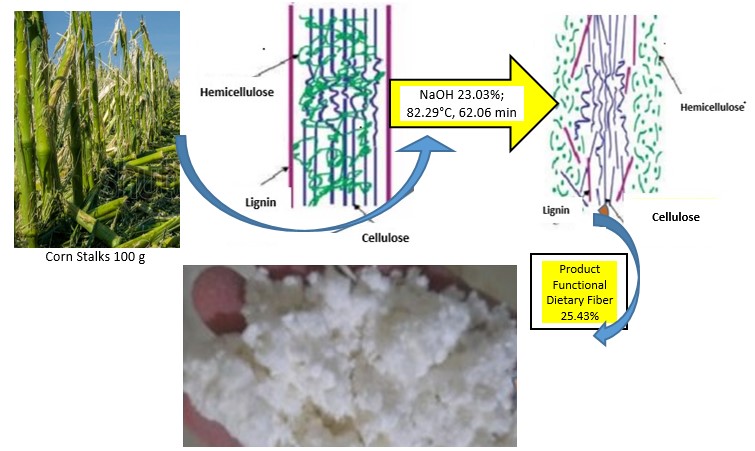
The growing demand for dietary fiber (DF) has encouraged the exploration of sustainable and low-cost sources from agricultural by-products. Corn stalks are an abundant agricultural residue that remains underutilized as a potential source of dietary fiber. This study aimed to optimize the alkali extraction of DF from corn stalks (Zea mays, L.) using Response Surface Methodology (RSM) with a Central Composite Design (CCD). Three independent variables, namely temperature (70-90°C), time (50-70 min), and NaOH concentration (15-25%), were investigated for their effects on DF yield. The model showed a high significance (p<0.0001) with R² = 0.99, indicating excellent predictive accuracy. The optimal extraction conditions were 82.29°C, 62.06 min, and 23.03% NaOH, resulting in a maximum DF yield of 25.75%. Verification experiments confirmed the model’s reliability, with an experimental yield of 25.43 ± 0.24%. The extracted DF exhibited favorable functional properties, including high water holding capacity/WHC (4.7 ± 0.08 g/g), water binding capacity/WBC (2.7 ± 0.05 g/g), swelling capacity/SW (5.12 mL/g), oil holding capacity/OHC (1.8 ± 0.07 g/g), and Fourier Transform Infrared Spectroscopy (FTIR) analysis confirmed the removal of lignin and hemicellulose. These characteristics highlight its potential as a functional ingredient in food formulations, particularly in meat- and fish-based products that require improved texture and moisture retention. This study demonstrates the valorization of corn stalk waste into a valuable DF source, supporting sustainable resource utilization and the development of clean-label, fiber-enriched food products aligned with circular economy principles.
Article Details

This work is licensed under a Creative Commons Attribution-NonCommercial-NoDerivatives 4.0 International License.
References
Alahmari, L. A. Dietary Fiber Influence on Overall Health, with an Emphasis on CVD, Diabetes, Obesity, Colon Cancer, and Inflammation. Front. Nutr. 2024, 11, 1510564. https://doi.org/10.3389/fnut.2024.1510564
Zhang, L.; Chen, Y.; Yang, Q.; Guo, J.; Zhou, S.; Zhong, T.; Xiao, Y.; Yu, X.; Feng, K.; Peng, Y.; Han, Z.; Feng, F.; Wang, L. The Impact of Dietary Fiber on Cardiovascular Diseases: A Scoping Review. Nutrients 2025, 17(3), 444. https://doi.org/10.3390/nu17030444
Li, M.; Ma, S. A Review of Healthy Role of Dietary Fiber in Modulating Chronic Diseases. Food Res. Int. 2024, 191, 114682. https://doi.org/10.1016/j.foodres.2024.114682
Puițel, A. C.; Balan, C. D.; Nechita, M. T. Corn Stalks-Derived Hemicellulosic Polysaccharides: Extraction and Purification. Polysaccharides 2025, 6(1), 2. https://doi.org/10.3390/polysaccharides6010002
Puițel, A. C.; Suditu, G. D.; Danu, M.; Ailiesei, G.-L.; Nechita, M. T. An Experimental Study on the Hot Alkali Extraction of Xylan-Based Hemicelluloses from Wheat Straw and Corn Stalks and Optimization Methods. Polymers 2022, 14, 1662. https://doi.org/10.3390/polym14091662
Shaikh, J. R.; Chakraborty, S.; Odaneth, A.; Annapure, U. S. A Sequential Approach of Alkali Enzymatic Extraction of Dietary Fiber from Rice Bran: Effects on Structural, Thermal, Crystalline Properties, and Food Application. Food Res. Int. 2024, 193, 114847. https://doi.org/10.1016/j.foodres.2024.114847
Nguyen, N. T.; Tran, N. T.; Phan, T. P.; Nguyen, A. T.; Nguyen, M. X. T.; Nguyen, N. N.; Ko, Y. H.; Nguyen, D. H.; Van, T. T. T.; Hoang, D. The Extraction of Lignocelluloses and Silica from Rice Husk Using a Single Biorefinery Process and Their Characteristics. J. Ind. Eng. Chem. 2022, 108, 150–158. https://doi.org/10.1016/j.jiec.2021.12.032
Nurhayati; Irianto, H. E.; Riastuti, R.; Pangesty, A. I.; Nugraha, A. F.; Todo, M.; Jumahat, A.; Chalid, M. Extraction and Characterization of Micro-Fibrillated Cellulose from Rice Husk Waste for Biomedical Purposes. Int. J. Technol. 2024, 15(2), 342–352. https://doi.org/10.14716/ijtech.v15i2.6698
Qiu, S.; Yadav, M. P.; Yin, L. Characterization and Functionalities Study of Hemicellulose and Cellulose Components Isolated from Sorghum Bran, Bagasse and Biomass. Food Chem. 2017, 230, 225–233. https://doi.org/10.1016/j.foodchem.2017.03.021
Yin, X.; Wei, L.; Pan, X.; Liu, C.; Jiang, J.; Wang, K. The Pretreatment of Lignocelluloses with Green Solvent as Biorefinery Preprocess: A Minor Review. Front. Plant Sci. 2021, 12, 670061. https://doi.org/10.3389/fpls.2021.670061
Oliveira, R. M. S. F.; Santos, H. M. L. S.; Fernandes, S. S.; Egea, M. B. Exploring Plant Agro-Industrial By-Products as a Source of Fibrous Food Ingredients: A Review of Extraction Methods and Technological Properties. J. Food Sci. 2025, 90(7), e70408. https://doi.org/10.1111/1750-3841.70408
Jiang, G.; Wu, Z.; Ramachandra, K.; Zhao, C.; Ameer, K. Changes in Structural and Chemical Composition of Insoluble Dietary Fibers Bound Phenolic Complexes from Grape Pomace by Alkaline Hydrolysis Treatment. Food Sci. Technol. (Campinas) 2022, 42, e50921. https://doi.org/10.1590/fst.50921
Oriez, V.; Peydecastaing, J.; Pontalier, P. Lignocellulosic Biomass Mild Alkaline Fractionation and Resulting Extract Purification Processes: Conditions, Yields, and Purities. Clean Technol. 2020, 2(1), 91–115. https://doi.org/10.3390/cleantechnol2010007
Rafat, A. A.; Barbará, P. V.; Ullah, A.; Kontturi, E.; Law, R. V.; Hallett, J. P. Efficient Extraction of Carboxylated Nanocellulose from ionoSolv Pulps with Alkaline H2O2 Assisted Oxidation. Cellulose 2025, 32, 853–875. https://doi.org/10.1007/s10570-024-06319-4
Sun, S.; Cao, X.; Sun, S.; Xu, F.; Song, X.; Sun, R.; Jones, G. L. Improving the Enzymatic Hydrolysis of Thermo-Mechanical Fiber from Eucalyptus urophylla by a Combination of Hydrothermal Pretreatment and Alkali Fractionation. Biotechnol. Biofuels 2014, 7, 116. https://doi.org/10.1186/s13068-014-0116-8
Türker, I. İ.; Daştan, S.; İşleroğlu, H. Alkali Extraction of Dietary Fiber from Trigonella foenum-graecum L. Seeds (Dietary Fiber of Fenugreek Seeds). Turk. J. Agric. Food Sci. Technol. 2022, 10(4), 621–628. https://doi.org/10.24925/turjaf.v10i4.621-628.4696
Phuong, N. N. M.; Vuong, K. M.; Danh, L. T.; Loc, N. B.; Nhan, T. C. Effects of Alkaline Extraction Conditions on the Yield and Physicochemical Properties of Dietary Fiber from Cat Chu Mango (Mangifera indica L.) Peel. Acta Sci. Pol. Technol. Aliment. 2024, 23(2), 203–212. https://doi.org/10.17306/J.AFS.001224
Lee, H. V.; Hamid, S. B.; Zain, S. K. Conversion of Lignocellulosic Biomass to Nanocellulose: Structure and Chemical Process. Sci. World J. 2014, 631013. https://doi.org/10.1155/2014/631013
Gao, F.; Wang, H.; Li, F.; De, Y.; Ma, Y.; Jiang, H.; Jing, Y.; Qu, H.; Li, P. Evaluation of Lignocellulose Degradation and Ethanol Production via Dilute Acid and Alkali Pretreatment of Hybrid Pennisetum. BioResources 2022, 17(3), 4517–4531. https://doi.org/10.15376/biores.17.3.4517-4531
Fang, S.; Wang, W.; Tong, S.; Zhang, C.; Liu, P. Evaluation of the Effects of Isolated Lignin on Cellulose Enzymatic Hydrolysis of Corn Stover Pretreatment by NaOH Combined with Ozone. Molecules 2018, 23(6), 1495. https://doi.org/10.3390/molecules23061495
Sun, Z.; Zhao, Y.; Zhang, Z.; Wang, L.; Du, J.; Zhang, S. Optimization of Chemical Extraction Conditions of Dietary Fiber from Cistanche deserticola Residues and Its Structural Characteristics and Physicochemical and Functional Properties. Molecules 2023, 28(22), 7604. https://doi.org/10.3390/molecules28227604
Devi, S.; Poonia, P. K.; Kumar, V.; Tiwari, A.; Meena, R. K.; Kumar, U.; Gulnaz, A.; Al-Sadoon, M. K. Characterization of Natural Fiber Extracted from Corn (Zea mays L.) Stalk Waste for Sustainable Development. Sustainability 2022, 14(24), 16605. https://doi.org/10.3390/su142416605
Lee, B. C. Y.; Mahtab, M. S.; Neo, T. H.; Farooqi, I. H.; Khursheed, A. A Comprehensive Review of Design of Experiment (DOE) for Water and Wastewater Treatment Application: Key Concepts, Methodology and Contextualized Application. J. Water Process Eng. 2022, 47, 102673. https://doi.org/10.1016/j.jwpe.2022.102673
Ain, N.; Sarah, S. A.; Azmi, N.; Bujang, A.; Ab Mutalib, S. R. Response Surface Methodology (RSM) Identifies the Lowest Amount of Chicken Plasma Protein (CPP) in Surimi-Based Products with Optimum Protein Solubility, Cohesiveness, and Whiteness. CyTA J. Food 2023, 21(1), 646–655. https://doi.org/10.1080/19476337.2023.2272627
Elleuch, M.; Bedigian, D.; Roiseux, O.; Besbes, S.; Blecker, C.; Attia, H. Dietary Fibre and Fibre-Rich By-Products of Food Processing: Characterisation, Technological Functionality and Commercial Applications: A Review. Food Chem. 2011, 124(2), 411–421. https://doi.org/10.1016/j.foodchem.2010.06.077
Grigelmo-Miguel, N. Comparison of Dietary Fibre from By-Products of Processing Fruits and Greens and from Cereals. LWT-Food Sci. Technol. 1999, 32(8), 503–508. https://doi.org/10.1006/fstl.1999.0587.
