
Factors Influencing the Incorporation of 2AP in Fluidized Bed Drying Processes
Article Sidebar
Main Article Content
Abstract
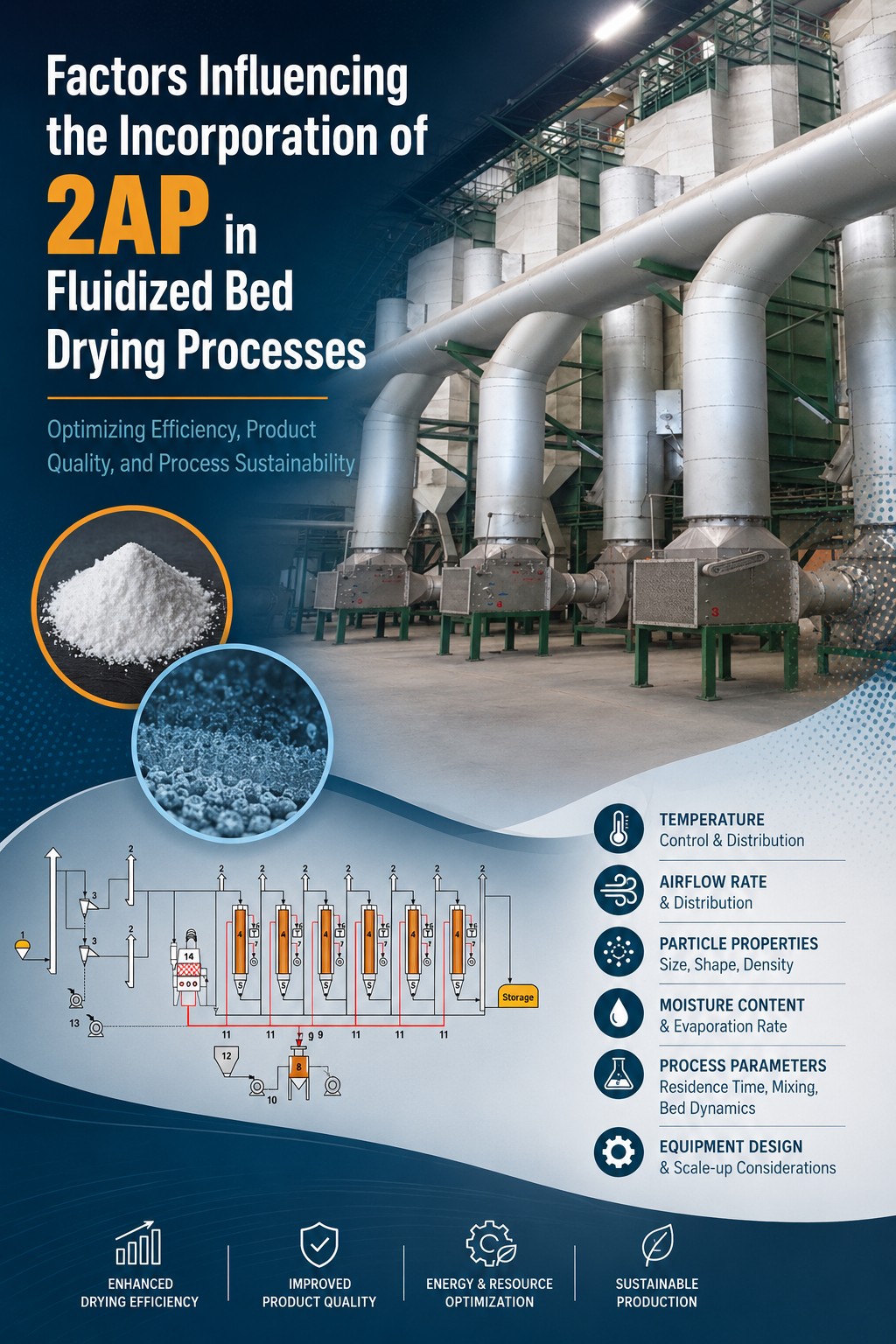
Drying high-moisture paddy rice while retaining the quality of the grains and their natural aroma is one of the hardest things to perform in industrial processing. This study examines a hybrid drying system comprising drying units from Louisiana State University (LSU), a fluidized bed dryer, and a cyclone-based hot-air generator to reduce paddy moisture content from 25–30% to the safe storage level of 14% on a wet-basis. The cyclone furnace heated the air to 280°C using leftover charcoal. Before entering the fluidized bed dryer, the air was cooled to 101.7 °C. The grain's temperature was kept below 57.7 °C during this time, which helped preserve the rice's quality. After the rice had dried out a bit, it was put in six LSU (Louisiana State University) drying chambers. Each chamber could hold 37.5 tons of rubbish every hour and worked in groups for 10 hours. The procedure worked well to lower the moisture level in a single step, even when it reached 18%. By eliminating the middle resting stage, the drying process is easier and faster without affecting the final product's quality. The dried rice had 10.7% moisture, a grain temperature of 36.9°C, and 4.15 µg/g of 2-acetyl-1-pyrroline (2AP). This means that the rice still smelled good. These results show that using fluidized bed drying with LSU drying is a good approach to make large-scale commercial drying systems work better and be simpler while maintaining excellent rice quality.
Article Details

This work is licensed under a Creative Commons Attribution-NonCommercial-NoDerivatives 4.0 International License.
References
Chungcharoen, T.; Duangniras, K.; Wongsukri, W.; Meekotekong, A. Effects of Initial Moisture Content and Bed Height of Paddy on the Minimum Air Velocity in the Fluidization Testing Machine. RSU Natl. Res. Conf. 2017, 255–264.
Ying, T.; Spang, E. S. Paddy Drying Technologies: A Review of Existing Literature on Energy Consumption. Processes 2024, 12, 532. https://doi.org/10.3390/pr12030532
Chua, K. J.; Mujumdar, A. S.; Chou, S. K. Intermittent Drying of Bioproducts—An Overview. Bioresour. Technol. 2003, 90, 285–295. https://doi.org/10.1016/S0960-8524(03)00133-0
Chitsuthipakorn, K.; Thanapornpoonpong, S.-n. Drying Kinetic Models of Rice Applying Fluidized Bed Dryer. Math. Model. Eng. Probl. 2023, 10, 334–339. https://doi.org/10.18280/mmep.100138
Nimmol, C.; Devahastin, S. Development and Study of Paddy Dehydration Process Using an Impinging Stream Dryer with Recirculating Hot-Air System; Thailand Research Fund (TRF): Thailand, 2014; Tech. Rep. RDG5450042.
Itani, T.; Tamaki, M.; Hayata, Y.; Fushimi, T.; Hashizume, K. Variation of 2-Acetyl-1-Pyrroline Concentration in Aromatic Rice Grains Collected in the Same Region in Japan and Factors Affecting Its Concentration. Plant Prod. Sci. 2004, 7, 178–183. https://doi.org/10.1626/pps.7.178
Champagne, E. T.; Bett-Garber, K. L.; Vinyard, B. T.; Webb, B. D.; McClung, A. M.; Barton, F. E.; Lyon, B. G.; Moldenhauer, K.; Linscombe, S.; Koheway, D. Effect of Drying Conditions, Final Moisture Content, and Degree of Milling on Rice Flavor. Cereal Chem. 1997, 74, 566–570. https://doi.org/10.1094/CCHEM.1997.74.5.566
Wongpornchai, S.; Dumri, K.; Jongkaew-Wattana, S.; Siri, B. Effects of Drying Methods and Storage Time on the Aroma and Milling Quality of Rice (Oryza sativa L.) cv. Khao Dawk Mali 105. Food Chem. 2004, 87, 407–414. https://doi.org/10.1016/j.foodchem.2003.12.014
Goufo, P.; Duan, M.; Wongpornchai, S.; Tang, X. Some Factors Affecting the Concentration of the Aroma Compound 2-Acetyl-1-Pyrroline in Two Fragrant Rice Cultivars Grown in South China. Front. Agric. China 2010, 4, 1–9. https://doi.org/10.1007/s11703-009-0087-x
Khomkaew, S. Influence of Drying Operating Temperature Difference on Aroma (2AP) of Thai Pathumthani Fragrant Rice. SWU Eng. J. 2021, 16, 49–55.
Khomkaew, S. Temperature of Recirculation Batch Drying of the Paddy Had an Effect on Aroma 2-AP. SWU Eng. J. 2021, 16, 1–9.
Iguaz, A.; Rodriguez, M.; Virseda, P. Influence of Handling and Processing of Rough Rice on Fissures and Head Rice Yields. J. Food Eng. 2006, 77, 803–809. https://doi.org/10.1016/j.jfoodeng.2005.08.006
Aquerreta, J.; Iguaz, A.; Arroqui, C.; Virseda, P. Effect of High Temperature Intermittent Drying and Tempering on Rough Rice Quality. J. Food Eng. 2007, 80, 611–618. https://doi.org/10.1016/j.jfoodeng.2006.06.012
Dong, R.; Lu, Z.; Liu, A.; Nishiyama, Y.; Cao, W. Moisture Distribution in a Rice Kernel during Tempering Drying. J. Food Eng. 2009, 91, 126–132. https://doi.org/10.1016/j.jfoodeng.2008.08.012
Calingacion, M.; Fang, L.; Quiatchon-Baeza, L.; Mumm, R.; Riedel, A.; Hall, R. D.; Fitzgerald, M. Delving Deeper into Technological Innovations to Understand Differences in Rice Quality. Rice 2015, 8, 1–6. https://doi.org/10.1186/s12284-015-0043-8
Soponronnarit, S. Drying of Grains in Energy Management Technology; King Mongkut's University of Technology: Thailand, 1997; pp 144–163.
Mahatheeranont, S.; Keawsa-ard, S.; Dumri, K. Quantification of the Rice Aroma Compound, 2-Acetyl-1-Pyrroline, in Uncooked Khao Dawk Mali 105 Brown Rice. J. Agric. Food Chem. 2001, 49, 773–779. https://doi.org/10.1021/jf000885y
Wongpornchai, S.; Dumri, K.; Jongkaewwattana, S.; Siri, B. Effects of Drying Methods and Storage Time on the Aroma and Milling Quality of Rice (Oryza sativa L.) cv. Khao Dawk Mali 105. Food Chem. 2003, 83, 363–369. https://doi.org/10.1016/j.foodchem.2003.12.014
Champagne, E. T. Rice Aroma and Flavor: A Literature Review. Cereal Chem. 2008, 85, 445–454. https://doi.org/10.1094/CCHEM-85-4-0445
Imran, M.; et al. The Kinetic Study of 2-Acetyl-1-Pyrroline Accumulation in the Model System: An Insight into Enhancing Rice Flavor through the Maillard Reaction. J. Agric. Food Chem. 2023, 71, 1234–1245.
Buttery, R. G.; Ling, L. C.; Juliano, B. O.; Turnbaugh, J. G. Cooked Rice Aroma and 2-Acetyl-1-Pyrroline. J. Agric. Food Chem. 1983, 31, 823–826. https://doi.org/10.1021/jf00118a036
Jezussek, M.; Juliano, B. O.; Schieberle, P. Comparison of Key Aroma Compounds in Cooked Brown Rice Varieties Based on Aroma Extract Dilution Analyses. J. Agric. Food Chem. 2002, 50, 1101–1105. https://doi.org/10.1021/jf0108720
Khan, F. A.; et al. Optimizing Tempering Drying Conditions for Milling and Physicochemical Quality of Extra Long Rice: A Machine Learning Approach. J. Agric. Food Res. 2025, 23, 102216. https://doi.org/10.1016/j.jafr.2025.102216
Martens, S.; et al. Drying and Intermittence Processes on the Polished and Brown Rice Physicochemical and Morphological Quality by Near-Infrared Spectroscopy, X-ray Diffraction, and Scanning Electron Microscopy. Food Chem. X 2023, 100753. https://doi.org/10.1016/j.fochx.2023.100753
Nasrnia, E.; Sadeghi, M.; Raeisi, A. A Study of Energy Consumption and Drying Rate: Comparison of Continuous and Intermittent Drying Methods of Rough Rice. Biomech. Bioenergy Res. 2024, 3, 39–50.
Li, J.; et al. Study on Optimization of Rice Drying Process Parameters Considering Nutritional Quality. Appl. Sci. 2024, 14, 10825. https://doi.org/10.3390/app142310825
Garcia Llobodanìn, L.; Billiris, A. Impact of the Drying Air Conditions on the Milling Quality of a Long Grain Rice Variety at Different Moisture Content Ranges Using a Lab Scale Dryer. Food Sci. Technol. (Campinas) 2024. https://doi.org/10.5327/fst.0028223
Jin, Y.; Yin, J.; Xie, H.; Zhang, Z. Investigation of a Precise Control Scheme for Rice Quality. Appl. Sci. 2023, 13, 7532. https://doi.org/10.3390/app13137532
Keya, A. C.; et al. Drying and Tempering Effect on Milling Process of Paddy in Unparboiled Condition. CIGR J. 2025.
Hasibuan, R.; et al. Drying Kinetic Models of Rice Applying Fluidized Bed Dryer. Math. Model. Eng. Probl. 2023, 10, 334–339. https://doi.org/10.18280/mmep.100138
Alim, M. S.; et al. Drying and Tempering Influence on the Milling Quality of Parboiled Paddy. Eur. J. Food Sci. Technol. 2024, 6. https://doi.org/10.24018/ejfood.2024.6.2.790
Wang, H.; et al. Effects of Drying Approaches Combined with Variable Temperature and Tempering on the Physicochemical Quality of Rice. Dry. Technol. 2023. https://doi.org/10.1080/07373937.2022.2133140
Chitsuthipakorn, K.; Thanapornpoonpong, S.-n. Effect of Large-Scale Paddy Rice Drying Process Using Hot Air Combined with Radio Frequency Heating on Milling and Cooking Qualities of Milled Rice. Foods 2022, 11, 519. https://doi.org/10.3390/foods11040519
Wang, G.; Wu, W.; Fu, D.; Xu, W.; Xu, Y.; Zhang, Y. Energy and Exergy Analyses of Rice Drying in a Novel Electric Stationary Bed Grain Drying System with Internal Circulation of the Drying Medium. Foods 2022, 11, 101. https://doi.org/10.3390/foods11010101
Taveesuvun, C.; Tirawanichakul, S.; Tirawanichakul, Y. Equilibrium Moisture Content Modeling and Study of Circulating Bed Drying Kinetics of Non-Fragrant and Fragrant Paddy Varieties. Trends Sci. 2022, 19, 4950. https://doi.org/10.48048/tis.2022.4950
Tran, T. T. H.; Le, K. H. Computational Fluid Dynamic Simulation of Packed Bed Drying Process: Impact of Particle Properties, Drying Conditions, and Lateral Edge Heating Modes on Drying Kinetics. Int. J. Air-Cond. Refrig. 2024, 32. https://doi.org/10.1007/s44189-024-00047-x
Nanvakenari, S.; Movagharnejad, K.; Latifi. Modelling and Experimental Analysis of Rice Drying in New Fluidized Bed Assisted Hybrid Infrared Microwave Dryer. Food Res. Int. 2022. https://doi.org/10.1016/j.foodres.2022.111617
Khomkaew, S.; et al. Optimizing Brown Rice Drying with Modified LSU Systems for Energy Efficiency, Carbon Reduction, and 2AP Preservation. ASEAN J. Sci. Technol. Rep. 2026, 29, 245–296. https://doi.org/10.55164/ajstr.v29i4.260421
