
Comparative Evaluation of Ground Resistance Measurement Techniques and FEM-Based Modeling under Grounding Electrode Configurations
Article Sidebar
Main Article Content
Abstract
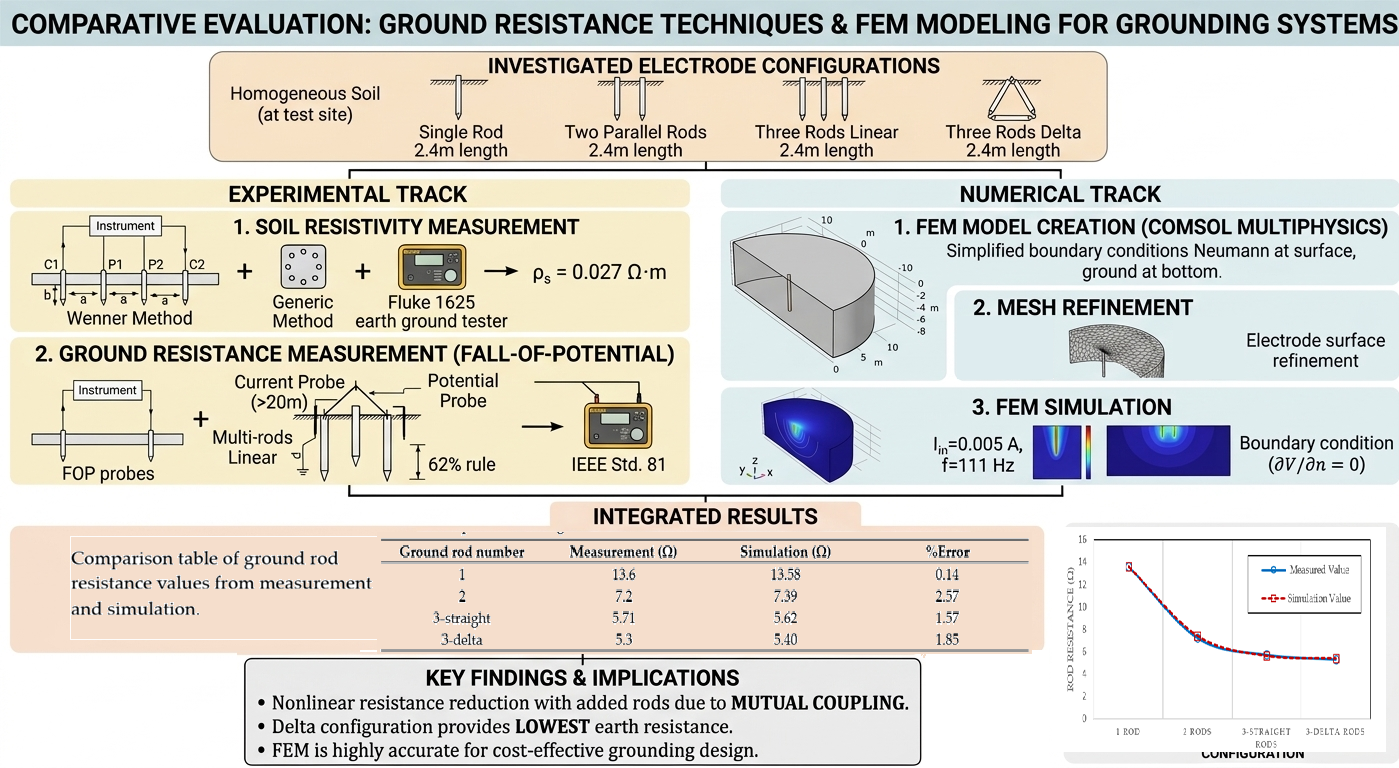
Accurate estimation of ground resistance is essential for designing safe and reliable electrical grounding systems. This study investigates the performance of four representative electrode configurations—single rod, two parallel rods, three rods in a linear arrangement, and three rods in a delta arrangement—by combining experimental measurements with numerical modeling. The ground resistance values were measured using the 3-pole Fall-of-Potential (FOP) method and the 4-pole Wenner method and compared with results simulated via the Finite Element Method (FEM) implemented in the COMSOL Multiphysics Program. The analytical solutions were set under homogeneous soil conditions at the test site. The soil resistivity was first determined experimentally to establish the boundary conditions for the FEM model. The numerical model's accuracy was confirmed by simulation results that closely matched field measurements, with a relative error of less than 3%. Moreover, the results revealed that increasing the number of grounding rods effectively reduces total earth resistance. However, the reduction is nonlinear due to mutual coupling between the adjacent electrodes. The delta configuration provided the lowest resistance, followed by the three-rod linear arrangement. Overall, the study demonstrates that FEM analysis achieves high accuracy in predicting ground resistance under uniform soil conditions. The integration of numerical and experimental approaches supports the development of cost-effective and technically robust grounding designs for high-voltage and power distribution systems.
Article Details

This work is licensed under a Creative Commons Attribution-NonCommercial-NoDerivatives 4.0 International License.
References
Sarker, M. T.; Al Qwaid, M.; Hossen, M. S.; Ramasamy, G. Performance Optimization of Grounding System for Multi-Voltage Electrical Installation. Appl. Sci. 2025, 15(15), 8600. https://doi.org/10.3390/app15158600
Dwight, H. B. Calculation of Resistances to Ground. Electr. Eng. 1936, 55, 1319–1328. https://doi.org/10.1109/T-AIEE.1936.5057209
Sunde, E. D. Earth Conduction Effects in Transmission Systems, 2nd ed.; Dover Publications: New York, 1968.
Nor, N. M.; Rajab, R.; Ramar, K. Validation of the Calculation and Measurement Techniques of Earth Resistance Values. Am. J. Appl. Sci. 2008, 5(10), 1313–1317. https://doi.org/10.3844/ajassp.2008.1313.1317
IEEE Guide for Measuring Earth Resistivity, Ground Impedance, and Earth Surface Potentials of a Grounding System; IEEE Std 81-2012; IEEE: 2012.
Gogom, M.; Gomba, R.; Lilonga-Boyenga, D. Contribution to the Improvement of the Earthing Resistance of Electrical Installations: Case of Tropical Zones Lands. Sci. J. Energy Eng. 2020, 8(1), 1–11. https://doi.org/10.11648/j.sjee.20200801.11
Muhammad, U.; Zaid, H.; Ahmad, N. N.; Mohamad Nor, N.; Aman, F. Evaluation of Steady-State Ground Resistance by Field Measurement and CDEGS Computation. Bull. Electr. Eng. Inform. 2024, 13(5), 3033–3042. https://doi.org/10.11591/eei.v13i5.7603
Abdul Ali, A. W.; Ahmad, N. N.; Mohamad Nor, N.; Idris, N. F.; Hanaffi, F. Investigations on the Performance of Grounding Device with Spike Rods (GDSR) with the Effects of Soil Resistivity and Configurations. Energies 2020, 13(14), 3538. https://doi.org/10.3390/en13143538
Abdelkader, B.; Boubakeur, Z.; Tahar, S.; Yahia, S. Implementation and Design of Grounding Systems Using COMSOL Multiphysics. In Proc. 2020 1st Int. Conf. Commun., Control Syst. Signal Process. (CCSSP); IEEE: El Oued, Algeria, 2020; pp 513–517. https://doi.org/10.1109/CCSSP49278.2020.9151798
Zaied, Z. B.; Slaoui-Hasnaoui, F.; Georges, S. Modeling and Simulation of the Potential of Four Grounding Electrodes Using the Finite Element Method. In 2023 Fifth Int. Conf. Adv. Comput. Tools Eng. Appl. (ACTEA); IEEE: Zouk Mosbeh, Lebanon, 2023; pp 162–166. https://doi.org/10.1109/ACTEA58025.2023.10194160
Dan, Y.; Zhang, Z.; Bu, S.; Wong, C.-N.; Lin, P. Analysis of Grounding Performance of Tower Grounding Electrodes in Elevated Terrain. IEEE Trans. Power Deliv. 2024, 39(6), 3305–3315. https://doi.org/10.1109/TPWRD.2024.3463174
Dikun, J.; Stanelyte, D.; Andriusis, A. Research Regarding the Methods for Computing Grounding Resistance. In 2023 IEEE 64th Int. Sci. Conf. Power Electr. Eng. Riga Tech. Univ. (RTUCON); IEEE: Riga, Latvia, 2023; pp 1–5. https://doi.org/10.1109/RTUCON60080.2023.10413122
Salam, M. A.; Rahman, Q. M. Power Systems Grounding; Springer: Singapore, 2016. https://doi.org/10.1007/978-981-10-0446-9
Guemes, J. A.; Hernando, F. E. Method for Calculating the Ground Resistance of Grounding Grids Using FEM. IEEE Trans. Power Deliv. 2004, 19(2), 595–600. https://doi.org/10.1109/TPWRD.2004.824761
Fluke Corporation. 1625-2 Earth/Ground Tester Users Manual; Fluke Corporation: Everett, WA, 2014.
