
Peer Review Process
Review Model
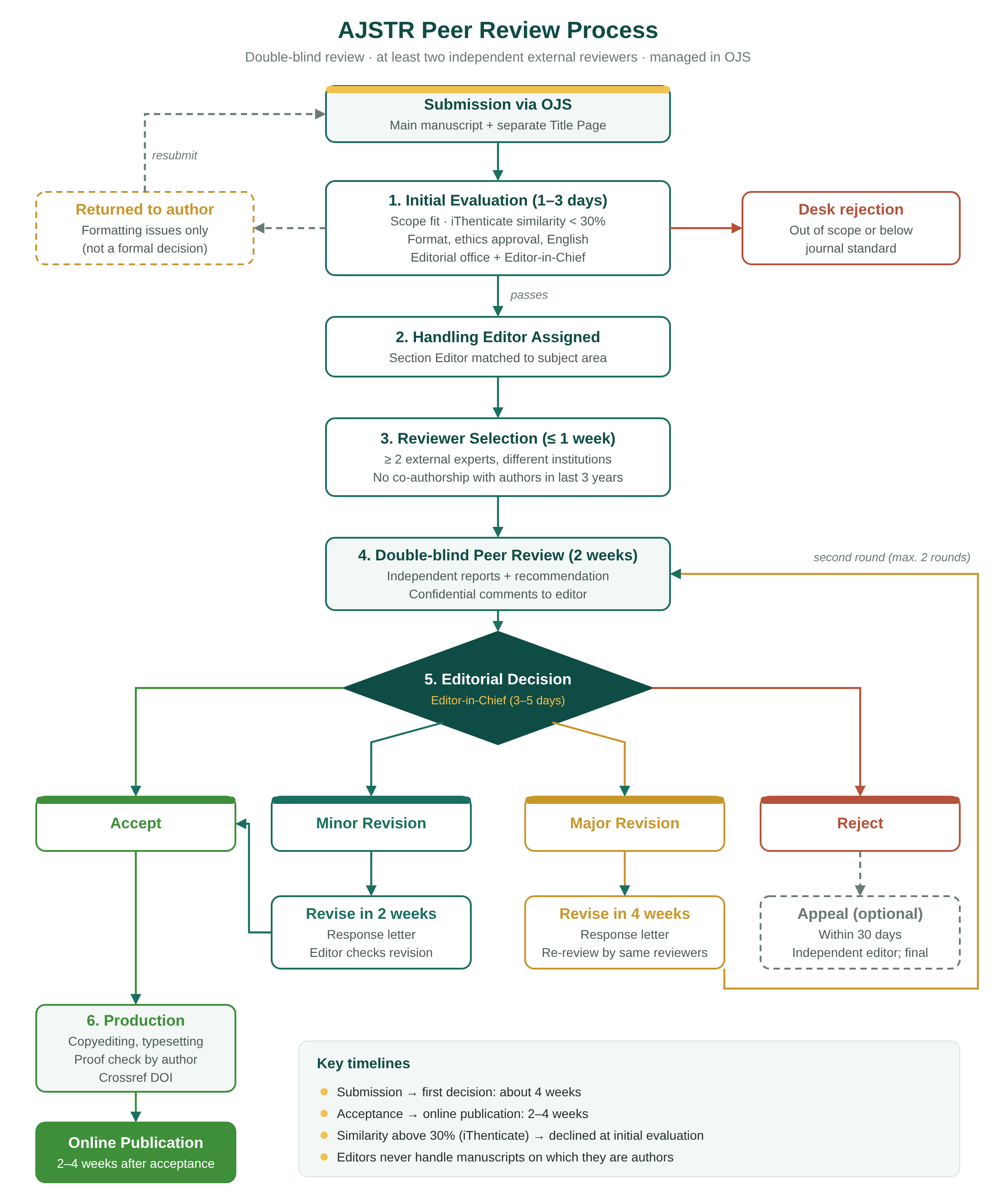
AJSTR operates double-blind peer review: reviewers do not know the identity of the authors, and authors do not know the identity of the reviewers. Every manuscript that passes initial evaluation is reviewed by at least two independent external experts. Up to five reviewers may be invited to secure two complete reports.
The review process is managed entirely through the OJS submission system and follows the COPE Ethical Guidelines for Peer Reviewers. The same process and standards apply to regular submissions and to Special Issue manuscripts.
Typical Timeline

| Stage | Target time |
|---|---|
| Initial evaluation (scope, format, similarity) | 1–3 working days |
| Reviewer invitation and assignment | within 1 week |
| Peer review | 2 weeks after accepting the invitation |
| Editorial decision | 3–5 working days after reports are complete |
| Author revision | 2 weeks (minor) / 4 weeks (major) |
| Acceptance to online publication | 2–4 weeks |
These are targets, not guarantees. Timelines may be longer when suitable reviewers are hard to find or when more than one round of revision is needed. Authors can follow the status of their manuscript at any time in their OJS dashboard.
The Review Process, Step by Step
The editorial office and the Editor-in-Chief (or a designated Associate Editor) check every new submission for:
- fit with the journal's Aims & Scope;
- similarity using iThenticate (manuscripts above 30% overall similarity are declined);
- compliance with the Author Guidelines (template, word limit, ACS references, separate Title Page);
- basic scientific soundness, ethics approval where required, and adequate English.
Manuscripts that are out of scope or clearly below the journal's standard are declined without external review (desk rejection). Manuscripts with only formatting problems are returned to the authors for correction; this is not a formal decision.
The Editor-in-Chief assigns the manuscript to the Section Editor whose expertise best matches the subject. The handling editor manages the review and makes a recommendation to the Editor-in-Chief.
Reviewers are selected for their expertise and publication record in the field. To ensure independence, reviewers:
- must not be affiliated with the same institution as any author;
- must not have co-authored with any author in the past three years;
- must declare any conflict of interest before accepting the invitation.
Authors may suggest reviewers and may request that specific individuals be excluded. The editor considers these requests but is not obliged to follow them, and at least one reviewer on every manuscript is chosen independently of the authors' suggestions.
Each reviewer assesses the manuscript independently using the AJSTR review form, covering originality, relevance to scope, soundness of methods, validity of results and conclusions, quality of figures and tables, adequacy of references, and clarity of presentation. Reviewers provide comments for the authors, confidential comments for the editor, and a recommendation.
The Editor-in-Chief makes the final decision based on the reviewers' reports and the handling editor's recommendation. Reviewer recommendations are advisory; the decision rests on the quality of the arguments, not on a vote count. When reports conflict, the editor may invite an additional reviewer. The decision and the anonymised reviewer comments are sent to the corresponding author through OJS.
Decision Types
Revision and Resubmission
- Deadlines: 2 weeks for minor revisions and 4 weeks for major revisions. Authors who need more time should ask the editorial office before the deadline. Revisions received after the deadline without an agreed extension may be treated as new submissions.
- Files to upload: (1) the revised manuscript with all changes highlighted or tracked, (2) a clean version, and (3) a point-by-point response letter.
- Response letter: address every comment, either by making the change or by giving a clear scientific reason for not doing so, and state where in the manuscript each change was made.
- Rounds: normally no more than two rounds of revision. A manuscript that still does not meet the reviewers' main concerns after two rounds may be rejected.
After acceptance, authors submit the final clean version. The editorial office handles copyediting, typesetting and Crossref DOI registration, and sends page proofs to the corresponding author for checking before publication.
Appeals
Authors who believe a decision was based on a factual error or a misunderstanding may appeal within 30 days by emailing aseanjstr@tsu.ac.th with the subject "Appeal – [Manuscript ID]" and a reasoned, point-by-point response. The appeal is assessed by an editor who was not involved in the original decision, who may consult an additional reviewer. Only one appeal is considered per manuscript, and the outcome of the appeal is final. Disagreement with a reviewer's opinion alone is not grounds for appeal.
Conflicts of Interest and Editorial Submissions
- Editors and reviewers must declare any personal, professional or financial relationship with the authors and step aside from the manuscript if a conflict exists.
- Manuscripts submitted by the Editor-in-Chief, Associate Editors or Section Editors are handled by another editor with no conflict. The author-editor has no access to the review records of their own manuscript, and such submissions go through the same double-blind review as all others.
- Guest Editors of Special Issues do not handle manuscripts on which they are authors; these are managed by a regular editor of the journal.
Guidance for Reviewers
- Respond promptly. Accept or decline the invitation within 5 days; if declining, please suggest an alternative reviewer.
- Check for conflicts. Decline if you have any relationship with the authors or their institution, or if you recognise the work and cannot be impartial.
- Keep it confidential. Do not share the manuscript, discuss it with others, or use its content before publication. Do not contact the authors.
- Be constructive and specific. Explain the strengths and weaknesses of the work and what the authors need to do to improve it. Personal or discriminatory comments are not acceptable.
- Judge the science. Base your recommendation on originality, methodology, validity and relevance. You may note language problems, but do not reject a manuscript on language alone.
- Do not request unnecessary citations to your own work or to any particular journal, including AJSTR.
- Report concerns. Tell the editor in confidential comments if you suspect plagiarism, data manipulation, image manipulation or duplicate publication.
- Meet the deadline. Submit your report within 2 weeks of accepting. If you need more time, ask the editorial office before the deadline.
The Reviewer Manual explains how to use the OJS review system. Reviewers may request a Certificate of Peer Review from the editorial office, and with their consent the journal publishes an annual list of reviewers to acknowledge their contribution. Reviewers can also record their reviews on ORCID or Web of Science Reviewer Recognition.