
Enhancing Oil Palm (Elaeis guineensis Jacq.) Growth Using Microbial Consortia: Roles of Phosphate Solubilization and Nitrogen Fixation
Article Sidebar
Main Article Content
Abstract
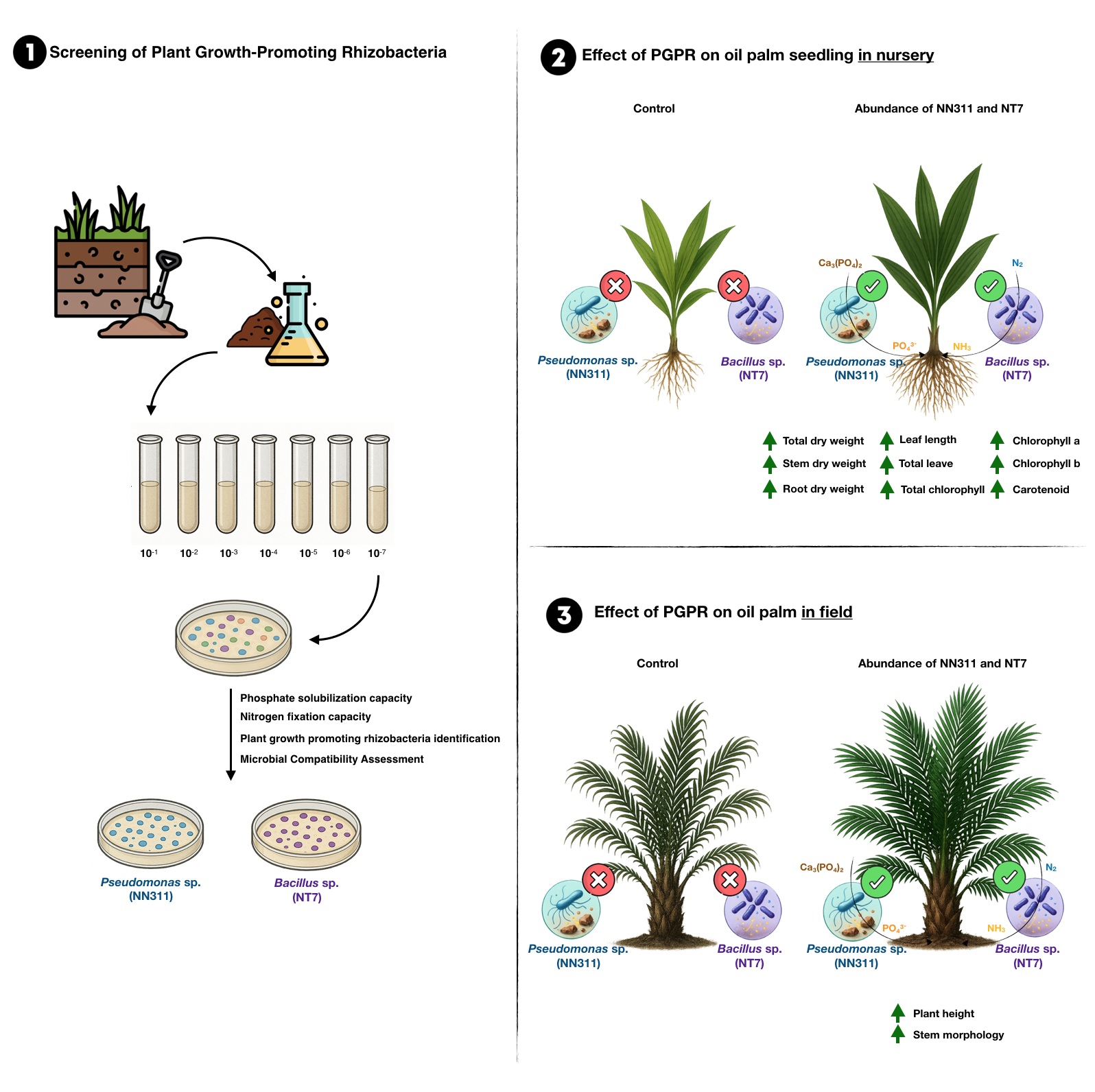
In Thailand, oil palm is a vital economic crop, primarily cultivated in the southern region. Farmers are expanding plantations by establishing new sites and replanting previous crop areas. Proper maintenance from the seedling stage is essential for growth. Agriculturists place rock phosphate at the planting hole base to speed seedling recovery after transplantation. Converting rock phosphate into water-soluble phosphate, essential for root development and pre-planting, is a labor-intensive process dependent on microbial activity. The objective of this investigation is to identify microbes capable of converting insoluble phosphate into a soluble form in water. Furthermore, oil palm seedlings require a significant amount of nitrogen. Therefore, nitrogen-fixing microorganisms are also screened. Several phosphate-soluble microorganisms have been identified, especially the NN311 strain, which is the most effective at releasing water-soluble phosphate, both qualitatively and quantitatively. For nitrogen fixation, strain NT7 performed best. NN311 was classified as Pseudomonas sp., whereas NT7 was classified as Bacillus sp., according to nucleic acid sequence analysis in comparison to the NCBI database. In the absence of antagonistic interactions between NN311 and NT7, they were assessed simultaneously in nursery research. The results indicated that the application of these microorganisms, individually or in combination, markedly enhanced seedling growth compared to the control group. Nonetheless, combining them yields optimal outcomes. The combination of NN311 and NT7 with rock phosphate in the planting hole enhances seedling growth post-transplantation. After 18 months, seedlings treated with both strains of bacteria exhibit much superior growth compared to those that do not receive microorganisms.
Article Details

This work is licensed under a Creative Commons Attribution-NonCommercial-NoDerivatives 4.0 International License.
References
Office of Agricultural Economics. Thailand Agricultural Production Index. https://www.ceicdata.com/en/thailand/agricultural-production-index-office-of-agricultural-economics (accessed Dec 12, 2024).
Wulandari, D.; Baskoro, K.; Mahmuudah, Y.; Kusmiyati, F.; Pratiwi, A. R.; Budiharjo, A. Bioprospecting of Rhizobia as Plant Growth Promoting Rhizobacteria Potential from Root Nodules of Groundnut (Arachis hypogaea L.). Trends Sci. 2024, 7651-7651. https://doi.org/10.48048/tis.2024.7651
Danesh, Y. R.; Pellegrini, M.; Akköprü, A.; Farda, B.; Boyno, G.; Djebaili, R. Plant Growth–Promoting Rhizobacteria: Their Potential as Biological Control Agents in Sustainable Agriculture. Sustainable Agricultural Practices 2024, pp. 145-159. https://doi.org/10.1016/B978-0-443-19150-3.00015-1
Oktari, I.; Mustamu, N. E.; Walida, H. Ultisols Fertility and Morphological Characteristics of N-Fixing Bacteria from Oil Palm Rhizosphere. Pesqui. Agropecu. Trop. 2021, 51, e68559. https://doi.org/10.1590/1983-40632021v5168559
Hidayat, F.; Pane, R. D. P.; Sapalina, F.; Listia, E.; Lubis, M. E. S.; Oshiro, M.; Sakai, K.; Tashiro, Y. Novel Multifunctional Plant Growth-Promoting Bacteria Isolated from the Oil Palm Rhizosphere under Long-Term Organic Matter Application. J. Biosci. Bioeng. 2024, 138, 406-414. https://doi.org/10.1016/j.jbiosc.2024.07.008
Van Chuong, N. Effect of Three Different Nitrogen Rates and Three Rhizosphere N2-Fixing Bacteria on Growth, Yield and Quality of Peanuts. Trends Sci. 2024, 21, 7281–7281. https://doi.org/10.48048/tis.2024.7281
de Aquino, G. S.; Shahab, M.; Moraes, L. A.; Moreira, A. Plant Growth Promoting Rhizobacteria Increased Canola Yield and Root System. J. Plant Nutr. 2023, 46, 1400–1406. https://doi.org/10.1080/01904167.2022.2068441
Nosheen, A.; Yasmin, H.; Naz, R.; Keyani, R.; Mumtaz, S.; Hussain, S. B.; Hassan, M. N.; Alzahrani, O. M.; Noureldeen, A.; Darwish, H. Phosphate Solubilizing Bacteria Enhanced Growth, Oil Yield, Antioxidant Properties and Biodiesel Quality of Kasumbha. Saudi J. Biol. Sci. 2022, 35, 1574–1581. https://doi.org/10.1016/j.sjbs.2021.09.068
Farhat, F.; Tariq, A.; Waseem, M.; Masood, A.; Raja, S.; Ajmal, W.; Iftikhar, I.; Zulfiqar, U.; Maqsood, M. F. Plant Growth Promoting Rhizobacteria (PGPR) Induced Improvements in the Growth, Photosynthesis, Antioxidants, and Nutrient Uptake of Rapeseed (Brassica napus L.). Gesunde Pflanzen 2023, 75, 2075-2088. https://doi.org/10.1007/s10343-023-00845-0
Azri, M. H.; Ismail, S.; Abdullah, R. An Endophytic Bacillus Strain Promotes Growth of Oil Palm Seedling by Fine Root Biofilm Formation. Rhizosphere 2018, 5, 1–7. https://doi.org/10.1016/j.rhisph.2017.10.003
Son, J. S.; Sumayo, M.; Hwang, Y. J.; Kim, B. S.; Ghim, S. Y. Screening of Plant Growth-Promoting Rhizobacteria as Elicitor of Systemic Resistance against Gray Leaf Spot Disease in Pepper. Appl. Soil Ecol. 2014, 73, 18. https://doi.org/10.1016/j.apsoil.2013.07.016
King, E. J. The Colorimetric Determination of Phosphorus. Biochem. J. 1932, 26, 292. https://doi.org/10.1042/bj0260292
Dobereiner, J.; Marriel, I.; Nery, M. Ecological Distribution of Spirillum lipoferum Beijerinck. Can. J. Microbiol. 1976, 22, 1464-1473. https://doi.org/10.1139/m76-217
Bradstreet, R. B. Kjeldahl Method for Organic Nitrogen. Anal. Chem. 1954, 26, 185–187. https://doi.org/10.1021/ac60085a028
Sambrook, J.; Fritsch, E. F.; Maniatis, T. Molecular Cloning: A Laboratory Manual, 2nd ed.; Cold Spring Harbor Laboratory Press: Cold Spring Harbor, NY, 1989.
Weisburg, W.G.; Barns, S.M.; Pelletier, D.A.; Lane, D.J. 16S ribosomal DNA amplification for phylogenetic study. J. Bacteriol. 1991. https://doi.org/10.1128/jb.173.2.697-703.1991
Basic Local Alignment Search Tool. http://www.ncbi.nlm.nih.gov/blast/Blast.cgi (accessed July 9, 2024).
Hossain, T. J. Methods for screening and evaluation of antimicrobial activity: A review of protocols, advantages, and limitations. Eur. J. Microbiol. Immunol. 2024, 14, 97–115. https://doi.org/10.1556/1886.2024.00035
Johan, F.; Jafri, M.; Lim, H.; Maznah, W. W. Laboratory Measurement: Chlorophyll-a Concentration Measurement with Acetone Method Using Spectrophotometer. In Proceedings of the 2014 IEEE International Conference on Industrial Engineering and Engineering Management; IEEE: Piscataway, NJ, 2014, pp 744-748. https://doi.org/10.1109/IEEM.2014.7058737
Amri, M.; Rjeibi, M. R.; Gatrouni, M.; Mateus, D. M.; Asses, N.; Pinho, H. J.; Abbes, C. Isolation, identification, and characterization of phosphate-solubilizing bacteria from Tunisian soils. Microorganisms 2023, 11, 783. https://doi.org/10.3390/microorganisms11030783
Ahmad, R.; Khan, S.; Hayat, M.; Afzal, S. M.; Muhammad, J. Plant Growth-Promoting Rhizobacteria/Pseudomonas as a Biofertilizer. In Biofertilizers for Sustainable Soil Management; CRC Press, 2023, pp 179–201.
Ahmad, A.; Haq, T.; Karim, A.; Saleem, M.; Hasan, K.; Liaqat, I.; Zafar, U. Designing of Phosphate Rich Compost Inoculated with Environmental Strain Pseudomonas aeruginosa AAC1 As a Phosphate Solubilizer. Int. J. Environ. Sci. Technol. 2024. 1–20. https://doi.org/10.1007/s13762-024-06278-0
Idress, M.; Khan, P.; Nawab, J.; Khan, A.; Khan, S.; Ali, R.; Rehman, A.; Alam, A.; Ayaz, S.; Bayabil, H. Improving Phosphorus Availability in Saline-Alkaline Agricultural Soils through Biochar and Phosphorus Solubilizing Bacteria (PSB) Inoculation: A Greenhouse Experiment. Int. J. Phytoremediation 2025, 27, 1042–1056. https://doi.org/10.1080/15226514.2025.2473594
Jain, S.; Varma, A.; Choudhary, D. K. Perspectives on Nitrogen-Fixing Bacillus Species. In Soil Nitrogen Ecology; Springer: Cham, Switzerland, 2021, 359–369. https://doi.org/10.1007/978-3-030-71206-8_18
Patani, A.; Patel, M.; Islam, S.; Yadav, V. K.; Prajapati, D.; Yadav, A. N.; Sahoo, D. K.; Patel, A. Recent advances in Bacillus-mediated plant growth enhancement: a paradigm shift in redefining crop resilience. World J. Microbiol. Biotechnol. 2024, 40, 77. https://doi.org/10.1007/s11274-024-03903-5
Kumar, A.; Patel, J. S.; Meena, V. S.; Srivastava, R. Recent Advances of PGPR Based Approaches for Stress Tolerance in Plants for Sustainable Agriculture. Biocatal. Agric. Biotechnol. 2019, 20, 101271. https://doi.org/10.1016/j.bcab.2019.101271
dos Reis, G. A.; Martínez-Burgos, W. J.; Pozzan, R.; Pastrana Puche, Y.; Ocán-Torres, D.; de Queiroz Fonseca Mota, P.; Rodrigues, C.; Lima Serra, J.; Scapini, T.; Karp, S. G. Comprehensive Review of Microbial Inoculants: Agricultural Applications, Technology Trends in Patents, and Regulatory Frameworks. Sustainability 2024, 16, 8720. https://doi.org/10.3390/su16198720
Lin, Q.; Li, L.; Adams, J. M.; Heděnec, P.; Tu, B.; Li, C.; Li, T.; Li, X. Nutrient Resource Availability Mediates Niche Differentiation and Temporal Co-Occurrence of Soil Bacterial Communities. Appl. Soil Ecol. 2021, 163, 103965. https://doi.org/10.1016/j.apsoil.2021.103965
Ge, J.; Li, D.; Ding, J.; Xiao, X.; Liang, Y. Microbial Coexistence in the Rhizosphere and the Promotion of Plant Stress Resistance: A Review. Environ. Res. 2023, 222, 115298. https://doi.org/10.1016/j.envres.2023.115298
Singh, M.; Jha, S.; Pathak, D.; Maisnam, G. Advancing Biofertilizers: The Evolution from Single-Strain Formulations to Synthetic Microbial Communities (SynCom) for Sustainable Agriculture. Discov. Plants 2025, 2, 226. https://doi.org/10.1007/s44372-025-00318-w
Zhao, Y.; Zhang, M.; Liu, Z.; Yang, F. Migration and Transformation of Soil Phosphorus by Organic Acids: A Global Meta-Analysis. J. Soils Sediments 2024, 24, 589–602. https://doi.org/10.1007/s11368-023-03665-x
Zhang, W.; Ni, K.; Long, L.; Ruan, J. Nitrogen Transport and Assimilation in Tea Plant (Camellia sinensis): A Review. Front. Plant Sci. 2023. https://doi.org/10.3389/fpls.2023.1249202
Seghouani, M.; Bravin, M. N.; Mollier, A. Crop Response to Nitrogen-Phosphorus Colimitation: Theory, Experimental Evidences, Mechanisms, and Models. A Review. Agron. Sustain. Dev. 2024, 44, 3. https://doi.org/10.1007/s13593-023-00939-z
Zulfiqar, S.; Sharif, S.; Saeed, M.; Tahir, A. Role of Carotenoids in Photosynthesis. In Carotenoids: Structure and Function in the Human Body; Springer: Cham, Switzerland, 2021, pp. 147–187. https://doi.org/10.1007/978-3-030-46459-2_5
Berg, J. M.; Tymoczko, J. L.; Gatto, G. J.; Stryer, L. Photosynthetic organisms convert light energy into chemical energy to produce sugars as precursors for other organic molecules. Biochemistry, 8th ed.; W.H. Freeman: New York, 2015; pp. 765–790.
Fathi, A. Role of Nitrogen (N) in Plant Growth, Photosynthesis Pigments, and N Use Efficiency: A. Agrisost 2022, 28, 1–8. https://doi.org/10.5281/zenodo.7143588
Melero, S.; Madejón, E.; Ruiz, J. C.; Herencia, J. F. Chemical and Biochemical Properties of a Clay Soil under Dryland Agriculture System as Affected by Organic Fertilization. Eur. J. Agron. 2007, 26, 327–334. https://doi.org/10.1016/j.eja.2006.11.004
Huntley, B. J. Soil, Water and Nutrients. In Ecology of Angola: Terrestrial Biomes and Ecoregions; Springer: Cham, Switzerland, 2023, pp. 127–147. https://doi.org/10.1007/978-3-031-18923-4_6
Corley, R. H. V.; Tinker, P. B. The Oil Palm, 5th ed.; Wiley-Blackwell: Chichester, UK, 2016.
Ajijah, N.; Fiodor, A.; Pandey, A. K.; Rana, A.; Pranaw, K. Plant Growth-Promoting Bacteria (PGPB) with Biofilm-Forming Ability: A Multifaceted Agent for Sustainable Agriculture. Diversity 2023, 15, 112. https://doi.org/10.3390/d15010112
