
Development of High-performance Activated Carbon Derived from Longan Peel for Caffeine Removal in Ion-rich Hospital Wastewater
Article Sidebar
Main Article Content
Abstract
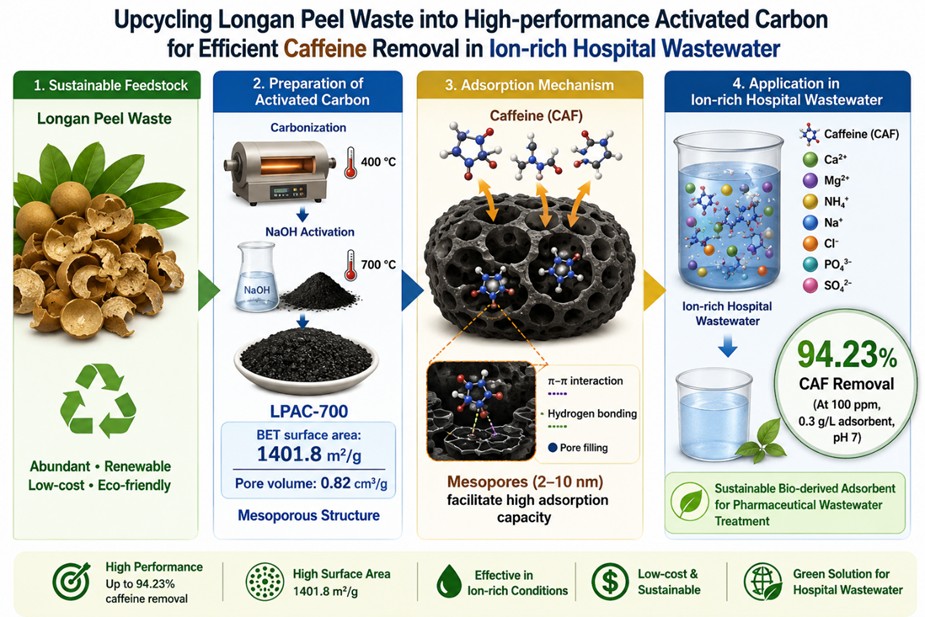
This study presents the development of activated carbon derived from longan peel (LPAC) as an efficient and low-cost adsorbent for the removal of caffeine (CAF) from synthetic hospital wastewater. Longan peel was carbonized and chemically activated at 600 °C and 700 °C, producing LPAC-600 and LPAC-700, respectively. The structural, textural, and functional properties of the adsorbents were characterized using XRD, FTIR, N₂ adsorption–desorption analysis, and SEM. The results indicated that increasing the activation temperature significantly enhanced surface area, pore volume, and graphitic carbon structure, with LPAC-700 exhibiting the highest BET surface area (1401.8 m²/g) and mesoporosity. Batch adsorption experiments demonstrated that LPAC-700 achieved superior CAF removal compared to LPAC-600 in both deionized water and synthetic hospital wastewater, although ion-rich conditions reduced removal efficiency due to competitive adsorption. The optimal adsorbent dosage was 0.3 g/L, yielding up to 94.23% CAF removal at an initial concentration of 100 ppm. Solution pH strongly influenced adsorption, with maximum removal at pH 7, attributed to favorable π–π interactions and hydrogen bonding. These findings confirm that LPAC-700 is a promising bio-derived adsorbent for caffeine removal in complex wastewater systems.
Article Details

This work is licensed under a Creative Commons Attribution-NonCommercial-NoDerivatives 4.0 International License.
References
Colombo, R.; Papetti, A. An Outlook on the Role of Decaffeinated Coffee in Neurodegenerative Diseases. Crit. Rev. Food Sci. Nutr. 2020, 60, 760–779. https://doi.org/10.1080/10408398.2018.1550384
Bachmann, S. A. L.; Calvete, T.; Féris, L. A. Caffeine Removal from Aqueous Media by Adsorption: An Overview of Adsorbents Evolution and the Kinetic, Equilibrium and Thermodynamic Studies. Sci. Total Environ. 2021, 767, 144229. https://doi.org/10.1016/j.scitotenv.2020.144229
Li, S.; He, B.; Wang, J.; Liu, J.; Hu, X. Risks of Caffeine Residues in the Environment: Necessity for a Targeted Ecopharmacovigilance Program. Chemosphere 2020, 243, 125343. https://doi.org/10.1016/j.chemosphere.2019.125343
Vieira, L. R.; Soares, A. M. V. M.; Freitas, R. Caffeine as a Contaminant of Concern: A Review on Concentrations and Impacts in Marine Coastal Systems. Chemosphere 2022, 286(2), 131675. https://doi.org/10.1016/j.chemosphere.2021.131675
Buerge, I. I.; Poiger, T.; Müller, M. D.; Buser, H.-R. Caffeine: An Anthropogenic Marker for Wastewater Contamination of Surface Waters. Environ. Sci. Technol. 2003, 37(4), 691–700. https://doi.org/10.1021/es020125z
Quesada, H. B.; de Araújo, T. P.; Cusioli, L. F.; de Barros, M. A. S. D.; Gomes, R. G.; Bergamasco, R. Caffeine Removal by Chitosan/Activated Carbon Composite Beads: Adsorption in Tap Water and Synthetic Hospital Wastewater. Chem. Eng. Res. Des. 2022, 184, 1–12. https://doi.org/10.1016/j.cherd.2022.05.044
Thomas, T.A.; Stüber, J.; Herrmann, N.; McDowell, D.; Ried, A.; Kampmann, M.; Bernhard, T. Ozonation: A Tool for Removal of Pharmaceuticals, Contrast Media and Musk Fragrances from Wastewater. Water Res. 2003, 37(8), 1976–1982. https://doi.org/10.1016/S0043-1354(02)00570-5
Afonso-Olivares, C.; Fernández-Rodríguez, C.; Ojeda-González, R. J.; Sosa-Ferrera, Z.; Santana-Rodríguez, J. J.; Doña Rodríguez, J. M. Estimation of Kinetic Parameters and UV Doses Necessary to Remove Twenty-Three Pharmaceuticals from Pre-Treated Urban Wastewater by UV/H₂O₂. J. Photochem. Photobiol. A 2016, 329, 130–138. https://doi.org/10.1016/j.jphotochem.2016.06.018
Ptaszkowska-Koniarz, M.; Gościańska, J.; Pietrzak, R. Synthesis of Carbon Xerogels Modified with Amine Groups and Copper for Efficient Adsorption of Caffeine. Chem. Eng. J. 2018, 345, 13–21. https://doi.org/10.1016/j.cej.2018.03.132
Beltrame, K. K.; Cazetta, A. L.; de Souza, P. S. C.; Spessato, L.; Silva, T. L.; Almeida, V. C. Adsorption of Caffeine on Mesoporous Activated Carbon Fibers Prepared from Pineapple Plant Leaves. Ecotoxicol. Environ. Saf. 2018, 147, 64–71. https://doi.org/10.1016/j.ecoenv.2017.08.034
Essam, A.; Eldek, S. I.; Shehata, N. Management of Caffeine in Wastewater Using MOF and Perovskite Materials: Optimization, Kinetics, and Adsorption Isotherm Modelling. J. Environ. Health Sci. Eng. 2024, 22, 345–360. https://doi.org/10.1007/s40201-024-00904-2
Hua, Y.; Liu, G.; Lin, Z.; Jie, Z.; Zhao, C.; Han, J.; Chen, G.; Li, L.; Huang, X.; Liu, Z.; Lv, J.; Xu, D. Engineering of Zeolitic Imidazolate Frameworks Based on Magnetic 3D Graphene for Adsorption and Removal of Caffeine from Tea Samples. Food Chem. 2024, 431, 137143. https://doi.org/10.1016/j.foodchem.2023.137143
Hoa, N. T. H.; Quynh, N. T.; Nguyen, V. D.; Nguyen, T. N.; Huy, B. Q.; Thanh, N. T.; Loan, H. T.; Hoa, N. T. Q.; Nghia, N. T. Adsorptive Removal of Reactive Black 5 by Longan Peel-Derived Activated Carbon. Water 2025, 17, 1678. https://doi.org/10.3390/w17111678
Yang, J.; Yu, M.; Chen, W. Adsorption of Hexavalent Chromium from Aqueous Solution by Activated Carbon Prepared from Longan Seed: Kinetics, Equilibrium and Thermodynamics. J. Ind. Eng. Chem. 2015, 21, 414–422. https://doi.org/10.1016/j.jiec.2014.02.054
Tiwari, B.; Sellamuthu, B.; Piché-Choquette, S.; Drogui, P.; Tyagi, R. D.; Vaudreuil, M. A.; Sauvé, S.; Buelna, G.; Dubé, R. The Bacterial Community Structure of Submerged Membrane Bioreactor Treating Synthetic Hospital Wastewater. Bioresour. Technol. 2019, 286, 121362. https://doi.org/10.1016/j.biortech.2019.121362
Cazetta, A. L.; Martins, A. C.; Pezoti, O.; Bedin, K. C.; Beltrame, K. K.; Asefa, T.; Almeida, V. C. Synthesis and Application of N,S-Doped Mesoporous Carbon Obtained from Nanocasting. Chem. Eng. J. 2016, 315, 54–63. https://doi.org/10.1016/j.cej.2016.04.124
Yakout, S. M.; El-Deen, G. S. Characterization of Activated Carbon Prepared by Phosphoric Acid Activation of Olive Stones. Arab. J. Chem. 2016, 9, 1155–1162. https://doi.org/10.1016/j.arabjc.2011.12.002
Zhu, D.; Pignatello, J. J. Characterization of Aromatic Compound Interactions with Black Carbon (Charcoal) Assisted by Graphite as a Model. Environ. Sci. Technol. 2005, 39, 2033–2041. https://doi.org/10.1021/es0491376
Yang, R.; Liu, G.; Xu, X.; Li, M.; Zhang, J.; Hao, X. Surface Texture, Chemistry and Adsorption Properties of Acid Blue 9 of Hemp (Cannabis sativa L.) Bast-Based Activated Carbon Fibers Prepared by Phosphoric Acid Activation. Biomass Bioenergy 2011, 35, 437–445. https://doi.org/10.1016/j.biombioe.2010.08.061
Rajkamal, A.; Kim, H. Theoretical Verification on Adsorptive Removal of Caffeine by Carbon- and Nitrogen-Based Surfaces: Role of Charge Transfer, π-Electron Occupancy, and Temperature. Chemosphere 2023, 339, 139667. https://doi.org/10.1016/j.chemosphere.2023.139667
