
Production of Fermented Vinegar Drink From Hang Rice With Pineapple Peel Syrup
Article Sidebar
Main Article Content
Abstract
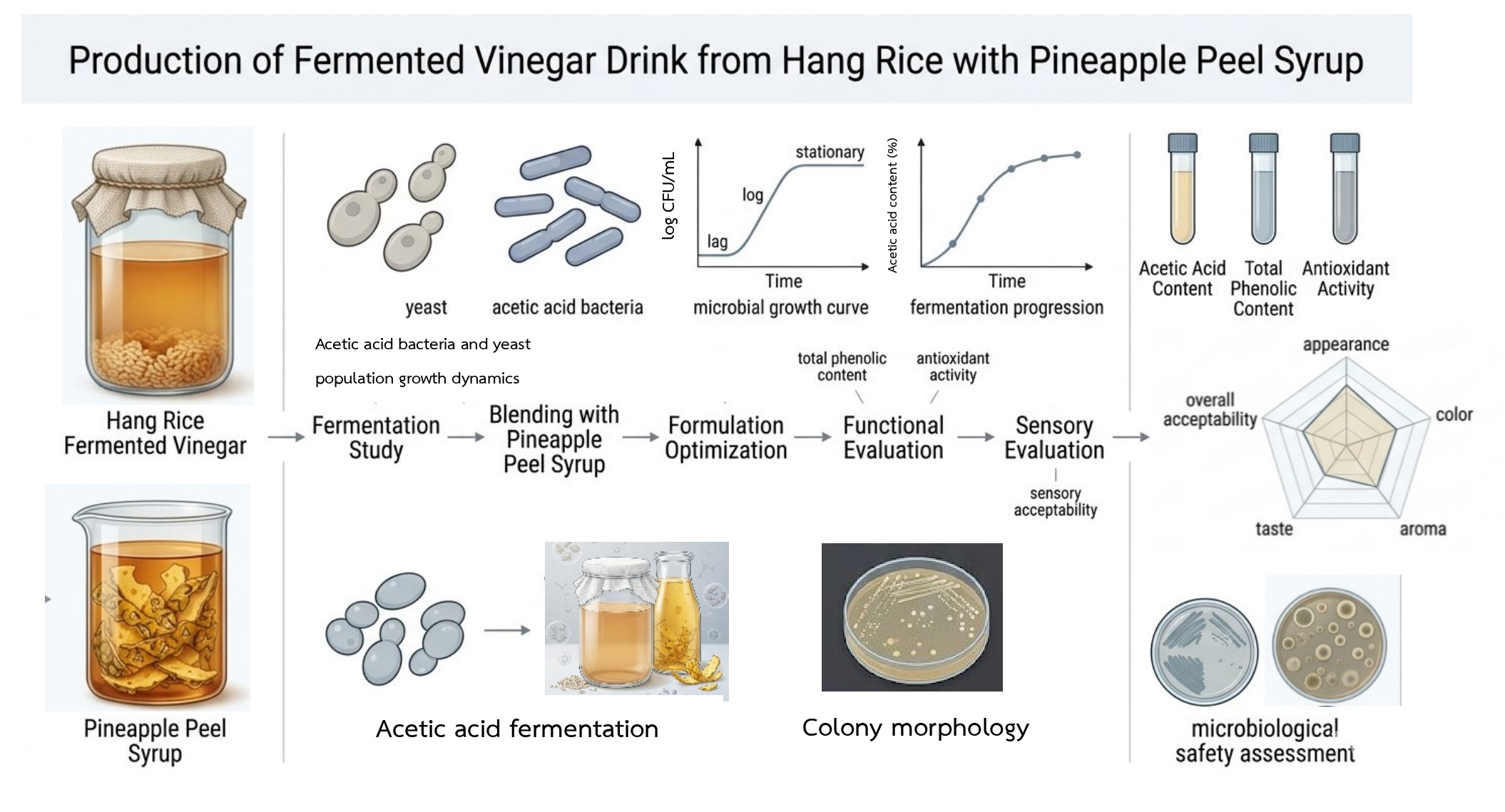
This study aimed to develop fermented vinegar beverages produced from Hang rice combined with pineapple peel syrup through traditional fermentation. The fermentation process was carried out under ambient conditions for 30 days using a traditional method to monitor changes in acetic acid bacteria and yeast populations, as well as acetic acid production. Consumer preference for the final product was also assessed. The microbial populations of both acetic acid bacteria and yeast showed a sharp increase during the first 14 days, reaching their peaks at 7.92 ± 0.24 log CFU/mL and 7.06 ± 0.28 log CFU/mL, respectively, after 30 days. The final vinegar exhibited 4.44 ± 0.31% acetic acid, a pH of 3.6, and showed no detectable alcohol. Three formulations were prepared by varying the ratio of Hang rice vinegar to pineapple peel syrup—Formula 1 (60:40), Formula 2 (50:50), and Formula 3 (40:60). Among them, Formula 3 demonstrated the highest DPPH radical scavenging activity (503.70 ± 24.42 µg Trolox/mL) and the greatest total phenolic content (97.24 ± 4.36 µgGAE/mL). Sensory analysis revealed comparable acceptability scores across all samples, ranging from “like slightly” to “like moderately”. These findings suggest that Hang rice vinegar supplemented with pineapple peel syrup represents a novel beverage with significant in vitro antioxidant capacity, adding value to germinated brown rice and promoting the utilization of pineapple peel waste.
Article Details

This work is licensed under a Creative Commons Attribution-NonCommercial-NoDerivatives 4.0 International License.
References
Xia, T.; Zhang, B.; Duan, W.; Zhang, J.; Wang, M. Nutrients and Bioactive Components from Vinegar: A Fermented and Functional Food. J. Funct. Foods 2020, 64, 103681. https://doi.org/10.1016/j.jff.2019.103681
Kandylis, P.; Bekatorou, A.; Dimitrellou, D.; Plioni, I.; Giannopoulou, K. Health Promoting Properties of Cereal Vinegars. Foods 2021, 10, 344. https://doi.org/10.3390/foods10020344
Hindi, N. K. K. In Vitro Antibacterial Activity of Aquatic Garlic Extract, Apple Vinegar and Apple Vinegar–Garlic Extract Combination. AJPCT 2013, 1, 42–51.
Baba, N.; Higashi, Y.; Kanekura, T. Japanese Black Vinegar “Izumi” Inhibits the Proliferation of Human Squamous Cell Carcinoma Cells via Necroptosis. Nutr. Cancer 2013, 65(7), 1093–1097. https://doi.org/10.1080/01635581.2013.815234
Shi, G. Talk about Chinese Vinegar. China Brewing 1999, 63, 9–40
Taweekasemsombut, S.; Tinoi, J.; Mungkornasawakul, P.; Chandet, N. Thai Rice Vinegars: Production and Biological Properties. Appl. Sci. 2021, 11, 5929. https://doi.org/10.3390/app11135929
Tudpor, K.; Jirasatid, S.; Srinukoon, K.; Srisuk, N. Vinegar Production from Thai Rice Varieties with Emphasis on the Biological Properties of Sangyod Rice Vinegar. Res. Square 2025. https://doi.org/10.21203/rs.3.rs-7050140/v1
Boonsupa, W.; Tongdonpriang, K.; Seehabuntong, K.; Soongpon, W.; Kinboran, W.; Chumduang, N.; Janngam, W.; Thongdee, A.; Pase, U.; Saksriboondee, P. Chemical Properties, Antioxidant Activity and Sensory Evaluation of Fermented Vinegar from Three Rice Cultivars. RMUTI J. Sci. Technol. 2019, 12(2), 52–61
Saithong, P.; Permpool, J.; Nitipan, S. Antioxidant and Anthocyanin-Rich Vinegar Fermented from Thai Colored Rice Varieties. Trends Sci. 2023, 21(6), 7532. https://doi.org/10.48048/tis.2024.7532
Prommakool, A. Comparison of Chemical Compositions and Bioactive Compounds of Non-Germinated and Germinated Black Hang Rice. In Proc. Int. Conf. Starch Technol.; Bangkok, Thailand, 2013
Moongngarm, A.; Saetung, N. Comparison of Chemical Compositions and Bioactive Compounds of Germinated Rough Rice and Brown Rice. Food Chem. 2010, 122, 782–788. https://doi.org/10.1016/j.foodchem.2010.03.053
Lin, P. Y.; Lai, H. M. Bioactive Compounds in Rice during Grain Development. Food Chem. 2011, 127, 86–93. https://doi.org/10.1016/j.foodchem.2010.12.092
Kim, H. Y.; Hwang, I. G.; Kim, T. M.; Woo, K. S.; Park, D. S.; Kim, J. H.; Kim, D. J.; Lee, J.; Lee, Y. R.; Jeong, H. S. Chemical and Functional Components in Different Parts of Rough Rice (Oryza sativa L.) before and after Germination. Food Chem. 2012, 134(1), 288–293. https://doi.org/10.1016/j.foodchem.2012.02.138
Chunthanom, P.; Tsai, P. J. Qualities of Hang Rice in Northeast Thailand. In Proc. KU-KPS Natl. Conf.; Kasetsart University: Nakhon Pathom, Thailand, 2014
Kerdpiboon, S.; Puttongsiri, T. Characteristics of Hang Rice and Its Cooking. KKU Res. J. 2015, 20(1), 26–33. https://doi.org/10.14456/KKURJ.2015.3
Cornelia, M.; Kristyanti, T. Utilization of Pineapple Peel Waste as Raw Material in Cider Making. In Proc. Int. Conf. Comput. Environ. Agric. Soc. Sci. Eng. Technol.; Medan, Indonesia, 2018. https://doi.org/10.5220/0010041402580263
Roda, A.; Lambri, M. Food Uses of Pineapple Waste and By-Products: A Review. Int. J. Food Sci. Technol. 2019. https://doi.org/10.1111/ijfs.14128
AOAC International. Official Methods of Analysis, 21st ed.; AOAC: Gaithersburg, MD, 2019
Xia, T.; Zhang, B.; Duan, W.; Zhang, J.; Wang, M. Nutrients and Bioactive Compounds in Traditional Rice Vinegars: A Review. Food Chem. 2020, 310, 125835. https://doi.org/10.1016/j.foodchem.2019.125835
Tamaruay, C.; Boonkerd, N.; Tantratian, S.; Panyachariwat, A. Quality of Germinated Brown Rice Vinegar Fermented by Different Strains of Acetobacter aceti. J. Appl. Sci. 2017, 16(1), 1–13
Klaudia, M.; Karolina, J. Chemical Profiles and Antioxidant Properties of Fruit and Vegetable Vinegars Available on the Polish Market. Foods 2024, 13, 1488. https://doi.org/10.3390/foods13101488
Manosroi, A.; Ruksiriwanich, W.; Kietthanakorn, B.; Manosroi, W.; Manosroi, J. Relationship between Biological Activities and Bioactive Compounds in Fermented Rice Sap. Food Res. Int. 2011, 44, 2757–2765. https://doi.org/10.1016/j.foodres.2011.06.010
Taechavasonyoo, A.; Thaniyavarn, J.; Yompakdee, C. Identification of Molds and Yeasts in Loogpang Starter. Asian J. Food Agro-Ind. 2013, 6, 24–38
Tochampa, W.; Jittrepotch, N.; Kongbangkerd, T.; Kraboun, K.; Rojsuntornkitti, K. Microwave Heating Effects on Sweet Fermented Glutinous Rice. Int. J. Food Sci. Technol. 2011, 18, 239–248
Isham, N. K. M.; Mokhtar, N.; Fazry, S.; Lim, S. J. Development of an Alternative Fermentation Model for Vinegar Production. LWT 2019, 100, 322–327. https://doi.org/10.1016/j.lwt.2018.10.065
Codex Alimentarius Commission. Standard for Vinegar (CXS 162-1987); FAO/WHO, 1987
Bhat, S. V.; Akhtar, R.; Amin, T. Biological Production of Vinegar: An Overview. Int. J. Food Sci. Technol. 2014, 3, 139
Mota, J.; Vilela, A. Aged to Perfection: The Science behind Vinegar and Acetic Acid Bacteria. Fermentation 2024, 10, 200. https://doi.org/10.3390/fermentation10040200
Tran, T.; Grandvalet, C.; Verdier, F.; Martin, A.; Alexandre, H.; Tourdot-Maréchal, R. Microbial Dynamics in Kombucha Fermentation. Foods 2020, 9, 963. https://doi.org/10.3390/foods9070963
Vilela, A. Microbial Dynamics in Wine Vinegar. Appl. Sci. 2023, 13, 7366. https://doi.org/10.3390/app13137366
Vilela, A. Microbial dynamics in sour–sweet wine vinegar: Impacts on chemical and sensory composition. Appl. Sci. 2023, 13, 7366. https://doi.org/10.3390/app13137366.
Wu, J. J.; Ma, Y. K.; Zhang, F. F.; Chen, F. S. Biodiversity of yeasts, lactic acid bacteria and acetic acid bacteria in the traditional fermentation of Shanxi aged vinegar. Food Microbiol. 2012, 30(2), 289–297. https://doi.org/10.1016/j.fm.2011.08.010
Santos, R. C.; Pires, L. S. O.; Barbosa, H. C. P.; Uetanabaro, A. P. T.; Assis, S. A.; Ramos, C. L.; Schwan, R. F. Spontaneous and induced fermentation of pineapple vinegar: Physicochemical and sensory profiles. Int. J. Food Sci. Technol. 2022, 57(1), 45–56. https://doi.org/10.1111/ijfs.15174
Roda, A.; Lambri, M.; De Faveri, D. M. Vinegar production from pineapple wastes: An overview. J. Food Process. Preserv. 2017, 41(5), e13173.
Antoniewicz, P.; Satora, P.; Pielech-Przybylska, K. Microbiological and chemical profile of vinegars produced by spontaneous fermentation. Appl. Sci. 2021, 11(13), 5929. https://doi.org/10.3390/app11135929
Jayus, J.; Setiawan, R.; Giyarto, G. Chemical and sensory properties of spontaneous fermented red rice vinegar. In Proceedings of the 3rd International Conference on Food and Agriculture (ICFA); Politeknik Negeri Jember (Polije): Jember, Indonesia, 2020.
Talukder, A. A.; Easmin, F.; Mahmud, S. A.; Yamada, M. Thermotolerant yeasts capable of producing bioethanol: Isolation from natural fermented sources, identification and characterization. Biotechnol. Biotechnol. Equip. 2016, 30(6), 1106–1114. https://doi.org/10.1080/13102818.2016.1228477
Choi, D. H.; Park, E. H.; Kim, M. D. Isolation of thermotolerant yeast Pichia kudriavzevii from nuruk. Food Sci. Biotechnol. 2017, 26, 1357–1362. https://doi.org/10.1007/s10068-017-0155-6
Aouine, M.; Elalami, D.; Koraichi, S. I.; Haggoud, A.; Barakat, A. Exploring natural fermented foods as a source for new efficient thermotolerant yeasts for the production of second-generation bioethanol. Energies 2022, 15(14), 4954. https://doi.org/10.3390/en15144954
Cheenacharoen, S.; Juntachai, W. Diversity and genetic relationship of ethanol tolerant yeasts isolated from rice wine starters (Loog-Pang) in Chiang Mai province. TJST 2018, 478–489. https://doi.org/10.14456/jstel.2022.23
Chay, C.; Dizon, E. I.; Elegado, F. B.; Norng, C.; Hurtada, W. A.; Raymundo, L. C. Isolation and identification of mold and yeast in medombae, a rice wine starter culture from Kompong Cham Province, Cambodia. Food Res. 2017, 6, 213–220. https://doi.org/10.26656/fr.2017.6.101
Gullo, M.; Giudici, P. Acetic acid bacteria in traditional balsamic vinegar: Phenotypic traits relevant for starter cultures selection. Int. J. Food Sci. Technol. 2018, 125(1), 46–53. https://doi.org/10.1016/j.ijfoodmicro.2007.11.076
Saithong, P.; Permpool, J.; Nitipan, S. Antioxidant and anthocyanin-rich vinegar fermented from Thai colored rice varieties. TiS 2023, 21(6), 7532. https://doi.org/10.48048/tis.2024.7532
Ezemba, A. S.; Osuala, O. J.; Orji, M. U.; Ezemba, C. C.; Anaukwu, C. Production and comparative physicochemical analysis of vinegar from locally grown fruits in Nigeria and industrial produced vinegar. Am. J. Microbiol. Res. 2021, 9(1), 25–33. https://doi.org/10.12691/ajmr-9-1-4
Pan, D. D.; Wu, Z.; Peng, T.; Zeng, X. Q.; Li, H. Volatile organic compounds profile during milk fermentation by Lactobacillus pentosus and correlations between volatile flavor and carbohydrate metabolism. J. Dairy Sci. 2014, 97, 624–631. https://doi.org/10.3168/jds.2013-7131
Su, M. S.; Chien, P. J. Aroma impact components of rabbiteye blueberry (Vaccinium ashei) vinegars. Food Chem. 2010, 119, 923–928. https://doi.org/10.1016/j.foodchem.2009.07.053
Umaru, F. F.; Esedafe, W. K.; Obidah, J. S.; Akinwotu, O.; Danba, E. Production of vinegar from pineapple peel wine using Acetobacter species. In Proceedings of the 3rd International Conference on Biological, Chemical and Environmental Sciences; Kuala Lumpur, Malaysia, 2015.
Tesfaye, W.; García-Parrilla, M.; Troncoso, A. Sensory evaluation of sherry wine vinegar. J. Sens. Stud. 2002, 17, 133–144. https://doi.org/10.1111/j.1745-459X.2002.tb00338.x
Lu, S.; Cao, Y.; Yang, Y.; Jin, Z.; Luo, X. Effect of fermentation modes on nutritional and volatile compounds of Huyou vinegar. J. Food Sci. Technol. 2018, 55, 2631–2640. https://doi.org/10.1007/s13197-018-3184-0
Al-Dalali, S.; Zheng, F. P.; Xu, B. C.; Abughoush, M.; Li, L. H.; Sun, B. G. Processing technologies and flavor analysis of Chinese cereal vinegar: A comprehensive review. Food Anal. Methods 2023, 16(1), 29–29. https://doi.org/10.1007/s12161-022-02328-w
Zhou, Z.; Liu, S.; Kong, X.; Ji, Z.; Han, X.; Wu, J.; Mao, J. Elucidation of the aroma compositions of Zhenjiang aromatic vinegar using comprehensive two-dimensional gas chromatography coupled to time-of-flight mass spectrometry and gas chromatography-olfactometry. J. Chromatogr. A 2017, 1487, 218–226. https://doi.org/10.1016/j.chroma.2017.01.014
Chotimarkorn, C.; Benjakul, S.; Silalai, N. Antioxidant components and properties of five long-grained rice bran extracts from commercially available cultivars in Thailand. Food Chem. 2008, 111, 636–641. https://doi.org/10.1016/j.foodchem.2008.04.031
Suwannawong, P.; Waratchareeyakul, W.; Chasvised, S.; Yuenyongcharoendee, K.; Pangnole, S.; Yusorn, A.; Apinansawat, N. Brown rice and Hang rice of Lai Pla Thong variety: Antioxidant activity and consumer acceptance. J. Sci. Technol. Rajabhat Maha Sarakham Univ. 2023, 6(1), 1–13.
Phattayakorn, K.; Pajanyor, P.; Wongtecha, S.; Prommakool, A.; Saveboworn, W. Effect of germination on total phenolic content and antioxidant properties of Hang rice. Int. Food Res. J. 2016, 23(1), 406–409.
Boonsupa, W.; Tongdonpriang, K.; Seehabuntong, K.; Soongpon, W.; Kinboran, W.; Chumduang, N.; Janngam, W.; Thongdee, A.; Pase, U.; Saksriboondee, P. Chemical properties, antioxidant activity and sensory evaluation of fermented vinegar from three rice cultivars. RMUTI J. Sci. Technol. 2019, 12(2), 52–61.
Liu, S. H.; Liu, Y. G.; Zhang, X. M. Extraction conditions and antioxidant activities of pineapple peel extracts by ultrasonic method. IOP Conf. Ser.: Earth Environ. Sci. 2018, 186, 012038. https://doi.org/10.1088/1755-1315/186/4/012038
Lourenço, S. C.; Campos, D. A.; Gómez-García, R.; Pintado, M.; Oliveira, M. C.; Santos, D. I.; Corrêa-Filho, L. C.; Moldão-Martins, M.; Alves, V. D. Optimization of natural antioxidants extraction from pineapple peel and their stabilization by spray drying. Foods 2021, 10, 1255. https://doi.org/10.3390/foods10061255
Dabesor, A. P.; Asowata-Ayodele, A. M.; Umoiette, P. Phytochemical compositions and antimicrobial activities of Ananas comosus peel and Cocos nucifera kernel. Am. J. Plant Sci. 2017, 2, 73–76. https://doi.org/10.11648/j.ajpb.20170202.15
Punbusayakul, N.; Samart, S.; Sudmee, W. Antimicrobial activity of pineapple peel extract. In Proceedings of the Innovation of Functional Foods in Asia Conference; University of Phayao: Phayao, Thailand, 2017.
Li, T.; Shen, P.; Liu, W.; Liu, C.; Liang, R.; Yan, N.; Chen, J. Major polyphenolics in pineapple peels and their antioxidant activities. Food Chem. 2014, 154, 112–118. https://doi.org/10.1016/j.foodchem.2013.12.110
Shao, Y.; Bao, J. Polyphenols in Whole Rice Grain: Genetic Diversity and Health-Promoting Effect. Food Chem. 2015, 59 (1), 31–54. https://doi.org/10.1016/j.foodchem.2015.02.027
Goufo, P.; Trindade, H. Rice Antioxidants: Phenolic Acids, Flavonoids, Anthocyanins, Proanthocyanidins, Tocopherols, Tocotrienols, γ-Oryzanol, and Phytic Acid. Food Sci. Nutr. 2014, 2(2), 75–104. https://doi.org/10.1002/fsn3.86
Tian, S.; Nakamura, K.; Kayahara, H. Analysis of Phenolic Compounds in White Rice, Brown Rice, and Germinated Brown Rice. J. Agric. Food Chem. 2004, 52, 4808–4813. https://doi.org/10.1021/jf049446v
Prommakool, A.; Tinchan, P. Effect of Steaming on GABA and Physico-Chemical Properties of Hang Rice. In Proceedings of the 16th Food Innovation Asia Conference 2014: Science and Innovation for Quality of Life; Bangkok, Thailand, June 12–13, 2014.
Moongngarm, A.; Saetung, N. Comparison of Chemical Compositions and Bioactive Compounds of Germinated Rough Rice and Brown Rice. Food Chem. 2010, 122, 782–788. https://doi.org/10.1016/j.foodchem.2010.03.053
Kim, H. Y.; Hwang, I. G.; Kim, T. M.; Woo, K. S.; Park, D. S.; Kim, J. H.; Kim, D. J.; Lee, J.; Lee, Y. R.; Jeong, H. S. Chemical and Functional Components in Different Parts of Rough Rice (Oryza sativa L.) before and after Germination. Food Chem. 2012, 134(1), 288–293. https://doi.org/10.1016/j.foodchem.2012.02.138
Lynch, K. M.; Zannini, E.; Coffey, A.; Arendt, E. K. The Role of Microbial Biotransformation in the Development of Healthy Fermented Foods. Curr. Opin. Food Sci. 2018, 22, 75–82. https://doi.org/10.1016/j.cofs.2018.01.002
Soobrattee, M. A.; Neergheen, V. S.; Luximon-Ramma, A.; Aruoma, O. I.; Bahorun, T. Phenolics as Potential Antioxidant Therapeutic Agents: Mechanism and Actions. Mutat. Res., Fundam. Mol. Mech. Mutagen. 2005, 579 (1–2), 200–213. https://doi.org/10.1016/j.mrfmmm.2005.03.023
Zawistowski, J.; Kopec, A.; Kitts, D. D. Effects of a Black Rice Extract (Oryza sativa L. indica) on Cholesterol Levels and Plasma Lipid Parameters in Wistar Kyoto Rats. J. Funct. Foods 2009, 1, 50–56. https://doi.org/10.1016/j.jff.2008.09.008
Pengkumsri, N.; Chaiyasut, C.; Saenjum, C.; Sirilun, S.; Peerajan, S.; Suwannalert, P.; Sirisattha, S.; Sivamaruthi, B. S. Physicochemical and Antioxidative Properties of Black, Brown and Red Rice Varieties of Northern Thailand. Food Sci. Technol. 2015, 35, 331–338. https://doi.org/10.1590/1678-457X.6573
Tananuwong, K.; Tewaruth, W. Extraction and Application of Antioxidants from Black Glutinous Rice. LWT--Food Sci. Technol. 2010, 43, 476–481. https://doi.org/10.1016/j.lwt.2009.09.014
Larrauri, J. A.; Rupérez, P.; Saura-Calixto, F. Pineapple Shell as a Source of Dietary Fiber with Associated Polyphenols. J. Agric. Food Chem. 1997, 45(10), 4028–4031. https://doi.org/10.1021/jf970450j
Campos, D. A.; Ribeiro, T. B.; Teixeira, J. A.; Pastrana, L.; Pintado, M. M. Integral Valorization of Pineapple (Ananas comosus L.) By-Products through a Green Chemistry Approach towards Added Value Ingredients. Foods 2020, 9(1), 60. https://doi.org/10.3390/foods9010060
Dávalos, A.; Bartolomé, B.; Gómez-Cordovés, C. Antioxidant Properties of Commercial Grape Juices and Vinegars. Food Chem. 2005, 93, 325–330. https://doi.org/10.1016/j.foodchem.2004.09.030
Chen, S.; Su, J.; Liu, C.; Zhang, H. Y.; Heng, Y. W.; Liu, Y. B. Analysis of Contents of Total Phenolic Compounds and Total Flavones and DPPH Radical Scavenging Activity during Overmature Vinegar Production. Food Sci. 2009, 17, 159–162.
Li, Y.-L.; Hu, J.-J.; Li, H.-M.; Shan, F.; Bian, J.-S.; Sun, Q.-Y. Study on Variations of Main Functional Ingredients in the Tartary Buckwheat Vinegar Fermentation Process with Uncooked Material. Sci. Technol. Food Ind. 2011, 12, 55.
Wang, A.; Zhang, J.; Li, Z. Correlation of Volatile and Nonvolatile Components with the Total Antioxidant Capacity of Tartary Buckwheat Vinegar: Influence of the Thermal Processing. Food Res. Int. 2012, 49, 65–71. https://doi.org/10.1016/j.foodres.2012.07.020
Pokkakaw, R.; Manangsatit, P. The Comparison of Two Rice Varieties on Quality of Rice Vinegar. In Proceedings of the 20th Food Innovation Asia Conference 2018 (FIAC 2018): Creative Food for Future and Sustainability; Bangkok, Thailand, June 14–16, 2018.
Taweekasemsombut, S.; Tinoi, J.; Mungkornasawakul, P.; Chandet, N. Thai Rice Vinegars: Production and Biological Properties. Appl. Sci. 2021, 11, 5929. https://doi.org/10.3390/app11135929
Sriphochanart, W.; Krusong, W.; Surayot, U.; Mekkerdchoo, O.; Sriprom, P. Germinated Brown Rice Preparation for Value Added Material for Healthy Brewed Vinegar. Curr. Appl. Sci. Technol. 2021, 22(3). https://doi.org/10.55003/cast.2022.03.22.007
Topuz Türker, S.; Bayram, M. Determination of Total Phenolic Compound, Antioxidant Activity, and Some Physicochemical Properties of Different Commercial Fruit Vinegars. Gida 2025, 50(4), 606–619. https://doi.org/10.15237/gida.GD25063
