
Evaluation of the Nutritional, Mineral, and Estimated Metabolizable Energy Values of Agricultural Biomass Raw Materials Used for the Development of Concentrated Fermented Feed for Beef Cattle in Mukdahan Province, Northeast Thailand
Article Sidebar
Main Article Content
Abstract
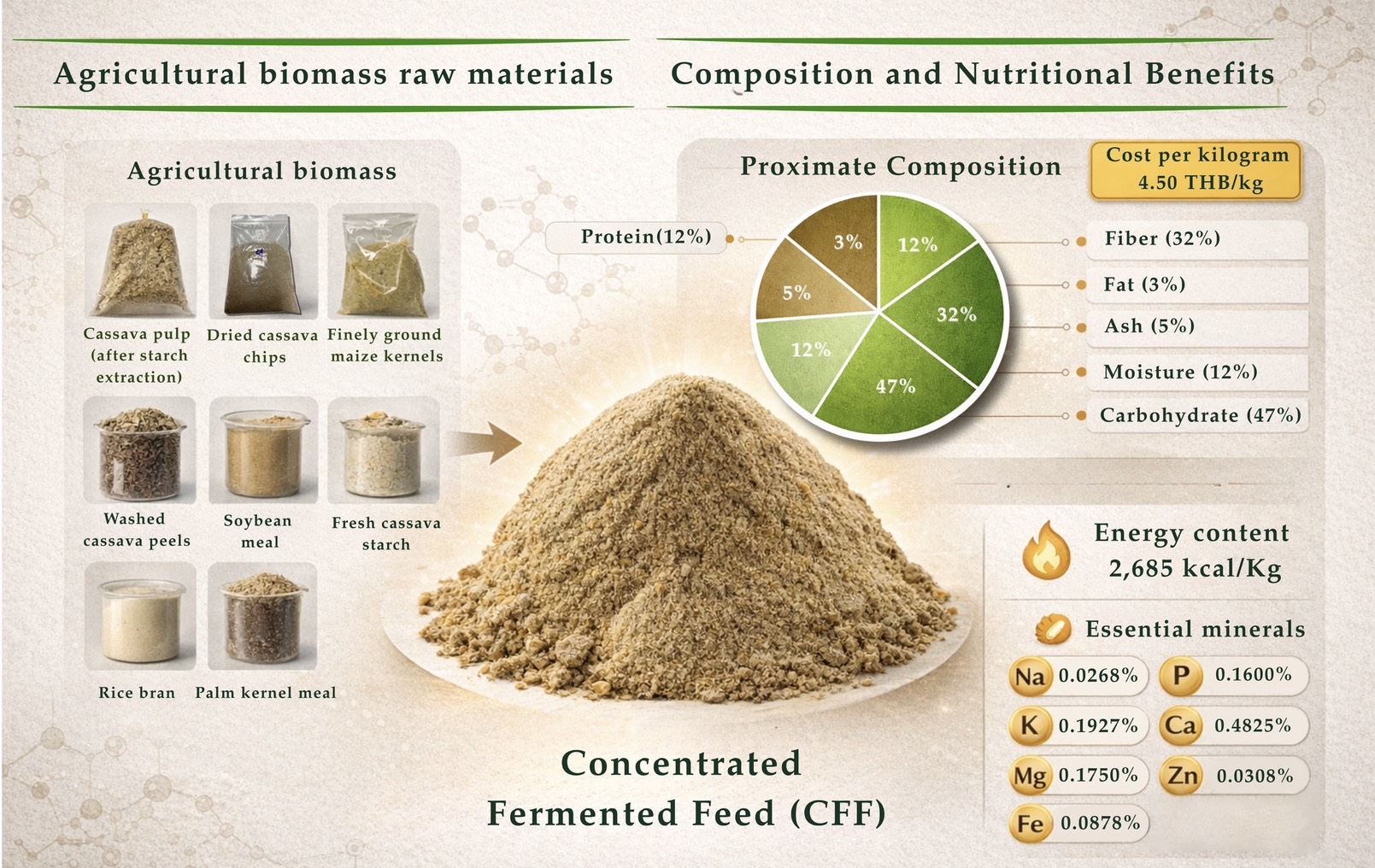
This study evaluated the nutritional, mineral, and estimated metabolizable energy (EME) profiles of eight locally available agricultural biomass raw materials to support the development of a cost-effective concentrated fermented feed (CFF) for beef cattle in Mukdahan Province, Northeast Thailand. Finely ground maize kernels, soybean meal, palm kernel meal, rice bran, dried cassava chips, cassava pulp, washed cassava peels, and fresh cassava starch residue were analyzed for proximate composition, EME, and essential minerals (Ca, Mg, P, Fe, Zn, Na, and K), with all values reported on an as-fed basis. A CFF formulation (1,000 kg batch) was developed from these raw materials and compared with five commercial beef cattle feeds. Soybean meal, palm kernel meal, and rice bran exhibited the highest protein contents, while rice bran showed the greatest calculated EME value (4097 kcal/kg of sample). Cassava-based by-products were rich in carbohydrates but relatively low in protein and fat. Mineral analysis revealed substantial variation among raw materials, with high concentrations of P, Mg, Ca, and K in several biomass sources. The formulated CFF contained 12.16 ± 0.21% crude protein, 3.29 ± 0.05% fat, and 47.56 ± 0.90% carbohydrates. The calculated EME content was 2685 kcal/kg of sample, which is highly comparable to the nutrient profiles of commercial feeds available in the market. Importantly, CFF production costs were markedly lower (4.50 THB/kg) than those of commercial products (10.67–15.33 THB/kg), demonstrating significant economic advantages. Overall, the results confirm that locally sourced biomass can be effectively used to formulate nutritionally adequate, mineral-rich, and low-cost fermented feed, thereby contributing to sustainable beef cattle production and reducing farmers' feed expenses.
Article Details

This work is licensed under a Creative Commons Attribution-NonCommercial-NoDerivatives 4.0 International License.
References
Thammayod, A.; Roschat, W.; Leelatam, T.; Phewphong, S.; Maneerat, B.; Leelatam, N.; Thangthong, A.; Moonsin, P.; Promarak, V. Development of High-Quality Organic Fertilizer from Biomass Waste and the Application of Biochar in Local Areas of Sakon Nakhon Province, Northeastern Thailand. Trends Sci. 2025, 22, 9105. https://doi.org/10.48048/tis.2025.9105
Ruamchimplee, T.; Kumdee, O.; Donsri, W.; Noiprasan, N.; Rengkounkway, M. The Desire to Improve Quality of Life through Integrated Farming Practices among Farmers in Ban Na Sao Ung Village, Lom Kao District, Phetchabun Province. J. Soc. Sci. Cult. 2025, 9, 236–249.
Romyen, A.; Nunti, C.; Neranon, P. Trade Efficiency under FTA for Thailand’s Agricultural Exports: Copula-Based Gravity Stochastic Frontier Model. Econ. Struct. 2023, 12, 9. https://doi.org/10.1186/s40008-023-00303-0
Tansuchat, R.; Suriyankietkaew, S.; Petison, P.; Punjaisri, K.; Nimsai, S. Impacts of COVID-19 on Sustainable Agriculture Value Chain Development in Thailand and ASEAN. Sustainability 2022, 14, 12985. https://doi.org/10.3390/su142012985
Kumsueb, B.; Kitchaicharoen, J.; Jintrawet, A.; Limnirunkul, B.; Kono, Y. Transformation towards Organic Cassava Production in Yasothon Province, Thailand. Curr. Appl. Sci. Technol. 2024, 25, e0260947. https://doi.org/10.55003/cast.2024.260947
World Bank. Thailand Rural Income Diagnostic; 2022. https://documents1.worldbank.org/curated/en/099005010202299399/pdf/P1775991e5f180ee130cf14572184e61f60735628d80.pdf (accessed Nov 5, 2025).
Bank of Thailand. Agriculture Landscape in Thailand; 2022. https://www.bot.or.th/content/dam/bot/financial-innovation/sustainable-finance/green/taxonomy/03_EN_Thailand_Taxonomy-Agriculture_Sector.pdf (accessed Nov 5, 2025).
Boonthongniam, N. Data on the Number of Livestock Farmers and Animal Population in 2021; Department of Livestock Development: Thailand, 2021. https://ict.dld.go.th/webnew/images/stories/stat_web/yearly/2564/province/T2-1-Cattle.pdf (accessed Nov 5, 2025).
Lambertz, C.; Chaikong, C.; Maxa, J.; Schlecht, E.; Gauly, M. Characteristics, Socioeconomic Benefits and Household Livelihoods of Beef Buffalo and Beef Cattle Farming in Northeast Thailand. J. Agric. Rural Dev. Trop. Subtrop. 2012, 113, 155–164.
Bunmee, T.; Chaiwang, N.; Kaewkot, C.; Jaturasitha, S. Current Situation and Future Prospects for Beef Production in Thailand—A Review. Asian-Australas. J. Anim. Sci. 2018, 31, 968–975. https://doi.org/10.5713/ajas.18.0201
Khunchaikarn, S.; Mankeb, P.; Suwanmaneepong, S. Economic Efficiency of Beef Cattle Production in Thailand. J. Manag. Inf. Decis. Sci. 2022, 25, 1–9.
Thannithi, W.; Intawicha, P.; Kongmuang, N.; Inyawilert, W.; Tiantong, A.; Saengwong, S. Understanding Smallholder Beef Production: Cost Structures, Market Channels and Pathways to Enhanced Profitability. Adv. Anim. Vet. Sci. 2025, 13, 16–25. https://doi.org/10.17582/journal.aavs/2025/13.1.16.25
Polyorach, S.; Sitthigripong, R.; Mitchaothai, J.; Lukkananukool, A.; Chaosap, C.; Srikitkasemwat, K.; Thammakarn, C.; Nampukdee, R. Evaluation of Production Performance, Feed Cost and Nutritional Digestibility of Charolais- and Wagyu-Cross Beef Cattle Raised by Pineapple Co-Products Diet. J. Mahanakorn Vet. Med. 2022, 16, 263–271.
Sooksoi, P. Evaluation of Roughage and Agricultural Residue Quality for Dairy Farmers in Sakaeo Province. King Mongkut’s Agric. J. 2020, 38, 376–381.
Munier, F. F.; Wardi, W.; Takdir, M. The Effect of Fermented Corncob Feed on Daily Weight Gains and Body Condition Score of Donggala Cattle in Central Sulawesi. In Proc. 9th Int. Semin. Trop. Anim. Prod.; Atlantis Press, 2022; pp 328–331. https://doi.org/10.2991/absr.k.220207.069
Dagaew, G.; Wongtangtintharn, S.; Suntara, C.; Prachumchai, R.; Wanapat, M.; Cherdthong, A. Feed Utilization Efficiency and Ruminal Metabolites in Beef Cattle Fed Cassava Pulp Fermented with Yeast Waste as a Replacement for Soybean Meal. Sci. Rep. 2022, 12, 16090. https://doi.org/10.1038/s41598-022-20471-6
Phewphong, S.; Roschat, W.; Namwongsa, K.; Wonam, A.; Kaisri, T.; Duangpakdee, P.; Leelatam, T.; Moonsin, P.; Promarak, V. Evaluation of the Nutritional, Mineral, and Antioxidant Potential of Roselle (Hibiscus sabdariffa Linn.) Seeds from Roi Et Province in Thailand. Trends Sci. 2023, 20, 6664. https://doi.org/10.48048/tis.2023.6664
Suwannatrai, K.; Namwongsa, K.; Phanomkhet, N.; Tawil, S.; Roschat, W. Analysis of the Nile Tilapia (Oreochromis niloticus L.) Proximate Composition in Sakon Nakhon Province, Thailand. Creative Sci. 2023, 15, 251073. https://doi.org/10.55674/cs.v15i1.251073
Preecharram, S.; Phosri, S.; Theansungnoen, T.; Roschat, W.; Arthan, S.; Lasopha, S.; Jandaruang, J. Nutritional Values and Their Potential Applications in Food Products of Krabok Seed (Irvingia malayana). Trends Sci. 2024, 21, 7316. https://doi.org/10.48048/tis.2024.7316
AOAC. Official Methods of Analysis, 17th ed.; Assoc. Off. Anal. Chem.: MD, USA, 2000.
Preecharram, S.; Posoongnoen, S.; Thummavongsa, T.; Pasom, W.; Panyakom, S.; Sripakdee, T.; Jandaruang, J. Values, Bioactive Compounds, and Antioxidant Activities of Brown Rice and Germinated Brown Rice, and Their Pellet Products. Creative Sci. 2025, 17, 257996. https://doi.org/10.55674/cs.v17i1.257996
Suwannatrai, K.; Namwongsa, K.; Phanomkhet, N.; Nuntapanich, H.; Roschat, W. Analysis of nutritional value, total phenolic and flavonoid contents, and antioxidant activities from ethanolic extracts of roasted broken brown rice powder. SNRU Journal of Science and Technology 2022, 14(2), 246426. https://doi.org/10.55674/snrujst.v14i2.246426
Salami, S. O.; Afolayan, A. J. Evaluation of Nutritional and Elemental Compositions of Green and Red Cultivars of Roselle. Sci. Rep. 2021, 11, 1–13. https://doi.org/10.1038/s41598-020-80433-8
AOAC. Official Methods of Analysis, 18th ed.; Sci. Res. Publ.: Washington, DC, 2010.
Bvenura, C.; Afolayan, A. J. The Role of Wild Vegetables in Household Food Security in South Africa: A Review. Food Res. Int. 2015, 76, 1001–1011. https://doi.org/10.1016/j.foodres.2015.06.013
Oh, J.; Cho, H.; Jeong, S.; Kang, K.; Lee, M.; Jeon, S.; Kang, H.; Seo, S. Effects of Dietary Crude Protein Level of Concentrate Mix on Growth Performance, Rumen Characteristics, Blood Metabolites, and Methane Emissions in Fattening Hanwoo Steers. Animals 2024, 14, 469. https://doi.org/10.3390/ani14030469
Kim, W. S.; Ghassemi Nejad, J.; Peng, D. Q.; et al. Effects of Different Protein Levels on Growth Performance and Stress Parameters in Beef Calves under Heat Stress. Sci. Rep. 2022, 12, 8113. https://doi.org/10.1038/s41598-022-09982-4
Weligama Thuppahige, V. T.; Moghaddam, L.; Welsh, Z. G.; Wang, T.; Xiao, H.-W.; Karim, A. Extraction and Characterisation of Starch from Cassava Agro-Industrial Wastes. LWT-Food Sci. Technol. 2023, 182, 114787. https://doi.org/10.1016/j.lwt.2023.114787
Banditvong, C.; Laosiripojana, N.; Varongchayakul, S.; Songkasiri, W. Utilization of Cassava Pulp to Produce Micro- and Nano-Cellulose. Sci. Eng. Connect. 2024, 47, 322–347.
Imran, M.; Lee, S.-G.; Park, S.-Y.; et al. Influence of Environmental Factors and Genotype on Natural Variation in Maize Seeds. Sustainability 2024, 16, 10451. https://doi.org/10.3390/su162310451
Srisikam, S.; Lueanglawan, P. The Use of Yeast-Fermented Cassava Pulp in Beef Cattle Diets on Rumen Fermentation and Production Performance; Master’s Thesis, Burapha University, Thailand.
Kraiprom, T.; Jantarat, S.; Madting, P.; Dueraso, H. Study of Nutritive Value of Oil Palm Frond Silage with Molasses. J. Sci. Technol. Yala Rajabhat Univ. 2018, 3, 94–100.
Budianto, M. The Effects of Energy and Protein Content in Maize Forage-Based Complete Diet on In Vitro Ruminal Fermentation, Gas Production, and Feed Degradability. J. Sci. Agric. Technol. 2023, 4, 27–33. https://doi.org/10.14456/jsat.2023.5
Bamikole, A. A. Evaluation of Proximate and Fibre Composition, Metabolizable Energy, and Organic Matter Digestibility of Maize (Zea mays) and Wheat (Triticum aestivum) Hydroponic Fodder. Pak. J. Nutr. 2024, 23, 39–45. https://doi.org/10.3923/pjn.2024.39.45
Gunha, T.; Kongphitee, K.; Binsulong, B.; Sommart, K. Net Energy Value of a Cassava Chip Ration for Lactation in Holstein–Friesian Crossbred Dairy Cattle Estimated by Indirect Calorimetry. Animals 2023, 13, 2296. https://doi.org/10.3390/ani13142296
Manzoor, A.; Pandey, V. K.; Dar, A. H.; Fayaz, U.; Das, K. K.; Shams, R.; Ahmad, S.; Bashir, I.; Fayaz, J.; Singh, P.; Khan, S. A.; Ganaie, T. A. Rice Bran: Nutritional, Phytochemical, and Pharmacological Profile and Its Contribution to Human Health Promotion. Food Chem. Adv. 2023, 2, 100296. https://doi.org/10.1016/j.focha.2023.100296
Zhao, J.; Zhu, Q.; Song, X.; Yang, M.; Liu, L. Development of Prediction Equations for Digestible and Metabolizable Energy in Cereal Processing By-Products Fed to Growing Pigs. Animals 2024, 14, 3101. https://doi.org/10.3390/ani14213101
Suriyapha, C.; Suntara, C.; Wanapat, M.; Cherdthong, A.; Kang, S.; Polyorach, S. Effects of Substituting Agro-Industrial By-Products for Soybean Meal on Beef Cattle Feed Utilization and Rumen Fermentation. Sci. Rep. 2022, 12, 21630. https://doi.org/10.1038/s41598-022-26191-1
Department of Livestock Development. Mineral Contents in Forage Plants; n.d. https://nutrition.dld.go.th/nutrition/images/knowledge/old_knowledge/pro27.html (accessed Nov 10, 2025).
Burhan, K. A. R. A.; Ertek, A.; Bekir, A. T. A. R. Mineral Nutrient Content of Sweet Corn under Deficit Irrigation. J. Agric. Sci. 2016, 22, 54–61. https://doi.org/10.1501/Tarimbil_0000001367
Bayero, A. S.; Datti, Y.; Abdulhadi, M.; Yahya, A. T.; Salihu, I.; Lado, U. A.; Imrana, B. Proximate Composition and Mineral Contents of Glycine max (Soybeans) Available in Kano State, Nigeria. Chemsearch J. 2019, 10, 62–65.
Grzyb, A.; Wolna-Maruwka, A.; Niewiadomska, A. Environmental Factors Affecting the Mineralization of Crop Residues. Agronomy 2020, 10, 1951. https://doi.org/10.3390/agronomy10121951
Ahmed, W.; Liu, K.; Qaswar, M.; Huang, J.; Huang, Q.; Xu, Y.; Ali, S.; Mehmood, S.; Ammar Asghar, R. M.; Mahmood, M.; Zhang, H. Long-Term Mineral Fertilization Improved Grain Yield and Phosphorus Use Efficiency by Changing Soil P Fractions. Agronomy 2019, 9, 784. https://doi.org/10.3390/agronomy9120784
Atsawat, A. Development of Animal Feed from Pumpkin and Fermented Cassava for Beef Cattle Feeding; Doctoral Dissertation, University of Phayao, Thailand, 2019. http://www.updc.clm.up.ac.th//handle/123456789/1001 (accessed Nov 10, 2025).
Puttha, W.; Tangtaweewipat, S. Nutrient Chemical Composition and Effect of Replacing Either Fermented Corn Grain or Fermented Napier Grass in Commercial Diet for Royal Project Black Pig. King Mongkut’s Agric. J. 2022, 40, 302–314.
Thaowarn, M. Effect of Using Pakchong 1 Napier Grass Silage in Total Mixed Ration on Productive Performance of Goats and Acceptance among Smallholder Farmers. PSU Libr. J. 2016, 27, 116–122.
Kilama, J.; Yakir, Y.; Shaani, Y.; Adin, G.; Kaadan, S.; Wagali, P.; Sabastian, C.; Ngomuo, G.; S. J., M. Chemical Composition, In Vitro Digestibility, and Storability of Selected Agro-Industrial By-Products. Heliyon 2023, 9, e14581. https://doi.org/10.1016/j.heliyon.2023.e14581
Chen, Y. H.; Chen, Y. M.; Tu, P. A.; Chen, C. Y.; Wang, H. T. Stabilizing Total Mixed Ration Dry Matter to Mitigate Environmental Relative Humidity Effects on Lactating Cow Performance. Animals 2025, 15, 1137. https://doi.org/10.3390/ani15081137
