
Improving the Efficiency of Vermicompost Production by Using a Two-Step Composting Process with Agricultural Waste Materials
Article Sidebar
Main Article Content
Abstract
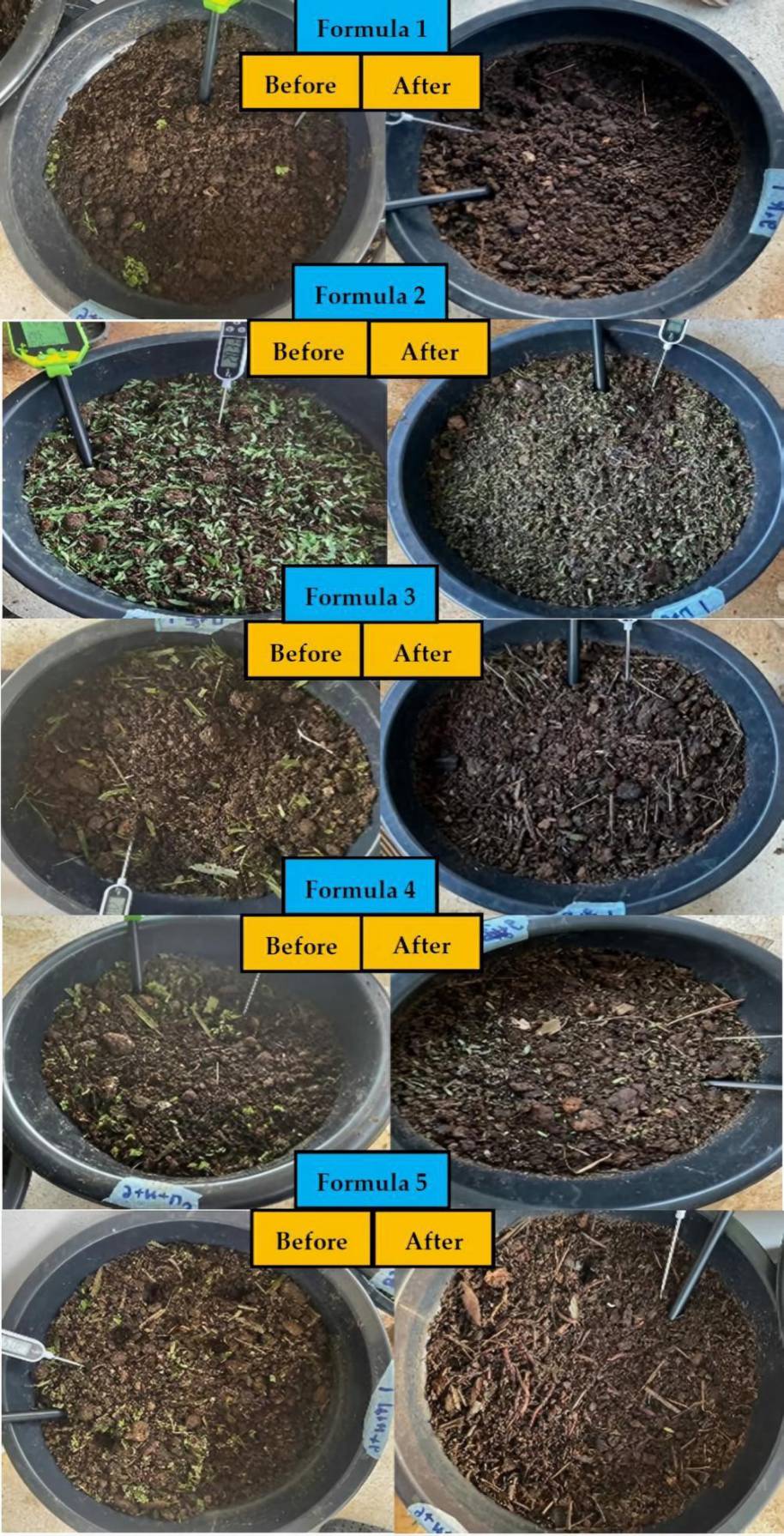
This research aimed to improve the vermicompost production process by combining a two-step composting process with agricultural waste to enhance soil fertility, increase productivity, and reduce costs. The experiment was divided into three phases: Phase 1 tested the production of vermicompost using manure from cows, goats, and sheep. Cow manure (CM) was found to be the most suitable raw material due to its friability, ease of digestion, and high-quality fertilizer value. Phase 2 investigated the production of vermicompost using supplementary materials from local plants, including Azolla (AZ), Leucaena leaves (LL), and Palm leaves (PL), combined with five formulas of cow manure for growing kale. Formula 5, consisting of 75% Cow manure (CM), 15% Azolla (AZ), and 10% Palm leaves (PL) by weight, provided the highest nitrogen content at 852.57 ± 0.045 mg/kg. Finally, the growth of kale was studied using vermicompost from the second stage mixed with soil at a 1:1 ratio. Formula 7 (50% Vermicompost [CM+AZ+PL] and 50% NS) yielded the best kale growth, in terms of height, leaf width, weight, and fertility.
Article Details

This work is licensed under a Creative Commons Attribution-NonCommercial-NoDerivatives 4.0 International License.
References
Chanwichaiphot, P. Cultivation of AF Earthworm Strain to Produce Biofertilizer for Chinese Kale (Brassica rapa var. parachinensis); 2019. Available online: https://shorturl.asia/6LM3I (accessed Dec 23, 2024).
Department of Agriculture. “Azolla,” a Miraculous Aquatic Plant Used as a Fertilizer and Livestock Feed in Organic Farming; 2022. Available online: https://shorturl.asia/ZIKwg (accessed Nov 25, 2025).
Dhaker, D. L.; Karthik, R.; Maurya, S. Cultivation of Azolla: A Proteinaceous Fodder for Livestock. Agric. Environ. 2021, 2(11), 50–52.
Nammuang, C.; Rathert, G.; Rojanakuson, S.; Podisuk, V.; Kanwanshirathada, K.; Songmuang, P.; Kanareugsa, C. Use of Leucaena leucocephala for Increasing Yield. Thai Agric. Res. J. 1989, 7(1–3).
Department of Agriculture. Fertilizer Use Based on Soil and Leaf Analysis in Palm Oil Production; 2020. Available online: https://shorturl.asia/jzvQa (accessed Nov 25, 2025).
Ministry of Agriculture and Cooperatives. Basic Information for Satun Province; 2024. Available online: https://shorturl.asia/mRvfA (accessed Dec 20, 2024).
APHA. Standard Methods for the Examination of Water and Wastewater, 22nd ed.; American Public Health Association: Washington, DC, 2012.
Edwards, C. A.; Domínguez, J.; Arancon, N. Q. The Influence of Vermicomposts on Plant Growth and Pest Incidence. In Soil Zoology for Sustainable Development in the 21st Century; Shakir, S. H., Mikhail, W. Z. A., Eds.; 2004; pp 397–420.
Aira, M.; Monroy, F.; Domínguez, J. Changes in Microbial Biomass and Activity after Passage through the Gut of Eisenia fetida. Biol. Fertil. Soils 2006, 42(4), 379–385. https://doi.org/10.1007/s00374-005-0047-4
Anandyawati, A.; Muktamar, Z.; Prameswari, W. Comparison of Conventional Compost and Vermicompost from Animal Manure. FUDMA J. Agric. Agric. Technol. 2023, 19(4), 1435–1446.
FAO. Leucaena: Promising Forage and Tree Fodder for the Tropics; FAO Animal Production and Health Paper No. 47; 1984.
Kearl, L. C. Nutrient Requirements of Ruminants in Developing Countries; Utah State University, 1982.
Ting, J. Y.; Kamaruddin, N.; Syahirah, S.; Mohamad, S. Nutritional Evaluation of Azolla pinnata and Azolla microphylla. J. Agrobiotechnol. 2022, 13(IS), 17–23. https://doi.org/10.37231/jab.2022.13.1S.314
Gupta, S. K.; Chandra, R.; Dey, D.; Mondal, G.; Shinde, K. P. Chemical Composition of Sun-Dried Azolla pinnata. J. Pharmacogn. Phytochem. 2018, 7(6), 1214–1216.
Ngan, M. A. Utilization of Oil Palm Fronds as Feed in Ruminants. Malays. J. Anim. Sci. 2014, 17(2), 15–25.
Domínguez, J.; Edwards, C. A. Vermicomposting Organic Wastes: A Review. In Soil Zoology for Sustainable Development in the 21st Century; 2004; pp 369–395.
Jones, R. J.; Megarrity, R. G. Transfer of DHP-Degrading Bacteria in Ruminants. Aust. Vet. J. 1986, 63, 259–262. https://doi.org/10.1111/j.1751-0813.1986.tb02990.x
Aye, P. A.; Adegun, M. K. Chemical Composition of Leaf Meals. Res. J. Chem. Environ. Sci. 2014, 2(3), 1–5.
Seng, V. Leucaena Leaves as Supplementary Feed. Livest. Res. Rural Dev. 2001, 13(4).
Mardamootoo, T.; Preez, C. C. U.; Barbard, J. H. Phosphorus Management Issues. Afr. J. Agric. Res. 2021, 17(7), 939–952. https://doi.org/10.5897/AJAR2020.15205
Chapin, F. S. Mineral Nutrition of Wild Plants. Annu. Rev. Ecol. Syst. 1980, 11, 233–260. https://doi.org/10.1146/annurev.es.11.110180.001313
Marschner, P. Mineral Nutrition of Higher Plants; Academic Press: 2012. https://doi.org/10.1016/C2009-0-63043-9
Sundram, S. Oil Palm Fronds as Feed. Asian-Australas. J. Anim. Sci. 2003, 16(6), 858–863.
Jiraporn, P. Plant Nutrient Formulations for Leafy Vegetables. Kasetsart J. 2020, 10(2), 35–42.
Department of Agriculture. Guidelines for Safe Vegetable Production; Bangkok, 2019.
