
Application of a Heuristic-Based System for Sustainable Faculty Routing and Workload Balancing in Cooperative Education
Article Sidebar
Main Article Content
Abstract
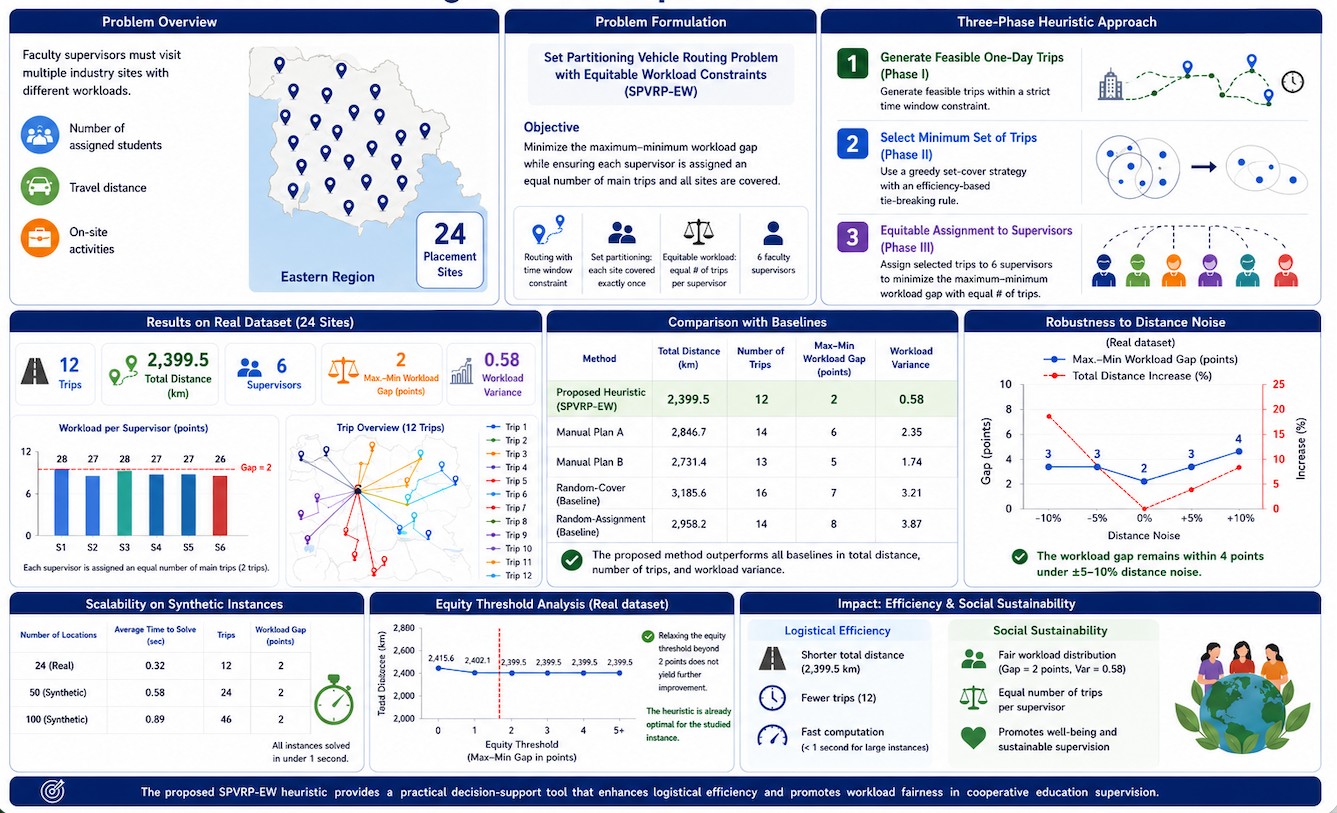
In cooperative education programs, faculty supervisors are required to visit multiple industry sites hosting students, with each site imposing a distinct workload characterized by the number of assigned students, travel distance, and on-site activities. This study formulates the supervisory routing task as a Set Partitioning Vehicle Routing Problem with Equitable Workload Constraints (SPVRP-EW) and introduces a three-phase heuristic approach. The first phase generates feasible one-day trips within a strict time window constraint. The second phase selects a minimum set of trips that covers all locations using a greedy set-cover strategy with an efficiency-based tie-breaking rule. The final phase assigns the selected trips to six faculty supervisors to minimize the maximum–minimum workload gap while ensuring that each supervisor is responsible for an equal number of main trips. Using a real dataset of 24 placement sites across four provinces in Thailand, the proposed method generated 12 trips totaling 2,399.5 km. The solution achieved a maximum–minimum workload gap of only 2 points and a workload variance of 0.58. Extended experiments further demonstrate that the method outperforms two simulated manual plans, as well as random-cover and random-assignment baselines, in terms of total distance, number of trips, and workload variance. The heuristic remains robust under ±5–10% distance noise, with the workload gap staying within 4 points. In addition, synthetic instances with 50 and 100 locations can be solved in under one second, confirming their practical scalability. Relaxing the equity threshold beyond 2 points does not yield further improvement, indicating that the heuristic is already optimal for the studied instance. Overall, the framework serves as a decision-support tool that enhances both logistical efficiency and social sustainability by improving workload fairness in cooperative education supervision.
Article Details

This work is licensed under a Creative Commons Attribution-NonCommercial-NoDerivatives 4.0 International License.
References
Jackson, D. Student perceptions of the importance of employability skill provision in business undergraduate programs. J. Educ. Bus. 2013, 88(5), 271–279. https://doi.org/10.1080/08832323.2012.697928
Billett, S. Learning through work: Exploring instances of relational interdependencies. Int. J. Educ. Res. 2008, 47(4), 232–240. https://doi.org/10.1016/j.ijer.2008.07.006
Smith, C.; Ferns, S.; Russell, L.; Cretchley, P. The Impact of Work Integrated Learning on Student Work-Readiness; Office for Learning and Teaching: Australia, 2014. https://hdl.voced.edu.au/10707/337518
Harris, M. Academic workloads: Achieving equity and flexibility. J. Tertiary Educ. Adm. 1993, 15(2), 141–155. https://doi.org/10.1080/1036970930150202
Braekers, K.; Ramaekers, K.; Van Nieuwenhuyse, I. The vehicle routing problem: State of the art classification and review. Comput. Ind. Eng. 2016, 99, 300–313. https://doi.org/10.1016/j.cie.2015.12.007
Adamo, T.; Gendreau, M.; Ghiani, G.; Guerriero, E. A review of recent advances in time-dependent vehicle routing. Eur. J. Oper. Res. 2024, 319(1), 1–15. https://doi.org/10.1016/j.ejor.2024.06.016
Pillac, V.; Gendreau, M.; Guéret, C.; Medaglia, A. L. A review of dynamic vehicle routing problems. Eur. J. Oper. Res. 2013, 225(1), 1–11. https://doi.org/10.1016/j.ejor.2012.08.015
Matl, P.; Hartl, R. F.; Vidal, T. Workload equity in vehicle routing problems: A survey and analysis. Transp. Sci. 2018, 52(2), 239–260. https://doi.org/10.1287/trsc.2017.0744
Lehuédé, F.; Péton, O.; Tricoire, F. A lexicographic minimax approach to the vehicle routing problem with route balancing. Eur. J. Oper. Res. 2020, 282(1), 129–147. https://doi.org/10.1016/j.ejor.2019.09.010
Jozefowiez, N.; Semet, F.; Talbi, E.-G. The bi-objective covering tour problem. Comput. Oper. Res. 2007, 34(7), 1929–1942. https://doi.org/10.1016/j.cor.2005.07.022
Halvorsen-Weare, E. E.; Savelsbergh, M. W. P. The bi-objective mixed capacitated general routing problem with different route balance criteria. Eur. J. Oper. Res. 2016, 251(2), 451–465. https://doi.org/10.1016/j.ejor.2015.11.024
Kaewploy, W.; Boonkanok, R.; Lertwachara, K. One-day trip itinerary planning for visitors to Songkhla City. ASEAN J. Sci. Technol. Rep. 2025, 28(6), 33–45. https://doi.org/10.55164/ajstr.v28i6.259060
Chvátal, V. A greedy heuristic for the set-covering problem. Math. Oper. Res. 1979, 4(3), 233–235. https://doi.org/10.1287/moor.4.3.233
Johnson, D. S. Approximation algorithms for combinatorial problems. J. Comput. Syst. Sci. 1974, 9(3), 256–278. https://doi.org/10.1016/S0022-0000(74)80044-9
Korf, R. E. A complete anytime algorithm for number partitioning. Artif. Intell. 1998, 106(2), 181–203. https://doi.org/10.1016/S0004-3702(98)00086-1
Della Croce, F.; Scatamacchia, R. The Longest Processing Time rule for identical parallel machines revisited. J. Sched. 2020, 23(2), 163–176. https://doi.org/10.1007/s10951-018-0597-6
Wang, X.; Golden, B.; Wasil, E. The min–max multi-depot vehicle routing problem: Heuristics and computational results. J. Oper. Res. Soc. 2015, 66(9), 1430–1441. https://doi.org/10.1057/jors.2014.108
Borgulya, I. An algorithm for the capacitated vehicle routing problem with route balancing. Cent. Eur. J. Oper. Res. 2008, 16(4), 331–343. https://doi.org/10.1007/s10100-008-0062-2
Kool, W.; van Hoof, H.; Welling, M. Attention, learn to solve routing problems! In Proceedings of the International Conference on Learning Representations (ICLR), 2019. https://arxiv.org/abs/1803.08475
Doubilet, P.; Begg, C. B.; Weinstein, M. C.; Braun, P.; McNeil, B. J. Probabilistic sensitivity analysis using Monte Carlo simulation: A practical approach. Med. Decis. Making 1985, 5(2), 157–177. https://doi.org/10.1177/0272989X8500500205
Department of Alternative Energy Development and Efficiency (DEDE), Ministry of Energy, Thailand. Thailand Energy Statistics 2022; DEDE: Bangkok, 2022.
Department for Environment, Food & Rural Affairs (DEFRA), UK. UK Government GHG Conversion Factors for Company Reporting: 2024; DEFRA: London, 2024.
Pisinger, D.; Ropke, S. Large neighborhood search. In Handbook of Metaheuristics; Springer: Cham, Switzerland, 2019; pp 99–127. https://doi.org/10.1007/978-3-319-91086-4_4
Vidal, T.; Crainic, T. G.; Gendreau, M.; Prins, C. A hybrid genetic algorithm with adaptive diversity management for a large class of vehicle routing problems with time-windows. Comput. Oper. Res. 2013, 40(1), 475–489. https://doi.org/10.1016/j.cor.2012.07.018
