
Genetic Relationship Assessment of Micropropagated Nymphaea colorata Peter Seedlings using HAT-RAPD
Article Sidebar
Main Article Content
Abstract
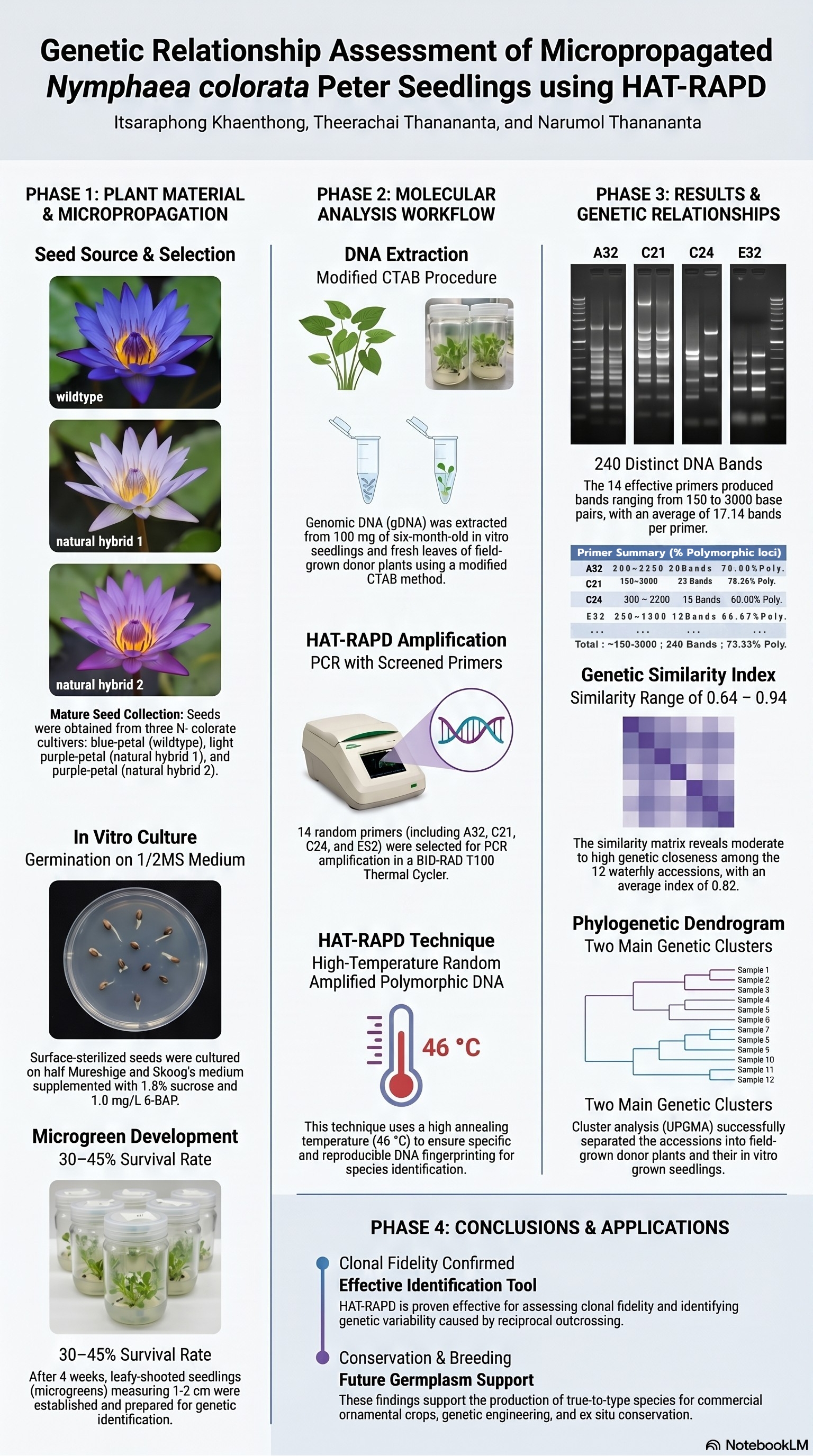
Nymphaea colorata Peter and its natural hybrids are typical African waterlily cultivars with beautiful, blue-flowered shading, which were precisely selected to be subjects in this study. We have proposed to assess the genetic relationships and variability of in vitro seedlings derived from cross pollination of three N. colorata cultivars. The surface-sterilized mature seeds were cultured on half Murashige and Skoog’s (1/2MS) semi-solid medium supplemented with 1.5% (w/v) sucrose and 1.0 mg/L 6- (N6)-benzylaminopurine (6-BAP). After 4 weeks of culture, leafy-shooted seedlings (microgreens) were observed in all cultivars. For ex situ conservation and certain germplasm utilization, it is necessary to confirm that true-to-type waterlily species, wildtype and hybrid cultivars, are identified by their genetic backgrounds and genotyping. Thus, high-temperature random amplified polymorphic DNA (HAT-RAPD) markers were applied to examine genetic relationships among in vitro cultured seedlings compared with their field grown seed donor plants. Fourteen random primers were screened and selected from seventy-two universal primers for polymerase chain reaction (PCR) amplification and DNA fingerprinting. Genetic distances were represented as similarity coefficients ranging from 0.64 to 0.94 and then classified into two main clusters : the parental plant populations and their next generation populations. Therefore, HAT-RAPD might be effective for analyzing genetic relationships and variability in these waterlily cultivars. These scientific findings will support further conservation, breeding, genetic engineering and production of waterlily germplasm.
Article Details

This work is licensed under a Creative Commons Attribution-NonCommercial-NoDerivatives 4.0 International License.
References
Yu, C.; Qiao, G.; Qiu, W.; Yu, D.; Zhou, S.; Shen, Y.; Yu, G.; Jiang, J.; Han, X.; Liu, M.; Zhang, L.; Chen, F.; Chen, Y.; Zhuo, R. Molecular breeding of water lily: Engineering cold stress tolerance into tropical water lily. Hortic. Res. 2018, 5, 73. https://doi.org/10.1038/s41438-018-0086-2
Borsch, T.; Hilu, K. W.; Wiersema, J. H.; Löhne, C.; Barthlott, W.; Wildes, V. Phylogeny of Nymphaea (Nymphaeaceae): Evidence from substitutions and microstructural changes in the chloroplast trnT-trnF region. Int. J. Plant Sci. 2007, 168(5), 639–671. https://doi.org/10.1086/513476
Nzei, J. M.; Médez, N. M.; Mwanzia, V. M.; Kurauka, J. K.; Wang, Q. F.; Li, Z. Z.; Chen, J. M. Climatic niche evolution and niche conservation of Nymphaea species in Africa, South America, and Australia. BMC Plant Biol. 2024, 24, 476. https://doi.org/10.1186/s12870-024-05141-1
Borsch, T.; Wiersema, J. H.; Hellquist, C. B.; Löhne, C.; Govers, K. Speciation in North American water lilies: Evidence for the hybrid origin of the newly discovered Canadian endemic Nymphaea loriana sp. nov. (Nymphaeaceae) in a past contact zone. Botany 2014, 92, 867–882. https://doi.org/10.1139/cjb-2014-0060
Löhne, C.; Borsch, T.; Jacobs, S. W. L.; Hellquist, C. B.; Wiersema, J. H. Nuclear and plastid DNA sequences reveal complex reticulate patterns in Australian waterlilies (Nymphaea subgenus Anecphya, Nymphaeaceae). Aust. Syst. Bot. 2008, 21, 229–250. https://doi.org/10.1071/SB07010
Borsch, T.; Löhne, C.; Wiersema, J. Phylogeny and evolutionary patterns in Nymphaeales: Integrating genes, genomes and morphology. Taxon 2008, 57(4), 1052–1081. https://doi.org/10.1002/tax.574004
Sangsri, N.; Kuleung, C.; Hongtrakul, V. Analysis of nrITS sequence in Thai waterlilies, Nymphaea spp. Thai J. Sci. Technol. 2018, 8(3), 258–270.
Songpanich, P.; Hongtrakul, V. Intersubgeneric cross in Nymphaea spp. L. to develop a blue hardy waterlily. Sci. Hortic. 2010, 124, 475–481. https://doi.org/10.1016/j.scienta.2010.01.024
Parveen, S.; Singh, N.; Adit, A.; Kumaria, S.; Tandon, R.; Agarwal, M.; Jagannath, A.; Goel, S. Contrasting reproductive strategies of two Nymphaea species affect existing natural genetic diversity as assessed by microsatellite markers: Implications for conservation and wetlands restoration. Front. Plant Sci. 2022, 13, 773572. https://doi.org/10.3389/fpls.2022.773572
Murashige, T.; Skoog, F. A revised medium for rapid growth and bio-assays with tobacco tissue culture. Physiol. Plant. 1962, 15(3), 473–497. https://doi.org/10.1111/j.1399-3054.1962.tb08052.x
Khan, S.; Al-Qurainy, F.; Nadeem, M. Biotechnological approaches for conservation and improvement of rare and endangered plants of Saudi Arabia. Saudi J. Biol. Sci. 2012, 19(1), 1–11. https://doi.org/10.1016/j.sjbs.2011.11.001
Doyle, J. J.; Doyle, J. L. A rapid DNA isolation procedure for small quantities of fresh leaf tissue. Phytochem. Bull. 1987, 19(1), 11–15.
Noimai, Y.; Charoenwattana, P. Effects of BA and IAA on in vitro shoot induction of Nymphaea sp. ‘King of Siam’. Agric. Sci. J. 2012, 43(2, Suppl.), 249–252.
Khaenthong, I.; Chuenboonngarm, N.; Muengkrut, A. In vitro self and cross pollinated seed culture of Nymphaea rubra ‘Maeploi’, a night-blooming tropical waterlily hybrid (Nymphaeaceae) from Thailand. Res. J. Rajamangala Univ. Technol. Thanyaburi 2021, 20(1), 123–133. https://doi.org/10.14456/rj-rmutt.2021.12
Pereva, P. I. P.; Attanayaka, D. P. S. T. G.; Yakandawala, K.; Yakandawala, D. M. D.; Fernando, C. N.; Arachchi, U. P. E.; Gunawardhana, W. P. D. S.; Weerashighe, W. D. C. D. In vitro culture of Nymphaea nouchali seeds: A conservation approach for a vulnerable species. J. Natl. Sci. Found. Sri Lanka 2021, 49(3), 393–402. https://doi.org/10.4038/jnsfsr.v49i3.10305
Suksakul, S.; Thanananta, T.; Thanananta, N. Genetic relationship assessment and identification of Nymphaea sp. and their hybrids using HAT-RAPD. Thai J. Sci. Technol. 2018, 7(4, Suppl.), 418–426. https://doi.org/10.14456/tjst.2018.39
Poczai, P.; Mátyás, K. K.; Szabó, I.; Vanga, I.; Hyvönen, J.; Cernák, I.; Gorji, A. M.; Decsi, K.; Taller, J. Genetic variability of thermal Nymphaea (Nymphaeaceae) populations based on ISSR markers: Implications on relationships, hybridization, and conservation. Plant Mol. Biol. Rep. 2011, 29, 906–918. https://doi.org/10.1007/s11105-011-0302-9
Rodboot, N.; Yenchon, S.; Te-chato, S. Optimization of explant sterilization and plant growth regulators for enhancing the in vitro propagation of Nymphaea colorata Peter. Plant Cell Tissue Organ Cult. 2024, 159, 59. https://doi.org/10.1007/s11240-024-02911-5
Williams, J. G. K.; Kubelik, A. R.; Livak, K. J.; Rafalski, J. A.; Tingey, S. V. DNA polymorphisms amplified by arbitrary primers are useful as genetic markers. Nucleic Acids Res. 1990, 18(22), 6531–6535. https://doi.org/10.1093/nar/18.22.6531
Lin, F.; Kang, Y.; Huqail, A. A. A.; Alshehri, D.; Li, Y.; Guo, Y.; Yang, G.; Tang, F.; Yin, J.; Ding, Z.; Eissa, M. A. Novel cultivation techniques for water lily (Nymphaea micrantha Guill. & Perr.) production based on in vitro technology. Plant Methods 2025, 21, 56. https://doi.org/10.1186/s13007-025-01377-6
Khatun, M. M.; Tanny, T.; Yesmin, S.; Salimullah, M.; Alam, I. Evaluation of genetic fidelity of in vitro-propagated Aloe vera plants using DNA-based markers. ScienceAsia 2018, 44, 87–91. https://doi.org/10.2306/scienceasia1513-1874.2018.44.087
Chen, F.; Liu, X.; Yu, C.; Chen, Y.; Tang, H.; Zhang, L. Water lilies as emerging models for Darwin's abominable mystery. Hortic. Res. 2017, 4, 17051. https://doi.org/10.1038/hortres.2017.51
Dong, S.; Zhao, C.; Chen, F.; Liu, Y.; Zhang, S.; Wu, H.; Zhang, L.; Liu, Y. The complete mitochondrial genome of the early flowering plant Nymphaea colorata is highly repetitive with low recombination. BMC Genomics 2018, 19, 614. https://doi.org/10.1186/s12864-018-4991-4
Suksakul, S.; Thanananta, T.; Thanananta, N. Genetic relationship assessment and identification of Nymphaea sp. and their hybrids using SCoT markers. Thai J. Sci. Technol. 2018, 7(6), 570–579.
Kashima, S.; Thanananta, T.; Kachonpadungkitti, Y.; Bodhipadma, K. Induced mutation in Musa spp. genomes AAA using acute gamma ray and determination with HAT-RAPD markers. Thai J. Sci. Technol. 2020, 9(5), 668–679.
Chuengpanya, R.; Muangkroot, A.; Jenjittikul, T.; Thammasiri, K.; Umpunjun, P.; Viboonjun, U.; Chuenboonngarm, N. In vitro propagation and genetic fidelity assessment of Hedychium longicornutum Griff. ex Baker, a vulnerable zingiberaceous plant of Thailand. Curr. Appl. Sci. Technol. 2022, 22 (6), 1–21. https://doi.org/10.55003/cast.2022.06.22.012
Rittirat, S.; Thammasiri, K.; Klaocheed, S. In vitro rapid multiplication of a highly valuable ornamental aquatic plant Anubias heterophylla. Trends Sci. 2021, 18 (19), 3. https://doi.org/10.48048/tis.2021.3
Zhang, L.; Chen, F.; Zhang, X.; Li, Z.; Zhao, Y.; Lohaus, R.; Chang, X.; Dong, W.; Ho, S. Y. W.; Liu, X.; Song, A.; Chen, J.; Guo, W.; Wang, Z.; Zhuang, Y.; Wang, H.; Chen, X.; Hu, J.; Liu, Y.; Tang, H. The water lily genome and the early evolution of flowering plants. Nature 2020, 577(7788), 79–84. https://doi.org/10.1038/s41586-019-1852-5
Tang, H.; Zhang, L.; Chen, F.; Zhang, X.; Chen, F.; Ma, H.; Van de Peer, Y. Nymphaea colorata (Blue-Petal Water Lily). Trends Genet. 2020, 36 (9), 718–719. https://doi.org/10.1016/j.tig.2020.06.004
Xiong, X.; Zhang, J.; Yang, Y.; Chen, Y.; Su, Q.; Zhao, Y.; Wang, J.; Xia, Z.; Wang, L.; Zhang, L.; Chen, F. Water lily research: Past, present, and future. Trop. Plants 2023, 2(1), 1–8. https://doi.org/10.48130/TP-2023-0001
Khaenthong, I.; Phairin, U.; Mattisinlapin, P.; Subudom, S.; Sripan, S.; Boonthongto, A.; Malaithong, S. The effects of seed coat scarification, priming, and cold stratification on seed germination of a tropical night-blooming waterlily hybrid Nymphaea rubra ‘Maeploi’. Acta Hortic. 2020, 1298, 581–586. https://doi.org/10.17660/ActaHortic.2020.1298.80
Orban, I.; Bouharmont, J. Megagametophyte development of Nymphaea nouchali Burm. f. (Nymphaeaceae). Bot. J. Linn. Soc. 1998, 126, 339–348. https://doi.org/10.1111/j.1095-8339.1998.tb01386.x
Rodboot, N.; Te-chato, S.; Yenchon, S. Influence of MS medium strengths and types on in vitro shoot multiplication and development of Nymphaea colorata. ASEAN J. Sci. Technol. Rep. 2025, 28(4), e258176. https://doi.org/10.55164/ajstr.v28i4.258176
Khaenthong, I.; Akkarakultron, P. Seed coat scarification of some Australian Nymphaea species by vinegar. Agric. Sci. J. 2016, 47(2, Suppl.), 537–540.
Song, W.; Shi, W.; Wang, H.; Zhang, Z.; Tao, R.; Liu, J.; Wang, S.; Engel, M. S.; Shi, C. Comparative analysis of 12 water lily plastid genomes reveals genomic divergence and evolutionary relationships in early flowering plants. Mar. Life Sci. Technol. 2024, 6, 425–441. https://doi.org/10.1007/s42995-024-00242-0
