
Development of a Sustainable Wood Treatment Process for Palmyra Palm Fronds toward Furniture Production
Article Sidebar
Main Article Content
Abstract
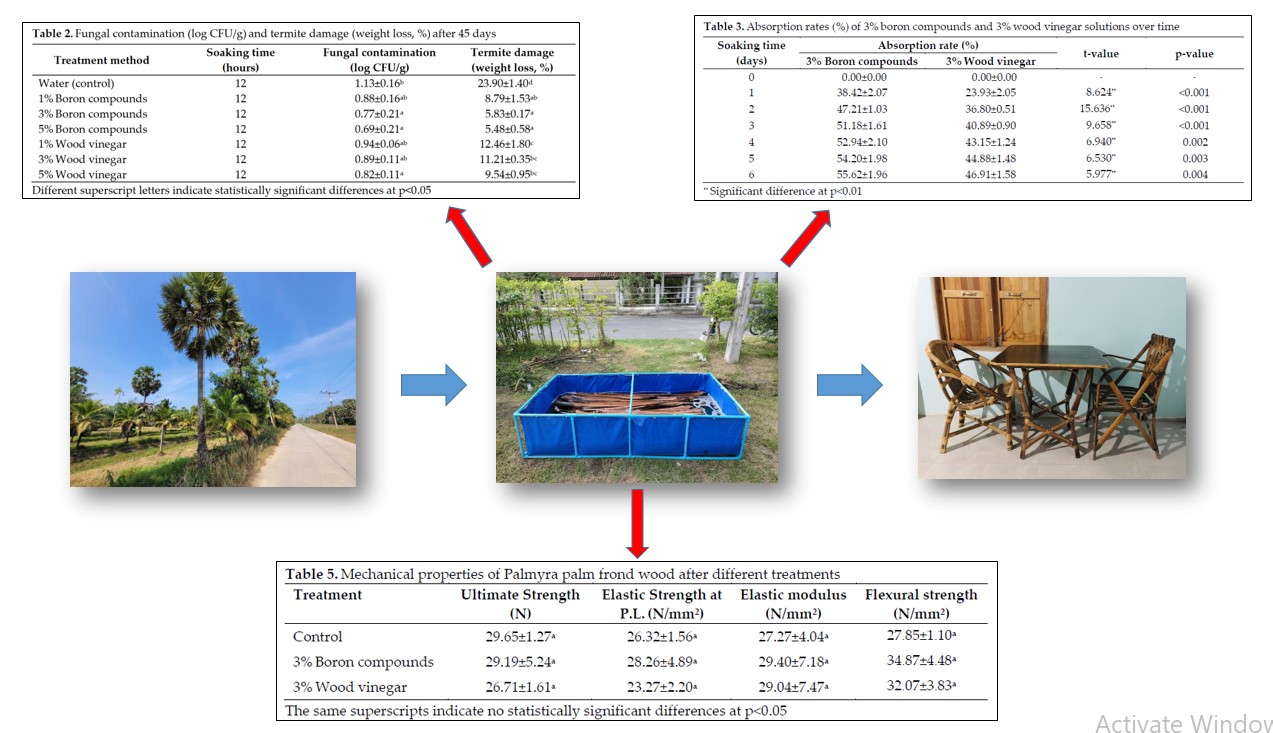
This study investigated the potential of Palmyra palm frond wood preservation treatments as an alternative material for furniture production. The palm fronds were composed of 74.94 ± 2.05% moisture, 30.61 ± 17.67% cellulose, 23.54 ± 1.00% hemicellulose, and 45.36 ± 0.55% lignin. Specimens (2.5x2.5 cm) were treated with boron compounds (boric acid: borax, 1:1.5) or wood vinegar at concentrations of 1%, 3%, and 5%, and then tested for fungal resistance, termite resistance, and mechanical properties. The 3% boron compound treatment demonstrated optimal performance, with 55.62 ± 1.96% absorption after 6 days, significantly higher than 3% wood vinegar (46.91 ± 1.58%). Termite resistance testing revealed weight loss of 5.83 ± 0.17% for the 3% boron-treated samples compared to 11.21 ± 0.35% for wood vinegar and 23.90 ± 1.40% for untreated controls after 45 days. Mechanical testing showed numerically higher flexural strength values for boron-treated specimens (34.87 ± 4.48 N/mm2) than for controls (27.85 ± 1.10 N/mm2), although the difference was not statistically significant (p>0.05). Color stability remained acceptable with L-values decreasing from 68.60 ± 0.53 to 59.30 ± 0.44 after three months. Microscopic examination confirmed preservative penetration into the cellular structure. The optimized 3% boron compound treatment provided an economically viable and environmentally sustainable solution for utilizing abundant Palmyra palm resources in Southern Thailand, creating durable furniture components while reducing the pressure on endangered hardwood species.
Article Details

This work is licensed under a Creative Commons Attribution-NonCommercial-NoDerivatives 4.0 International License.
References
Kaewmanee, J.; Pradabphetrat, P.; Rangpan, V. Carbon Footprint Assessment Based on Life Cycle Assessment of Biomass Power Plant. ASEAN J. Sci. Tech. Report. 2024, 27(1), 92-101. https://doi.org/10.55164/ajstr.v27i1.250754
Jangsawang, W. Preliminary Experimental of Biomass Gasification Process with Open Core Throat Less Downdraft Gasifier. ASEAN J. Sci. Tech. Report. 2022, 26(1), 1-10. https://doi.org/10.55164/ajstr.v26i1.247166
Jirawattanasomkul, N.; Roschat, W.; Leelatam, T.; Phanphli, S.; Chaipikun, W.; Thammayod, A.; Khotsuno, N.; Yeemin, P.; Wongma, N.; Phewphong, S. Evaluation of the nutritional, mineral, and Estimated Metabolizable Energy values of agricultural biomass raw materials used for the development of concentrated fermented feed for beef cattle in Mukdahan Province, Northeast Thailand. ASEAN J. Sci. Tech. Report. 2026, 29(4), e262452. https://doi.org/10.55164/ajstr.v29i4.262452
Shigematsu, A.; Mizoue, N.; Kajisa, T..; Yoshida, S. Importane of Rubberwood in Wood Export of Malaysia and Thailand. New For. 2011, 41, 179-189. https://doi.org/10.1007/s11056-010-9219-7
Teoh, Y. P.; Don, M. M.; Ujang, S. Assessment of the Properties, Utilization, and Preservation of Rubberwood (Hevea brasiliensis): A Case Study in Malaysia. J. Wood Sci. 2011, 57, 255-266. https://doi.org/10.1007/s10086-011-1173-2
Tamiz, A.; Alfredsen, G.; Eikenes, M.; Terziev, N. Decay Resistance of Wood Treated with Boric Acid and Tall Oil Derivates. Bioresour. Technol. 2008, 99, 2102-2106. https://doi.org/10.1016/j.biortech.2007.08.052
Intharapat, P.; Nakason, C.; Kongnoo, A. Preparation of Boric Acid Suppored Natural Rubber as A Reactive Flame Retardant and Its Properties. Decay Resistance of Wood Treated with Boric Acid and Tall Oil Derivates. Bioresour. Technol. 2008, 99, 2102-2106. https://doi.org/10.1016/j.biortech.2007.08.052
Suwanno, T.; Veenin, T.; Jarusombuti, S. Study on Fire Retardant Treatment of Rubberwood by Boron Compounds. J. For. 2017, 36, 129-135 (In Thai).
Pankong, A.; Komoltree, B.; Tepsing, P. The Existences of Sugar Palms Wisdom in Sathing Phra Peinsula in The Midst. GTHJ. 2023, 29(20), 236-248 (In Thai).
Worachetwarawat, P.; Pungchompoo, S.; Worachetwarawat, P.; Kuniart, B.; Podkumnerd, N. Furniture Product Design and Development Based on Consumer Demands: A Case Study of Products Made from Palmyra Palm Leaf Stalk in the Singha Nakhon Peninsula, Songkhla Province. ECBAJ-TSU. 2026, 8(1), 27-42 (In Thai).
Pantamanatsopa, P.; Srivabut, C.; Homkhiew, C.; Boonchouytan, W.; Rawangwong, S.; Thongmung
Kamnerdwam, A. Comparative Analysis of Rubberwood, Plywood, and Wood-Plastic Composites for Safe Elderly Toy Applications. ASEAN J. Sci. Tech. Report. 2025, 29(4), e260685. https://doi.org/10.55164/ajstr.v29i4.260685
Yang, J. F.; Yang, C. H.; Liang, M. T.; Gao, Z. J.; Wu, Y. W.; Chuang, L. Y. Chemical Composition, Antioxidant, and Antibacterial Activity of Wood Vinegar from Litchi chinensis. Molecules 2016, 21, 1150. https://doi.org/10.3390/molecules21091150
Ratanapisit, J.; Apiraksakul, S.; Rerngnarong, A.; Chungsiriporn, J.; Bunyakarn, C. Preliminary Evaluation of Production and Characterization of Wood Vinegar from Rubberwood. Songklanakarin J. Sci. Technol. 2009, 31, 343-349.
Puttinun, P. Wood Vinegar. Nat. Agric. 2011, 9, 928–933 (In Thai).
Grace, J. K.; Yamamoto, R. T. Repeated Exposure of Borate-Treated Douglas-Fir Lumber of Formosan Subterranean Termites in an Accelerated Field Test. For. Prod. J. 1994, 44, 65-67.
Williams, L. H. Borate Wood-Protection Compounds: A Review of Research and Commercial Use. APT Bull. J. Preser. Tech. 1996, 27, 46-51- doi: 10.2307/1504564
Kartal, S. N.; Ayrilmis, N. Blockboard with Boron-Treated Veneers: Laboratory Decay and Termite Resistance Tests. Int. Biodeterior. Biodegrad. 2005, 55, 93-98. https://doi.org/10.1016/j.ibiod.2004.08.001
Kartal, S. N.; Ayrilmis, N.; Imamura, Y. Decay and Termite Resistance of Plywood Treated with Various Fire Retardants. Build. Environ. 2007, 42, 1207-1211. https://doi.org/10.1016.j.buildenv.2005.12.011
Morris, D. L. Quantitative Determination of Carbohydrates with Dreywood’s Anthrone Reagent. Science 1948, 107, 254-255. https://doi.org/10.1126/science.107.2775.254
Miller, G. L. Use of Dinitrosalicylic Acid Reagent for Determination of Reducing Sugar. Anal. Chem. 1959, 31, 426-428. https://doi.org/10.1021/ac60147a030
ASTM. Standard Test Method for Laboratory Evaluation of Wood and Other Cellulosic Materials for Resistance to Termites; ASTM D 3345-74; American Society for Testing and Materials: West Conshohocken, PA, 1999.
ASTM. Standard Test Method for Flexural Properties of Polymer Matrix Composite Materials; ASTM D7264/D7264M-07; ASTM International: West Conshohocken, PA, 2007.
Manosong, W.; Nuanla-ong, M.; Udomvech, A. Isolation of fiber-cellulose and characterization from oil palm frond for 3D and 4D printing materials application. ASEAN J. Sci. Tech. Report. 2024, 27(5), e253216. https://doi.org/10.55164/ajstr.v27i5.253216
Yanjuan, W.; Yanxiong, F.; Wei, T.; Chunying, L. Preservation of Aged Paper Using Borax in Alcohols and the Supercritical Carbon Dioxide System. J. Cult. Herit. 2013, 14, 16-22. https://doi.org/10.1016/j.culher.2012.03.003
Pedieu, R.; Bentis, A.; Riedl, B.; Wang, X. M.; Deng, J.; Braghiroli, F. L.; Koubaa, A. Enhancing Fire Resistance and Mechanical Properties of Wood Strand Boards by Impregnation with Sodium Bicarbonate and Sodium Borate. Polymers. 2025, 17, 2943. https://doi.org/10.3390/polym17212943
Tsunoda, K. Preservative Properties of Vapor-Boron-Treated Wood and Wood-Based Composites. J. Wood. Sci. 2001, 47(2), 149-153. https://doi.org/10.1007/bf00780565
Anggraini, R.; Khabibi, J.; Ridho, M. R. Utilization of Wood Vinegar as a Natural Preservative for Sengon Wood (Falcataria moluccana Miq.) against Fungal Attack (Schizophyllum commune Fries). J. Sylva Lestari. 2021, 9(2), 302-313. https://doi.org/10.23960/jsl29302-313
