
Carbon Footprint Assessment and GHG Reduction Guidelines for the Rubberwood Processing Industry in Yala Province
Article Sidebar
Main Article Content
Abstract
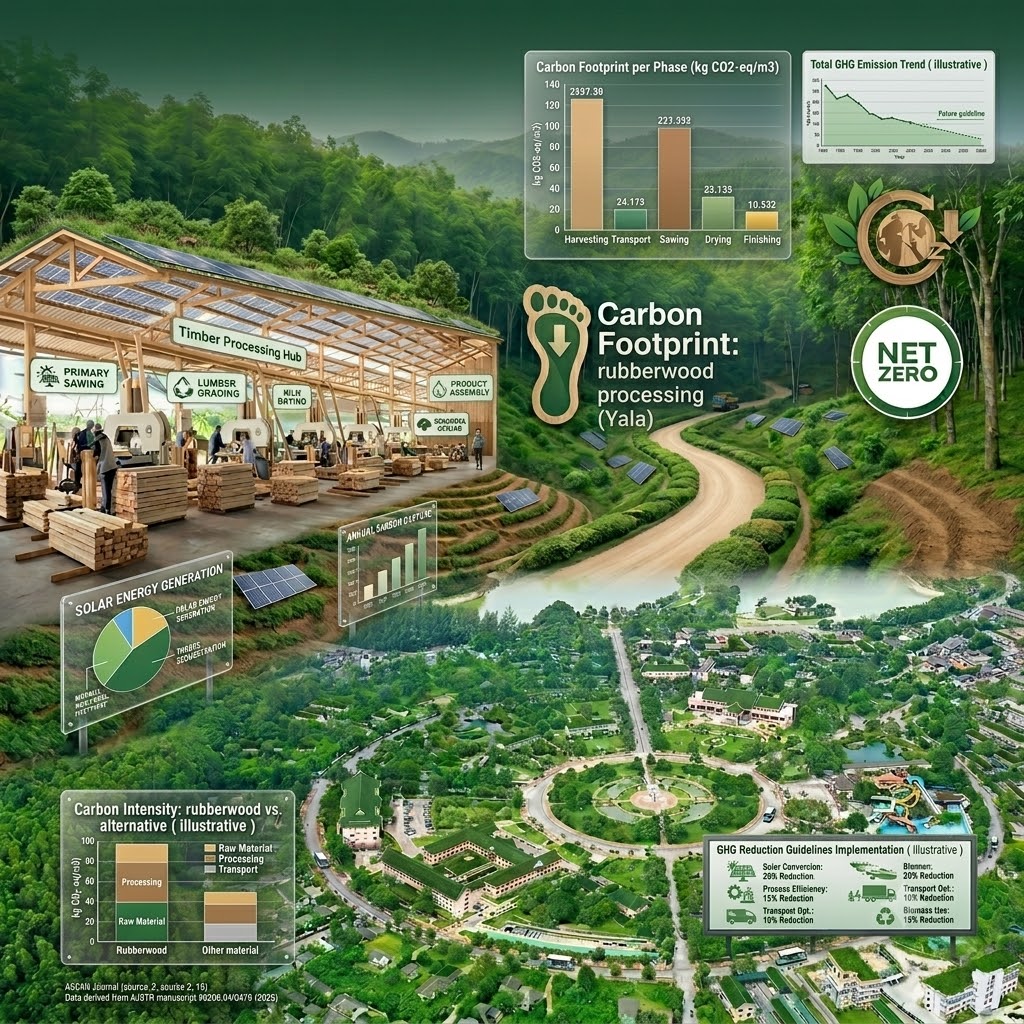
This study presents a Cradle-to-Gate carbon footprint assessment (CFP) of a representative rubberwood (Hevea brasiliensis) processing factory in Yala Province, Thailand, conducted in accordance with the Life Cycle Inventory (LCI) framework and ISO 14067:2018. The functional unit was defined as one cubic meter (1 m³) of processed rubberwood leaving the factory gate. The total greenhouse gas (GHG) emission intensity was calculated as 40.83 kgCO₂-eq/m³, with raw materials and processing residues identified as the dominant emission sources, accounting for approximately 90% of total emissions. Electricity (2.33 kgCO₂-eq/m³) and diesel fuel (0.11 kgCO₂-eq/m³) constituted secondary contributors, while consumables and auxiliary materials contributed negligibly. The findings should be interpreted as a single-factory case study rather than an industry-wide representative baseline. Potential mitigation pathways, drawn from analogous studies, include optimized inventory management (15–30% reduction potential), biomass fuel substitution (50–85%), operational efficiency improvements through preventive maintenance and AI-assisted optimization (5–15%), and waste valorization through biochar conversion. These hotspots align with Thai national policy frameworks, including the Nationally Determined Contribution (NDC), Carbon Neutrality (2050), Net Zero (2065), the TGO Carbon Label Program, the EU Carbon Border Adjustment Mechanism (CBAM), the Bio-Circular-Green (BCG) economic model, and the energy policies under the Power Development Plan (PDP) and the Department of Alternative Energy Development and Efficiency (DEDE). The study provides empirical baseline data for the rubberwood processing sector and serves as a methodological reference for future, larger-scale assessments.
Article Details

This work is licensed under a Creative Commons Attribution-NonCommercial-NoDerivatives 4.0 International License.
References
Ratnasingam, J.; Ramasamy, G.; Ioras, F.; Parasuraman, N. Assessment of the Carbon Footprint of Rubberwood Sawmilling in Peninsular Malaysia: Challenging the Green Label of the Material. BioResources 2017, 12(2), 3490–3503. https://doi.org/10.15376/biores.12.2.3490-3503
Eshun, J. F.; Marfo, E. D.; Quartey, G. A. Evaluation of the Carbon Footprint of Rubberwood Lumber Production in Ghana. Eur. J. Appl. Sci. 2022, 10(4), 803–810. https://doi.org/10.14738/aivp.104.12951
Jawjit, S.; Jawjit, W.; Pibul, P.; Wongcharee, S.; Suwannahong, K. Enhancing the Sustainability of the Sawn Rubberwood Industry through Resource-Efficient and Cleaner Production Approaches. J. Clean. Prod. 2024, 479, 143913. https://doi.org/10.1016/j.jclepro.2024.143913
Chaichana, T.; Thongdee, S.; Pechurai, W. Carbon Footprint and Carbon Stock Volume for Para Rubber Production in Southern Thailand. In 2020 International Conference on Energy, Environment and Climate Change (ICUE); 2020; pp 1–6. https://doi.org/10.1109/ICUE49301.2020.9307004
Yala Provincial Industry Office. Industrial Investment Movement Report of Yala Province as of January 2022; Yala Provincial Industry Office: Yala, Thailand, 2022.
He, K.; Dong, X.; Gong, C.; Yu, Q.; Ye, Q.; Guo, Q.; Varbanov, P. S.; Wang, X. Spatiotemporal Prediction of Greenhouse Gas Emissions from Rubber Wood Furniture Industry, Taking Hainan as the Case. J. Clean. Prod. 2024, 480, 144049. https://doi.org/10.1016/j.jclepro.2024.144049
Office of Natural Resources and Environmental Policy and Planning. Thailand's Long-Term Low Greenhouse Gas Emission Development Strategy (LT-LEDS); ONEP: Bangkok, Thailand, 2021.
Office of Natural Resources and Environmental Policy and Planning. Thailand's Second Updated Nationally Determined Contribution (NDC); ONEP: Bangkok, Thailand, 2022.
Rubberwood Processing Factory. Annual Production Report 2022; Internal Document; Yala, Thailand, 2022.
Wang, H.; Wu, J.; Chen, Z. Carbon Footprint Accounting and Low-Carbon Path Optimization for Imported Timber-Based Wooden Furniture Supply Chains. BioResources 2021, 16(4), 6870–6890. https://doi.org/10.15376/biores.16.4.6870-6890
Srichat, P.; Nanthasamroeng, P.; Bonnet, S. Life Cycle Assessment of Wood Pellet Production in Thailand. Sustainability 2020, 12(17), 6996. https://doi.org/10.3390/su12176996
Thaipradith, P.; Tuprakay, S.; Ratcha, M.; Suwannahong, K. Assessing the Carbon Footprint of a Product: A Case Study of the Wooden Chair Production Process. J. Health Environ. Educ. 2023, 8(3), 178–186.
Thailand Greenhouse Gas Management Organization. Emission Factors by Industrial Sector; TGO: Bangkok, Thailand, 2025.
Climatiq. The Largest Database of Vetted Emission Factors; Climatiq, 2025.
Türkmen, B. A. Life Cycle Environmental Impacts of Disposable Medical Masks. Environ. Sci. Pollut. Res. 2022, 29, 25496–25506. https://doi.org/10.1007/s11356-021-17430-5
Kwon, K.-S.; Lee, H.-S. Sustainable Development of Sawdust Biochar as a Green and Promising Material for CO₂ Capture Technologies. Materials 2025, 18(14), 3243. https://doi.org/10.3390/ma18143243
Department of Climate Change and Environment. National Greenhouse Gas Emission Reduction Action Plan 2021–2030; DCCE: Bangkok, Thailand, 2021.
Thailand Greenhouse Gas Management Organization. National Guideline Carbon Footprinting for Organization; TGO: Bangkok, Thailand, 2025.
Office of the National Economic and Social Development Council. Driving the BCG Economic Model (Bio-Circular-Green Economy); NESDC: Bangkok, Thailand, 2025.
Department of Alternative Energy Development and Efficiency. Thailand's Energy Conservation Plan and Renewable Energy Development Plan; DEDE: Bangkok, Thailand, 2025.
