
Development of Pilgrimage Tourism as an Application for Supporting Local Religious People
Article Sidebar
Main Article Content
Abstract
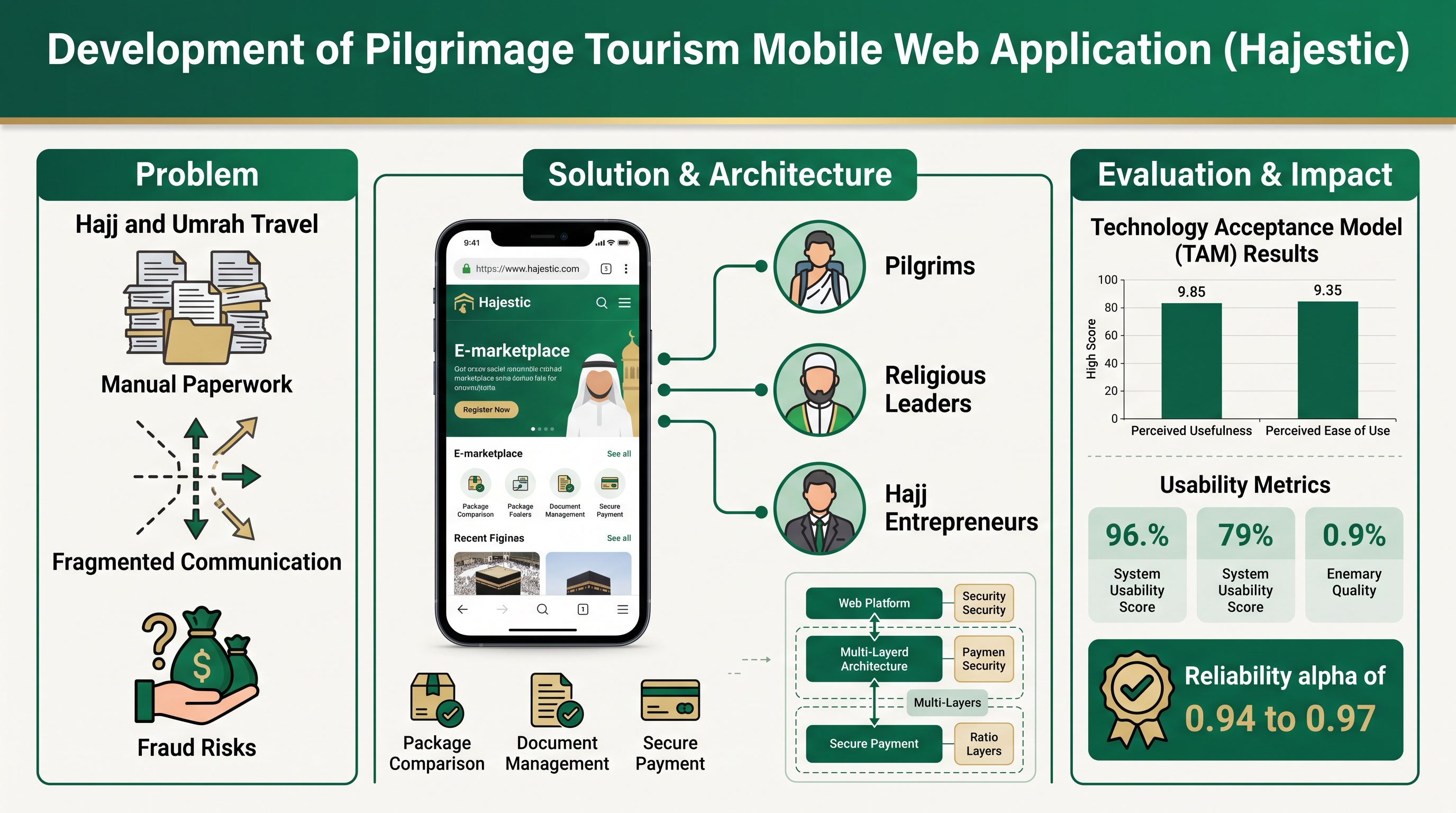
Hajj and Umrah are both Islamic pilgrimages in Mecca, Saudi Arabia, which are the main activities for Muslims. These are also required by Muslims in Thailand, and the trend is increasing every year. Typically, the number of pilgrims who can perform Hajj is limited by Saudi Arabia. In 2022, Thailand received a quota of 13,000 people, and the Committee for the Promotion of Hajj Affairs in Thailand will distribute the quota to entrepreneurs and religious leaders who have licenses to lead pilgrimage tourism. However, there are some difficulties in a pilgrimage tour, such as visa applications, accommodation bookings, flights, and so on. These processes need a lot of paperwork, so entrepreneurs and religious leaders will present to support pilgrims. There have been reports of pilgrimage tourism, including high service charges, poor management, and fraud by scammers. To the best of our knowledge, there is no digital platform to help local religious leaders organize the tour and provide online services for pilgrims. Therefore, we design and develop a novel application for pilgrimage tourism to facilitate religious leaders in handling paperwork for the Committee for the Promotion of Hajj Affairs in Thailand and support pilgrims in booking pilgrimage tours through a mobile web application, namely https://www.hajestic.com. The key development of the application is a user-centric, e-marketplace-based structure integrated to secure online payments and ensure compliance for users. In addition, we also designed 3 qualitative questionnaires based on the technology acceptance model (TAM) to guarantee the application meets users’ requirements and satisfaction.
Downloads
Article Details

This work is licensed under a Creative Commons Attribution-NonCommercial-NoDerivatives 4.0 International License.
References
Department of Religious Affairs, Ministry of Culture. Hajj Pilgrimage Travel Manual; Express Transportation Organization Printing House: Bangkok, 2005.
Department of Provincial Administration, Ministry of Interior. List of Hajj Operators; 2024. https://hajthailand.dopa.go.th/content/agency/listAllAgencyPOP.html (accessed January 19, 2024).
Hat Yai News Center. Report on Damages from Deception/Fraud; Hat Yai News Center: Hat Yai, 2016.
Law, R.; Guillet, B. D.; Leung, R. Do Customers Share the Same Perspective? A Study on Online Travel Agencies' Ratings. Tour. Manage. 2016, 53, 162–174.
Castro, M.; Ferreira, J. Online Travel Agencies: Factors Influencing Tourist Purchase Decision (Booking.com and Expedia). Tour. Manag. Stud. 2020, 16, 7–15. https://doi.org/10.18089/tms.2019.150201
Turnšek, M. Platformization in Tourism: Typology of Business Models and Market Concentration. Tour. Hosp. 2025, 3, 1–18. https://doi.org/10.3390/platforms3010001
Venkatesh, V.; Bala, H. Technology Acceptance Model 3 and a Research Agenda on Interventions. Decis. Sci. 2008, 39, 273–315. https://doi.org/10.1111/j.1540-5915.2008.00192.x
School of Money. Platform Business Model; 2025. https://schoolofmoney.org/platform-business-model (accessed November 7, 2025).
Pohuda, N. V. The Influence of OTA Channels on the Tourism Industry. Sci. Notes Taurida Natl. V. I. Vernadsky Univ., Ser. Econ. Manag. 2023, 73, 43–51. https://doi.org/10.32782/2523-4803/73-2-8
Sánchez-Cartas, J. M.; León, G. Multisided Platforms and Markets: A Survey of the State of the Art. J. Econ. Surv. 2021, 35, 452–487. https://doi.org/10.1111/joes.12340
Hu, T. Digital Tourism Platform Features as Marketing Stimuli Shaping Tourist Experience and Revisit Intention. Front. Commun. 2026, 11, 1807972. https://doi.org/10.3389/fcomm.2026.1807972
Alves, J.; Teixeira, P.; Eusébio, C.; Teixeira, L. Benchmarking of Technological Platforms for Accessible Tourism: A Study Resulting in an Innovative Solution—Access@tour. Appl. Sci. 2022, 12, 3963. https://doi.org/10.3390/app12083963
Shariffuddin, N. S. M.; Azinuddin, M.; Yahya, N. E.; Hanafiah, M. H. Navigating the Tourism Digital Landscape: The Interrelationship of Online Travel Sites' Affordances, Technology Readiness, Online Purchase Intentions, Trust, and E-Loyalty. Heliyon 2023, 9, e18974. https://doi.org/10.1016/j.heliyon.2023.e19135
Vlahović, O.; Rađenović, Ž.; Perović, D.; Vujačić, V.; Davidović, K. Digital Transformation in Tourism: The Role of E-Booking Systems. Croat. Reg. Dev. J. 2024, 5, 129–145. https://doi.org/10.2478/crdj-2024-0012
Rosário, A. T.; Dias, J. C. Exploring the Landscape of Smart Tourism: A Systematic Bibliometric Review of the Literature of the Internet of Things. Adm. Sci. 2024, 14, 22. https://doi.org/10.3390/admsci14020022
Durán-Sánchez, A.; Álvarez-García, J.; del Río-Rama, M. C.; Oliveira, C. Religious Tourism and Pilgrimage: Bibliometric Overview. Religions 2018, 9, 249. https://doi.org/10.3390/rel9090249
Kluver, R.; Cheong, P. H. Technological Modernization, the Internet, and Religion in Singapore. J. Comput.-Mediat. Commun. 2007, 12, 1122–1142. https://doi.org/10.1111/j.1083-6101.2007.00366.x
Almuhrzi, H. M.; Alsawafi, A. M. Muslim Perspectives on Spiritual and Religious Travel beyond Hajj: Toward Understanding Motivations for Umrah Travel in Oman. Tour. Manage. Perspect. 2017, 24, 235–242. https://doi.org/10.1016/j.tmp.2017.07.016
Oliver, R. L. Satisfaction: A Behavioral Perspective on the Consumer; McGraw-Hill: New York, 1997.
Venkatesh, V.; Davis, F. D. A Theoretical Extension of the Technology Acceptance Model. Manage. Sci. 2000, 46, 186–204. https://doi.org/10.1287/mnsc.46.2.186.11926
Venkatesh, V.; Thong, J. Y. L.; Xu, X. Consumer Acceptance and Use of Information Technology: Extending the Unified Theory. J. Assoc. Inf. Syst. 2021, 22, 1251–1286.
Kawashima, N. Tourism and Religion: A Study of Pilgrimage. Tourism 2016, 64, 415–429.
Lubis, R. F.; Ananto, A. B.; Afifudin, A. Tourism Information Systems Development. IOP Conf. Ser.: J. Phys. 2021, 1811, 012044.
Majid, M. A.; Samah, B. A.; Yusuf, Y. Website Quality and User Satisfaction. Int. J. Adv. Comput. Sci. Appl. 2016, 7, 123–129.
Marinković, V. Customer Satisfaction in Tourism Services. Turizam 2019, 23, 73–82.
Hevner, A. R.; Malgonde, C. Design Science Research in Information Systems. Electron. Mark. 2019, 29, 407–421. https://doi.org/10.1007/s12525-019-00334-1
Puttitaweesri, P.; Kranruang, D.; Rimphati, W. Development of Smartphone-Based Navigation System in Ratchaburi. ASEAN J. Sci. Technol. Rep. 2019, 22, 97–108.
Sooknit, O.; Sakda, S. Local Tourism Routes from Geolocation Data Using Google Maps Platform. Thaksin Univ. J. 2020, 23, 66–77.
LINE Corporation. LINE Seed Sans TH; LINE Developers: 2022. https://line.me/en/developers/lineseedsansth (accessed November 7, 2025).
Ross, R.; Pillitteri, V.; Dempsey, K.; Riddle, M.; Guissanie, G. Protecting Controlled Unclassified Information in Nonfederal Systems and Organizations (NIST SP 800-171 Rev. 2); National Institute of Standards and Technology: Gaithersburg, MD, 2020. https://doi.org/10.6028/NIST.SP.800-171r2
Rescorla, E. The Transport Layer Security (TLS) Protocol Version 1.3 (RFC 8446); Internet Engineering Task Force, 2018. https://doi.org/10.17487/RFC8446
Rose, S.; Borchert, O.; Mitchell, S.; Connelly, S. Zero Trust Architecture (NIST SP 800-207); National Institute of Standards and Technology: Gaithersburg, MD, 2020. https://doi.org/10.6028/NIST.SP.800-207
Jones, M.; Bradley, J.; Sakimura, N. JSON Web Token (JWT) (RFC 7519); Internet Engineering Task Force, 2015. https://doi.org/10.17487/RFC7519
Ives, B.; Walsh, K. R.; Schneider, H. The Domino Effect of Password Reuse. Commun. ACM 2004, 47, 75–78. https://doi.org/10.1145/986213.986229
OWASP Foundation. OWASP Top 10: 2021; OWASP Foundation, 2021. https://owasp.org/Top10/.
Halfond, W. G. J.; Viegas, J.; Orso, A. A Classification of SQL Injection Attacks and Countermeasures. In Proceedings of the IEEE International Symposium on Secure Software Engineering; IEEE, 2006; pp 13–15.
Daemen, J.; Rijmen, V. The Design of Rijndael: AES—The Advanced Encryption Standard; Springer: Berlin, Germany, 2002. https://doi.org/10.1007/978-3-662-04722-4_1
Saltzer, J. H.; Schroeder, M. D. The Protection of Information in Computer Systems. Proc. IEEE 1975, 63, 1278–1308. https://doi.org/10.1109/PROC.1975.9939
PCI Security Standards Council. Payment Card Industry Data Security Standard (PCI DSS), Version 4.0; PCI SSC, 2022.
Stripe. Stripe API Reference; Stripe Inc., 2023. https://stripe.com/docs/api.
Balan, V.; Sabau, A. S.; Octavian, M. Payment Tokenization in E-Commerce: Security Analysis and Implementation Considerations. J. Inf. Secur. Appl. 2021, 58, 102779. https://doi.org/10.1016/j.jisa.2021.102779
Krawczyk, H.; Bellare, M.; Canetti, R. HMAC: Keyed-Hashing for Message Authentication (RFC 2104); Internet Engineering Task Force, 1997. https://doi.org/10.17487/RFC2104
Scarfone, K.; Mell, P. Guide to Intrusion Detection and Prevention Systems (IDPS) (NIST SP 800-94); National Institute of Standards and Technology: Gaithersburg, MD, 2007. https://doi.org/10.6028/NIST.SP.800-94
Likert, R. A Technique for the Measurement of Attitudes. Arch. Psychol. 1932, 140, 1–55.
Campbell, S.; Greenwood, M.; Prior, S.; Shearer, T.; Walkem, K.; Young, S.; Bywaters, D.; Walker, K. Purposive Sampling: Complex or Simple? Research Case Examples. J. Res. Nurs. 2020, 25, 652–661. https://doi.org/10.1177/1744987120927206
Etikan, I.; Musa, S. A.; Alkassim, R. S. Comparison of Convenience Sampling and Purposive Sampling. Am. J. Theor. Appl. Stat. 2016, 5, 1–4. https://doi.org/10.11648/j.ajtas.20160501.11
