
Chia Seed Extract Attenuates Streptozotocin-Induced Pancreatic Beta-Cell Dysfunction in Diabetic Rats: Evidence from Functional and Oxidative Stress Biomarkers
Article Sidebar
Main Article Content
Abstract
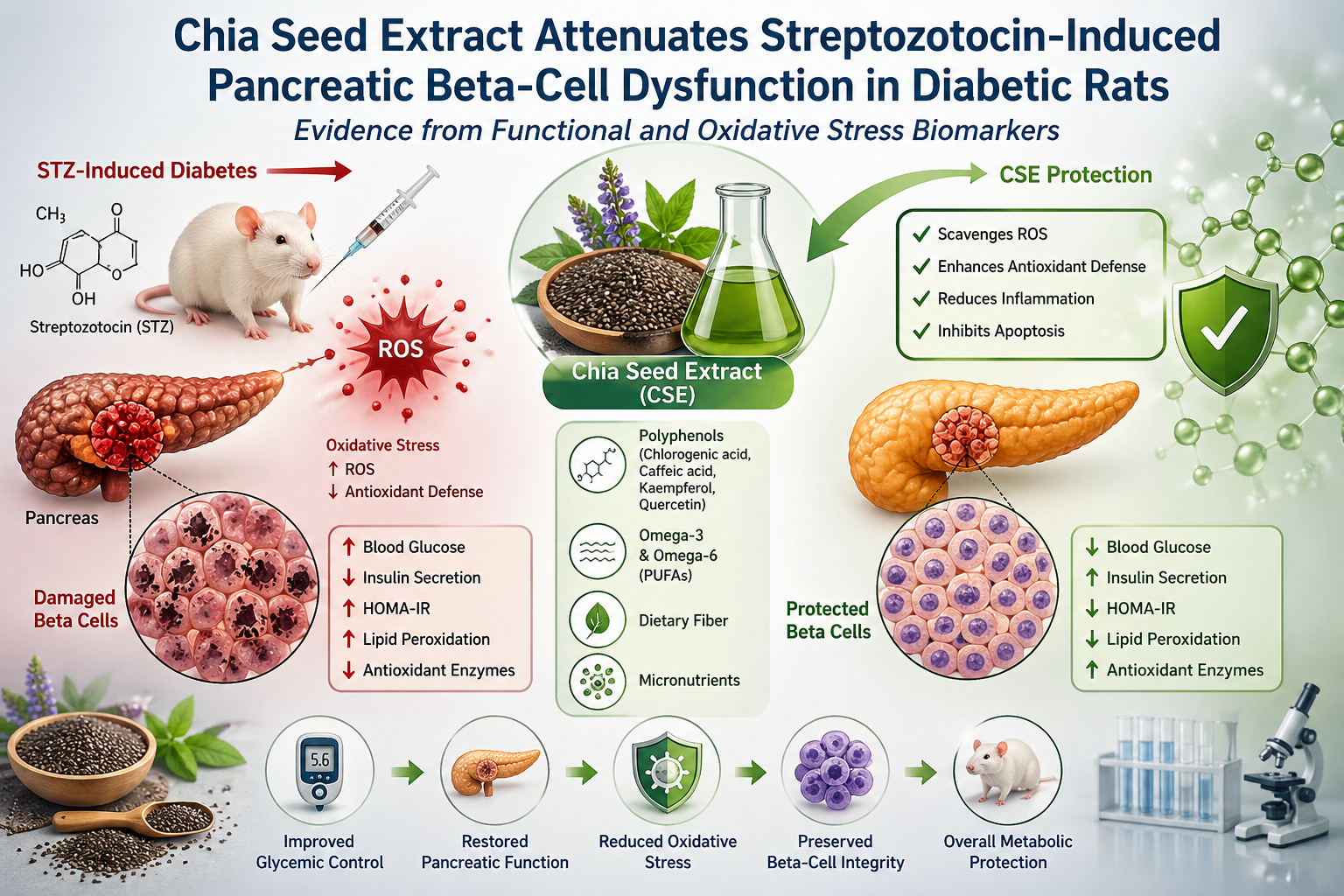
Diabetes mellitus has a global prevalence of more than 422 million cases, with progressive beta-cell dysfunction marked by pancreatic dysplasia. This paper appraised the protective influences of chia seed extract (CSE) on beta-cell dysfunction induced by streptozotocin (STZ) in diabetic rats. In this experiment, Wistar rats (160g) were separated into four groups (normal control, diabetic control, and two CSE-treated diabetic groups (250 and 500 mg/kg body weight)). The separation lasted 8 weeks, during which 32 male rats were used. STZ (40mg/kg) was injected intraperitoneally to induce diabetes. The measured parameters included fasting glucose, HbA1c, serum insulin, HOMA-IR, pancreatic enzymes, and oxidative stress markers. CSE treatment dose-dependently lowered fasting glucose (59% reduction at high dose, p<0.001), augmented insulin secretion (p<0.001), diminished HOMA-IR (62% reduction, p<0.001), and highly inhibited oxidative imbalance in pancreatic tissue. The CSE 500mg/kg concentration suppressed malondialdehyde by 59 percent and replenished glutathione by 105 percent. These results indicate that the chia seed extract has strong antidiabetic and antioxidant effects, suppressing STZ-induced pancreatic beta-cell dysfunction by reducing oxidative stress.
Article Details

This work is licensed under a Creative Commons Attribution-NonCommercial-NoDerivatives 4.0 International License.
References
International Diabetes Federation. IDF Diabetes Atlas, 10th ed.; International Diabetes Federation: Brussels, Belgium, 2021.
Kahn, S. E.; Cooper, M. E.; Del Prato, S. Pathophysiology and treatment of type 2 diabetes: Perspectives on the past, present, and future. Lancet 2014, 383, 1068–1083. https://doi.org/10.1016/S0140-6736(13)62154-6
Eizirik, D. L.; Colli, M. L.; Ortis, F. The role of inflammation in insulitis and beta-cell loss in type 1 diabetes. Nat. Rev. Endocrinol. 2009, 5, 219–226. https://doi.org/10.1038/nrendo.2009.21
Szkudelski, T. The mechanism of alloxan and streptozotocin action in B cells of the rat pancreas. Physiol. Res. 2001, 50, 537–546. https://doi.org/10.33549/physiolres.930111
Lenzen, S. The mechanisms of alloxan- and streptozotocin-induced diabetes. Diabetologia 2008, 51, 216–226. https://doi.org/10.1007/s00125-007-0886-7
Elsner, M.; Gurgul-Convey, E.; Lenzen, S. Relative importance of caspase-dependent and caspase-independent apoptosis in β cells. Diabetologia 2012, 55, 1350–1357.
Tiedge, M.; Lortz, S.; Drinkgern, J.; Lenzen, S. Relation between antioxidant enzyme gene expression and antioxidative defense status of insulin-producing cells. Diabetes 1997, 46, 1733–1742. https://doi.org/10.2337/diabetes.46.11.1733
Robertson, R. P.; Zhou, H.; Zhang, T.; Harmon, J. S. Chronic oxidative stress as a mechanism for glucose toxicity of the beta cell in type 2 diabetes. Cell Biochem. Biophys. 2007, 48, 139–146. https://doi.org/10.1007/s12013-007-0026-5
Nieman, D. C.; Cayrado, C. A.; Austin, M. D.; Benowitz, D. A.; Shanely, R. A.; Jensen, R. S. Chia seed does not promote weight loss or alter disease risk factors in overweight adults. Nutr. Res. 2009, 29, 414–418. https://doi.org/10.1016/j.nutres.2009.05.011
Coates, W.; Ayerza, R. Chia seed (Salvia hispanica L.): A new source of omega-3 fatty acids and its biological activities. J. Am. Oil Chem. Soc. 1996, 73, 23–25.
Martinez-Cruz, O.; Paredes-López, O. Phytochemical profile and nutraceutical potential of chia seeds (Salvia hispanica L.) by ultra high performance liquid chromatography. J. Chromatogr. A 2014, 1346, 43–48. https://doi.org/10.1016/j.chroma.2014.04.007
Pandey, K. B.; Rizvi, S. I. Plant polyphenols as dietary antioxidants in human health and disease. Oxid. Med. Cell. Longev. 2009, 2, 270–278. https://doi.org/10.4161/oxim.2.5.9498
Rerup, C. C. Drugs producing diabetes through damage to the insulin secretory mechanism. Pharmacol. Rev. 1970, 22, 485–518.
Bolzan, A. D.; Bianchi, M. S. Genotoxicity of streptozotocin. Mutat. Res. 2002, 512, 121–134. https://doi.org/10.1016/S1383-5742(02)00044-3
Ceriello, A.; Testa, R. Antioxidant anti-inflammatory treatment in diabetes. Diabetes Care 2009, 32, S232–S236. https://doi.org/10.2337/dc09-S316
American Diabetes Association. Standards of medical care in diabetes. Diabetes Care 2023, 46, S1–S291.
Hii, C. S. T.; Howell, S. L. Effects of flavonoids on insulin secretion and Ca²⁺ handling in rat islets of Langerhans. J. Endocrinol. 1985, 107, 1–8. https://doi.org/10.1677/joe.0.1070001
Eid, H. M.; Nachar, A.; Thong, F.; Sweeney, G.; Haddad, P. S. The molecular basis of the antidiabetic action of quercetin. Pharmacogn. Mag. 2015, 11, 74–81. https://doi.org/10.4103/0973-1296.149708
Demirtas, B.; Gonenc, S.; Akman, S.; Yegen, B. C.; Senol, A. Protective effect of melatonin on streptozotocin-induced pancreatic tissue damage. Pancreas 2001, 22, 309–314.
Aggarwal, B. B.; Kunnumakkara, A. B.; Harikumar, K. B.; Tharakan, S. T.; Sung, B.; Anand, P. Potential of spice-derived phytochemicals for cancer prevention. Planta Med. 2008, 74, 1560–1569. https://doi.org/10.1055/s-2008-1074578
Maritim, A. C.; Sanders, R. A.; Watkins, J. B. Diabetes, oxidative stress, and antioxidants: A review. J. Biochem. Mol. Toxicol. 2003, 17, 24–38. https://doi.org/10.1002/jbt.10058
Valko, M.; Leibfritz, D.; Moncol, J.; Cronin, M. T. D.; Mazur, M.; Telser, J. Free radicals and antioxidants in human disease. Int. J. Biochem. Cell Biol. 2007, 39, 44–84. https://doi.org/10.1016/j.biocel.2006.07.001
Sies, H. Glutathione and its role in cellular functions. Free Radic. Biol. Med. 1999, 27, 916–921. https://doi.org/10.1016/S0891-5849(99)00177-X
Marineli, R. D. S.; Lenquiste, S. A.; Marques, M. C.; Bogo, D.; Menezes, E. M.; Lancha, A. H., Jr. Chemical characterization and antioxidant potential of Chilean chia seeds. LWT–Food Sci. Technol. 2015, 62, 370–377.
Scalbert, A.; Johnson, I. T.; Saltmarsh, M. Polyphenols: Antioxidants and beyond. Am. J. Clin. Nutr. 2005, 81, 215S–217S. https://doi.org/10.1093/ajcn/81.1.215S
Simopoulos, A. P. The importance of the omega-6/omega-3 fatty acid ratio. Exp. Biol. Med. 2008, 233, 674–688. https://doi.org/10.3181/0711-MR-311
