Therapeutic Effects of Marjoram (Origanum majorana L.) Extract and Nano-Formulation on Hormonal Parameters and Ovarian Histology in Letrozole-Induced Polycystic Ovary Syndrome in Rats
Article Sidebar
Main Article Content
Abstract
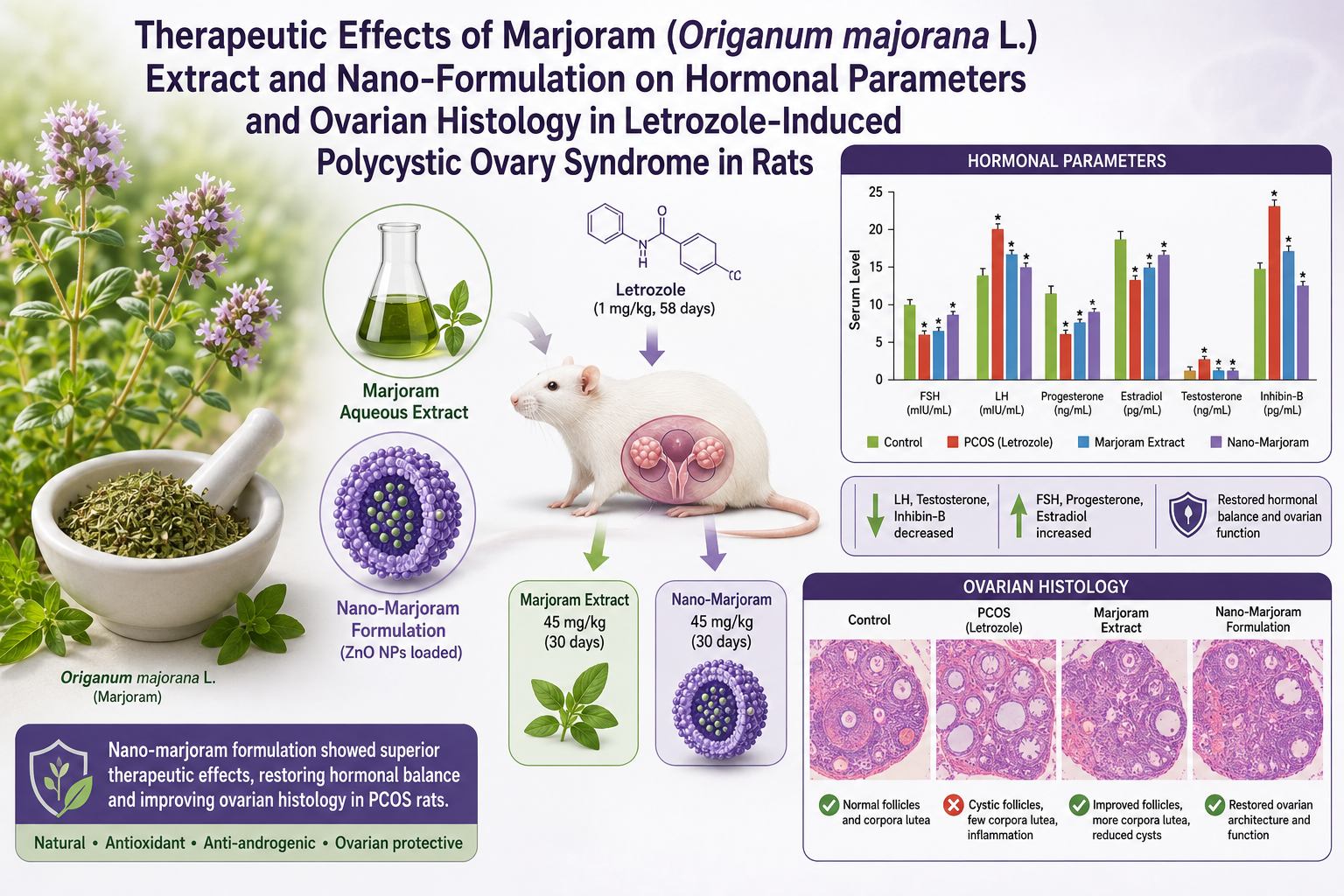
Polycystic ovary syndrome (PCOS) represents a prevalent endocrine disorder characterized by hyperandrogenism, hormonal imbalances, and ovarian dysfunction, affecting approximately 30% of female infertility cases globally. This study evaluated the therapeutic efficacy of marjoram (Origanum majorana L.) aqueous extract and zinc oxide nano-loaded marjoram formulation on letrozole-induced PCOS in female Wistar rats. Fifty rats (150-250 g) were randomly assigned to five groups (n=10): negative control (physiological saline), carboxymethylcellulose (CMC) control, PCOS induction (1 mg/kg letrozole for 58 days), marjoram extract treatment (45 mg/kg for 30 days post-induction), and nano-marjoram treatment (45 mg/kg for 30 days post-induction). Serum hormonal parameters and ovarian histology were assessed. Letrozole induction produced characteristic PCOS features with significant hormonal alterations: 44% FSH decrease (5.78 vs. 10.30 mIU/mL, p<0.05), 46% LH increase (20.07 vs. 13.71 mIU/mL, p<0.05), 43% progesterone decrease (6.87 vs. 12.07 mIU/mL, p<0.05), 32% estradiol decrease (72.91 vs. 106.66 pg/mL, p<0.05), 125% testosterone increase (0.45 vs. 0.20 pg/mL, p<0.05), and 158% inhibin-B increase (378.59 vs. 146.58 pg/mL, p<0.05) compared to controls. Nano-marjoram treatment demonstrated superior therapeutic effects, restoring FSH by 51% (8.73 mIU/mL), reducing LH by 18% (16.44 mIU/mL), increasing progesterone by 36% (9.33 mIU/mL), increasing estradiol by 24% (90.64 pg/mL), reducing testosterone by 42% (0.26 pg/mL), and reducing inhibin-B by 53% (179.35 pg/mL) relative to PCOS group. Histological examination revealed that nano-marjoram treatment significantly improved ovarian architecture, increasing the number of corpora lutea, restoring Graafian follicles, and reducing cystic follicles and inflammatory infiltration compared with the PCOS group. These findings demonstrate that marjoram, particularly in nano-formulation, effectively ameliorates PCOS-associated hormonal dysregulation and ovarian pathology through antioxidant and anti-androgenic mechanisms, suggesting potential clinical applications for PCOS management.
Article Details

This work is licensed under a Creative Commons Attribution-NonCommercial-NoDerivatives 4.0 International License.
References
Zehravi, M.; Maqbool, M.; Ara, I. Polycystic Ovary Syndrome and Infertility: An Update. Int. J. Adolesc. Med. Health 2021, 34, 1–9. https://doi.org/10.1515/ijamh-2021-0073
Soni, N. R. Current Management on PCOS (Polycystic Ovary Syndrome)/Stein-Leventhal Syndrome. Invest. Gynecol. Res. Women’s Health 2017, 1, 10–31. https://doi.org/10.31031/IGRWH.2017.01.000511
Zhu, T.; Goodarzi, M. O. Causes and Consequences of Polycystic Ovary Syndrome: Insights from Mendelian Randomization. J. Clin. Endocrinol. Metab. 2022, 107, e899–e911. https://doi.org/10.1210/clinem/dgab757
Al-Yasiry, R. Z.; Jwad, M. A.; Hasan, M. F.; Alsayigh, H. A. How Obesity Affects Female Fertility. Med. J. Babylon 2022, 19, 111–114. https://doi.org/10.4103/MJBL.MJBL_8_22
Priyadarshani, A.; Madan, V.; Jayaraj, P. Veritable Evaluation and Inspection of PCOS and Its Apropos Medicaments. Indian J. Biochem. Biophys. 2022, 59, 1039–1047.
Walker, K.; DeCherney, A. H.; Saunders, R. Menstrual Dysfunction in PCOS. Clin. Obstet. Gynecol. 2021, 64, 119–125. https://doi.org/10.1097/GRF.0000000000000596
Escobar-Morreale, H. F. Polycystic Ovary Syndrome: Definition, Aetiology, Diagnosis and Treatment. Nat. Rev. Endocrinol. 2018, 14, 270–284. https://doi.org/10.1038/nrendo.2018.24
Hoeger, K. M.; Dokras, A.; Piltonen, T. Update on PCOS: Consequences, Challenges, and Guiding Treatment. J. Clin. Endocrinol. Metab. 2021, 106, e1071–e1083. https://doi.org/10.1210/clinem/dgaa839
Pachiappan, S.; Matheswaran, S.; Saravanan, P.; Muthusamy, G. Medicinal Plants for Polycystic Ovary Syndrome: A Review of Phytomedicine Research. Int. J. Herb. Med. 2017, 5, 78–80.
Alaee, S.; Bagheri, M.; Sadeghi, M.; Koohpeyma, F. Capacity of Mentha spicata (Spearmint) Extract in Alleviating Hormonal and Folliculogenesis Disturbances in Polycystic Ovarian Syndrome Rat Model. World’s Vet. J. 2020, 10, 451–456. https://doi.org/10.36380/scil.2020.wvj56
Dar, R. A.; Shahnawaz, M.; Ahanger, M. A.; Majid, I. U. Exploring the Diverse Bioactive Compounds from Medicinal Plants: A Review. J. Phytopharmacol. 2023, 12, 189–195. https://doi.org/10.31254/phyto.2023.12307
Guo, M.; Lv, H.; Chen, H.; Dong, S.; Zhang, J.; Liu, W.; He, L.; Ma, Y.; Yu, H.; Chen, S.; et al. Strategies on Biosynthesis and Production of Bioactive Compounds in Medicinal Plants. Chin. Herb. Med. 2023, 16, 13–26. https://doi.org/10.1016/j.chmed.2023.01.007
Zagoskina, N. V.; Zubova, M. Y.; Nechaeva, T. L.; Kazantseva, V. V.; Goncharuk, E. A.; Katanskaya, V. M.; Baranova, E. N.; Aksenova, M. A. Polyphenols in Plants: Structure, Biosynthesis, Abiotic Stress Regulation, and Practical Applications (Review). Int. J. Mol. Sci. 2023, 24, 13874. https://doi.org/10.3390/ijms241813874
Erenler, R.; Sen, O.; Aksit, H.; Demirtas, I.; Yaglioglu, A. S.; Elmastas, M.; Telci, I. Isolation and Identification of Chemical Constituents from Origanum majorana and Investigation of Antiproliferative and Antioxidant Activities. J. Sci. Food Agric. 2016, 96, 822–836. https://doi.org/10.1002/jsfa.7155
Roby, M. H. H.; Sarhan, M. A.; Selim, K. A. H.; Khalel, K. I. Evaluation of Antioxidant Activity, Total Phenols and Phenolic Compounds in Thyme (Thymus vulgaris L.), Sage (Salvia officinalis L.), and Marjoram (Origanum majorana L.) Extracts. Ind. Crops Prod. 2013, 43, 827–831. https://doi.org/.10.1016/j.indcrop.2012.08.029
Dăneasă, A.; Cucolaş, C.; Lenghel, L. M.; Olteanu, D.; Orăsan, R.; Filip, G. A. Letrozole vs Estradiol Valerate Induced PCOS in Rats: Glycemic, Oxidative and Inflammatory Status Assessment. Reproduction 2016, 151, 401–409. https://doi.org/10.1530/REP-15-0352
Atashpour, S.; Jahromi, H. K.; Jahromi, Z. K.; Maleknasab, M. Comparison of the Effects of Ginger Extract with Clomiphene Citrate on Sex Hormones in Rats with Polycystic Ovarian Syndrome. Int. J. Reprod. Biomed. 2017, 15, 561–568. https://doi.org/10.29252/ijrm.15.9.561
Shahrajabian, M. H.; Sun, W. Asparagus (Asparagus officinalis L.) and Pennyroyal (Mentha pulegium L.), Impressive Advantages with Wondrous Health-Beneficial Phytochemicals. Not. Sci. Biol. 2022, 14, 11212. https://doi.org/10.55779/nsb14211212
Cala, A.; Salcedo, J. R.; Torres, A.; Varela, R. M.; Molinillo, J. M. G.; Macías, F. A. A Study on the Phytotoxic Potential of the Seasoning Herb Marjoram (Origanum majorana L.) Leaves. Molecules 2021, 26, 3356. https://doi.org/10.3390/molecules26113356
Bashi, A. M.; Hussein, M. Z.; Zainal, Z.; Tichit, D. Synthesis and Controlled Release Properties of 2,4-Dichlorophenoxy Acetate-Zinc Layered Hydroxide Nanohybrid. J. Solid State Chem. 2013, 203, 19–24. https://doi.org/10.1016/j.jssc.2013.03.047
[21] Wang, M. X.; Yin, Q.; Xu, X. A Rat Model of Polycystic Ovary Syndrome with Insulin Resistance Induced by Letrozole Combined with High Fat Diet. Med. Sci. Monit. 2020, 26, e922136-1–e922136-11. https://doi.org/10.12659/MSM.922136
Ibrahim, H. S.; Aboraya, A. O.; Elgazar, A. F.; Helala, E. S. The Treatment Effect of Marjoram Leaves on Letrozole Induced-Polycystic Ovary Syndrome Experimental Design and Assembly of Rats. Stat. Anal. 2023, 12, 466–474.
Bashi, A. M.; Hussein, M. Z.; Zainal,Z.; Tichit, D. Synthesis and Controlled Release Properties of 2,4-Dichlorophenoxy Acetate-Zinc Layered Hydroxide Nanohybrid. J. Solid State Chem. 2013, 203, 19–24. https://doi.org/10.1016/j.jssc.2013.03.047
Sangar, G. H. M.; Mirazi, N.; Roodbari, N. H.; Hossieni, A. Nutritional Value of Palm Meristem from Phoenix dactylifera L. and Its Effect on Polycystic Ovary Syndrome in Female Rats Induced with Estradiol Valerate. World J. Tradit. Chin. Med. 2024, 10, 476–484. https://doi.org/10.4103/wjtcm.wjtcm_65_24
Majaliah, A. A.; Saleh, S. The Effect of Activin A Hormone Levels in Women with Recurrent Miscarriage Associated with Polycystic Ovary Syndrome. Ibn Sina J. Med. Sci. Health Pharm. 2025, 2, 8–19.
Kandasamy, S.; Inmozhi Sivagamasundari, R.; Bupathy, A.; Sethupathy, S. The Plasma Nitric Oxide and Homocysteine Levels and Their Association with Insulin Resistance in South Indian Women with Polycystic Ovary Syndrome. Int. J. Res. Med. Sci. 2016, 4, 4829–4835. https://doi.org/10.18203/2320-6012.ijrms20163774
Poojary, P. S.; Nayak, G.; Panchanan, G.; Rao, A.; Kundapur, S. D.; Kalthur, S. G.; Kalthur, G. Distinctions in PCOS Induced by Letrozole vs Dehydroepiandrosterone with High-Fat Diet in Mouse Model. Endocrinology 2022, 163, bqac171. https://doi.org/10.1210/endocr/bqac097
Dewailly, D.; Robin, G.; Peigne, M.; Decanter, C.; Pigny, P.; Catteau-Jonard, S. Interactions between Androgens, FSH, Anti-Müllerian Hormone and Estradiol during Folliculogenesis in the Human Normal and Polycystic Ovary. Hum. Reprod. Update 2016, 22, 709–724. https://doi.org/10.1093/humupd/dmw027
Elfiky, A. M.; Ibrahim, R. S.; Khattab, A. R.; Kadry, M. O.; Ammar, N. M.; Shawky, E. Exploring the Therapeutic Potential of Marjoram (Origanum majorana L.) in Polycystic Ovary Syndrome: Insights from Serum Metabolomics, Network Pharmacology and Experimental Validation. BMC Complement. Med. Ther. 2025, 25, 67. https://doi.org/10.1186/s12906-025-04774-5
Al-Harbi, L. N.; ALSedairy, S. A.; Alshammari, G. M.; Binobead, M. A.; Arzoo, S. Protective Effect of Marjoram against Letrozole-Induced Ovarian Damage in Rats with Polycystic Ovarian Syndrome Entails Activation of Nrf2 and Suppression of NF-κB. Pharmaceuticals 2025, 18, 1291. https://doi.org/10.3390/ph18091291
Beceren, A.; Hazar-Yavuz, A. N.; Bingol Ozakpinar, O.; Taskin, D.; Senkardes, İ.; Taskin, T.; Yerer, M. B.; Elcioglu, H. K. Toxicological Assessment of Origanum majorana L.: Evaluation of Its Cytotoxicity, Genotoxicity, and Acute Oral Toxicity. Int. J. Mol. Sci. 2025, 26, 9461. https://doi.org/10.3390/ijms26199461
Maharjan, R.; Nagar, P. S.; Nampoothiri, L. Effect of Aloe barbadensis Mill. Formulation on Letrozole Induced Polycystic Ovarian Syndrome Rat Model. J. Ayurveda Integr. Med. 2010, 1, 273–279. https://doi.org/10.4103/0975-9476.74090
Alkalby, J.; Hamzah, F. Ameliorative Effect of Fenugreek on Sex Hormones in Polycystic Ovary Syndrome Female Rats Induced by Letrozole. Kufa J. Vet. Med. Sci. 2017, 8, 24–32. https://doi.org/10.36326/kjvs/2017/v8i24123
Niepsuj, J.; Piwowar, A.; Franik, G.; Bizoń, A. The Concentration of Follistatin and Activin A in Serum and Selected Biochemical Parameters in Women with Polycystic Ovary Syndrome: Stratification by Tobacco Smoke Exposure, Insulin Resistance, and Overweight/Obesity. J. Clin. Med. 2024, 13, 5316. https://doi.org/10.3390/jcm13175316
Mamitha, Z. A. A. A. J.; Al-Fatlawi, A. C. Y.; Hamdan, M. Evaluation of Serum Inhibin-B in Polycystic Ovarian Syndrome (PCOs), Premature Ovarian Failure (POF) and Related with Obese Infertility, Case-Control Study. Iraqi J. Appl. Sci. 2025, 2, 25–33. https://doi.org/10.69923/ewnpb460
Al Syaad, K. M.; Ibrahim, E. H. Study of the Antioxidant, Immunomodulatory and Antibacterial Properties of Origanum majorana Leaf Acetone Extract. Pak. J. Pharm. Sci. 2020, 33, 1547–1553.
Muzykiewicz, A.; Florkowska, K.; Nowak, A.; Zielonka-Brzezicka, J.; Klimowicz, A. Antioxidant Activity of St. John’s Wort Extracts Obtained with Ultrasound-Assisted Extraction. Pomeranian J. Life Sci. 2019, 65, 89–93. https://doi.org/10.21164/pomjlifesci.640
