
Gastroprotective Effects of Purslane (Portulaca oleracea L.) Ethanolic Extract Against Aspirin-Induced Gastric Ulcer: Modulation of Oxidative Stress, Inflammatory Mediators, and EGFR Signaling in Rats
Article Sidebar
Main Article Content
Abstract
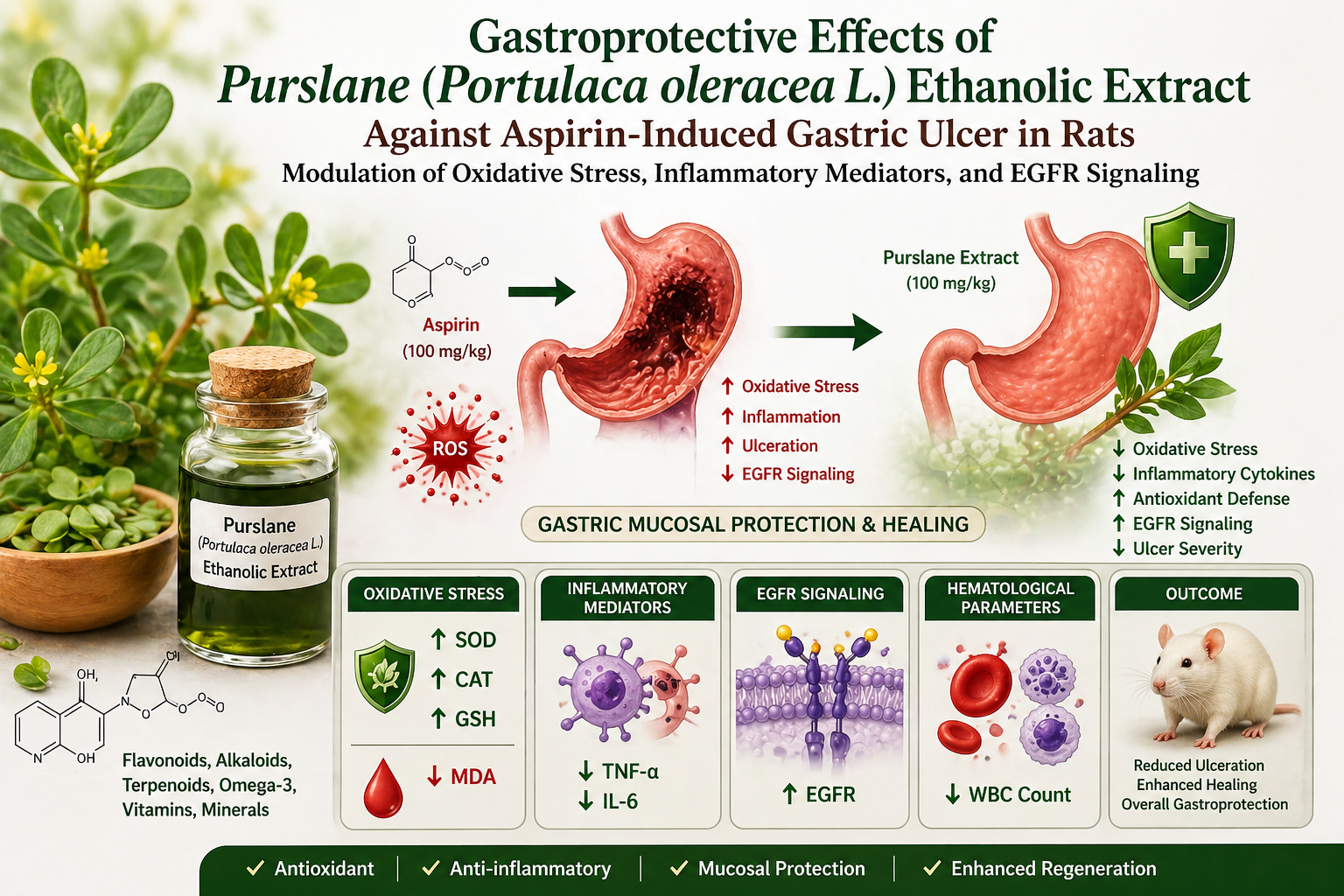
Aspirin-induced gastric ulcer represents a significant clinical challenge involving oxidative stress, inflammation, and impaired mucosal repair. This study evaluated the gastroprotective efficacy of Purslane (Portulaca oleracea L.) ethanolic extract compared with omeprazole in aspirin-induced gastric ulcer in rats. Twenty-four adult male albino rats were randomly assigned to four groups (n=6): negative control, ulcer-induced untreated, ulcer+omeprazole (20 mg/kg), and ulcer+P. oleracea extract (100 mg/kg). A gastric ulcer was induced with oral aspirin (100 mg/kg), followed by a 30-day treatment. Oxidative stress markers (SOD, CAT, GSH, MDA), inflammatory cytokines (TNF-α, IL-6), epidermal growth factor receptor (EGFR), and hematological parameters were quantified. Aspirin administration significantly decreased SOD activity by 26% (1.87 ± 0.05 vs. 2.51±0.01 ng/mL, p≤0.05), CAT by 39% (51.60±7.68 vs. 84.19 ± 3.13 U/mL, p≤0.05), and EGFR by 45% (50.29 ± 1.86 vs. 90.96 ± 10.64 pg/mL, p≤0.05) compared to controls. Conversely, MDA increased by 50% (776.81 ± 18.6 vs. 516.76 ± 38.2 ng/mL, p≤0.05), TNF-α increased by 106% (139.36 ± 14.1 vs. 67.77 ± 5.13 pg/mL, p≤0.05), IL-6 increased by 229% (148.43 ± 5.6 vs. 45.12 ± 0.93 pg/mL, p≤0.05), and WBC count increased by 19% (13.85± 1.08 vs. 11.66 ± 2.62 ×10³/µL, p≤0.05). P. oleracea treatment restored SOD by 44% above ulcer values (2.70±0.03 ng/mL, exceeding control), normalized GSH (50.33 ± 0.06 µg/mL), reduced MDA by 23% (601.70 ± 4.27 ng/mL), decreased TNF-α by 55% (63.02 ± 5.26 pg/mL, approaching control), reduced IL-6 by 58% (62.64 ± 2.57 pg/mL), and increased EGFR by 97% (98.94 ± 5.32 pg/mL, surpassing control) relative to ulcer group. Notably, P. oleracea demonstrated superior effects compared with omeprazole in restoring GSH levels, reducing MDA, and attenuating inflammatory cytokines. These findings demonstrate that P. oleracea exerts comprehensive gastroprotective activity through synergistic antioxidant, anti-inflammatory, and EGFR-mediated regenerative mechanisms, suggesting potential as a complementary therapeutic agent for NSAID-induced gastric ulceration.
Article Details

This work is licensed under a Creative Commons Attribution-NonCommercial-NoDerivatives 4.0 International License.
References
Sung, J. J. Y.; Kuipers, E. J.; El-Serag, H. B. Systematic Review: The Global Incidence and Prevalence of Peptic Ulcer Disease. Aliment. Pharmacol. Ther. 2009, 29, 938–946. https://doi.org/10.1111/j.1365-2036.2009.03960.x
Laine, L.; Takeuchi, K.; Tarnawski, A. Gastric Mucosal Defense and Cytoprotection: Bench to Bedside. Gastroenterology 2008, 135, 41–60. https://doi.org/10.1053/j.gastro.2008.05.030
Arif, H.; Aggarwal, S. Salicylic Acid (Aspirin). In StatPearls; StatPearls Publishing: Treasure Island, FL, USA, 2025.
Vane, J. R.; Botting, R. M. The Mechanism of Action of Aspirin. Thromb. Res. 2003, 110, 255–258. https://doi.org/10.1016/S0049-3848(03)00379-7
Wallace, J. L. Prostaglandins, NSAIDs, and Gastric Mucosal Protection: Why Doesn’t the Stomach Digest Itself? Physiol. Rev. 2008, 88, 1547–1565. https://doi.org/10.1152/physrev.00004.2008
Sostres, C.; Gargallo, C. J.; Lanas, A. Adverse Effects of Non-Steroidal Anti-Inflammatory Drugs (NSAIDs, Aspirin and Coxibs) on Upper Gastrointestinal Tract. Best Pract. Res. Clin. Gastroenterol. 2010, 24, 121–132. https://doi.org/10.1016/j.bpg.2009.11.005
Kwiecień, S.; Brzozowski, T.; Konturek, S. J. The Role of Reactive Oxygen Species in the Mechanism of Gastric Mucosal Injury and Protection. J. Physiol. Pharmacol. 2002, 53, 523–543.
Abbassy, A.; Marzouk, M. A.; Mansour, S. A. Impact of Oxidative Stress and Lipid Peroxidation Induced by Lambda-Cyhalothrin on P450 in Male Rats. J. Environ. Anal. Toxicol. 2014, 4, 218. https://doi.org/10.4172/2161-0525.1000218
Halliwell, B.; Gutteridge, J. M. C. Free Radicals in Biology and Medicine, 5th ed.; Oxford University Press: Oxford, UK, 2015. https://doi.org/10.1093/acprof:oso/9780198717478.001.0001
Singh, K.; Kumar, R.; Singh, A. P.; Malhotra, M.; Rani, R. Peptic Ulcer: A Review. Int. J. Med. Pharm. Drug Res. 2024, 8, 38–46. https://doi.org/10.22161/ijmpd.8.2.5
Tarnawski, A. S. Cellular and Molecular Mechanisms of Gastrointestinal Ulcer Healing. Dig. Dis. Sci. 2005, 50, S24–S33. https://doi.org/10.1007/s10620-005-2803-6
Tarnawski, A. S.; Ahluwalia, A. The Critical Role of Growth Factors in Gastric Ulcer Healing. Cells 2021, 10, 1964. https://doi.org/10.3390/cells10081964
Vakil, N. Peptic Ulcer Disease: A Review. JAMA 2024, 332, 1832–1842. https://doi.org/10.1001/jama.2024.19094
Kim, G. H. Proton Pump Inhibitor-Related Gastric Mucosal Changes. Gut Liver 2021, 15, 646–652. https://doi.org/10.5009/gnl20036
Gurib-Fakim, A. Medicinal Plants: Traditions of Yesterday and Drugs of Tomorrow. Mol. Aspects Med. 2006, 27, 1–93. https://doi.org/10.1016/j.mam.2005.07.008
Zhou, Y. X.; Xin, H. L.; Rahman, K.; Wang, S. J.; Peng, C.; Zhang, H. Portulaca oleracea L.: A Review of Phytochemistry and Pharmacological Effects. Biomed Res. Int. 2015, 925631. https://doi.org/10.1155/2015/925631
Rahimi, V. B.; Ajam, F.; Rakhshandeh, H.; Askari, V. R. A Pharmacological Review on Portulaca oleracea L.: Focusing on Anti-Inflammatory and Antioxidant Activities. J. Pharmacopuncture 2019, 22, 7–15. https://doi.org/10.3831/KPI.2019.22.001
Uddin, M. K.; Juraimi, A. S.; Ali, M. E.; Ismail, M. R. Purslane Weed (Portulaca oleracea): A Prospective Plant Source of Nutrition and Antioxidant Attributes. ScientificWorldJournal 2014, 951019. https://doi.org/10.1155/2014/951019
Qadhi, A.; Elfky, N. A. Study the Protective Effects of Portulaca oleracea on Peptic Ulcer in Male Rats. Pathogenesis 2019, 3, 2.
Ward, R. J. The Vitamins Requirements of Laboratory Animals. In Nutritional and Disease in Experimental Animals; Academic Press: London, UK, 1970; pp 1–24.
Hamza, D. A.; Hatrosh, S. J. Effect of Ethanolic Extract of Glycyrrhiza glabra Roots on Some Physiological Parameters in Male Albino Rats Treated with Mitomycin-C. Karbala J. Sci. 2015, 13, 66–72.
Wang, Z.; Hasegawa, J.; Wang, X.; Matsuda, A.; Tokuda, T.; Miura, N.; Watanabe, T. Protective Effects of Ginger Against Aspirin-Induced Gastric Ulcers in Rats. Yonago Acta Med. 2011, 54, 11–20.
Muslim, I. T.; Taher, K. N.; Ghazi, A. M. Effect of Fermented Mare’s Milk on Healing of Aspirin-Induced Gastric Ulcer in Albino Rats. Al-Qadisiyah J. Vet. Med. Sci. 2015, 14, 12–17.
Habib, S. H.; Aljammaz, A. A. Effect of Aqueous Licorice Extract on Gastric Ulcer Induced by Aspirin in Rats. J. Home Econ. 2017, 27, 1–12.
Al-Mousawi, H. Histological and Physiological Study of Sweet Potato Extract in Treating Aspirin-Induced Peptic Ulcer; Master’s Thesis, Al-Qadisiyah University, Iraq, 2019.
Feng, J.; Wang, J.; Wang, Y.; Huang, X.; Shao, T.; Deng, X.; Cao, Y.; Zhou, M.; He, X. Oxidative Stress and Lipid Peroxidation in Diabetic Ulcers. Front. Cell Dev. Biol. 2022, 10, 898657. https://doi.org/10.3389/fcell.2022.898657
Park, J. U.; Kang, J. H.; Rahman, M. A.; Hussain, A.; Cho, J. S.; Lee, Y. I. Gastroprotective Effects of Plant Extracts on Gastric Injury. Biomed Res. Int. 2019, 8759708. https://doi.org/10.1155/2019/8759708
Majeed, W.; Khaliq, T.; Aslam, B.; Khan, J. A.; Iftikhar, A. Medicinal Plants with Gastroprotective Potential. Bangladesh J. Pharmacol. 2015, 10, 588–603. https://doi.org/10.3329/bjp.v10i3.23578
Wu, Y.; Guo, Y.; Huang, T.; Wang, H.; Li, Y.; Cao, Y.; Zhang, H. Licorice Flavonoid Alleviates Gastric Ulcers. Biomed. Pharmacother. 2023, 169, 115868. https://doi.org/10.1016/j.biopha.2023.115868
Xu, K.; Li, J.; Guo, S.; Zhang, J.; Zhang, X. Gastric Mucosal Repair via EGF-NO/PGE2-PI3K Pathway. Front. Pharmacol. 2025, 16, 1594089. https://doi.org/10.3389/fphar.2025.1594089
