
Association Between Vitamin D3 Status, Blood Pressure, and Lipid Profiles in Hypertensive Patients
Article Sidebar
Main Article Content
Abstract
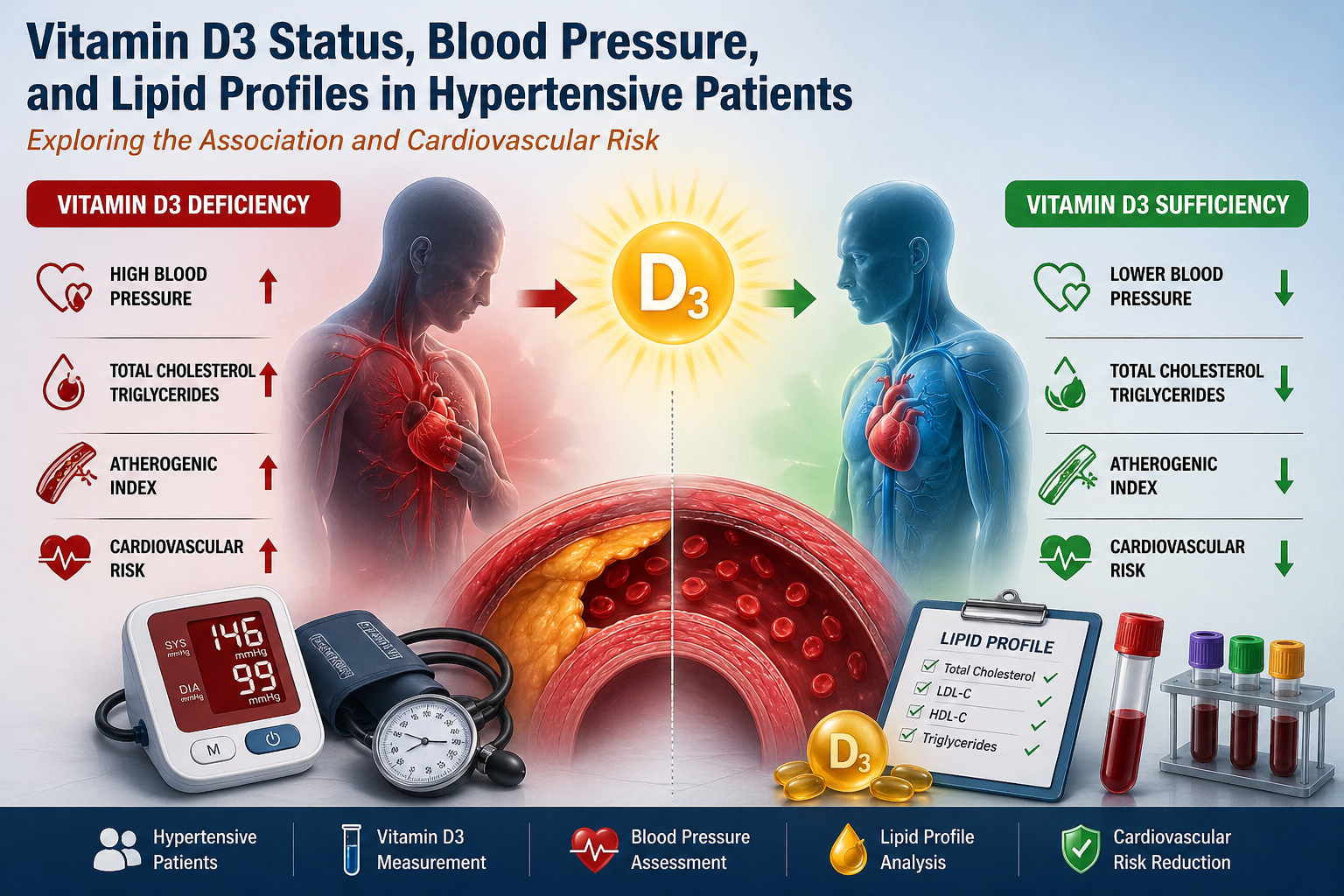
Hypertension is a major global health burden that is associated with millions of people across the globe. Epidemiological research indicates that vitamin D3 deficiency appears to be associated with hypertension, although extensive quantitative analyses have not been conducted. This research analyzed the correlation among serum Cholecalciferol levels, blood pressure parameters, and lipid profiles among individuals with hypertension. The study was an observational study that included 138 participants (80 hypertensive and 58 controls). A chemiluminescence assay was employed to evaluate participants' blood pressure status and categorize vitamin D3 levels as deficient (less than 20 ng/mL), insufficient (20-30 ng/mL), or sufficient (30 or higher). Blood pressure indices, lipid profiles, and biochemical parameters were measured. Pearson's correlation was utilized to appraise the relationships among variables. Compared to controls, hypertensive patients showed a highly reduced level of vitamin D3 (18.3 2 ± 1.03 vs. 30.33 ± 1.06 ng/mL, p<0.001), a high systolic blood pressure (146.9 ± 2.31 vs. 119.0 ± 1.34 mmHg, p<0.001), and a higher diastolic blood pressure (99.13 ± 2.31 vs. 77.93 ± 1.03 mmHg, p<0.001). Vitamin D3 showed significant inverse relationships regarding the systolic blood pressure (r= -0.5981, p=0.001), the diastolic blood pressure (r= -0.4077, p=0.001), total cholesterol (r= -0.5938, p=0.001), triglycerides (r= -0.3161, p=0.05), and with atherogenic index (r= -0.3630, p<0.01 The results reflect deficiency of vitamin D3 is significantly linked to high blood pressure and dyslipidemia in hypertensive patients and thus it could be considered to be used as a cardiovascular risk biomarker.
Article Details

This work is licensed under a Creative Commons Attribution-NonCommercial-NoDerivatives 4.0 International License.
References
Karadeniz, Y.; Özpamuk-Karadeniz, F.; Ahbab, S.; Ataoğlu, E.; Can, G. Vitamin D deficiency is a potential risk for blood pressure elevation and the development of hypertension. Medicina 2021, 57, 1297. https://doi.org/10.3390/medicina57121297
Mittal, B. V.; Singh, A. K. Hypertension in the developing world: Challenges and opportunities. Am. J. Kidney Dis. 2010, 55, 590–598. https://doi.org/10.1053/j.ajkd.2009.06.044
Adams, J. M.; Wright, J. S. A national commitment to improve the care of patients with hypertension in the US. JAMA 2020, 324, 1825–1826. https://doi.org/10.1001/jama.2020.20356
Holick, M. F. Vitamin D: Important for prevention of osteoporosis, cardiovascular heart disease, type 1 diabetes, autoimmune diseases, and some cancers. South. Med. J. 2005, 98, 1024–1028. https://doi.org/10.1097/01.SMJ.0000140865.32054.DB
Elliott, W. J. Systemic hypertension. Curr. Probl. Cardiol. 2007, 32, 201–259. https://doi.org/10.1016/j.cpcardiol.2007.01.002
Waikar, S. S.; Betensky, R. A.; Bonventre, J. V. Creatinine as the gold standard for kidney injury biomarker studies? Nephrol. Dial. Transplant. 2009, 24, 3263–3265. https://doi.org/10.1093/ndt/gfp428
Pludowski, P.; Holick, M. F.; Pilz, S.; Wagner, C. L.; Hollis, B. W.; Grant, W. B.; Shoenfeld, Y.; Lerchbaum, E.; Llewellyn, D. J.; Kienreich, K.; et al. Vitamin D effects on musculoskeletal health, immunity, autoimmunity, cardiovascular disease, cancer, fertility, pregnancy, dementia and mortality—A review of recent evidence. Autoimmun. Rev. 2013, 12, 976–989. https://doi.org/10.1016/j.autrev.2013.02.004
Kader, A.-E.; Ahmad, S.; Ahmad, Y. K.; El-Ghamry, E. M.; Tawfik, S.; Atia, W. M.; Keder, M. M. Assessment of vitamin D status in patients with essential hypertension. Egypt. J. Hosp. Med. 2018, 72, 4434–4438. https://doi.org/10.21608/ejhm.2018.9496
Schneider, A.; Lutsey, P.; Selvin, E.; Mosley, T.; Sharrett, A.; Carson, K.; Post, W.; Pankow, J.; Folsom, A.; Gottesman, R. Vitamin D, vitamin D binding protein gene polymorphisms, race and risk of incident stroke: The ARIC study. Eur. J. Neurol. 2015, 22, 1220–1227. https://doi.org/10.1111/ene.12731
Khammissa, R.; Fourie, J.; Motswaledi, M.; Ballyram, R.; Lemmer, J.; Feller, L. The biological activities of vitamin D and its receptor in relation to calcium and bone homeostasis, cancer, immune and cardiovascular systems, skin biology, and oral health. BioMed Res. Int. 2018, 2018, 9276380. https://doi.org/10.1155/2018/9276380
Vatakencherry, R. M. J.; Saraswathy, L. Association between vitamin D and hypertension in people coming for health check up to a tertiary care centre in South India. J. Fam. Med. Prim. Care 2019, 8, 2061–2067. https://doi.org/10.4103/jfmpc.jfmpc_236_19
Li, Y. C. Vitamin D and the renin–angiotensin system. In Feldman and Pike’s Vitamin D, 5th ed.; Elsevier: Amsterdam, The Netherlands, 2024; pp 925–951. https://doi.org/10.1016/B978-0-323-91386-7.00015-5
Turin, A.; Bax, J. J.; Doukas, D.; Joyce, C.; Lopez, J. J.; Mathew, V.; Pontone, G.; Shah, F.; Singh, S.; Wilber, D. J. Interactions among vitamin D, atrial fibrillation, and the renin–angiotensin–aldosterone system. Am. J. Cardiol. 2018, 122, 780–784. https://doi.org/10.1016/j.amjcard.2018.05.013
Becher, U. M.; Endtmann, C.; Tiyerili, V.; Nickenig, G.; Werner, N. Endothelial damage and regeneration: The role of the renin–angiotensin–aldosterone system. Curr. Hypertens. Rep. 2011, 13, 86–92. https://doi.org/10.1007/s11906-010-0171-x
Briet, M.; Schiffrin, E. L. Vascular actions of aldosterone. J. Vasc. Res. 2013, 50, 89–99. https://doi.org/10.1159/000345243
Abd Aon, Y. S.; Kadhim, S. J.; Al Khafaji, I. H. M.; Tahir, N. T. The role of vitamin D3 in improving lipid profile in type 2 diabetes patients with cardiovascular disease. Indian J. Forensic Med. Toxicol. 2022, 16, 1278–1285. https://doi.org/10.37506/ijfmt.v16i1.17672
Dobnig, H.; Pilz, S.; Scharnagl, H.; Renner, W.; Seelhorst, U.; Wellnitz, B.; Kinkeldei, J.; Boehm, B. O.; Weihrauch, G.; Maerz, W. Independent association of low serum 25-hydroxyvitamin D and 1,25-dihydroxyvitamin D levels with all-cause and cardiovascular mortality. Arch. Intern. Med. 2008, 168, 1340–1349. https://doi.org/10.1001/archinte.168.12.1340
Martini, L. A.; Wood, R. J. Vitamin D status and the metabolic syndrome. Nutr. Rev. 2006, 64, 479–486. https://doi.org/10.1301/nr.2006.nov.479–486
Bashir, N. A.; Bashir, A. A. M.; Bashir, H. A. Effect of vitamin D deficiency on lipid profile. Am. J. Lab. Med. 2019, 4, 11–18. https://doi.org/10.11648/j.ajlm.20190401.12
Wang, M.; Chen, Z.; Wang, Y.; Xu, X.; Li, H.; Yang, J. Effects of vitamin D supplementation on serum lipid profiles and neonatal outcomes in gestational diabetes mellitus: A meta-analysis. Acta Acad. Med. Sin. 2021, 43, 82–91.
Potenza, M. V.; Mechanick, J. I. The metabolic syndrome: Definition, global impact, and pathophysiology. Nutr. Clin. Pract. 2009, 24, 560–577. https://doi.org/10.1177/0884533609342436
Polkowska, A.; Głowińska, B.; Tobiaszewska, M.; Bossowski, A. Risk factors for cardiovascular disease in children with type 1 diabetes in 2000–2010 in Podlasie Province. Pediatr. Endocrinol. Diabetes Metab. 2015, 20, 113–120. https://doi.org/10.18544/PEDM-20.02.0002
Gebrie, A.; Gnanasekaran, N.; Menon, M.; Sisay, M.; Zegeye, A. Evaluation of lipid profiles and hematological parameters in hypertensive patients: Laboratory-based cross-sectional study. SAGE Open Med. 2018, 6, 2050312118756663. https://doi.org/10.1177/2050312118756663
Guan, C.; Fu, S.; Zhen, D.; Li, X.; Niu, J.; Cheng, J.; Zhao, N.; Liu, J.; Yin, H.; Tang, X. Correlation of serum vitamin D with lipid profiles in middle-aged and elderly Chinese individuals. Asia Pac. J. Clin. Nutr. 2020, 29, 839–845.
Kar, A.; Datta, S. A study of serum vitamin D level and its association with hypertension. J. Fam. Med. Prim. Care 2018, 7, 546–550. https://doi.org/10.4103/jfmpc.jfmpc_82_18
Holick, M. F.; Binkley, N. C.; Bischoff-Ferrari, H. A.; Gordon, C. M.; Hanley, D. A.; Heaney, R. P.; Murad, M. H.; Weaver, C. M. Evaluation, treatment, and prevention of vitamin D deficiency: An Endocrine Society clinical practice guideline. J. Clin. Endocrinol. Metab. 2011, 96, 1911–1930. https://doi.org/10.1210/jc.2011-0385
Mahmoodi, M. R.; Najafipour, H. Associations between serum vitamin D3, atherogenic indices of plasma and cardiometabolic biomarkers among patients with diabetes in the KERCADR study. BMC Endocr. Disord. 2022, 22, 126. https://doi.org/10.1186/s12902-022-01043-1
Purari, S.; Singh, R.; Kumar, S.; Kishore, K. Study on co-relation between serum vitamin D level and essential hypertension. Int. J. Health Sci. Res. 2023, 13, 68–74.
Sinha, R. K.; Choudhury, A. Study of serum uric acid and vitamin-D levels in patients with essential hypertension at MGM Medical College, Kishanganj. Int. J. Acad. Med. Pharm. 2023, 5, 1352–1357.
Holick, M. F. Sunlight and vitamin D for bone health and prevention of autoimmune diseases, cancers, and cardiovascular disease. Am. J. Clin. Nutr. 2004, 80, 1678S–1688S. https://doi.org/10.1093/ajcn/80.6.1678S
Ross, A. C.; Taylor, C. L.; Yaktine, A. L.; Del Valle, H. B. Dietary Reference Intakes for Calcium and Vitamin D; Food and Nutrition Board, Institute of Medicine; National Academies Press: Washington, DC, 2011; pp 35–111.
Pan, D.; Qiao, H.; Wang, H.; Wu, S.; Wang, J.; Wang, C.; Guo, J.; Gu, Y. Association of serum 25-hydroxyvitamin D concentration with all-cause and cause-specific mortality in hypertensive patients. Nutr. Metab. Cardiovasc. Dis. 2024, 34, 1274–1282. https://doi.org/10.1016/j.numecd.2024.02.003
Ye, H.; Li, Y.; Liu, S.; Zhang, X.; Liang, H.; Wang, Y.; Wang, R.; Liu, H.; Wen, Y.; Jing, C. Association between serum 25-hydroxyvitamin D and vitamin D dietary supplementation and risk of all-cause and cardiovascular mortality among adults with hypertension. Nutr. J. 2024, 23, 33. https://doi.org/10.1186/s12937-024-00914-8
Forman, J. P.; Curhan, G. C.; Taylor, E. N. Plasma 25-hydroxyvitamin D levels and risk of incident hypertension among young women. Hypertension 2008, 52, 828–832. https://doi.org/10.1161/HYPERTENSIONAHA.108.117630
Patil, D.; Dutta, T. Correlation between serum vitamin D3 levels and blood pressure in patients with essential hypertension and normotensive individuals. Int. J. Adv. Med. 2020, 7, 971–976. https://doi.org/10.18203/2349-3933.ijam20202113
Vimaleswaran, K. S.; Cavadino, A.; Berry, D. J.; Jorde, R.; Dieffenbach, A. K.; Lu, C.; Alves, A. C.; Heerspink, H. J. L.; Tikkanen, E.; Eriksson, J.; et al. Association of vitamin D status with arterial blood pressure and hypertension risk: A Mendelian randomisation study. Lancet Diabetes Endocrinol. 2014, 2, 719–729.
Tomaschitz, A.; Pilz, S.; Ritz, E.; Grammer, T.; Drechsler, C.; Boehm, B. O.; März, W. Independent association between 1,25-dihydroxyvitamin D, 25-hydroxyvitamin D and the renin–angiotensin system: The Ludwigshafen Risk and Cardiovascular Health (LURIC) study. Clin. Chim. Acta 2010, 411, 1354–1360. https://doi.org/10.1016/j.cca.2010.05.037
Chonchol, M.; Scragg, R. 25-Hydroxyvitamin D, insulin resistance, and kidney function in the Third National Health and Nutrition Examination Survey. Kidney Int. 2007, 71, 134–139. https://doi.org/10.1038/sj.ki.5002002
Goodman, W. G. Recent developments in the management of secondary hyperparathyroidism. Kidney Int. 2001, 59, 1187–1201. https://doi.org/10.1046/j.1523-1755.2001.00605.x
Subber, Z.; Hashim, H.; Al-Shamma, G. The impact of vitamin D level on serum lipids in type 2 diabetes mellitus. Baghdad J. Biochem. Appl. Biol. Sci. 2021, 2, 230–236. https://doi.org/10.47419/bjbabs.v2i04.47
Cho, H.-J.; Kang, H.-C.; Choi, S.-A.; Ju, Y.-C.; Lee, H.-S.; Park, H.-J. The possible role of Ca²⁺ on the activation of microsomal triglyceride transfer protein in rat hepatocytes. Biol. Pharm. Bull. 2005, 28, 1418–1423. https://doi.org/10.1248/bpb.28.1418
Reid, I. R. Effects of calcium supplementation on circulating lipids: Potential pharmacoeconomic implications. Drugs Aging 2004, 21, 7–17. https://doi.org/10.2165/00002512-200421010-00002
Christensen, R.; Lorenzen, J. K.; Svith, C. R.; Bartels, E.; Melanson, E.; Saris, W.; Tremblay, A.; Astrup, A. Effect of calcium from dairy and dietary supplements on faecal fat excretion: A meta-analysis of randomized controlled trials. Obes. Rev. 2009, 10, 475–486. https://doi.org/10.1111/j.1467-789X.2009.00599.x
Jiang, W.; Miyamoto, T.; Kakizawa, T.; Nishio, S.-i.; Oiwa, A.; Takeda, T.; Suzuki, S.; Hashizume, K. Inhibition of LXRα signaling by vitamin D receptor: Possible role of VDR in bile acid synthesis. Biochem. Biophys. Res. Commun. 2006, 351, 176–184. https://doi.org/10.1016/j.bbrc.2006.10.027
Song, S. J.; Si, S.; Liu, J.; Chen, X.; Zhou, L.; Jia, G.; Liu, G.; Niu, Y.; Wu, J.; Zhang, W. Vitamin D status in Chinese pregnant women and their newborns in Beijing and their relationships to birth size. Public Health Nutr. 2013, 16, 687–692. https://doi.org/10.1017/S1368980012003084
Karnchanasorn, R.; Ou, H.-Y.; Chiu, K. C. Plasma 25-hydroxyvitamin D levels are favorably associated with β-cell function. Pancreas 2012, 41, 863–868. https://doi.org/10.1097/MPA.0b013e31823c947c
Curvello-Silva, K. L.; Oliveira, N. A.; Silva, T. S.; Sousa, C. D.; Daltro, C. Association between cardiovascular risk factors and 25(OH)D levels in obese patients. Metab. Syndr. Relat. Disord. 2020, 18, 328–332. https://doi.org/10.1089/met.2020.0023
Ioannidou, S.; Kazeli, K.; Ventouris, H.; Amanatidou, D.; Gkinoudis, A.; Lymperaki, E. Correlation of vitamin 25(OH)D, liver enzymes, potassium, and oxidative stress markers with lipid profile and atheromatic index: A pilot study. J. Xenobiot. 2023, 13, 193–204. https://doi.org/10.3390/jox13020015
