
Development of an IoT Smart Learning Board Innovation to Enhance IoT and Coding Skills for Sustainable Secondary Education in Thailand
Article Sidebar
Main Article Content
Abstract
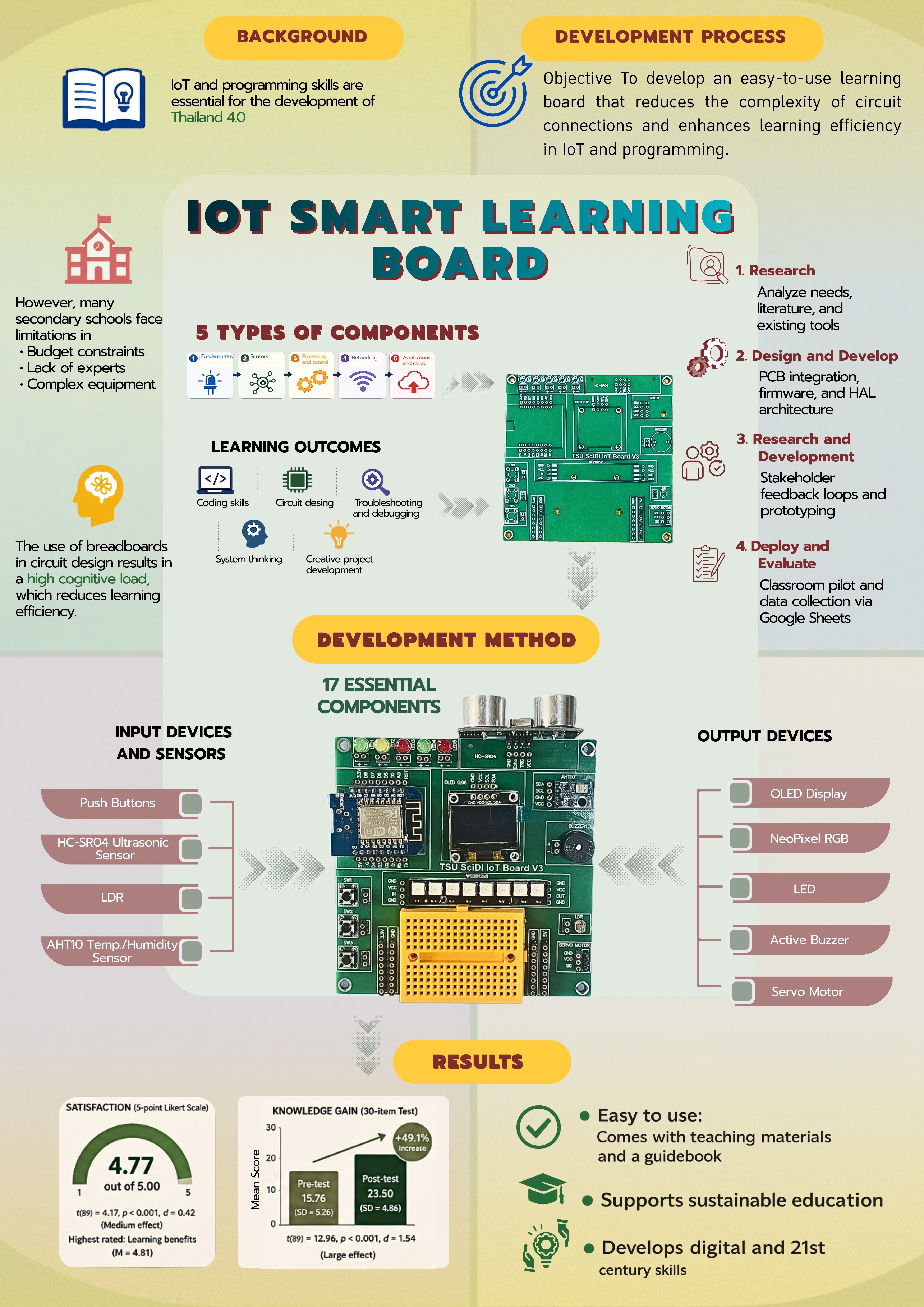
The growing demand for Internet of Things (IoT) and programming competencies in Thai secondary education necessitates accessible, hardware-based learning tools that reduce technical barriers while supporting structured skill development. This study developed and evaluated the IoT Smart Learning Board, a two-layer printed circuit board (PCB) integrating 17 electronic components — including an ESP8266 Wemos D1 mini microcontroller, HC-SR04 ultrasonic sensor, AHT10 temperature/humidity sensor, 0.96-inch OLED display, WS2812 NeoPixel RGB strip, and SG90 servo motor — designed around a Terminal-based Hardware Abstraction Layer architecture. Development followed a four-phase Research and Development (R&D) framework employing an iterative R&D approach with stakeholder feedback loops, producing an 18-exercise practice manual progressing from basic digital I/O to cloud-based data telemetry via Google Sheets. Evaluation involved 90 participants (17 teachers and 73 upper-secondary students, Grades 10–12) from 10 schools across southern Thailand. Knowledge was assessed using a 30-item multiple-choice instrument (KR-20 = 0.87), while satisfaction was measured using a 15-item, 5-point Likert-scale questionnaire (Cronbach's α = 0.89–0.93). Results demonstrated a statistically significant increase in mean knowledge scores from 15.76 (SD = 5.26) at pre-test to 23.50 (SD = 4.86) at post-test, representing a 25.80% gain (t(89) = 12.96, p < 0.001, Cohen's d = 1.54). Overall participant satisfaction reached 4.77 out of 5.00 (SD = 0.42), with the highest ratings recorded for learning benefits (M = 4.81), programming skill development (M = 4.82), and project extensibility (M = 4.81). These findings are consistent with the hypothesis that Terminal-based PCB architecture reduces extraneous cognitive load associated with breadboard wiring, enabling learners to focus on higher-order computational thinking and IoT system design. These findings suggest that the IoT Smart Learning Board holds promise as an accessible, affordable platform for technology education in resource-constrained secondary school contexts; however, broader applicability across Thailand and the ASEAN region warrants validation through future multi-site research with diverse school populations.
Article Details

This work is licensed under a Creative Commons Attribution-NonCommercial-NoDerivatives 4.0 International License.
References
Puriwat, W.; Tripopsakul, S. Preparing for Industry 4.0 – Will youths have enough essential skills?: An Evidence from Thailand. Int. J. Instr. 2020, 13(3), 89–104. https://doi.org/10.29333/iji.2020.1337a
Sethakul, P.; Utakrit, N. Challenges and Future Trends for Thai Education: Conceptual Framework into Action. Int. J. Eng. Pedagogy IJEP. 2019, 9(2), 8. https://doi.org/10.3991/ijep.v9i2.10220
Phattanajureephan, C.; Ruangmontri, K.; Namwan, T. Components and Indicators of Digital Citizenship Among Teachers in Private Schools Under the Office of the Private Education Commission, Northeastern Region. J. Educ. Learn. 2025, 15(1), 446. https://doi.org/10.5539/jel.v15n1p446
Cakiroglu, U.; Suicmez, S. S.; Kurtoglu, Y. B.; Sari, A.; Yildiz, S.; Ozturk, M. Exploring perceived cognitive load in learning programming via Scratch. Res. Learn. Technol. 2018, 26, 1888. https://doi.org/10.25304/rlt.v26.1888
Jeng, Y. L.; Lai, C. F.; Huang, S. B.; Chiu, P. S.; Zhong, H. X. To Cultivate Creativity and a Maker Mindset Through an Internet of Things Programming Course. Front. Psychol. 2020, 11, 1572. https://doi.org/10.3389/fpsyg.2020.01572
Ga, S. H.; Chang, C. Y. Developing Affordable and Research Grade Measurement Devices with Arduino for School Science: A Guide for Non Coders. J. Chem. Educ. 2025, 102(1), 404–409. https://doi.org/10.1021/acs.jchemed.4c00998
Márquez Vera, M. A.; Martínez Quezada, M.; Calderón Suárez, R.; Rodríguez, A.; Ortega Mendoza, R. M. Microcontrollers programming for control and automation in undergraduate biotechnology engineering education. Digit. Chem. Eng. 2023, 9, 100122. https://doi.org/10.1016/j.dche.2023.100122
Tsai, F. H. Development and Evaluation of an Internet of Things Project for Preservice Elementary School Teachers. Sustainability. 2024, 16(17), 7632. https://doi.org/10.3390/su16177632
Neutens, T.; Barbion, E.; Coolsaet, K.; Wyffels, F. Comparing learning ecologies of primary graphical programming: create or fix? J. Comput. Assist. Learn. 2021, 37(5), 1296–1311. https://doi.org/10.1111/jcal.12570
Hercog, D.; Lerher, T.; Truntič, M.; Težak, O. Design and Implementation of ESP32 Based IoT Devices. Sensors. 2023, 23(15), 6739. https://doi.org/10.3390/s23156739
Fitsilis, P.; Damasiotis, V.; Boti, E. Agile Learning: An innovative curriculum for educators. Qeios. 2023. https://doi.org/10.32388/RQX9T9.2
Reinsfield, E. Secondary technology teachers’ perceptions and practice: Digital Technology and a future focused curriculum in New Zealand. Waikato J. Educ. 2019, 23(2). https://doi.org/10.15663/wje.v23i2.655
Ozgul, E.; Ocak, M. A. The effect of internet of things education through distance education on student success and motivation. J. Educ. Technol. Online Learn. 2023, 6(2), 403–420. https://doi.org/10.31681/jetol.1241362
Yilmaz, T.; Izmirli, S. Effect of unplugged and plugged coding activities on secondary school students’ computational thinking skills. J. Educ. Technol. Online Learn. 2023, 6(4), 1180–1193. https://doi.org/10.31681/jetol.1375335
Al Muqbil, N. S. M. The Impact of a Nanotechnology Based Training Program on the Development of Digital Competencies among High School Biology Teachers. J. Curric. Teach. 2024, 13(2), 98. https://doi.org/10.5430/jct.v13n2p98
Prakash Chand, S. Constructivism in Education: Exploring the Contributions of Piaget, Vygotsky, and Bruner. Int. J. Sci. Res. IJSR. 2023, 12(7), 274–278. https://doi.org/10.21275/SR23630021800
Tortoriello, F. S.; Veronesi, I. Internet of things to protect the environment: a technological transdisciplinary project to develop mathematics with ethical effects. Soft Comput. 2021, 25(13), 8159–8168. https://doi.org/10.1007/s00500-021-05737-x
Sarnkong, R.; Kamnuay, K.; Sakorn, W.; Pakinumhung, N. A Comparative Study on the Effects of Project Based Learning and Online Lessons on the Learning Achievement on the Internet of Things Among Thai Grade 9 Students. J. Educ. Learn. 2025, 14(4), 136. https://doi.org/10.5539/jel.v14n4p136
Ariyanto, R.; et al. IoT Board Education Design and Analysis for Elementary School Students. KnE Soc. Sci. 2024. https://doi.org/10.18502/kss.v9i10.15729
Awouda, A.; Traini, E.; Asranov, M.; Chiabert, P. Bloom’s IoT Taxonomy towards an effective Industry 4.0 education: Case study on Open source IoT laboratory. Educ. Inf. Technol. 2024. https://doi.org/10.1007/s10639-024-12468-7
Hughes, J.; Robb, J.; Lam, M. Making Future Ready Students with Design and the Internet of Things. EAI Endorsed Trans. Creat. Technol. 2020, 6(21), 163096. https://doi.org/10.4108/eai.13-7-2018.163096
Peppler, K. A.; Sedas, R. M.; Thompson, N. Paper Circuits vs. Breadboards: Materializing Learners’ Powerful Ideas Around Circuitry and Layout Design. J. Sci. Educ. Technol. 2023, 32(4), 469–492. https://doi.org/10.1007/s10956-023-10029-0
Corno, F.; De Russis, L.; Saenz, J. P. Pain Points for Novice Programmers of Ambient Intelligence Systems: An Exploratory Study. 2017 IEEE 41st Annual Computer Software and Applications Conference (COMPSAC). 2017, 250–255. https://doi.org/10.1109/COMPSAC.2017.186
Corno, F.; De Russis, L.; Sáenz, J. P. Easing IoT development for novice programmers through code recipes. Proceedings of the 40th International Conference on Software Engineering: Software Engineering Education and Training. 2018, 13–16. https://doi.org/10.1145/3183377.3183385
Hercog, D.; Lerher, T.; Truntič, M.; Težak, O. Design and Implementation of ESP32 Based IoT Devices. Sensors. 2023, 23(15), 6739. https://doi.org/10.3390/s23156739
Beranek, M.; Lisunov, I.; Vacek, V. Learning IoT skills in the context of student projects. 2018 11th IFIP Wireless and Mobile Networking Conference (WMNC). 2018, 1–6. https://doi.org/10.23919/WMNC.2018.8480926
Elfadil, N.; Ibrahim, I. Embedded System Design Student’s Learning Readiness Instruments: Systematic Literature Review. Front. Educ. 2022, 7, 799683. https://doi.org/10.3389/feduc.2022.799683
Tsai, C. C.; Chung, C. C.; Cheng, Y. M.; Lou, S. J. Deep learning course development and evaluation of artificial intelligence in vocational senior high schools. Front. Psychol. 2022, 13, 965926. https://doi.org/10.3389/fpsyg.2022.965926
