Study of Surface Water Quality Using Biological Indicators Inside the Ruean Thai Pond Area, Nakhon Si Thammarat Rajabhat University
Article Sidebar
Main Article Content
Abstract
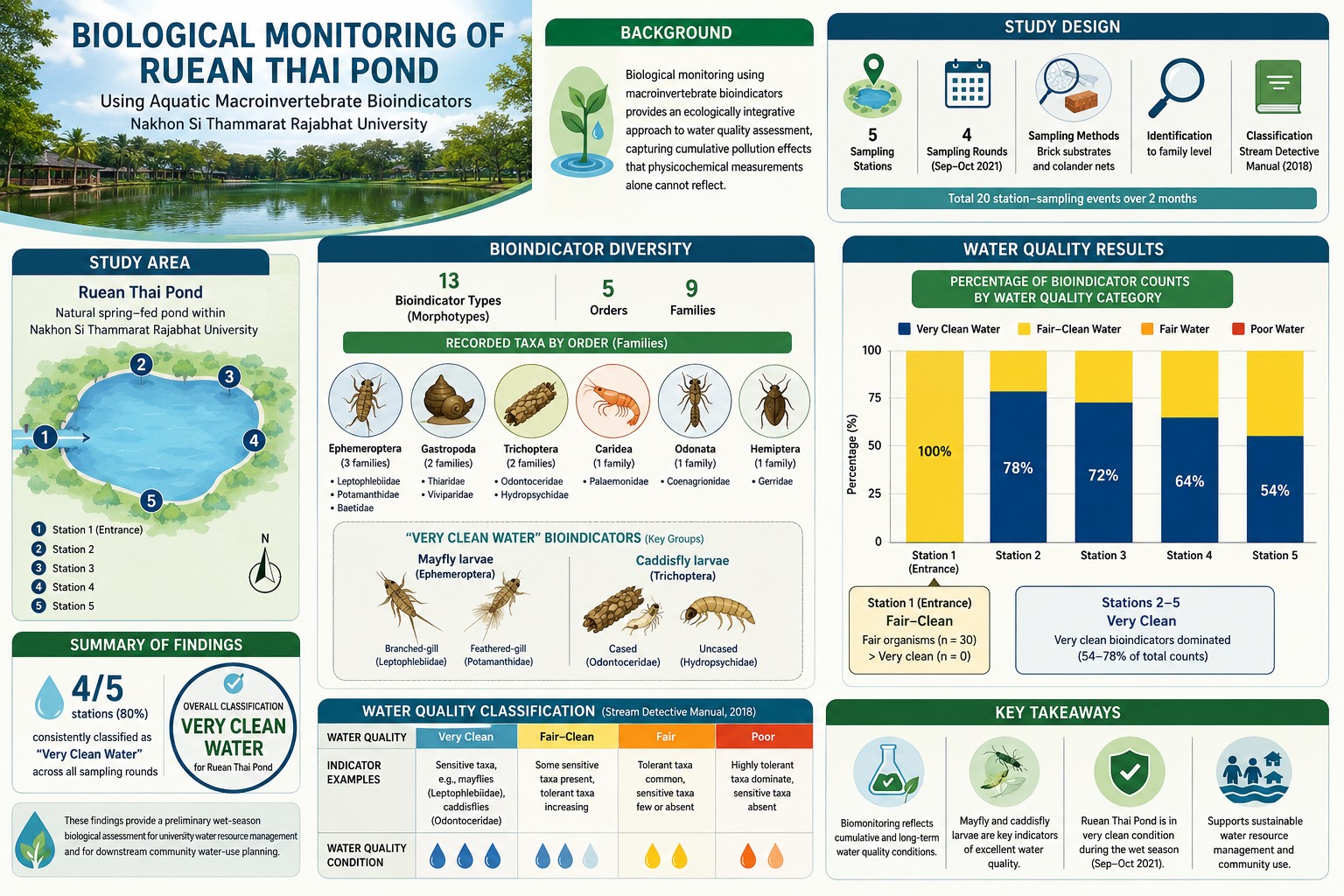
Biological monitoring using macroinvertebrate bioindicators provides an ecologically integrative approach to water quality assessment, capturing cumulative pollution effects that physicochemical measurements alone cannot reflect. This study assessed the surface water quality of the Ruean Thai Pond, a natural spring-fed water body within Nakhon Si Thammarat Rajabhat University, using aquatic macroinvertebrate assemblages. Five sampling stations were established along the pond. Sampling was conducted four times over two months (September–October 2021), totaling 20 station-sampling events. Aquatic insect larvae and associated bioindicator organisms were collected using brick substrates and colander nets, then identified to family level and classified into water quality categories according to the Stream Detective Manual (Green World Foundation, 2018). A total of 13 bioindicator types (morphotypes) representing 5 orders and 9 families were recorded. Ephemeroptera was the most diverse order with 3 families (Leptophlebiidae, Potamanthidae, Baetidae), followed by Gastropoda and Trichoptera (2 families each), and Caridea, Odonata, and Hemiptera (1 family each). "Very clean water" bioindicators — branched-gill and feathered-gill mayfly larvae (Leptophlebiidae, Potamanthidae) and cased and uncased caddisfly larvae (Odontoceridae, Hydropsychidae) — dominated Stations 2–5, accounting for 54–78% of total bioindicator counts. Station 1 (pond entrance station) was the only station classified as "fair–clean," where fair-category organisms (n = 30) outnumbered very-clean-category organisms (n = 0). Four of five stations (80%) were consistently classified as "very clean water" across all sampling rounds, yielding an overall classification of "very clean" for the Ruean Thai Pond. These findings provide a preliminary wet-season biological assessment for university water resource management and for downstream community water-use planning.
Article Details

This work is licensed under a Creative Commons Attribution-NonCommercial-NoDerivatives 4.0 International License.
References
Weerawattananon, W. Environmental Science; Odeon Store Publishing: Bangkok, Thailand, 2017.
Thartong, S. Water Management in Thailand; Rajabhat Institute Press: Nakhon Ratchasima, Thailand, 2017.
Butsuk, B. Water Resource Challenges in Thailand; Kasetsart University Press: Bangkok, Thailand, 2017.
Al-Jawahery, H. F.; Naji, N. S.; Al-Azawey, A. S. N. Physicochemical and Microbiological Evaluation of Reverse Osmosis Drinking Water Quality in Babylon Province, Iraq. ASEAN J. Sci. Technol. Rep. 2024, 29, e260629. https://doi.org/10.55164/ajstr.v29i1.260629
Alburo, R. P.; Villegas, L. M. G. Ecological Risk Assessment of Heavy Metal Pollution in Surface Water and Sediment of Lahug River, Cebu, Philippines. ASEAN J. Sci. Technol. Rep. 2024, 28, e257492. https://doi.org/10.55164/ajstr.v28i3.257492
Pattarasini, P. Nature Studies; V-Print: Bangkok, Thailand, 2017.
Soontornprasit, K.; Valunpion, S.; Pithakpol, S. Biodiversity of Aquatic Insects in Ing River. Khon Kaen Agric. J. 2013, 41 (Suppl. 1), 142–148.
Soontornprasit, K. Use of Aquatic Insects as Bioindicators of Water Quality in Kwan Phayao, Phayao Province. J. Community Dev. Res. 2012, 5(1), 15–24.
Tagun, R.; Kunpradid, T. The Relationship between Diversity and Distribution of Aquatic Insects with Water Quality of Mae Chaem Headwater Streams, Kanlayaniwattana District, Chiang Mai Province. Srinakharinwirot Sci. J. 2017, 33(1), 117–133.
Tangmangmee, H. Environmental Survey of Mahachai Stream; Internal Report; Nakhon Si Thammarat Rajabhat University: Nakhon Si Thammarat, Thailand, 2015.
Issarawanrong, T. Using Benthic Macroinvertebrates for Biological Monitoring; Department of Biology, Mahasarakham University: Maha Sarakham, Thailand, 2017.
Kanjanavanit, S. Field Guide to Freshwater Invertebrates, 2nd ed.; Green World Foundation: Bangkok, Thailand, 2018.
Vitheepradit, A.; Mitpuangchon, N.; Prommi, T.-O. Biodiversity and Community Structure of Aquatic In-sects in Freshwater Ponds; Faculty of Liberal Arts and Science, Kasetsart University, Kamphaeng Saen Campus: Nakhon Pathom, Thailand, 2016.
Thiptaban, R.; Kanjanatheeraphong, T. Distribution of Aquatic Insects (EPT) and Water Quality in Mae Chaem Headwater Streams; Chiang Mai Rajabhat University: Chiang Mai, Thailand, 2017.
Issarawanrong, T. Benthic Macroinvertebrate-Based Biomonitoring; Department of Biology, Mahasarak-ham University: Maha Sarakham, Thailand, 2017.
Thepnarong, K.; Chiayvareesajja, S.; Kantachote, D.; Sangnoi, Y. Effects of Selected Probiotics on Water Quality and Growth Performance of Nile Tilapia Cultured in a Recirculating Water System. ASEAN J. Sci. Technol. Rep. 2024, 28, e255832. https://doi.org/10.55164/ajstr.v28i2.255832
Ruangrak, E.; Salaemae, N.; Sornnok, S.; Sin Htwe, N. M. P. Effect of Pre-Harvest Periods by Replacing Nutrient Solution with Tap Water on Nitrate and Quality in Hydroponic Lettuce. ASEAN J. Sci. Technol. Rep. 2023, 26(1), 76–83. https://doi.org/10.55164/ajstr.v26i1.247666
Matondang, P. A. S.; Taparhudee, W.; Yoonpundh, R.; Jongjaraunsuk, R. Water Quality Management Guidelines to Reduce Mortality Rate of Red Tilapia (Oreochromis niloticus × Oreochromis mossambicus) Fingerlings Raised in Outdoor Earthen Ponds with a Recirculating Aquaculture System Using Machine Learning Techniques. ASEAN J. Sci. Technol. Rep. 2022, 25(4), 30–41. https://doi.org/10.55164/ajstr.v25i4.247049
