
Trichoderma asperelloides TSUxPT3.5 Exhibits Antifungal Activity Against Plant Pathogenic Fungi and Enhances the Growth of Mini Cos Lettuce (Lactuca sativa L.)
Article Sidebar
Main Article Content
Abstract
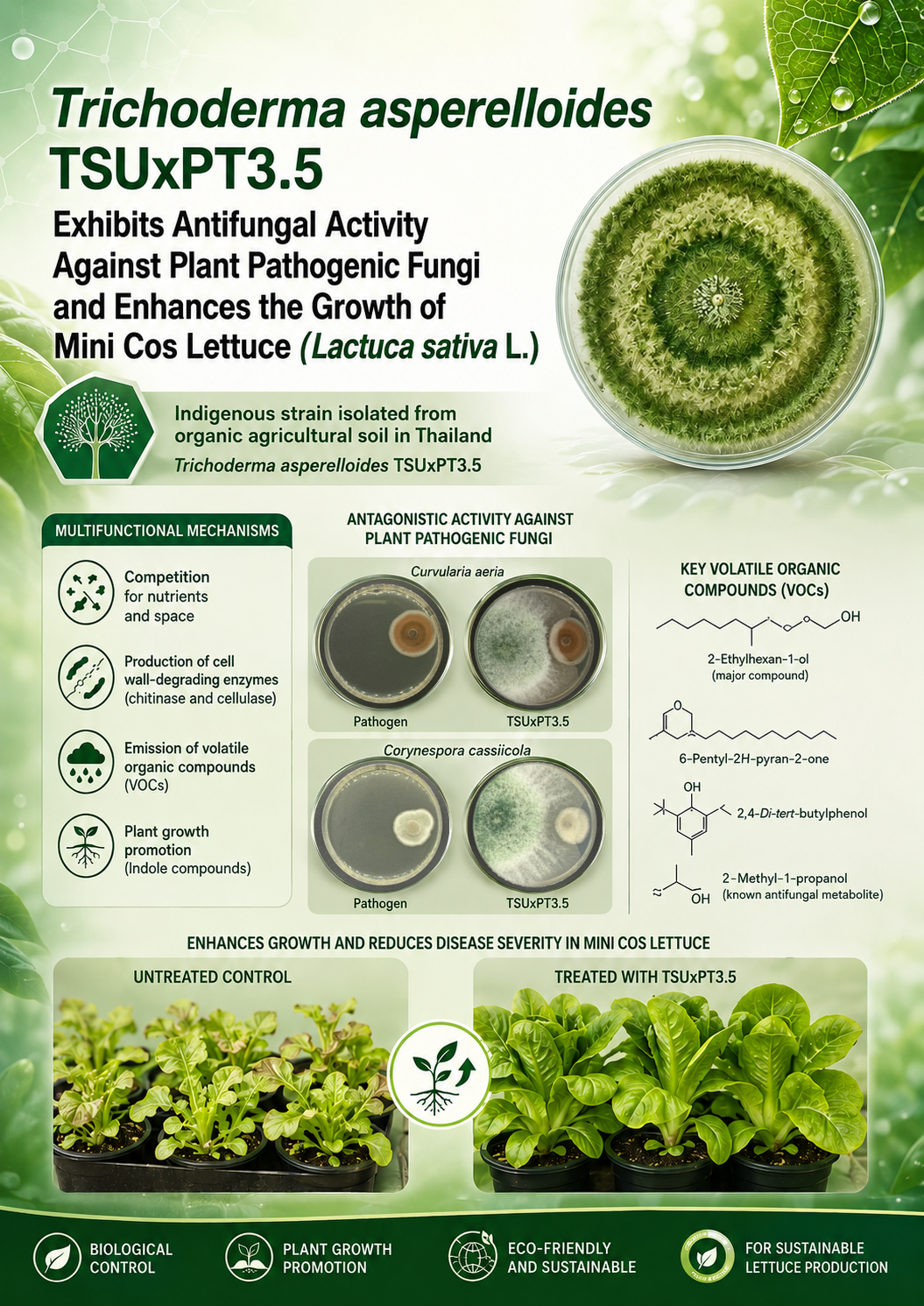
Trichoderma species are widely recognized as effective biological control agents due to their multifaceted antagonistic mechanisms and plant growth-promoting activities. In this study, an indigenous fungal strain, TSUxPT3.5, was isolated from organic agricultural soil in southern Thailand. Molecular identification based on multi-locus sequence analysis of the ITS, tef1, and rpb2 regions confirmed the strain as Trichoderma asperelloides. This fungus was further characterized for its plant growth-promoting traits through both direct and indirect mechanisms. Trichoderma asperelloides TSUxPT3.5 produced indole compounds and exhibited antagonistic activity against economically important plant pathogenic fungi, including Curvularia aeria and Corynespora cassiicola, causal agents of leaf spot disease in lettuce. Its biocontrol mechanisms involved competition for nutrients and space, production of cell wall-degrading enzymes (chitinase and cellulase), and emission of volatile organic compounds (VOCs). Among the detected VOCs, 2-ethylhexan-1-ol was the predominant compound. Additionally, 6-pentyl-2H-pyran-2-one, 2,4-Di-tert-butylphenol, and 2-methyl-1-propanol, a well-known antifungal metabolite, were also identified. Application of T. asperelloides TSUxPT3.5 significantly enhanced the growth of mini cos lettuce (Lactuca sativa L.), increasing fresh weight and improving plant vigor compared with the untreated control. In addition, disease severity was markedly reduced in treated plants. These findings demonstrate that the indigenous T. asperelloides TSUxPT3.5 possesses multifunctional antagonistic and plant growth–promoting traits, highlighting its potential as an eco-friendly biological control agent for sustainable lettuce production.
Article Details

This work is licensed under a Creative Commons Attribution-NonCommercial-NoDerivatives 4.0 International License.
References
Savary, S.; Willocquet, L.; Pethybridge, S.J.; Esker, P.; McRoberts, N.; Nelson, A. The global burden of pathogens and pests on major food crops. Nat. Ecol. Evol. 2019, 3(3), 430–439. https://doi.org/10.1038/s41559-018-0793-y
Garrett, K.A.; Dendy, S.P.; Frank, E.E.; Rouse, M.N.; Travers, S.E. Climate change effects on plant disease: Genomes to ecosystems. Annu. Rev. Phytopathol. 2006, 44, 489–509. https://doi.org/10.1146/annurev.phyto.44.070505.143420
Chakraborty, S.; Newton, A.C. Climate change, plant diseases and food security: An overview. Plant Pathol. 2011, 60(1), 2–14. https://doi.org/10.1111/j.1365-3059.2010.02411.x
Elad, Y.; Pertot, I. Climate change impacts on plant pathogens and plant diseases. J. Crop. Improv. 2014, 28(1), 99–139. https://doi.org/10.1080/15427528.2014.865412
Thithuan, N.; Bunjonsiri, P.; Sunpapao, A. Morphology and behavior of gametes and zoospores from the plant-parasitic green algae, Cephaleuros (Chlorophyta, Ulvophyceae) 1. Pac. Sci. 2019, 73(3), 403–410. https://doi.org/10.2984/73.3.7
Wonglom, P.; Thithuan, N.; Sunpapao, A. Occurrence and seasonal development of plant parasitic algae Cephaleuros (Chlorophyta, Ulvophyceae) in southern Thailand. Chiang Mai J. Sci. 2026a; 53(1), e2026013 https://doi.org/10.12982/CMJS.2026.013
Pornsuriya, C.; Ito, S.I.; Sunpapao, A. First report of leaf spot on lettuce caused by Curvularia aeria. J. Gen. Plant Pathol. 2018, 84(4), 296–299. https://doi.org/10.1007/s10327-018-0782-7
Wonglom, P.; Ito, S.; Sunpapao, A. First report of Curvularia lunata causing leaf spot on Barsica rapa subsp. pekinensis in Thailand. New Dis. Rep. 2018, 38, 15. https://doi.org/10.5197/j.2044-0588.2018.038.015
Liu, H.; Wang, H.; Zhong, J.; Lu, X.; Pan, X.T.; Zhu, H.J.; Zhou, Q. First report of Stemphylium lycopersici and Stemphylium vesicarium causing leaf spot on lettuce (Lactuca sativa) in China. Plant Dis. 2019, 103(11), 2957. https://doi.org/10.1094/PDIS-05-19-1052-PDN
Thaochan, N.; Pornsuriya, C.; Chairin, T.; Sunpapao, A. Roles of systemic fungicide in antifungal activity and induced defense responses in rubber tree (Hevea brasiliensis) against leaf fall disease caused by Neopestalotiopsis cubana. Physiol. Mol. Plant Pathol. 2020, 111, 101511. https://doi.org/10.1016/j.pmpp.2020.101511
Samarghandi, M.R.; Mohammadi, M.; Karami, A.; Tabandeh, L.; Dargahi, A.; Amirian, F. Residue analysis of pesticides, herbicides, and fungicides in various water sources using gas chromatography-mass detection. Pol. J. Environ. Stud, 2017, 26(5), 2189–2195. https://doi.org/10.15244/pjoes/70387
Santísima-Trinidad, A.B.L.; del Mar Montiel-Rozas, M.; Diéz-Rojo, M.Á.; Pascual, J.A.; Ros, M. Impact of foliar fungicides on target and non-target soil microbial communities in cucumber crops. Ecotoxicol. Environ. Saf. 2018, 166, 78–85. https://doi.org/10.1016/j.ecoenv.2018.09.074
Fungicide Resistance Action Committee (FRAC). FRAC Website. Available online: https://www.frac.info/#open-tour (accessed on 2 January 2026).
Omar, I.; O'neill, T.M.; Rossall, S. Biological control of Fusarium crown and root rot of tomato with antagonistic bacteria and integrated control when combined with the fungicide carbendazim. Plant Pathol. 2006, 55(1), 92–99. https://doi.org/10.1111/j.1365-3059.2005.01315.x
Baiyee, B.; Ito, S.; Sunapapo, A. Trichoderma asperellum T1 mediated antifungal activity and induced defense response against leaf spot fungi in lettuce (Lactuca sativa L.). Physiol. Mol. Plant Pathol. 2019a, 106, 96–101. https://doi.org/10.1016/j.pmpp.2018.12.009
Phoka, N.; Suwannarach, N.; Lumyong, S.; Ito, S.I.; Matsui, K.; Arikit, S.; Sunpapao, A. Role of volatiles from the endophytic fungus Trichoderma asperelloides PSU-P1 in biocontrol potential and in promoting the plant growth of Arabidopsis thaliana. J. Fungi 2020, 6, 341. https://doi.org/10.3390/jof6040341
Ruangwong, O.U.; Wonglom, P.; Phoka, N.; Suwannarach, N.; Lumyong, S.; Ito, S.I.; Sunpapao, A. Biological control activity of Trichoderma asperelloides PSU-P1 against gummy stem blight in muskmelon (Cucumis melo). Physiol. Mol. Plant Pathol. 2021a, 115, 101663. https://doi.org/10.1016/j.pmpp.2021.101663
Ruangwong, O.U.; Wonglom, P.; Suwannarach, N.; Kumla, J.; Thaochan, N.; Chomnunti, P.; Pitija, K.; Sunpapao, A. Volatile organic compound from Trichoderma asperelloides TSU1: Impact on plant pathogenic fungi. J. Fungi 2021b, 7, 187. https://doi.org/10.3390/jof7030187
Singh, B.N.; Singh, A.; Singh, B.R.; Singh, H.B. Trichoderma harzianum elicits induced resistance in sunflower challenged by Rhizoctonia solani. J. Appl. Microbiol. 2014, 116(3), 654–666. https://doi.org/10.1111/jam.12387
Herrera-Jiménez, E.; Alarcón, A.; Larsen, J.; Ferrera-Cerrato, R.; Cruz-Izquierdo, S.; Ferrera-Rodríguez, M.R. Comparative effects of two indole-producing Trichoderma strains and two exogenous phytohormones on the growth of Zea mays L., with or without tryptophan. J. Soil Sci. Plant Nutr. 2018, 18(1), 188–201. http://dx.doi.org/10.4067/S0718-95162018005000704
Nancha, N.; Hendarto, Z.; Bowchauy, S.; Wonglom, P. Efficacy of various Trichoderma spp. in controlling anthracnose disease in white Chaiburi pepper (Capsicum frutescens). AgriSci. Soc. J. 2025, 1(1), 1–7. https://li02.tci-thaijo.org/index.php/NRJ/article/view/1139
Hermosa, R.; Viterbo, A.; Chet, I.; Monte, E. Plant-beneficial effects of Trichoderma and of its genes. Microbiology 2012, 158(1), 17–25. https://doi.org/10.1099/mic.0.052274-0
FAO. FAOSTAT: Crops and Livestock Products. Food and Agriculture Organization of the United Nations. Available online: https://www.fao.org/faostat/. 2023.
Baiyee, B.; Pornsuriya, C.; Ito, S.; Sunapapo, A. Trichoderma spirale T76-1 displays biocontrol activity on lettuce (Lactuca sativa L.) caused by Corynespora cassiicola or Curvularia aeria. Biol. Control 2019b, 129, 195–200. https://doi.org/10.1016/j.biocontrol.2018.10.018
Chairin, T.; Pornsuriya, C.; Thaochan, N.; Sunpapao, A. Corynespora cassiicola causes leaf spot disease on lettuce (Lactuca sativa) cultivated in hydroponic systems in Thailand. Australas. Plant Dis. Notes 2017, 12(1), 16. https://doi.org/10.1007/s13314-017-0241-x
White, T.J.; Burns, T.; Lee, S.; Taylor, J.W. Amplification and direct sequencing of fungal ribosomal RNA genes for phylogenetics. In M.A. Innis, D.H. Gelfand, J.J. Sninsky & T.J. White (Eds.) PCR protocols: a guide to methods and applications (pp. 315– 322). 1990. https://doi.org/10.1016/B978-0-12-372180-8.50042-1
O’Donnell, K.; Kistler, H.C.; Cigelnik, E.; Ploetz, R.C. Multiple evolutionary origins of the fungus causing Panama disease of banana: Concordant evidence from nuclear and mitochondrial gene genealogies. Proc. Natl. Acad. Sci. U.S.A. 1998, 95, 2044–2049. https://doi.org/10.1073/pnas.95.5.2044
Carbone, I.; Kohn, L.M. A method for designing primer sets for speciation studies in filamentous ascomycetes. Mycologia 1999, 91(3), 553–556. https://doi.org/10.1080/00275514.1999.12061051
Samuels, G.J.; Dodd, S.L.; Gams, W.; Castlebury, L.A.; Petrini, O. Trichoderma species associated with the green mold epidemic of commercially grown Agaricus bisporus. Mycologia 2002, 94(1), 146–170. https://doi.org/10.1080/15572536.2003.11833257
Liu, Y.J.; Whelen, S.; Hall, B.D. Phylogenetic relationships among ascomycetes: evidence from an RNA polymerse II subunit. Mol. Biol. Evol. 1999, 16(12), 1799–1808. https://doi.org/10.1093/oxfordjournals.molbev.a026092
Nei, M.; Kumar, S. Molecular Evolution and Phylogenetics; Oxford University Press: New York, USA, 2000.
Kumar, S.; Stecher G.; Suleski, M.; Sanderford, M.; Sharma, S.; Tamura, K. Molecular Evolutionary Genetics Analysis Version 12 for adaptive and green computing. Mol. Biol. Evol. 2024, 41, 1–9. https://doi.org/10.1093/molbev/msae263
Felsenstein, J. Confidence limits on phylogenies: An approach using the bootstrap. Evolution 1985, 39, 783–791. https://doi.org/10.2307/2408678
Edgar, R.C. MUSCLE: multiple sequence alignment with high accuracy and high throughput. Nucleic Acids Res. 2004, 32, 1792–1797. https://doi.org/10.1093/nar/gkh340
Nuangmek, W.; Aiduang, W.; Kumla, J.; Lumyong, S.; Suwannarach, N. Evaluation of a newly identified endophytic fungus, Trichoderma phayaoense for plant growth promotion and biological control of gummy stem blight and wilt of muskmelon. Front. Microbiol. 2021, 12, e634772. https://doi.org/10.3389/fmicb.2021.634772
Kamala, T.; Indira, S. Evaluation of indigenous Trichoderma isolates from Manipur as biocontrol agent against Pythium aphanidermatum on common beans. 3 Biotech 2011, 1, 217–225. https://doi.org/10.1007/s13205-011-0027-3
Suwannarach, N.; Kaewyana, C.; Yodmeeklin, A.; Kumla, J.; Matsui, K.; Lumyong, S. Evaluation of Muscodor cinnamomi as an egg biofumigant for the reduction of microorganisms on eggshell surfaces and its effect on egg quality. Int. J. Food Microbiol. 2017, 244, 52–61. https://doi.org/10.1016/j.ijfoodmicro.2016.12.021
Gordon, S.A.; Weber, R.P. Colorimetric estimation of indoleacetic acid. Plant Physiol. 1951, 26, 192–195. https://doi.org/10.1104/pp.26.1.192
Cai, F.; Druzhinina, I.S. In honor of John Bissett: authoritative guidelines on molecular identification of Trichoderma. Fungal Divers. 2021, 107, 1-69. https://doi.org/10.1007/s13225-020-00464-4
Wonglom, P.; Suwannarach, N.; Kumla, J.; Pitija, K.; Sunpapao, A. Biocontrol mechanisms and field efficacy of Trichoderma asperelloides Z2-02 against anthracnose of torch ginger caused by Colletotrichum atlanticum. Physiol. Molec. Plant Pathol. 2026b, 142, 103133. https://doi.org/10.1016/j.pmpp.2026.103133
Vinale, F.; Sivasithamparam, K.; Ghisalberti, E.L.; Marra, R.; Woo, S.L.; Lorito, M. Trichoderma–plant–pathogen interactions. Soil Biol. Biochem. 2008, 40(1), 1–10. https://doi.org/10.1016/j.soilbio.2007.07.002
Wonglom, P.; Ito, S.I.; Sunpapao, A. Volatile organic compounds emitted from endophytic fungus Trichoderma asperellum T1 mediate antifungal activity, defense response and promote plant growth in lettuce (Lactuca sativa). Fungal Ecol. 2020 43, 100867. https://doi.org/10.1016/j.funeco.2019.100867
Zhang, Y.; Li, Z.; Wei, S.; Xu, C.; Chen, M.; Sang, J.; Han, L.; Yan, H.; Li., Z.; Cui, Z.; Ye, X. Antifungal activity and mechanisms of 2-ethylhexanol, a volatile organic compound produced by Stenotrophomonas sp. NAU1697, against Fusarium oxysporum f. sp. cucumerinum. J. Agric. Food Chem. 2024, 72(27), 15213-15227. https://doi.org/10.1021/acs.jafc.3c09851
Marcomini, E.K.; Rezende, P.S.T.; Gomes, J.; Leite, C.R.; de Oliveira, K.M.P.; Pomini, A.M.; Svidzinski, T.I.E.; Negri, M. 2-ethyl-1-hexanol: a promising molecule against priority fungal pathogens. J. Appl. Microbiol. 2025, 136(7), lxaf165. https://doi.org/10.1093/jambio/lxaf165
Wang, Z.; Duan, W.; Duan, B.; He, H.; Nan, J.; Yan, X.; Lei, S.; Bin, Y.; Chen, C.; Yue, X.; Xu, X.; Yuan, S.; Zuo, J.; Liu, J.; Xu, X.; Wang, Q. 2-Ethylhexanol inhibit Botrytis cinerea by interfering in sugar and amino acid metabolism. npj Sci. Food 2026 https://doi.org/10.1038/s41538-026-00753-3
Jeleń, H.; Błaszczyk, L.; Chełkowski, J.; Rogowicz, K.; Strakowska, J. Formation of 6-n-pentyl-2H-pyran-2-one (6-PAP) and other volatiles by different Trichoderma species. Mycol. Progress 2014, 13(3), 589-600. https://doi.org/10.1007/s11557-013-0942-2
Jin, X.; Guo, L.; Jin, B.; Zhu, S.; Mei, X.; Wu, J.; Liu, T.; He, X. Inhibitory mechanism of 6-Pentyl-2H-pyran-2-one secreted by Trichoderma atroviride T2 against Cylindrocarpon destructans. Pestic. Biochem. Physiol. 2020, 170, 104683. https://doi.org/10.1016/j.pestbp.2020.104683
Xing, M.; Zhao, J.; Zhang, J.; Wu, Y.; Khan, R.A.A.; Li, X.; Wang, R.; Li, T.; Liu, T. 6-Pentyl-2 H-pyran-2-one from Trichoderma erinaceum is fungicidal against litchi downy blight pathogen Peronophythora litchii and preservation of litchi. J. Agric. Food Chem. 2023, 71(49), 19488-19500. https://doi.org/10.1021/acs.jafc.3c03872
Wu, Y.; Li, X.; Dong, L.; Liu, T.; Tang, Z.; Lin, R.; Norvienyeku, J.; Xing, M. A new insight into 6-pentyl-2h-pyran-2-one against peronophythora litchii via TOR pathway. J. Fungi 2023, 9(8), 863. https://doi.org/10.3390/jof9080863
Dharni, S.; Sanchita; Maurya, A.; Samad, A.; Srivastava, S.K.; Sharma, A.; Patra, D.D. Purification, characterization, and in vitro activity of 2, 4-di-tert-butylphenol from Pseudomonas monteilii PsF84: conformational and molecular docking studies. J. Agric. Food. Chem. 2014, 62(26), 6138-6146. https://doi.org/10.1021/jf5001138
Varsha, K.K.; Devendra, L.; Shilpa, G.; Priya, S.; Pandey, A.; Nampoothiri, K.M. 2, 4-Di-tert-butyl phenol as the antifungal, antioxidant bioactive purified from a newly isolated Lactococcus sp. Int. J. Food Microbiol. 2015, 211, 44-50. https://doi.org/10.1016/j.ijfoodmicro.2015.06.025
Fan, K.; Yu, Y.; Hu, Z.; Qian, S.A.; Zhao, Z.; Meng, J.; Zheng, S.; Huang, Q.; Zhang, Z.; Nie, D.; Han, Z. Antifungal activity and action mechanisms of 2, 4-Di-tert-butylphenol against Ustilaginoidea virens. J. Agric. Food Chem. 2023, 71, 46, 17723–17732. https://doi.org/10.1021/acs.jafc.3c05157
Di Francesco, A.; Ugolini, L.; Lazzeri, L.; Mari, M. Production of volatile organic compounds by Aureobasidium pullulans as a potential mechanism of action against postharvest fruit pathogens. Biol. Control 2015, 81, 8-14. https://doi.org/10.1016/j.biocontrol.2014.10.004
Rahman, A.; Sitepu, I.R.; Tang, S.Y.; Hashidoko, Y. Salkowski’s reagent test as a primary screening index for functionalities of rhizobacteria isolated from wild dipterocarp saplings growing naturally on medium-strongly acidic tropical peat soil. Biosci., Biotechnol., Biochem. 2010, 74(11), 2202-2208. https://doi.org/10.1271/bbb.100360
Glickmann, E.; Dessaux, Y. A critical examination of the specificity of the Salkowski reagent for indolic compounds produced by phytopathogenic bacteria. Appl. Environ. Microbiol. 1995, 61(2), 793-796. https://doi.org/10.1128/aem.61.2.793-796.1995
Guardado-Fierros, B.G.; Tuesta-Popolizio, D.A.; Lorenzo-Santiago, M.A.; Rodriguez-Campos, J.; Contreras-Ramos, S.M. Comparative study between Salkowski reagent and chromatographic method for auxins quantification from bacterial production. Front. Plant Sci. 2024, 15, 1378079. https://doi.org/10.3389/fpls.2024.1378079
Contreras-Cornejo, H.A.; Schmoll, M.; Esquivel-Ayala, B.A.; González-Esquivel, C.E.; Rocha-Ramírez, V.; Larsen, J. Mechanisms for plant growth promotion activated by Trichoderma in natural and managed terrestrial ecosystems. Microbiol. Res. 2024, 281, 127621. https://doi.org/10.1016/j.micres.2024.127621
Contreras-Cornejo, H.A.; Macías-Rodríguez, L.; Cortés-Penagos, C.; López-Bucio, J. Trichoderma virens, a plant beneficial fungus, enhances biomass production and promotes lateral root growth through an auxin-dependent mechanism in Arabidopsis. Plant Physiol. 2009, 149, 1579–1592. https://doi.org/10.1104/pp.108.130369
Woo, S.L.; Pepe, O. Microbial consortia: promising probiotics as plant biostimulants for sustainable agriculture. Front. Plant Sci. 2018, 9, 1801. https://doi.org/10.3389/fpls.2018.01801
Saba, H.; Vibhash, D.; Manisha, M.; Prashant, K.S.; Farhan, H.; Tauseef, A. Trichoderma–a promising plant growth stimulator and biocontrol agent. Mycosphere 2012, 3(4), 524–531. https://doi.org/10.5943/mycosphere/3/4/14
