
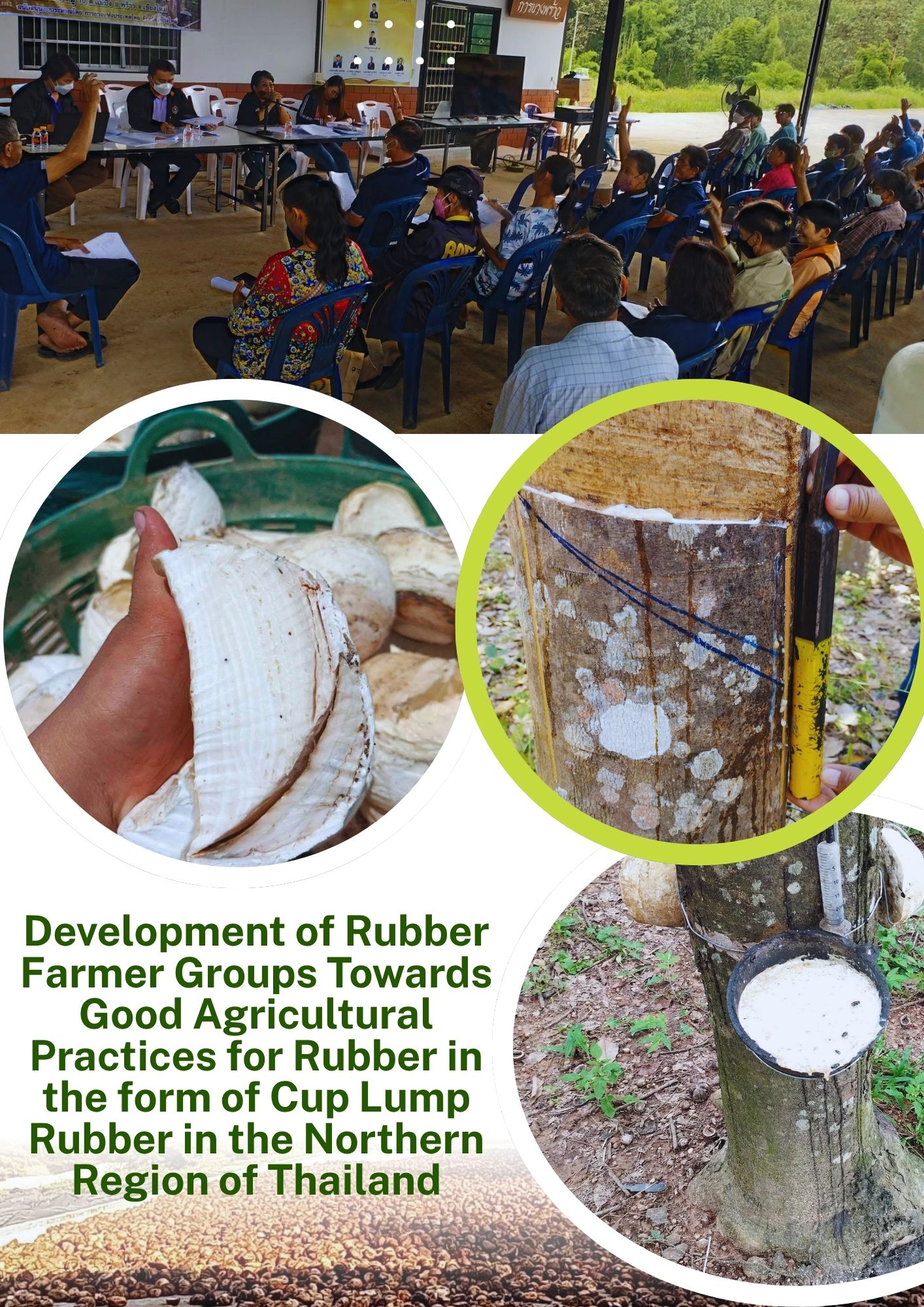
Development of Rubber Farmer Groups Towards Good Agricultural Practices for Rubber in the form of Cup Lump Rubber in the Northern Region of Thailand
Article Sidebar
Main Article Content
Abstract
This research aims to develop a group of rubber farmers in northern Thailand to adopt Good Agricultural Practices (GAP) for cup-lump rubber and to explore approaches to developing GAP for cup-lump rubber. The study focused on rubber farmers in Phrao District, Chiang Mai Province, using a participatory action research methodology. The research involved two steps. 1) assessing the farmers' capacity to manage rubber plantations according to Good Agricultural Practices (GAP) principles; and 2) proposing recommendations for developing Good Agricultural Practices (GAP) for cup-lump rubber farmers. The study found that in 2022, farmers had an average rubber plantation area of 3.31 Ha, generating an average income of 235,549.33 baht per year from rubber plantations, while incurring average plantation management expenses of 4,621.46 baht per year. Most farmers sold their products as dry cup lumps to their cooperative members, and most had a high potential for Good Agricultural Practices (GAP) in rubber (average 4.13). The development of rubber farmer groups in northern Thailand toward Good Agricultural Practices (GAP) for rubber in the form of cup lumps should involve promoting member participation, particularly in farmer group management, and establishing clear standards for rubber trading. This should be coupled with the development of knowledge and skills in rubber plantation management through training with the Rubber Authority of Thailand. Furthermore, product quality should be improved, participatory inspection systems implemented, fair marketing and profit-sharing plans promoted, and sustainability planning implemented. However, to successfully develop farmer potential, farmers must begin by shaping their attitudes toward the benefits of Good Agricultural Practices (GAP) and promoting knowledge and understanding of proper Good Agricultural Practices (GAP).
Downloads
Article Details

This work is licensed under a Creative Commons Attribution-NonCommercial-NoDerivatives 4.0 International License.
References
Department of Agriculture. Good Agricultural Practices Data; 2025. https://www.opsmoac.go.th/yasothon-article_prov-files-431691791798 (accessed March 30, 2026).
Rubber Authority of Thailand. Alternatives for Intercropping with Rubber, Rubber Plants and Additional Income Generating Activities for Farmers; 2018. https://www.arda.or.th/detail/6582 (accessed March 30, 2026).
Department of Agriculture. Handbook: The One Million Rai Rubber Project; 2004. http://lib.doa.go.th/multim/e-book/EB00139.pdf (accessed March 30, 2026).
Rubber Authority of Thailand. Alternatives for Intercropping with Rubber, Rubber Plants and Additional Income Generating Activities for Farmers; 2022. https://www.arda.or.th/detail/6582 (accessed March 30, 2026).
Northern Rubber Authority of Thailand. Data Book Information for Rubber Farmers; Thailand, 2022.
Department of Agriculture. Standard Operating Procedure (SOP) for GAP (Good Agricultural Practices) and Organic Crop Production Certification; 2021. https://gap.doa.go.th/web_manual/doc/SOP.pdf (accessed May 30, 2026).
USDA National Institute of Food and Agriculture. Food Safety Modernization Act; 2020. https://www.fda.gov/food/guidance-regulation-food-and-dietary-supplements/food-safety-modernization-act-fsma (accessed March 30, 2026).
Nubsang, K. Cooperative Management Mechanism for the Potential Development on Rubber Production of the Upper Northern Provincial Group 2 in Thailand. J. Soc. Acad. 2015, 8(3), 202–219.
Yamane, T. Statistics: An Introductory Analysis, 2nd ed.; Harper and Row: New York, 1967.
Thavon, C.; Phayakka, N.; Prapatigul, P.; Suriyong, S. Factors Affecting Farmers’ Adoption of Good Agricultural Practices for Mango in Bang Khla District, Chachoengsao Province. Khon Kaen Agric. J. 2024, 6, 1177–1188.
Khumdee, N.; Limnirankul, B.; Sirisunyaluck, R.; Suebpongsung, P. Factors Affecting Good Agricultural Practices of Quality Strawberry Farmers, Samoeng District, Chiang Mai Province. J. Agric. Res. Commun. 2022, 2, 201–208.
Bang, J.; Han, J. W. Factors Influencing Farmers’ Motivation to Adopt Smart Farm Technology in South Korea. arXiv 2025.
Oli, D.; Gyawali, B.; Acharya, S.; Oshikoya, S. Factors Influencing Learning Attitude of Farmers Regarding Adoption of Precision Farming Technologies. J. Agric. Educ. Technol. 2025. https://doi.org/10.2139/ssrn.5015356
McFadden, J.; Njuki, E.; Griffin, T. Precision Agriculture in the Digital Era: Recent Adoption on U.S. Farms; EIB-248; U.S. Department of Agriculture, Economic Research Service, 2023.
Kehinde, M. O.; Shittu, A. M.; Ogunnaike, M. G.; Oyawole, F. P.; Fapojuwo, O. E. Land Tenure and Property Rights and the Impacts on Adoption of Climate-Smart Practices among Smallholder Farmers in Selected Agroecologies in Nigeria. Bio-Based Appl. Econ. 2022, 11(1). https://doi.org/10.36253/bae-9992
Tana, N. An Adoption of Land Development Technology by Farmers in Mae Charim District, Nan Province; Master’s Thesis, Sukhothai Thammathirat Open University, Thailand, 2017.
Girma, Y. Credit Access and Agricultural Technology Adoption Nexus in Ethiopia: A Systematic Review and Meta-Analysis. J. Agric. Food Res. 2022, 10, 100362. https://doi.org/10.1016/j.jafr.2022.100362
Srinieng, S.; Yongram, S. Access to Agricultural Technology, Information, and Funding; Office of Agricultural Economics: Thailand, 2023; p 133.
