
Institutional Barriers and Stakeholder Perceptions in Agricultural Education: A Descriptive-Correlational Study of the BSA Program at Cebu Technological University–Barili Campus
Article Sidebar
Main Article Content
Abstract
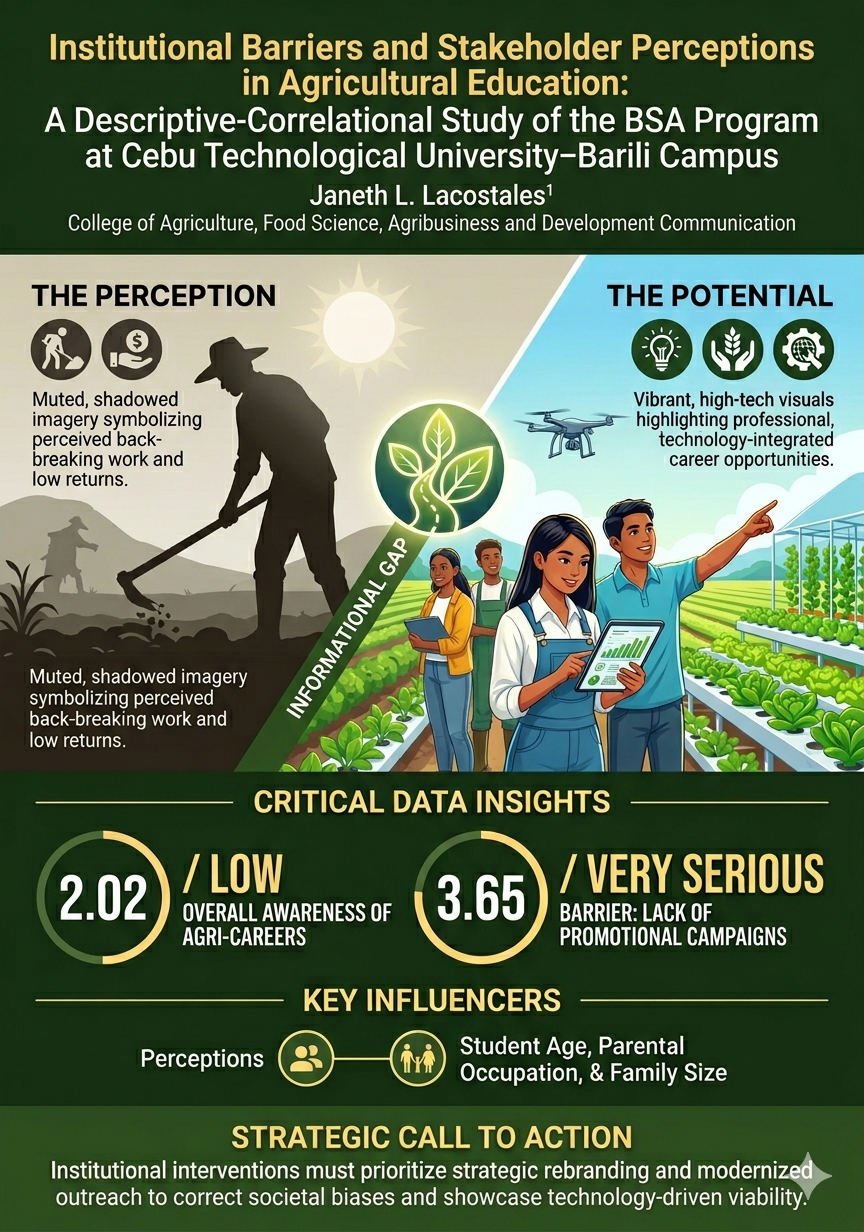
The declining enrollment in agricultural degree programs among Filipino youth presents a critical challenge to long-term food security and agricultural sustainability. This study assessed the level of awareness, perceptions, and perceived barriers toward the Bachelor of Science in Agriculture program among Senior High School students, parents, and administrators in Barili, Cebu. Utilizing a descriptive-correlational research design, the study analyzed quantitative data through weighted means and p-value significance tests. The findings revealed a "Low" overall level of awareness among all respondent groups (mean = 2.02), with students demonstrating the lowest familiarity regarding diverse career opportunities in the sector (mean = 1.88). While general perceptions toward the program were "Moderate" (mean = 2.75), the analysis identified significant relationships (p < 0.05) between respondent profiles—specifically student age, parental occupation, and family size—and their perceptions of the field. The most critical “Very Serious Barrier” to program enrollment was the lack of information and promotional campaigns (mean = 3.65), followed by negative perceptions of agriculture (mean = 3.42), and the belief that agriculture is not a financially viable career (mean = 3.31). These results underscore a pervasive informational gap that hinders the recruitment of the next generation of agricultural professionals. The study concludes that institutional interventions must prioritize strategic rebranding and modernized outreach to correct societal biases and showcase the technology-driven professional viability of the 21st-century agricultural industry.
Article Details

This work is licensed under a Creative Commons Attribution-NonCommercial-NoDerivatives 4.0 International License.
References
Palis, H. S. The Decline of Youth Interest in Farming and Its Implications for Agricultural Productivity; University of the Philippines Los Baños.
Bouis, H. E.; Sison, M. C. B.; Navasero, J. C. L. Youth Engagement in Transforming the Food System to Address Malnutrition in the Philippines. Asian J. Agric. Dev. 2024, 21 (20th Anniversary Issue), 93–112. https://doi.org/10.37801/ajad2024.21.20AI.6
Mercado, K. M. P.; Osbahr, H. Feeding the Future: Knowledge and Perceptions of the Filipino Youth Toward Agriculture. Asian J. Agric. Dev. 2023, 20(2), 31–50. https://doi.org/10.37801/ajad2023.20.2.3
Jinagool, W.; Arom, P. Influence of Watering Regimes on Physiological Traits, Growth, Yield, and Capsaicin Content of Chilies. ASEAN J. Sci. Technol. Rep. 2023, 26(1), e247571. https://doi.org/10.55164/ajstr.v26i1.247571
Ibañez, R.; Velza, J. F.; Gaylan, R.; Catimpuhan, J. M. Income and Expenditure Analysis of Selected Lowland Rainfed Rice Farmers in Tubog, Cawayan, Masbate. ASEAN J. Sci. Technol. Rep. 2024, 27(2), e249926. https://doi.org/10.55164/ajstr.v27i2.249926
Mendoza, C. R. C.; Garcia, R. Phenomenological Research on the Youth's Experiences on Agriculture in the Philippines. New Trends Qual. Res. 2023, 16, e767. https://doi.org/10.36367/ntqr.16.2023.e767
Bohulano, N. Vulnerability Assessment of Agricultural Produce to Flooding in Libacao, Aklan, Philippines. ASEAN J. Sci. Technol. Rep. 2025, 28(5), e258574. https://doi.org/10.55164/ajstr.v28i5.258574
Dizon, J. S.; Dizon, T. S.; Dizon, D. T. Perceptions on Agriculture among Freshmen Students at the University of the Philippines Los Baños. J. Agric. Educ. Ext.
Chaurasia, J.; Jaishi, M.; Khanal, S.; et al. Multi-Criteria Decision-Making for Post-secondary Graduates of Technical and Vocational Education Stream (Plant and Animal Science): Analytical Hierarchy Process for Career Preference. J. Saudi Soc. Agric. Sci. 2025, 24, 32. https://doi.org/10.1007/s44447-025-00042-7
Fabella, M.; Seki, M.; Kakinaka, M. General Perceptions of Career Decision-Making Autonomy Among Youth in Rural Philippines: An Experimental Study Examining Cultural and Gender Dynamics. Dev. Econ. 2025, 1–21. https://doi.org/10.1111/deve.12453
Saduak, W.; Poungsuk, P.; Phonpakdee, R.; Deeying, S. School Agricultural Learning Center for Sustainable Agricultural Learning. J. Educ. Gift. Young Sci. 2019, 7(3), 389–407. https://doi.org/10.17478/jegys.582993
Yamagishi, K.; Gantalao, C.; Ocampo, L. The Future of Farm Tourism in the Philippines: Challenges, Strategies and Insights. J. Tour. Futures 2024, 10(1), 87–109. https://doi.org/10.1108/JTF-06-2020-0101
Lekbangpong, S.; Ratanachai, A. Technology Transfer Needs Assessment for Turmeric Farmers in Paphayom District, Phatthalung Province. ASEAN J. Sci. Technol. Rep. 2025, 28(1), e254806. https://doi.org/10.55164/ajstr.v28i1.254806
Dollison, M. D.; Basulgan, E. B.; Cornal, N. R.; Dollison, B. B. Utilization of Information and Communication Technology (ICT) Tools Among Masbate Rice Seed Growers. ASEAN J. Sci. Technol. Rep. 2026, 29 (1), e257993. https://doi.org/10.55164/ajstr.v29i1.257993
Bryceson, K. P.; Borrero, A. N.; Vasuian, F. Internet of Things (IoT), PBL and 3D Holographic Modelling for Smart Agricultural Education at The University of Queensland. In Me, Us, IT! Proceedings ASCILITE 2017; Partridge, H., Davis, K., Thomas, J., Eds.; Australasian Society for Computers in Learning in Tertiary Education: 2017.
Balisacan, A. M. Philippine Agricultural Development in Historical Perspective. In Philippine Macroeconomic Perspective: Development and Policies; Montes, M. F., Sakai, H., Eds.; Institute of Developing Economies: Tokyo, 1989.
Santiago, A.; Roxas, F. Reviving Farming Interest in the Philippines Through Agricultural Entrepreneurship Education. J. Agric. Food Syst. Community Dev. 2015, 5(4), 15–27. https://doi.org/10.5304/jafscd.2015.054.016
Janchai, S.; Nakkorn, N.; Vorarat, S.; Thongprapa, S. Carbon Footprint Assessment Using Synthetic Fertilizer and Liquid Organic Biofertilizer in Cassava Cultivation to Promote Good Cultivation Practices and Prevent Greenhouse Gas Emissions from Agricultural Cultivation in Thailand. ASEAN J. Sci. Technol. Rep. 2025, 28(4), e257702. https://doi.org/10.55164/ajstr.v28i4.257702
Leelamanothum, A.; Vaenthaison, P.; Suetrong, N.; Rodpon, P.; Poowadin, P. Design of a Knowledge-Based System for Economic Plants: A Case Study of Thailand. ASEAN J. Sci. Technol. Rep. 2026, 29(5), e260716. https://doi.org/10.55164/ajstr.v29i5.260716
Tinnam, P.; Yodpijit, N.; Junsupasen, S.; Sappakittipakorn, M.; Jongprasithporn, M. Reduction of Sound Pressure Levels with Noise Barriers Containing Agricultural Residues: Case Study. ASEAN J. Sci. Technol. Rep. 2025, 28(3), e257762. https://doi.org/10.55164/ajstr.v28i3.257762
Luces, H. C. A Bibliometric Analysis of Stress Memory and Priming in Plants: Research Trends, Mechanisms, and Implications for Agricultural Resilience. ASEAN J. Sci. Technol. Rep. 2026, 29(1), e259013. https://doi.org/10.55164/ajstr.v29i1.259013
Keawsaard, Y.; Pentem, P.; Rotduang, P.; Weeraphong, M.; Ramasoot, S. Induction of Mutation in Toothbrush Orchids Using Ethylmethane Sulphonate (EMS) and Detection of Genetic Variation by SSR Marker. ASEAN J. Sci. Technol. Rep. 2025, 28(1), e255125. https://doi.org/10.55164/ajstr.v28i1.255125
Srirugsa, T.; Kaewpoung, S.; Su-hren, W.; Panwanitdumrong, K.; Chuchit, T. Improving Drying Efficiency for Red Chili Peppers Using Ventilated Solar Technology. ASEAN J. Sci. Technol. Rep. 2026, 29(4), e261032. https://doi.org/10.55164/ajstr.v29i4.261032
