
Feasibility Study of Automated Brackish Water Fish Pond Systems: Integrating IoT Sensor Networks and Generative Artificial Intelligence for Sustainable Aquaculture in Coastal Communities
Article Sidebar
Main Article Content
Abstract
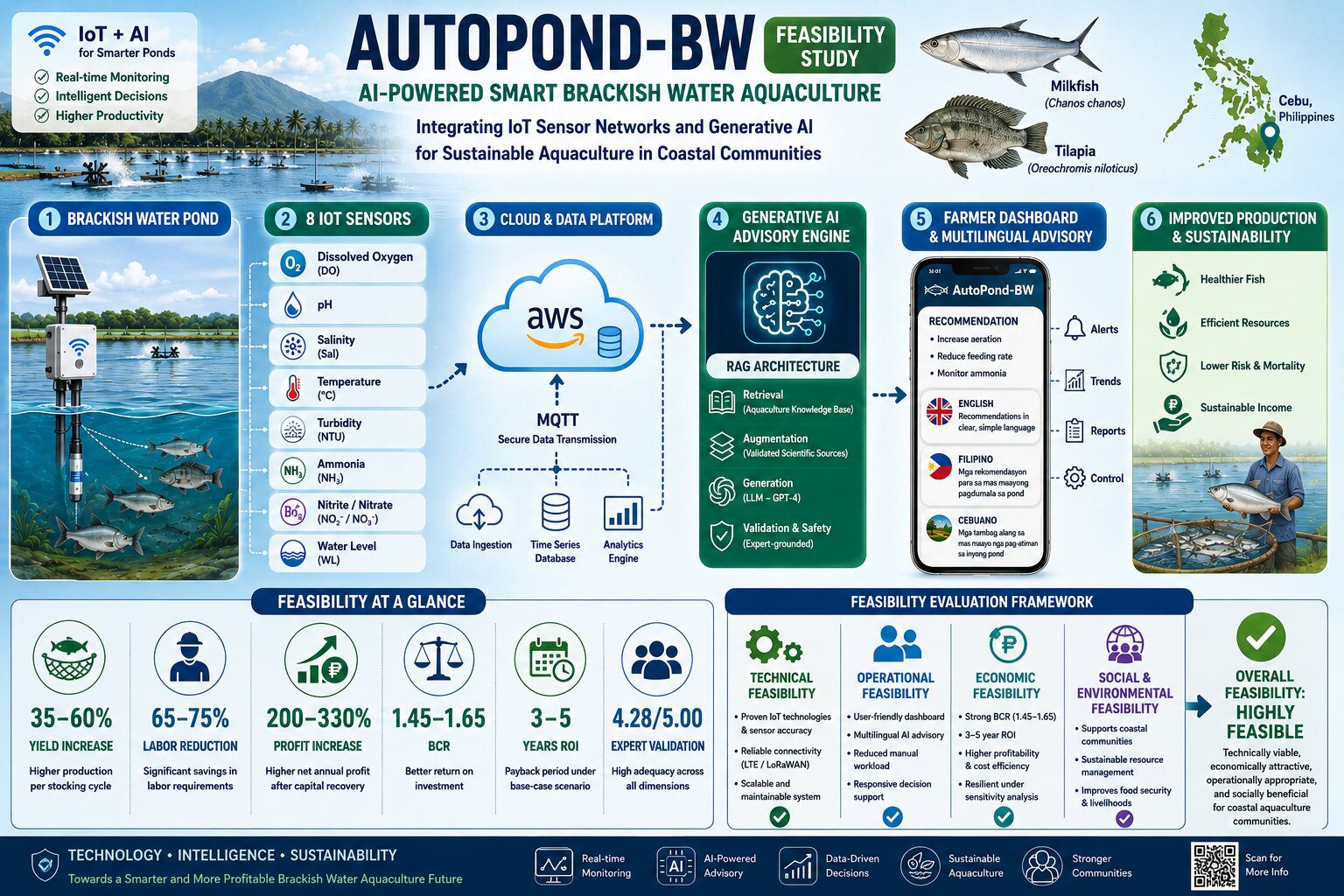
Brackish water aquaculture remains one of the most economically significant food-production sectors in Southeast Asia, yet productivity is persistently constrained by inefficient monitoring, reactive management, and limited decision-support infrastructure. This feasibility study investigates the technical, economic, and operational viability of deploying a fully automated, sensor-integrated, and generative AI (GenAI)-augmented management system in brackish water fish ponds, with emphasis on milkfish (Chanos chanos) and Nile tilapia (Oreochromis niloticus) culture in coastal Philippine settings. The proposed system -- designated AutoPond-BW -- integrates eight categories of IoT-enabled sensors connected through an MQTT-based data pipeline to a cloud analytics platform. Sensor outputs feed a retrieval-augmented generation (RAG)-powered large language model (LLM) advisory engine that generates real-time, context-aware management recommendations in English, Filipino, and Cebuano. A techno-economic analysis comparing automated versus manual pond systems was conducted across three production scenarios: small-scale (0.5-1.0 ha), medium-scale (1.0-5.0 ha), and commercial-scale (>5.0 ha). Based on a literature synthesis and financial modeling, automated systems are projected to yield a benefit-cost ratio (BCR) of 1.45-1.65, compared with 1.15-1.25 for manual systems, with projected net annual profit increases of 200-330% over a five-year horizon. Despite higher initial capital requirements (PHP 680,000-850,000/ha), automated systems achieve full return on investment within three to five years. Expert panel validation (n=12, using a 25-item Likert-type questionnaire across five operational dimensions) confirmed the system's adequacy, with an overall mean rating of 4.28/5.00. This study provides evidence-based recommendations for government agencies, aquaculture investors, and coastal farming communities as they consider transitioning to smart, automated aquaculture operations.
Article Details

This work is licensed under a Creative Commons Attribution-NonCommercial-NoDerivatives 4.0 International License.
References
FAO. The State of World Fisheries and Aquaculture 2022: Towards Blue Transformation; Food and Agriculture Organization of the United Nations: Rome, Italy, 2022; ISBN 978-92-5-136364-5
Naylor, R. L.; Hardy, R. W.; Buschmann, A. H.; Bush, S. R.; Cao, L.; Klinger, D. H.; Little, D. C.; Lubchenco, J.; Shumway, S. E.; Troell, M. A 20-Year Retrospective Review of Global Aquaculture. Nature 2021, 591, 551–563. https://doi.org/10.1038/s41586-021-03308-6
Garlock, T.; Asche, F.; Anderson, J.; Bjorndal, T.; Kumar, G.; Lorenzen, K.; Ropicki, A.; Smith, M. D.; Tveteras, R. A Global Blue Revolution: Aquaculture Growth across Regions, Species, and Countries. Rev. Fish. Sci. Aquac. 2020, 28, 107–116. https://doi.org/10.1080/23308249.2019.1678111
PCAARRD. Philippine Aquaculture Situationer and Development Agenda; Philippine Council for Agriculture, Aquatic and Natural Resources Research and Development: Los Baños, Laguna, Philippines, 2021.
Huynh, T. T.; Do, T. X.; Nguyen, V. H. Assessment of Smart Aquaculture Technologies for Small-Scale Farmers in Southeast Asia. Aquacult. Rep. 2020, 18, 100454. https://doi.org/10.1016/j.aqrep.2020.100454
Refuncion, J. M., Jr.; Durango, D.; Agbon, M. W. M.; Matugas, J. Agri-Fishery Practices through Product Resource Management, Value Addition and Commercialization Enhancement Project of Villages in Daram, Samar. ASEAN J. Sci. Technol. Rep. 2026, 29(2), 259686. https://doi.org/10.55164/ajstr.v29i2.259686
De Silva, S. S.; Soto, D. Climate Change and Aquaculture: Potential Impacts, Adaptation and Mitigation. In Climate Change Implications for Fisheries and Aquaculture; Cochrane, K., De Young, C., Soto, D., Bahri, T., Eds.; FAO Fisheries and Aquaculture Technical Paper No. 530; FAO: Rome, Italy, 2009; pp 151–212.
Klinger, D.; Naylor, R. Searching for Solutions in Aquaculture: Charting a Sustainable Course. Annu. Rev. Environ. Resour. 2012, 37, 247–276. https://doi.org/10.1146/annurev-environ-021111-161531
Suwanpakdee, S.; Sriyasak, P.; Pimolrat, P. Risk of Climate Variability on Tilapia Cage Culture in Songkhram River in Northeastern Thailand. ASEAN J. Sci. Technol. Rep. 2021, 24(3), 243848. https://doi.org/10.55164/ajstr.v24i3.243848
Bao, J.; Zhang, D.; Hu, L. IoT-Based Smart Aquaculture System Using Multi-Sensor Data Fusion and Machine Learning. Comput. Electron. Agric. 2021, 189, 106375. https://doi.org/10.1016/j.compag.2021.106375
Islam, M. S.; Tai, S.; Kusuda, S.; Tanaka, M. Water Quality Monitoring System Using IoT-Enabled Electrochemical Sensors for Brackish Water Aquaculture in Coastal Bangladesh. Sensors 2021, 21, 2811. https://doi.org/10.3390/s21082811
Al-Azad, S.; Brito, M. F.; Calado, R. Sensor-Based Water Quality Monitoring in Recirculating Aquaculture Systems: A Review. Aquacult. Eng. 2022, 97, 102234. https://doi.org/10.1016/j.aquaeng.2022.102234
Liu, X.; Zhang, B.; Li, J.; Yan, T. Large Language Models as Intelligent Advisors for Aquaculture: Applications of GPT-4 in Fish Pond Management Decision-Making. Comput. Electron. Agric. 2023, 212, 108097. https://doi.org/10.1016/j.compag.2023.108097
Kim, H. S.; Lee, B. W.; Kwon, J. Y.; Kim, S. K. ChatGPT-Based Decision Support for Aquaculture Farm Management: A Pilot Study. Aquaculture 2022, 561, 738670. https://doi.org/10.1016/j.aquaculture.2022.738670
Musa, N.; Leong, L. K.; Sungan, J. Techno-Economic Analysis of Integrated Automated Brackish Water Fish Farms in Malaysia. Aquacult. Rep. 2019, 15, 100218. https://doi.org/10.1016/j.aqrep.2019.100218
Martinez-Porchas, M.; Martinez-Cordova, L. R. World Aquaculture: Environmental Impacts and Troubleshooting Alternatives. Sci. World J. 2012, 2012, 389623. https://doi.org/10.1100/2012/389623
Espejo-Hermes, J. Fish Pond Culture Manual; Infofish: Kuala Lumpur, Malaysia, 2001; pp 122–134.
Putri, A. R.; Yustiati, A.; Mulyani, Y. Productivity and Profitability Assessment of Milkfish (Chanos chanos) Culture in Brackish Water Ponds in West Java, Indonesia. Aquacult. Rep. 2018, 11, 1–7. https://doi.org/10.1016/j.aqrep.2018.05.001
Azwar, Z. I.; Yamin, M.; Halim, A.; Pakpahan, S. Economic Feasibility of Milkfish Pond Culture in Brackish Water Areas of South Sulawesi, Indonesia. Aquacult. Rep. 2019, 14, 100196. https://doi.org/10.1016/j.aqrep.2019.100196
Punjam, T.; Tongsiri, S.; Promya, J.; Kongsombat, W.; Chitmanat, C. Influence of Dietary Fermented Mulberry (Morus alba) Leaf Inclusion on Growth Performance and Immune Responses in Nile Tilapia (Oreochromis niloticus). ASEAN J. Sci. Technol. Rep. 2026, 29(2), 260518. https://doi.org/10.55164/ajstr.v29i2.260518
Boyd, C. E.; Tucker, C. S.; Somridhivej, B. Alkalinity and Hardness: Critical but Elusive Concepts in Aquaculture. J. World Aquacult. Soc. 2016, 47, 6–41. https://doi.org/10.1111/jwas.12241
Yusoff, F. M.; Zubaidah, M. S.; Matias-Peralta, H. M.; Abdul Sattar, M. K. S. Abundance and Species Composition of Phytoplankton in a Tropical Shallow Coastal Area at Different Nutrient Levels. J. Environ. Sci. Technol. 2011, 4, 61–73.
Conte, F. S. Stress and the Welfare of Cultured Fish. Appl. Anim. Behav. Sci. 2004, 86, 205–223. https://doi.org/10.1016/j.applanim.2004.02.003
Rastegari, H.; Nadi, F.; Lam, S. S.; Ikhwanuddin, M.; Kasan, N. A.; Rahmat, R. F.; Mahari, W. A. W. Internet of Things in Aquaculture: A Review of the Challenges and Potential Solutions Based on Current and Future Trends. Smart Agric. Technol. 2023, 4, 100187. https://doi.org/10.1016/j.atech.2023.100187
Gallo, M.; Monfardini, P.; Marongiu, M. Automated Oxygen Management Systems in Semi-Intensive Aquaculture Ponds. Aquacult. Eng. 2020, 89, 102056. https://doi.org/10.1016/j.aquaeng.2020.102056
Karimanzira, D.; Rademacher, M.; Rauschenbach, T.; Pfutzenreuter, T.; Einsiedler, J.; Ament, C.; Feller, R. Dynamic Modeling of a Recirculating Aquaculture System and Parameter Identification for Control Design. Aquacult. Eng. 2016, 75, 29–39. https://doi.org/10.1016/j.aquaeng.2016.10.004
Matondang, P. A. S.; Taparhudee, W.; Yoonpundh, R.; Jongjaraunsuk, R. Water Quality Management Guidelines to Reduce Mortality Rate of Red Tilapia Fingerlings Raised in Outdoor Earthen Ponds with a Recirculating Aquaculture System Using Machine Learning Techniques. ASEAN J. Sci. Technol. Rep. 2022, 25(4), 247049. https://doi.org/10.55164/ajstr.v25i4.247049
Fu, Z.; Hu, L.; Chen, Z.; Zhang, X. Water Quality Prediction in Mariculture Using Attention-Based LSTM and Multi-Source Sensor Data Fusion. Ecol. Inform. 2022, 70, 101711.
Khor, W. H.; Ng, W. J. Machine Learning Applications for Water Quality Prediction in Recirculating Aquaculture Systems: A Systematic Review. Rev. Aquacult. 2021, 13, 1004–1023. https://doi.org/10.1111/raq.12518
Hu, Z.; Wang, S.; Zhang, Y.; Liu, H. Real-Time Fish Behavior Monitoring Using Computer Vision and Deep Learning for Smart Aquaculture. Comput. Electron. Agric. 2021, 187, 106267. https://doi.org/10.1016/j.compag.2021.106267
Li, D.; Wang, G.; Du, L.; Zheng, Y.; Wang, Z. Recent Advances in Intelligent Recognition Technologies for Fish in Aquaculture. Aquacult. Eng. 2022, 96, 102226. https://doi.org/10.1016/j.aquaeng.2021.102226
Sharma, G.; Shekhar, M.; Singh, R. Generative AI and Large Language Models for Aquaculture Farm Advisory Systems: An Exploratory Review. Appl. Sci. 2022, 12, 12751. https://doi.org/10.3390/app122412751
Cai, Y.; Lim, C. P.; Jain, L. C. Generative AI Applications in Precision Aquaculture: Opportunities and Challenges. Expert Syst. Appl. 2023, 215, 119342. https://doi.org/10.1016/j.eswa.2023.119342
Chiu, M. C.; Chang, I. J.; Chang, L. Y.; Chu, H. H. Applying Generative Adversarial Network to Fish Disease Diagnosis in Aquaculture. Comput. Electron. Agric. 2022, 195, 106831.
Brown, C. J.; Lowe, R. J. Cost-Benefit Analysis Frameworks for Aquaculture Automation Investment. Aquacult. Eng. 2020, 88, 102041. https://doi.org/10.1016/j.aquaeng.2019.102041
Srimachai, T.; Yodkruea, W.; Chuchuang, N.; Chumdaeng, S.; Suankaew, P.; Chobbun, S.; Khongnakhon, S.; Boonchuay, K.; Rattanadilok Na Phuket, K. Innovative Prototype of Zero-Waste Food Production System to Support Integrated Farming. ASEAN J. Sci. Technol. Rep. 2025, 28(2), 255925. https://doi.org/10.55164/ajstr.v28i2.255925
Gonzalez-Espinosa, P. C.; Mendez-Ramirez, I. Techno-Economic Assessment of Automated Aeration Systems in Tropical Brackish Water Ponds. Aquacult. Econ. Manag. 2019, 23, 178–199.
Lagarda-Dieguez, A.; Lopez-Martinez, J.; Ortega-Garcia, J. Cost Analysis and Economic Feasibility of Shrimp Pond Aquaculture in Sinaloa, Mexico. Aquacult. Econ. Manag. 2018, 22, 316–333.
Worawut, K.; Tokhun, N.; Noppawan, P.; Phungpis, B. Integrated Aquaponics System by Combining Japanese Cucumber Cultivation with Efficient Hybrid Catfish Farming for Enhanced Farmer Quality of Life. ASEAN J. Sci. Technol. Rep. 2024, 27(5), 254067. https://doi.org/10.55164/ajstr.v27i5.254067
Leyson, J. J. C.; Villegas, L. M. G.; Velasco, L. M.; Alburo, H. M.; Alburo, R. P. Trace Metal Contamination and Biomarker Responses in Fish from a Mining-Impacted River Basin in Cebu, Philippines. ASEAN J. Sci. Technol. Rep. 2025, 28(6), 257772. https://doi.org/10.55164/ajstr.v28i6.257772
Bureau of Fisheries and Aquatic Resources (BFAR). Technical Bulletin No. 14-2020: Water Quality Standards for Philippine Aquaculture; Department of Agriculture: Quezon City, Philippines, 2020.
Chen, C. H.; Wu, Y. C.; Zhang, J. X.; Chen, Y. H. IoT-Based Fish Farm Water Quality Monitoring System. Sensors 2022, 22, 6700. https://doi.org/10.3390/s22176700
Carabano, R.; Piquer, J.; de Blas, C. Automated Feeding Systems in Brackish Water Aquaculture: Technical Review and Performance Metrics. Aquaculture 2021, 535, 736413
Tacon, A. G. J.; Metian, M. Global Overview on the Use of Fish Meal and Fish Oil in Industrially Compounded Aquafeeds: Trends and Future Prospects. Aquaculture 2008, 285, 146–158. https://doi.org/10.1016/j.aquaculture.2008.08.015
Nguyen, T. T.; Hoang, T. D.; Pham, M. T.; Vu, T. T. Applying Deep Learning and IoT for Environmental Monitoring in Brackish Water Aquaculture. Aquacult. Eng. 2021, 94, 102178. https://doi.org/10.1016/j.aquaeng.2021.102178
Dey, M. M.; Briones, R. M.; Ahmed, M. Disaggregated Analysis of Fish Supply, Demand, and Trade in Asia: A Prospective Analysis. Aquacult. Econ. Manag. 2010, 14, 152–175.
