
Challenges and Opportunities in Controlled Cultivation of Vetiver: The Role of Endophytic Microorganisms in Essential Oil Biosynthesis
Article Sidebar
Main Article Content
Abstract
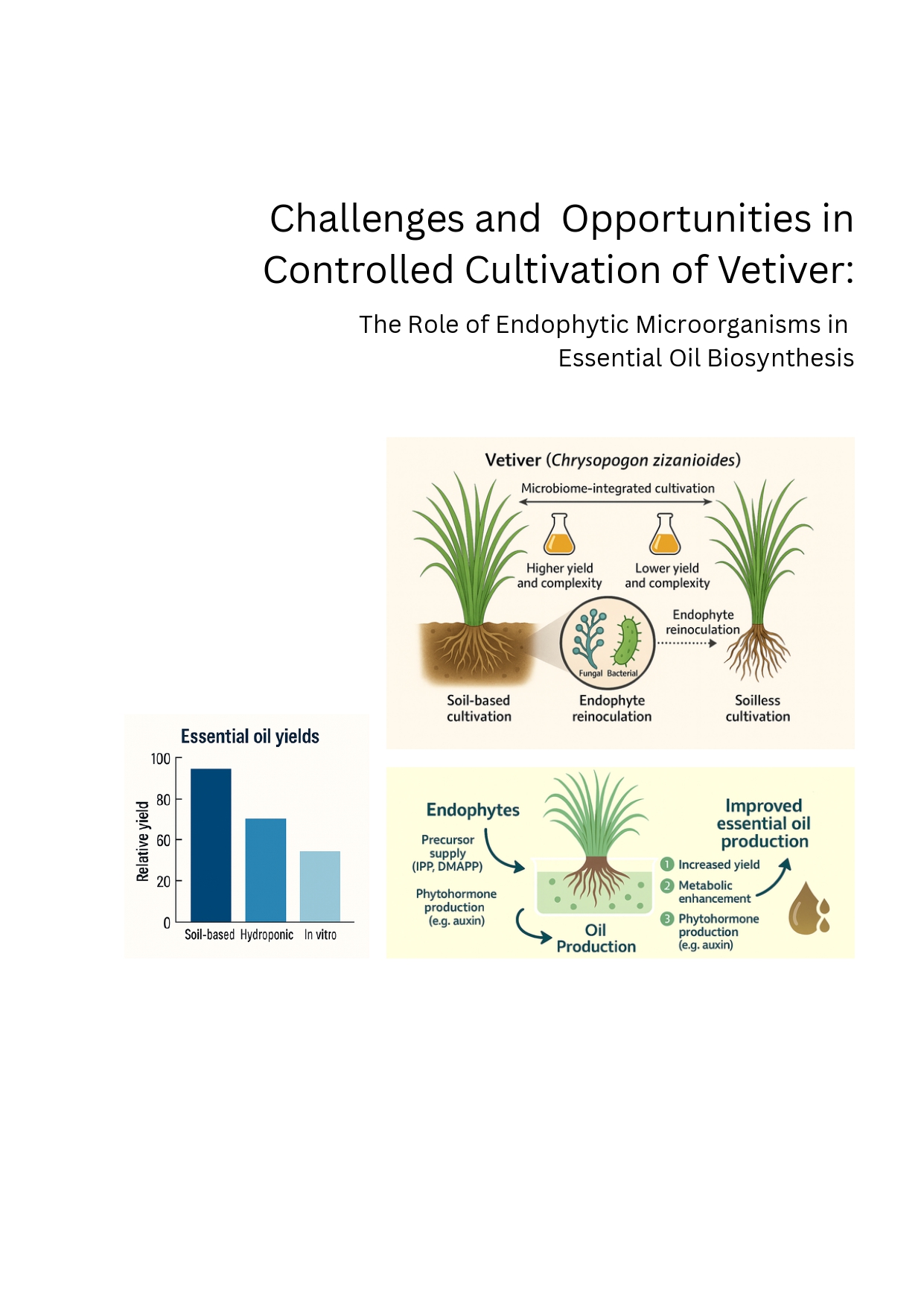
Vetiver (Chrysopogon zizanioides (L.) Roberty) is an aromatic grass widely applied in environmental engineering and as a source of essential oil for the fragrance industry. However, essential oil production under intensified cultivation systems remains constrained by inconsistent yield and chemical composition, particularly in soilless and controlled environments. This review evaluates the role of root‑associated endophytic microorganisms as a critical but under‑integrated biological factor influencing vetiver essential oil biosynthesis. A structured review of peer‑reviewed literature indexed in Scopus, Web of Science, and Google Scholar was conducted, focusing on cultivation systems, essential oil chemistry, plant–microbe interactions, and comparable mechanisms in other aromatic crops. Evidence was analyzed using a comparative, mechanism‑based framework emphasizing biochemical performance rather than descriptive system comparison. The reviewed studies indicate that soil‑based cultivation consistently produces higher root biomass, greater essential oil yields, and more chemically complex sesquiterpene profiles than in vitro, hydroponic, or aeroponic systems. In contrast, microbiome‑depleted plants exhibit reduced oil accumulation and reduced levels of oxygenated sesquiterpenes, while reinoculation with native root endophytes partially restores aroma characteristics. These findings indicate that limitations in soilless vetiver production stem from biological simplification and engineering constraints. This review proposes microbiome‑integrated cultivation and targeted endophyte reinoculation as feasible strategies to improve yield stability, chemical fidelity, and land‑use efficiency in controlled production systems.
Article Details

This work is licensed under a Creative Commons Attribution-NonCommercial-NoDerivatives 4.0 International License.
References
Lavania, U. C. Other Uses and Utilization of Vetiver: Vetiver Oil. In Proceedings of the Third International Conference on Vetiver; The Vetiver Network International: Guangzhou, China, 2003; pp 486–491.
Choudhary, A. Scenario of Vetiver Production and Marketing of Its Value-Added Products. Environ. Rep.: Int. J. 2024, 6(2), 31. https://doi.org/10.51470/ER.2024.6.2.31
Ciawi, Y.; Hidayati, A. M.; Kedaton, K. H.; Tonyes, S. G. Exploring the Mechanism of Vetiver System for Slope Reinforcement on Diverse Soil Types: A Review. J. Geosci. Eng. Environ. Technol. 2023, 8(2), 123–130. https://doi.org/10.25299/jgeet.2023.8.2.12705
Chomchalow, N. Vetiver Research, Development and Applications in Thailand. AU J. Technol. 2011, 14(4), 268–274.
Vetiver Farms Philippines. The Vetiver Network International; Quezon City, Philippines, 1990s.
Barcellos-Silva, I. G. C.; dos Santos, F. K. F.; Kharkwal, H.; Chander, S.; Kharkwal, A. C.; Awasthi, R.; Dhiman, N.; Sharma, B.; Kulkarni, G. T.; Larssen, H.; Veiga-Junior, V. F. Vetiver, Vetiveria zizanioides (L.) Nash: Biotechnology, Biorefineries, and the Production of Volatile Phytochemicals. Plants 2025, 14(10), 1435. https://doi.org/10.3390/plants14101435
Tesfa, G.; Terefe, A. Evaluating the Efficiency of Vetiver Grass (Vetiveria zizanioides) for Municipal Wastewater Treatment in Bahir Dar City, Ethiopia. Sci. Rep. 2025, 15, 38700. https://doi.org/10.1038/s41598-025-22576-0
Chahal, K. K.; Bhardwaj, U.; Kaushal, S.; Sandhu, A. K. Chemical Composition and Biological Properties of Chrysopogon zizanioides (L.) Roberty: A Review. Indian J. Nat. Prod. Resour. 2015, 6(4), 251–260.
David, A.; Farcaș, A.; Socaci, S. A. An Overview of the Chemical Composition and Bioactivities of Vetiveria zizanioides (L.) Nash Essential Oil. Trends Food Sci. Technol. 2023, 140, 104153. https://doi.org/10.1016/j.tifs.2023.104153
Thubthimthed, S.; Thisayakorn, K.; Rerk-am, U.; Tangstirapakdee, S.; Suntorntanasat, T. Vetiver Oil and Its Sedative Effect. In Proceedings of the Third International Conference on Vetiver; The Vetiver Network International: Guangzhou, China, 2003; pp 492–494.
Saiyudthong, S.; Pongmayteegul, S.; Marsden, C. A.; Phansuwan-Pujito, P. Anxiety-Like Behaviour and c-Fos Expression in Rats That Inhaled Vetiver Essential Oil. Nat. Prod. Res. 2015, 29(22), 2141–2144. https://doi.org/10.1080/14786419.2014.992342
Kandsi, F.; Abdnima, R.; Benkhaira, N.; Lafdil, F. Z.; Bnouham, M.; Yamani, B.; Mrabti, H. N.; Wondmie, G. F.; Bin Jardan, Y. A.; Ibenmoussa, S.; El Hachlafi, N. Integrated Assessment of Phytochemicals, Antilipase, Hemoglobin Antiglycation, Antihyperglycemic, Antifungal and Antibacterial Properties of Vetiveria zizanioides (L.) Nash. Int. J. Food Prop. 2024, 27, 1150–1166. https://doi.org/10.1080/10942912.2024.2387435
Adams, R. P.; Pandey, R. N.; Dafforn, M. R.; James, S. A. Vetiver DNA-Fingerprinted Cultivars: Effects of Environment on Growth, Oil Yields, and Composition. J. Essent. Oil Res. 2003, 15(5), 363–371. https://doi.org/10.1080/10412905.2003.9698612
Del Giudice, L.; Massardo, D. R.; Pontieri, P.; Bertea, C. M.; Mombello, D.; Carata, E.; Tredici, M. S.; Talà, A.; Mucciarelli, M.; Vigliotta, G.; Maffei, M. E.; Alifano, P. The Microbial Community of Vetiver Root and Its Involvement in Essential Oil Biogenesis. Environ. Microbiol. 2008, 10(11), 2824–2841. https://doi.org/10.1111/j.1462-2920.2008.01703.x
Alifano, P.; Del Giudice, L.; Talà, A.; De Stefano, M.; Maffei, M. E. Microbes at Work in Perfumery: The Microbial Community of Vetiver Root and Its Involvement in Essential Oil Biogenesis. Flavour Fragr. J. 2010, 25(2), 121–131. https://doi.org/10.1002/ffj.1978
Munakata, Y.; Gavira, C.; Genestier, J.; Bourgaud, F.; Hehn, A.; Slezack-Deschaumes, S. Composition and Functional Comparison of Vetiver Root Endophytic Microbiota Originating from Different Geographic Locations That Show Antagonistic Activity towards Fusarium graminearum. Microbiol. Res. 2021, 243, 126650. https://doi.org/10.1016/j.micres.2020.126650
Gavira, C.; Watteau, F.; Lainé, J.-M.; Bourgaud, F.; Legendre, L. Evaluation of Vetiver Volatile Compound Production under Aeroponic-Grown Conditions for the Perfume Industry. Molecules 2022, 27(6), 1942. https://doi.org/10.3390/molecules27061942
Prakasa Rao, E. V. S.; Akshata, S.; Gopinath, C. T.; Ravindra, N. S.; Hebbar, A.; Prasad, N. Vetiver Production for Small Farmers in India. In Sustainable Agriculture Reviews; Springer: Cham, Switzerland, 2015; Vol. 17, pp 337–355. https://doi.org/10.1007/978-3-319-16742-8_10
Dhawan, S. S.; Gupta, P.; Lal, R. K. Cultivation and Breeding of Commercial Perfumery Grass Vetiver. In Medicinal Plants: Sustainable Development and Biodiversity; Springer, 2021; pp 415–433. https://doi.org/10.1007/978-3-030-74779-4_14
Siripin, S. Microbiology Associated with the Vetiver Plant. In Proceedings of the Second International Conference on Vetiver; The Vetiver Network International: Phetchaburi, Thailand, 2000.
Hiranrat, W.; Hiranrat, A.; Supaphon, P. Antimicrobial Activity of Secondary Metabolites from Endophytic Fungus Fusarium sp. Isolated from Eichhornia crassipes Linn. ASEAN J. Sci. Technol. Rep. 2021, 24(3), e244115. https://doi.org/10.55164/ajstr.v24i3.244115
Nayan, M. A. N.; Sarizan, M. N.; Mackeen, M. M. M. Carbohydrate Interfaces in Plant–Fungal Interactions: A Scoping Review. ASEAN J. Sci. Technol. Rep. 2026, 29(5), e260552. https://doi.org/10.55164/ajstr.v29i5.262552
Thakur, S.; Piplani, M.; Goyal, P.; Bhateja, P. Metabolite Profiling and Morphological Screening of Cordyceps militaris Fruiting Body Extracts Using UHPLC-QTOF-IMS and GC-MS Analysis. ASEAN J. Sci. Technol. Rep. 2024, 27(6), e254493. https://doi.org/10.55164/ajstr.v27i6.254493
Kusari, S.; Hertweck, C.; Spiteller, M. Chemical Ecology of Endophytic Fungi: Origins of Secondary Metabolites. Chem. Biol. 2012, 19(7), 792–798. https://doi.org/10.1016/j.chembiol.2012.06.004
Ludwig-Müller, J. Plants and Endophytes: Equal Partners in Secondary Metabolite Production? Biotechnol. J. 2015, 10(4), 499–507. https://doi.org/10.1002/biot.201400499
Truong, P.; Van, T. T.; Pinners, E. The Vetiver System for Improving Water Quality; Technical Bulletin No. 2003/1; The Vetiver Network International: Bangkok, Thailand, 2008.
Food and Agriculture Organization of the United Nations. Vetiver Grass for Sustainable Land Management; FAO Land and Water Bulletin No. 5; FAO: Rome, Italy, 1998.
Pretty, J. Intensification for Redesigned and Sustainable Agricultural Systems. Science 2018, 362 (6417), eaav0294. https://doi.org/10.1126/science.aav0294
van der Heijden, M. G. A.; Hartmann, M. Networking in the Plant Microbiome. PLoS Biol. 2016, 14(2), e1002378. https://doi.org/10.1371/journal.pbio.1002378
Lugtenberg, B.; Kamilova, F. Plant-Growth-Promoting Rhizobacteria. Annu. Rev. Microbiol. 2009, 63, 541–556. https://doi.org/10.1146/annurev.micro.62.081307.162918
Compant, S.; Clément, C.; Sessitsch, A. Plant Growth-Promoting Bacteria in the Rhizo- and Endosphere. Soil Biol. Biochem. 2010, 42(5), 669–678. https://doi.org/10.1016/j.soilbio.2009.11.024
Santoyo, G.; Moreno-Hagelsieb, G.; Orozco-Mosqueda, M. C.; Glick, B. R. Plant Growth-Promoting Bacterial Endophytes. Microbiol. Res. 2016, 183, 92–99. https://doi.org/10.1016/j.micres.2015.11.008
Hardoim, P. R.; van Overbeek, L. S.; Berg, G.; Pirttilä, A. M.; Compant, S.; Campisano, A.; Döring, M.; Sessitsch, A. The Hidden World within Plants: Ecological and Evolutionary Considerations for Defining the Functioning of Microbial Endophytes. Microbiol. Mol. Biol. Rev. 2015, 79(3), 293–320. https://doi.org/10.1128/MMBR.00050-14
Roongtanakiat, N. Vetiver in Thailand: General Aspects and Basic Studies; Thailand, 2006.
Berg, G.; Rybakova, D.; Grube, M.; Köberl, M. The Plant Microbiome: Implications for Experimental Botany. J. Exp. Bot. 2016, 67(4), 995–1002. https://doi.org/10.1093/jxb/erv466
Cheng, R.; Yang, S.; Wang, D.; Qin, F.; Wang, S.; Meng, S. Advances in the Biosynthesis of Plant Terpenoids: Models, Mechanisms, and Applications. Plants 2025, 14(10), 1428. https://doi.org/10.3390/plants14101428
Pichersky, E.; Raguso, R. A. Why Do Plants Produce So Many Terpenoid Compounds? New Phytol. 2018, 220(3), 692–702. https://doi.org/10.1111/nph.14178
Food and Agriculture Organization of the United Nations. Agricultural Transformation in Asia; FAO: Rome, Italy, 2021.
Asian Development Bank. Food Security in Asia and the Pacific; Asian Development Bank: Manila, Philippines, 2013.
Berg, G.; Raaijmakers, J. M. Saving Seed Microbiomes. ISME J. 2018, 12(5), 1167–1170. https://doi.org/10.1038/s41396-017-0028-2
