
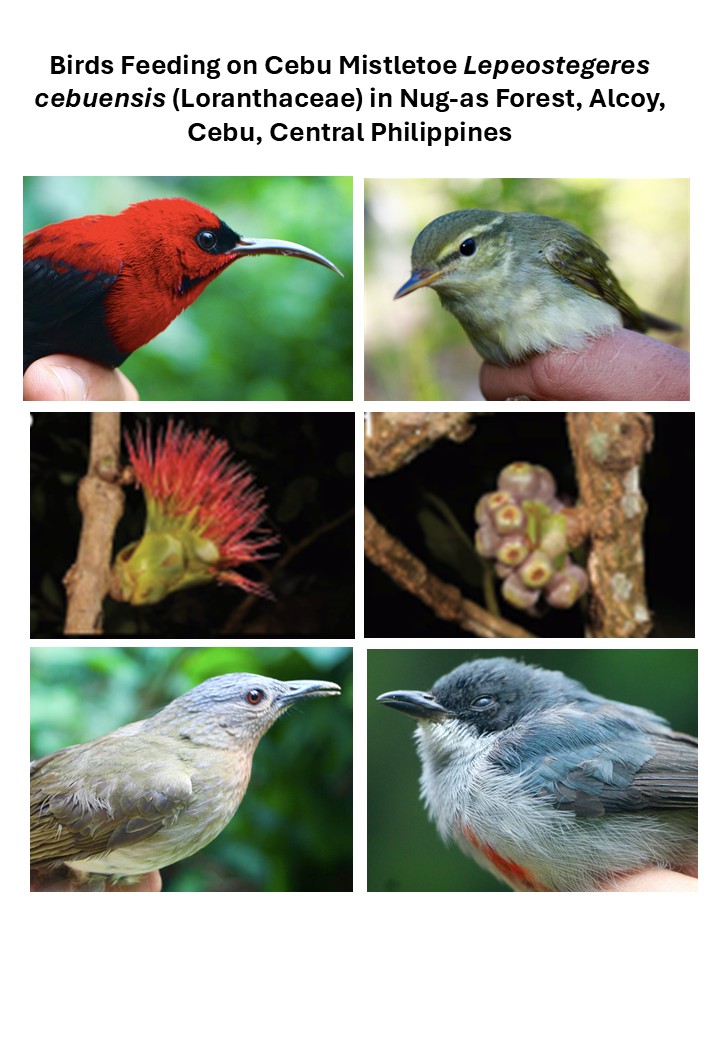
Birds Feeding on Cebu Mistletoe Lepeostegeres cebuensis (Loranthaceae) in Nug-as Forest, Alcoy, Cebu, Central Philippines
Article Sidebar
Main Article Content
Abstract
We studied the birds visiting and feeding on Cebu mistletoe (Lepeostegeres cebuensis) to understand the dynamics between the birds and the mistletoe. All birds feeding on and visiting the mistletoe from 6:00 AM to 6:00 PM were recorded using the modified listing and timed species count method over 108 observer-hours, divided into three replications. Eleven species in 7 families of birds were recorded, including 7 species feeding on the mistletoe and 4 plain visitors. Aethopyga bella, Tweeddale 1877, A. magnifica, Sharpe, 1876, Dicaeum pygmaeum, Kittlitz 1833, Zosterops everetti, Tweeddale 1878, and Parus elegans, Lesson 1831, fed only on nectar, while Cinnyris jugularis, Linnaeus 1766, and D. australe, Hermann 1783, fed on both nectar and fruits. Dicaeum australe was observed as the main agent of dispersal of L. cebuensis by removing ripe fruit, carrying it in flight, and rubbing its bill on a tree branch where the seed sticks. Significant differences were detected in the numbers of species and individuals visiting, as well as in the numbers of individuals feeding on nectar and fruits at different times of day. Birds prefer to feed in the morning, with sunbirds (C. jugularis, A. bella, and A. magnifica) generally feeding on nectar of flowers and the flowerpecker (D. australe) generally feeding on fruits.
Article Details

This work is licensed under a Creative Commons Attribution-NonCommercial-NoDerivatives 4.0 International License.
References
Lázaro González, A. Mistletoes as Keystone Species in Pine Woodlands: Exploring the Ecological Consequences of a New Interaction Cocktail; Ph.D. Dissertation, Universidad de Granada: Granada, Spain, 2020. http://hdl.handle.net/10481/63354
Zuria, I.; Castellanos, I.; Gates, J. E. The Influence of Mistletoes on Birds in an Agricultural Landscape of Central Mexico. Acta Oecol. 2014, 61, 51–56. https://doi.org/10.1016/j.actao.2014.10.004
Watson, D. M.; Herring, M. M. Mistletoe as a Keystone Resource: An Experimental Test. Proc. R. Soc. B. 2012, 279(1743), 3853–3860. https://doi.org/10.1098/rspb.2012.0856
Aguirre-Hernández, M. M.; Galán-Larrea, R.; García-Estrada, C.; De Labra-Hernández, M. Á. Interactions of Mistletoe with Its Hosts and Potential Seed-Dispersing Birds in a Peri-Urban Area of Central Pacific, Mexico. J. Urban Ecol. 2026, 12(1), juag004. https://doi.org/10.1093/jue/juag004
Fernández, V. P.; Fontúrbel, F. E. Temporal Variation of Daily Activity on Pollinator and Frugivorous Birds Simultaneously Interacting with a Specialized Mistletoe. Community Ecol. 2021, 22(2), 217–223. https://doi.org/10.1007/s42974-021-00050-x
Barea, L. P.; Watson, D. M. Temporal Variation in Food Resources Determines Onset of Breeding in an Australian Mistletoe Specialist. Emu 2007, 107(3), 203–209. https://doi.org/10.1071/MU07003
Watson, D. M. On Tropical Mistletoes: Tractable Models for Evolutionary Ecology, Ecosystem Function, and Phytochemistry. Botany 2017, 95(3), 253–261. https://doi.org/10.1139/cjb-2016-0232
Caraballo-Ortiz, M. A.; Gonzalez-Castro, A.; Yang, S.; dePamphilis, C. W.; Carlo, T. A. Dissecting the Contributions of Dispersal and Host Properties to the Local Abundance of a Tropical Mistletoe. J. Ecol. 2017, 105(6), 1661–1672. https://doi.org/10.1111/1365-2745.12795
Mellado, A.; Zamora, R. Generalist Birds Govern the Seed Dispersal of a Parasitic Plant with Strong Recruitment Constraints. Oecologia 2014, 176, 139–147. https://doi.org/10.1007/s00442-014-3013-8
Rist, L.; Uma Shaanker, R.; Ghazoul, J. The Spatial Distribution of Mistletoe in a Southern Indian Tropical Forest at Multiple Scales. Biotropica 2011, 43(1), 50–57. https://doi.org/10.1111/j.1744-7429.2010.00643.x
Green, A. K.; Ward, D.; Griffiths, M. E. Directed Dispersal of Mistletoe (Plicosepalus acaciae) by Yellow-Vented Bulbuls (Pycnonotus xanthopygos). J. Ornithol. 2009, 150, 167–173. https://doi.org/10.1007/s10336-008-0331-9
Lara, C.; Pérez-Flores, G. A.; Ornelas, J. F. Provenance, Guts, and Fate: Field and Experimental Evidence in a Host-Mistletoe-Bird System. Écoscience 2009, 16(3), 399–407. https://doi.org/10.2980/16-3-3235
Roxburgh, L.; Nicolson, S. W. Differential Dispersal and Survival of an African Mistletoe: Does Host Size Matter? Plant Ecol. 2008, 195, 21–31. https://doi.org/10.1007/s11258-007-9295-8
Wang, C.; Liu, R.; Shi, J.; Martinez del Rio, C. Spatiotemporal Mutualistic Model of Mistletoes and Birds. J. Math. Biol. 2013, 67(6), 1369–1392. https://doi.org/10.1007/s00285-013-0664-8
Hood, K. W.; Fabbro, F.; Karp, D. S. Mistletoe-Bearing Trees Positively Influence Bird Foraging Patterns across Urban and Natural Environments. Urban Ecosyst. 2025, 28, Article 112. https://doi.org/10.1007/s11252-025-01345-7
Pelser, P. B.; Nickrent, D. L.; Reintar, A. R. T.; Barcelona, J. F. Lepeostegeres cebuensis (Loranthaceae), a New Mistletoe Species from Cebu, Philippines. Phytotaxa 2016, 266(1), 48–52. https://doi.org/10.11646/phytotaxa.266.1.8
Malaon, M. M.; Fernando, E. S. Micropropagation of Philippine Endemic Orchids for Conservation. Philipp. J. Sci. 2010, 139(2), 161–169.
Mathiasen, R. L.; Nickrent, D. L.; Shaw, D. C.; Watson, D. M. Mistletoes: Pathology, Systematics, Ecology, and Management. Plant Dis. 2008, 92(7), 988–1006. https://doi.org/10.1094/PDIS-92-7-0988.
Nickrent, D. L.; Malécot, V.; Vidal-Russell, R.; Der, J. P. A Revised Classification of Santalales. Taxon 2010, 59(2), 538–558. https://doi.org/10.1002/tax.592019
Rosete, Y. M.; Rodríguez Flores, Z. E.; Fernández Pavía, Y. L. Trends in Endemic Plant Research under Climate Change Scenarios: A Bibliometric Analysis (1990–2025). Theor. Appl. Climatol. 2025, 156, 329. https://doi.org/10.1007/s00704-025-05553-5
Jakosalem, P. G. C. Breeding Season Habitat Use of Philippine Hawk Owl Ninox spilonota in Cebu Island, Philippines; Unpublished Master Thesis, University of East Anglia: UK, 2011.
Paguntalan, L. M. J.; Lepitin-Tabao, M.; Jakosalem, P. G. C.; Orolfo, A. O.; Rica, A. N. State of Cebu’s Biodiversity; Philippines Biodiversity Conservation Foundation, Inc.: Bacolod City, Philippines, 2015.
Mallari, N. A. D.; Tabaranza, B. R., Jr.; Crosby, M. J. Key Conservation Sites in the Philippines: A Haribon Foundation and BirdLife International Directory of Important Bird Areas; Bookmark, Inc.: Makati City, Philippines, 2001.
BirdLife International. Important Bird Areas Factsheet: Nug-as and Mt. Lantoy; BirdLife International: 2026.
Paguntalan, L. J.; Reintar, A. R. T.; Jakosalem, G. C.; Peña, G.; Villarojo, A. Population Density and Distribution of the Endangered Black Shama Kittacincla cebuensis. Bird Conserv. Int. 2023, 33, e33. https://doi.org/10.1017/S095927092200034X
Libosada, C. M., Jr. Bird-Watching Philippines, Volume 1; Philippine Department of Tourism; Recreational Outdoor Exchange (ROX); Wild Bird Club of the Philippines: Philippines, 2008.
Gibbons, D. W.; Gregory, R. D. Birds. In Ecological Census Techniques: A Handbook, 2nd ed.; Sutherland, W. J., Ed.; Cambridge University Press: Cambridge, UK, 2006; pp 308–345. https://doi.org/10.1017/CBO9780511790508.010
Kennedy, R. S.; Gonzales, P. C.; Dickinson, E. C.; Miranda, H. C., Jr.; Fisher, T. H. A Guide to the Birds of the Philippines; Oxford University Press: New York, 2000.
Watson, D. M. The Relative Contribution of Specialists and Generalists to Mistletoe Dispersal: Insights from a Neotropical Rain Forest. Biotropica 2013, 45(2), 195–202. https://doi.org/10.1111/j.1744-7429.2012.00905.x
Aukema, J. E.; Martínez del Rio, C. Where Does a Fruit-Eating Bird Deposit Mistletoe Seeds? Seed Deposition Patterns and an Experiment. Ecology 2002, 83(12), 3489–3496. https://doi.org/10.1890/0012-9658(2002)083[3489:WDAFEB]2.0.CO;2
López-de Buen, L.; Ornelas, J. F. Frugivorous Birds, Host Selection, and the Mistletoe Psittacanthus schiedeanus in Central Veracruz, Mexico. J. Trop. Ecol. 1999, 15(3), 329–340. https://doi.org/10.1017/S0266467499000851
Lerdsuwan, S.; Nalinanon, W.; Pisuttharachai, D. The Effect of Acacia mangium Leaf Feed on Apparent Metabolizable Energy, Growth Performance, and Carcass Composition of Broiler Chickens. ASEAN J. Sci. Technol. Rep. 2022, 25(4). https://doi.org/10.55164/ajstr.v25i4.247587
Limpangog, R. C.; Gacutan, M. D.; Come, W. D. Formulation of a Ketogenic Diet for Starter-Finisher and Its Effect on the Growth Performance and Carcass Quality of Broiler Chicken (Gallus gallus domesticus). ASEAN J. Sci. Technol. Rep. 2025, 28(4). https://doi.org/10.55164/ajstr.v28i4.257750
Khwannimit, P.; Maitreejorn, P. The Effect of Developed Blenderized Diet Formula on Physical Features. ASEAN J. Sci. Technol. Rep. 2026, 29(5). https://doi.org/10.55164/ajstr.v29i5.256663
