
Computational Fluid Dynamics-Based Characterization of Heat Transfer and Airflow in an Indirect Solar Fish Dryer Under Tropical Conditions
Article Sidebar
Main Article Content
Abstract
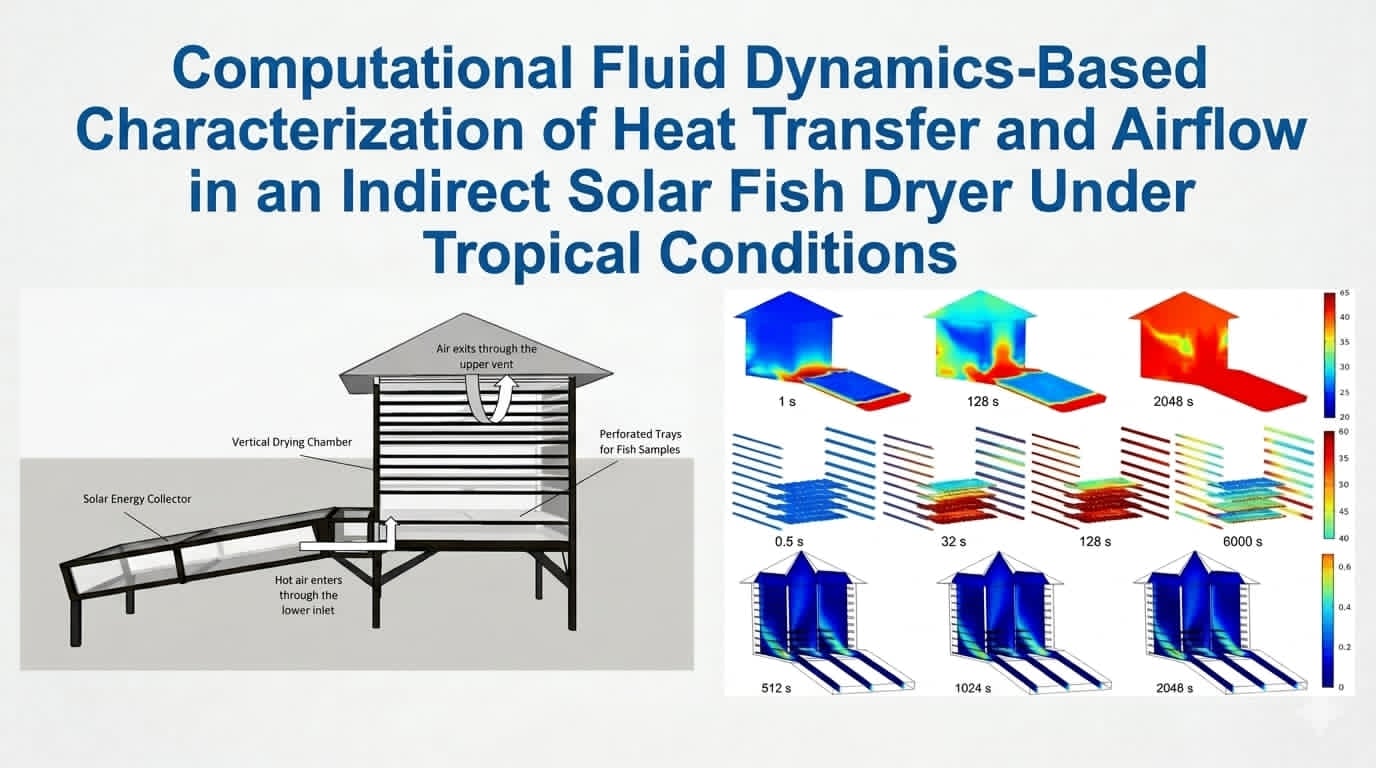
Indirect solar drying is a widely adopted fish preservation technique in tropical regions, valued for its low energy requirement and capacity to enhance product quality. However, non-uniform airflow and temperature distribution within drying chambers remain persistent design challenges that compromise drying efficiency and product consistency. This study investigated the airflow characteristics and convective heat transfer performance of an indirect solar fish dryer through computational fluid dynamics (CFD) simulation and experimental validation. A three-dimensional CFD model was developed to simulate temperature distribution and airflow patterns under forced convection, with an inlet air velocity of 1.2 m·s⁻¹ and an inlet air temperature of 60 °C. Experimental air temperatures were recorded inside the drying chamber during actual drying operations and compared with simulated values using linear regression and root-mean-square error (RMSE). The regression analysis yielded a strong linear relationship between simulated and experimental temperatures (R² = 0.9413), with an RMSE of 3.41 °C, indicating reasonable agreement in absolute temperature prediction. These results confirm that the CFD model accurately represents the thermal behavior and convective heat transfer characteristics of the dryer. The validated CFD framework provides a reliable, cost-effective tool for evaluating and optimizing the design and operational performance of indirect solar fish dryers under tropical conditions, thereby reducing reliance on iterative physical prototyping.
Article Details

This work is licensed under a Creative Commons Attribution-NonCommercial-NoDerivatives 4.0 International License.
References
Mehdipour, R.; Ghaffari, A. Solar dryer performance simulation: Experimental and numerical study. J. Food Process Eng. 2021, 44(10), e13875. https://doi.org/10.1111/jfpe.13875
Ennissioui, J.; Benghoulam, E.; El Rhafiki, T.; Fertahi, S. E. D. Three-dimensional computational fluid dynamics modeling using the RANS approach of indirect-type solar dryers based on smooth and corrugated absorber plates. ASME J. Therm. Sci. Eng. Appl. 2023, 15(12), 121008. https://doi.org/10.1115/1.4063295
Aouta, A. C. The effect of geometric adjustments in an indirect forced convection solar tunnel dryer: A study based on CFD simulations and experimental investigations. Research 2025. https://doi.org/10.34133/research.0606
Lephon, W. Quality of cocoons dried by solar and electrical drying. ASEAN J. Sci. Tech. Report. 2024, 27(3), 149–157.
Noh, A. M.; Mat, S.; Ruslan, M. H. CFD simulation of temperature and air flow distribution inside industrial scale solar dryer. J. Adv. Res. Fluid Mech. Therm. Sci. 2018, 45(1), 156–164.
Carrera Escobedo, J. L.; Ortiz Rivera, A.; Guzman Valdivia, C. H.; Garcia Ruiz, M. A.; Desiga Orenday, O. CFD analysis for improving temperature distribution in a chili dryer. Therm. Sci. 2018, 22(1B), 537–548. https://doi.org/10.2298/TSCI160531196C
Villagrán, E. A.; Henao-Rojas, J. C.; Franco, G. Thermo-environmental performance of four different shapes of solar greenhouse dryer with free convection operating principle and no load on product. Fluids 2021, 6(5), 183. https://doi.org/10.3390/fluids6050183
Srirugsa, T.; Kaewpoung, S.; Su-hren, W.; Panwanitdumrong, K.; Chuchit, T. Improving drying efficiency for red chili peppers using ventilated solar technology. ASEAN J. Sci. Tech. Report. 2026, 29(4), e261032. https://doi.org/10.55164/ajstr.v29i4.261032
Gunathilaka, M. D. T. D.; Narayana, M.; Witharana, S. Experimental and numerical analysis of an indirect forced convection solar dryer. Renewable Energy 2024, 222, 119933. https://doi.org/10.1016/j.renene.2024.119933
Mellalou, A.; Riad, W.; Hnawi, S. K.; Tchenka, A.; Bacaoui, A.; Outzourhit, A. Experimental and CFD investigation of a modified uneven-span greenhouse solar dryer in no-load conditions under natural convection mode. Int. J. Photoenergy 2021, 2021, 9918166. https://doi.org/10.1155/2021/9918166
Chavan, A.; Vitankar, V.; Shinde, N.; Thorat, B. CFD simulation of solar grain dryer. Drying Technol. 2021, 39(8), 1101–1113. https://doi.org/10.1080/07373937.2020.1863422
Iranmanesh, M.; Akhijahani, H. S.; Jahromi, M. S. B. CFD modeling and evaluation the performance of a solar cabinet dryer equipped with evacuated tube solar collector and thermal storage system. Renewable Energy 2020, 145, 914–930. https://doi.org/10.1016/j.renene.2019.06.038
Boonthum, E.; Somsila, P.; Sonsaree, S.; Teeboonma, U. Enhanced thermal efficiency of solar air heaters using porous material: an experimental approach. ASEAN J. Sci. Tech. Report. 2026, 29(1), e259025. https://doi.org/10.55164/ajstr.v29i1.259025
Benhamza, A.; Boubekri, A.; Atia, A.; Hadef, A.; Benmoussa, H. Drying uniformity analysis of an indirect solar dryer based on computational fluid dynamics and image processing. Sustainable Energy Technol. Assess. 2021, 47, 101466. https://doi.org/10.1016/j.seta.2021.101466
Angula, J. P.; Inambao, F. Modelling and CFD simulation of temperature and airflow distribution inside a forced convection mixed-mode solar grain dryer with a preheater. Int. J. Eng. Res. Technol. 2021, 10(2), 476–487. https://doi.org/10.17577/IJERTV10IS020241
Perez, J. H.; Tanaka, F.; Tanaka, F.; Hamanaka, D.; Uchino, T. Three-dimensional numerical modeling of convective heat transfer during shallow-depth forced-air drying of brown rice grains. Drying Technol. 2015, 33(11), 1350–1359. https://doi.org/10.1080/07373937.2015.1026440
Vivekanandan, M.; Periasamy, K.; Babu, C. D.; Selvakumar, G.; Arivazhagan, R. Experimental and CFD investigation of six shapes of solar greenhouse dryer in no load conditions to identify the ideal shape of dryer. Mater. Today: Proc. 2021, 37(2), 1409–1416. https://doi.org/10.1016/j.matpr.2020.07.062
Salhi, M.; Chaatouf, D.; Raillani, B.; Bria, A.; Amraqui, S.; Mezrhab, A. Numerical investigation of an indirect solar dryer equipped with two solar air collectors using computational fluid dynamics. J. Stored Prod. Res. 2023, 102, 102189. https://doi.org/10.1016/j.jspr.2023.102189
Singh, R.; Salhan, P.; Kumar, A. CFD modelling and simulation of an indirect forced convection solar dryer. IOP Conf. Ser.: Earth Environ. Sci. 2021, 795, 012003. https://doi.org/10.1088/1755-1315/795/1/012003
Chaudhari, V. D.; Kulkarni, G. N.; Sewatkar, C. M. Computational fluid dynamics analysis of cabinet-type solar dryer. J. Food Process Eng. 2021, 44(8), e13756. https://doi.org/10.1111/jfpe.13756
Vasquez, J.; Reyes, A.; Pailahueque, N. 3D computational fluid dynamics analysis of a convective drying chamber. Processes 2022, 10(12), 2721. https://doi.org/10.3390/pr10122721
Somasiri, W. L. W.; Amarasinghe, A. D. U. S.; Gunathilaka, M. D. T. D. Simulation of mixed-mode solar dryer with vertical air distribution channel. Heliyon 2022, 8(12), e12232. https://doi.org/10.1016/j.heliyon.2022.e12232
Machi, M. H.; Al-Neama, M. A.; Buzás, J.; Farkas, I. Energy-based performance analysis of a double pass solar air collector integrated to triangular shaped fins. Int. J. Energy Environ. Eng. 2022, 13(1), 243–256. https://doi.org/10.1007/s40095-021-00422-z
Sellam, A.; Fezai, S.; Nciri, R.; Lajnef, M.; Ben Ali, R.; Mouelhi, C.; Ben Ismail, C. Performance evaluation of a greenhouse solar dryer: Energy-exergy analysis, CFD simulation and eco-environmental assessment. Renewable Energy 2023, 218, 119393. https://doi.org/10.1016/j.renene.2023.119393
Murali, S.; Alfiya, P. V.; Delfiya, D. A.; Samuel, M. P.; Ninan, G. Solar hybrid drying system for marine applications—a comprehensive review. J. Aquat. Food Prod. Technol. 2023, 32(1), 38–58. https://doi.org/10.1080/10498850.2023.2167853
Pham, N. D.; Khan, M. I. H.; Karim, M. A. A mathematical model for predicting the transport process and quality changes during intermittent microwave convective drying. Food Chem. 2020, 325, 126932. https://doi.org/10.1016/j.foodchem.2020.126932
Korbuakaew, K.; Phoosomma, P. The approach for boosting the drying chamber’s temperature by pulse copper pipes to conduct heat. ASEAN J. Sci. Tech. Report. 2025, 28(3), e254983. https://doi.org/10.55164/ajstr.v28i3.254983
