
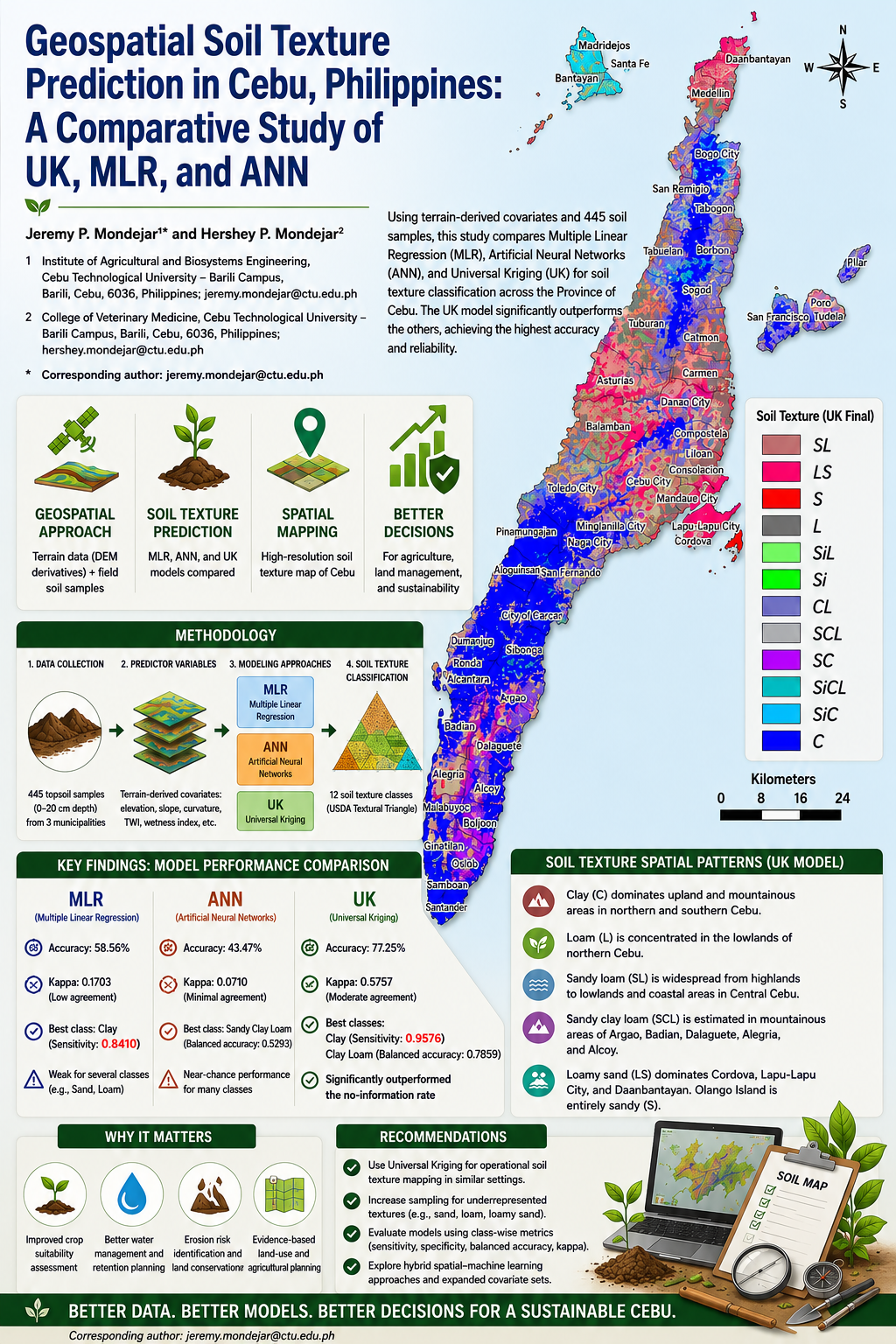
Geospatial Soil Texture Prediction in Cebu, Philippines: A Comparative Study of UK, MLR, and ANN
Article Sidebar
Main Article Content
Abstract
Many soil maps in the Philippines are outdated, lacking the detail required for effective land management and agricultural planning. Traditional survey methods, still widely used, often fail to capture the spatial variability of soil properties, which is critical given the country’s diverse topography and land-use patterns. This study compares three models—Multiple Linear Regression (MLR), Artificial Neural Networks (ANN), and Universal Kriging (UK) for soil texture classification, using open-source software tools: R and SAGA GIS. Results indicate that the UK model significantly outperforms both MLR and ANN, with the highest overall accuracy of 77.25%, a strong kappa value (0.5757), and a statistically significant p-value (5.937e-10). The UK model excels in class-wise performance, showing superior sensitivity for key classes such as Class 1 (0.9576) and Class 6 (0.6719), while maintaining high specificity across all classes. Its balanced accuracy, as high as 0.8949 for Class 1, reflects its ability to handle both major and minority classes effectively. In contrast, MLR and ANN show lower sensitivity, often failing to classify minority classes (0 sensitivity in multiple cases) and achieving poorer balanced accuracy overall. The findings highlight the UK as the most reliable classifier among the three, excelling in both overall and class-specific performance. Future research should focus on further optimizing the UK model and testing its applicability to other datasets and classification tasks. Additionally, expanding the dataset with more samples from underrepresented classes could further improve model accuracy.
Article Details

This work is licensed under a Creative Commons Attribution-NonCommercial-NoDerivatives 4.0 International License.
References
Mondejar, J. P.; Tongco, A. F. Estimating Topsoil Texture Fractions by Digital Soil Mapping - a Response to the Long Outdated Soil Map in the Philippines. Sustain. Environ. Res. 2019, 29(1), 31. https://doi.org/10.1186/s42834-019-0032-5
Azizi, K.; Garosi, Y.; Ayoubi, S.; Tajik, S. Integration of Sentinel-1/2 and Topographic Attributes to Predict the Spatial Distribution of Soil Texture Fractions in Some Agricultural Soils of Western Iran. Soil Tillage Res. 2023, 229, 105681. https://doi.org/10.1016/j.still.2023.105681
Khammao, P.; Rattanapichai, W.; Pitakdantham, R.; Kasemsap, P.; Sajjaphan, K. The Potential of Near-infrared Spectroscopy to Predict Soil Nutrient Contents Based on Soil Color. ASEAN J. Sci. Technol. Rep. 2024, 27(5), e252637. https://doi.org/10.55164/ajstr.v27i5.252637
Forkuor, G.; Hounkpatin, O. K. L.; Welp, G.; Thiel, M. High Resolution Mapping of Soil Properties Using Remote Sensing Variables in South-Western Burkina Faso: A Comparison of Machine Learning and Multiple Linear Regression Models. PLOS ONE 2017, 12(1), e0170478. https://doi.org/10.1371/journal.pone.0170478
Mallah, S.; Delsouz Khaki, B.; Davatgar, N.; Poppiel, R. R.; Demattê, J. A. M. Digital Mapping of Topsoil Texture Classes Using a Hybridized Classical Statistics–Artificial Neural Networks Approach and Relief Data. AgriEngineering 2023, 5(1), 40–64. https://doi.org/10.3390/agriengineering5010004
Sabbaghi, M. A.; Esfandiari, M.; Eftekhari, K.; Torkashvand, A. M. Predictive Map of Soil Texture Classes Using Decision Tree Model and Neural Network with Features of Geomorphology Level. Can. J. Soil Sci. 2024, 104(1), 72–90. https://doi.org/10.1139/cjss-2023-0011
Liu, J.; Yang, K.; Tariq, A.; Lu, L.; Soufan, W.; El Sabagh, A. Interaction of Climate, Topography and Soil Properties with Cropland and Cropping Pattern Using Remote Sensing Data and Machine Learning Methods. Egypt. J. Remote Sens. Space Sci. 2023, 26(3), 415–426. https://doi.org/10.1016/j.ejrs.2023.05.005
Wang, Y.; Yuan, F.; Cammarano, D.; Liu, X.; Tian, Y.; Zhu, Y.; Cao, W.; Cao, Q. Integrating Machine Learning with Spatial Analysis for Enhanced Soil Interpolation: Balancing Accuracy and Visualization. Smart Agric. Technol. 2025, 11, 101032. https://doi.org/10.1016/j.atech.2025.101032
Dornik, A.; Cheţan, M. A.; Crişan, T. E.; Heciko, R.; Gora, A.; Drăguţ, L.; Panagos, P. Geospatial Evaluation of the Agricultural Suitability and Land Use Compatibility in Europe’s Temperate Continental Climate Region. Int. Soil Water Conserv. Res. 2024, 12(4), 908–919. https://doi.org/10.1016/j.iswcr.2024.01.002
Sperandio, H. V.; de Morais, M. S.; de Jesus França, L. C.; Mucida, D. P.; Santana, R. C.; da Silva, R. S.; Rodrigues, C. R.; de Faria, B. L.; de Azevedo, M. L.; Gorgens, E. B. Land Suitability Modeling Integrating Geospatial Data and Artificial Intelligence. Agric. Syst. 2025, 223, 104197. https://doi.org/10.1016/j.agsy.2024.104197
Taghizadeh-Mehrjardi, R.; Nabiollahi, K.; Rasoli, L.; Kerry, R.; Scholten, T. Land Suitability Assessment and Agricultural Production Sustainability Using Machine Learning Models. Agronomy 2020, 10(4), 573. https://doi.org/10.3390/agronomy10040573
Tongkaemkaew, U.; Commons, M.; Verhofste, R.; Phooi, C. L.; Wonglom, P.; Bua-Khwan, B. Regeneration of Soil Fertility in Relationship with the Diversification of Rubber Agroforestry Systems. ASEAN J. Sci. Technol. Rep. 2025, 28(2), e255018. https://doi.org/10.55164/ajstr.v28i2.255018.
Bhullar, A.; Nadeem, K.; Ali, R. A. Simultaneous Multi-Crop Land Suitability Prediction from Remote Sensing Data Using Semi-Supervised Learning. Sci. Rep. 2023, 13(1), 6823. https://doi.org/10.1038/s41598-023-33840-6
Philippine Statistics Authority (PSA). 2020 Census of Population and Housing: Cebu Province; PSA: Manila, Philippines, 2022. Available online: https://psa.gov.ph (accessed May 2026).
Lumongsod, R. M. G.; Ramos, N. T.; Dimalanta, C. B. Mapping the Karstification Potential of Central Cebu, Philippines Using GIS. Environ. Earth Sci. 2022, 81(18), 449. https://doi.org/10.1007/s12665-022-10572-w
Cañete, S. F.; Schaap, L. L.; Andales, R.; Otadoy, R. E. S.; Blanco, A. C.; Babaan, J.; Cruz, C. Analysis of the Impact of Vegetation Distribution, Urbanization, and Solar Radiation on the Seasonal Variation of the Urban Heat Island Effect in Cebu City Using Landsat and Global Horizontal Irradiance Data. Int. Arch. Photogramm. Remote Sens. Spat. Inf. Sci. 2019, XLII-4-W19, 93–100. https://doi.org/10.5194/isprs-archives-XLII-4-W19-93-2019
Edillo, F.; Ymbong, R. R.; Navarro, A. O.; Cabahug, M. M.; Saavedra, K. Detecting the Impacts of Humidity, Rainfall, Temperature, and Season on Chikungunya, Dengue and Zika Viruses in Aedes Albopictus Mosquitoes from Selected Sites in Cebu City, Philippines. Virol. J. 2024, 21(1), 42. https://doi.org/10.1186/s12985-024-02310-4
Galang, W. N.; Tabañag, I. D.; Loretero, M. RS-GIS Approach on Biomass Energy Potential Estimation of Sugarcane Residues in Medellin, Cebu. Appl. Environ. Res. 2022, 44(1). https://doi.org/10.35762/AER.2021.44.1.6
Lillo, E. P.; Malaki, A. B.; Alcazar, S. M. T.; Rosales, R.; Redoblado, B. R.; Diaz, J. L. B.; Pantinople, E. M.; Buot, I. E. J. Inventory of Native and Mother Trees in Key Biodiversity Areas of Cebu Island, Philippines for Species Selection in Local Reforestation Programs. Biodiversitas J. Biol. Divers. 2021, 22(11). https://doi.org/10.13057/biodiv/d221105
Kasraei, B.; Schmidt, M. G.; Zhang, J.; Bulmer, C. E.; Filatow, D. S.; Arbor, A.; Pennell, T.; Heung, B. A Framework for Optimizing Environmental Covariates to Support Model Interpretability in Digital Soil Mapping. Geoderma 2024, 445, 116873. https://doi.org/10.1016/j.geoderma.2024.116873
Liu, F.; Zhang, G.-L.; Song, X.; Li, D.; Zhao, Y.; Yang, J.; Wu, H.; Yang, F. High-Resolution and Three-Dimensional Mapping of Soil Texture of China. Geoderma 2020, 361, 114061. https://doi.org/10.1016/j.geoderma.2019.114061
Mousavi, A.; Karimi, A.; Alavipanah, S. K.; Shahabi, M.; Safari, T. Spatial Modelling Soil Texture Variability in Northeastern Iran: Integrating Remote Sensing and Machine Learning. Earth Surf. Process. Landf. 2025, 50(8), e70110. https://doi.org/10.1002/esp.70110
Khaledian, Y.; Miller, B. A. Selecting Appropriate Machine Learning Methods for Digital Soil Mapping. Appl. Math. Model. 2020, 81, 401–418. https://doi.org/10.1016/j.apm.2019.12.016
Zhang, M.; Shi, W.; Xu, Z. Systematic Comparison of Five Machine-Learning Models in Classification and Interpolation of Soil Particle Size Fractions Using Different Transformed Data. Hydrol. Earth Syst. Sci. 2020, 24(5), 2505–2526. https://doi.org/10.5194/hess-24-2505-2020
Ali, P. J. M. Investigating the Impact of Min-Max Data Normalization on the Regression Performance of K-Nearest Neighbor with Different Similarity Measurements. ARO- Sci. J. Koya Univ. 2022, 10(1), 85–91. https://doi.org/10.14500/aro.10955
Liu, J.; Ye, Y.; Wang, C.; Chen, S.; Jiang, Y.; Guo, X.; Jiang, Y. Machine Learning-Based Comparative Analysis on Direct and Indirect Mapping of Soil Texture Types Through Soil Particle Size Fractions Using Multi-Source Remote Sensing. Agriculture 2025, 15(13), 1395. https://doi.org/10.3390/agriculture15131395
Mirzaeitalarposhti, R.; Shafizadeh-Moghadam, H.; Taghizadeh-Mehrjardi, R.; Demyan, M. S. Digital Soil Texture Mapping and Spatial Transferability of Machine Learning Models Using Sentinel-1, Sentinel-2, and Terrain-Derived Covariates. Remote Sens. 2022, 14(23), 5909. https://doi.org/10.3390/rs14235909
Chagas, C. da S.; de Carvalho Junior, W.; Bhering, S. B.; Calderano Filho, B. Spatial Prediction of Soil Surface Texture in a Semiarid Region Using Random Forest and Multiple Linear Regressions. CATENA 2016, 139, 232–240. https://doi.org/10.1016/j.catena.2016.01.001
Taghizadeh-mehrjardi, R.; Toomanian, N.; Khavaninzadeh, A. R.; Jafari, A.; Triantafilis, J. Predicting and Mapping of Soil Particle-Size Fractions with Adaptive Neuro-Fuzzy Inference and Ant Colony Optimization in Central Iran. Eur. J. Soil Sci. 2016, 67(6), 707–725. https://doi.org/10.1111/ejss.12382
Feng, L.; Khalil, U.; Aslam, B.; Ghaffar, B.; Tariq, A.; Jamil, A.; Farhan, M.; Aslam, M.; Soufan, W. Evaluation of Soil Texture Classification from Orthodox Interpolation and Machine Learning Techniques. Environ. Res. 2024, 246, 118075. https://doi.org/10.1016/j.envres.2023.118075
Khanbabakhani, E.; Torkashvand, A. M.; Mahmoodi, M. A. The Possibility of Preparing Soil Texture Class Map by Artificial Neural Networks, Inverse Distance Weighting, and Geostatistical Methods in Gavoshan Dam Basin, Kurdistan Province, Iran. Arab. J. Geosci. 2020, 13(5), 237. https://doi.org/10.1007/s12517-020-5134-1
Farhadpour, S.; Warner, T. A.; Maxwell, A. E. Selecting and Interpreting Multiclass Loss and Accuracy Assessment Metrics for Classifications with Class Imbalance: Guidance and Best Practices. Remote Sens. 2024, 16(3), 533. https://doi.org/10.3390/rs16030533
Luque, A.; Carrasco, A.; Martín, A.; de las Heras, A. The Impact of Class Imbalance in Classification Performance Metrics Based on the Binary Confusion Matrix. Pattern Recognit. 2019, 91, 216–231. https://doi.org/10.1016/j.patcog.2019.02.023
Tharwat, A. Classification Assessment Methods. Appl. Comput. Inform. 2020, 17(1), 168–192. https://doi.org/10.1016/j.aci.2018.08.003
Cabot, J. H.; Ross, E. G. Evaluating Prediction Model Performance. Surgery 2023, 174(3), 723–726. https://doi.org/10.1016/j.surg.2023.05.023
Obi, J. C. A Comparative Study of Several Classification Metrics and Their Performances on Data. World J. Adv. Eng. Technol. Sci. 2023, 8(1), 308–314. https://doi.org/10.30574/wjaets.2023.8.1.0054
Sabareeshwari, V.; Mary, P. C. N.; Mahendran, P. P.; Pandian, P. S.; Gurusamy, A.; Subhashini, R. Kriging: An Advanced Geostatistical Tool to Interpolate the Textural Variation Influences the Yield and Productivity of Tapioca (Manihot Esculenta) in Namakkal District, Tamil Nadu, India. Int. J. Plant Soil Sci., 2021, 33(2), 53–59. https://doi.org/10.9734/ijpss/2021/v33i230414
Diana, N. A.; Widodo, T.; Saputri, N. D. Stabilization of Sandy Soil with High Salinity Conditions using Rice Husk Ash and Gypsum to Improve Physical and Mechanical Properties. ASEAN J. Sci. Technol. Rep. 2024, 27(4), e252961. https://doi.org/10.55164/ajstr.v27i4.252961
