
Development and Evaluation of a Laboratory-scale Pyrolysis Reactor for Bio-oil Production
Article Sidebar
Main Article Content
Abstract
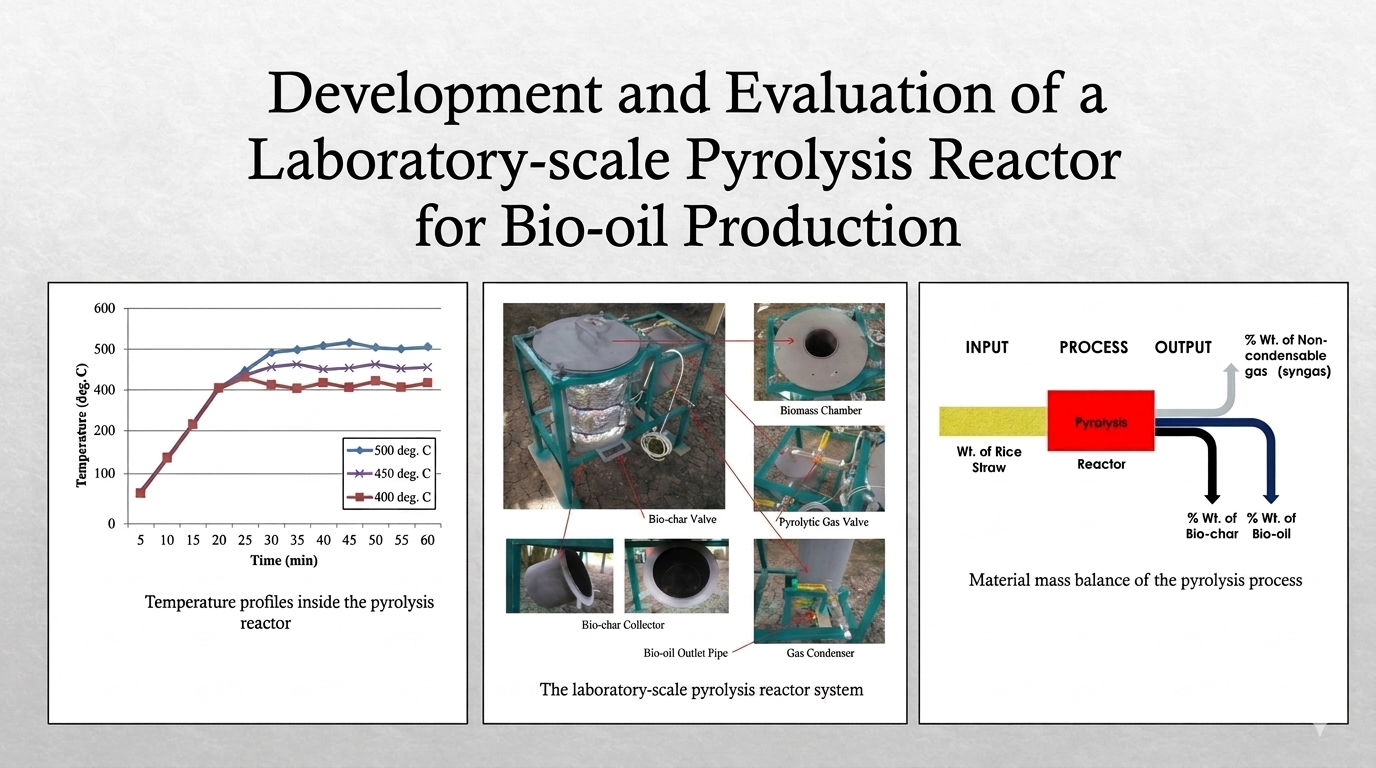
Biomass pyrolysis is gaining interest as a renewable energy conversion pathway that valorizes agricultural residues while mitigating environmental hazards from open burning. This study aimed to design and fabricate a batch-fed laboratory-scale biomass pyrolysis reactor and evaluate its technical performance for bio-oil production using rice straw as feedstock. A split-plot experiment in a completely randomized design was employed, varying reactor insulation thickness (25, 50, and 75 mm), pyrolysis temperature (400°C, 450°C, and 500°C), and biomass loading density (60, 90, and 120 kg/m³). Analysis of variance and Scheffe’s test were used to determine significant differences among treatments. Biomass loading density, pyrolysis temperature, and insulation thickness each had a significant effect on bio-oil production, whereas all two-way and three-way interactions were not significant. The combination of 25 mm insulation, 450°C pyrolysis temperature, and 90 kg/m³ loading density yielded the highest mean bio-oil (78.07 g, 76.74 g, and 73.26 g, respectively). The developed reactor demonstrated temperature stability and operational integrity at 400°C–500°C. The reactor is a viable tool for biomass pyrolysis, and the established standard operating procedure provides a useful guide for optimizing bio-oil and bio-char production from various biomass types.
Article Details

This work is licensed under a Creative Commons Attribution-NonCommercial-NoDerivatives 4.0 International License.
References
Chynoweth, D. P.; Owens, J. M.; Legrand, R. Renewable Methane from Anaerobic Digestion of Biomass. Renew. Energy 2001, 22(1–3), 1–8. https://doi.org/10.1016/S0960-1481(00)00019-7
Boyle, G. Renewable Energy; Oxford University Press: Oxford, UK, 2004; p 456.
Ramage, J.; Scurlock, J. Biomass. In Renewable Energy—Power for a Sustainable Future; Boyle, G., Ed.; Oxford University Press: Oxford, UK, 1996.
Zhang, Q.; Chang, J.; Wang, T.; Xu, Y. Review of Biomass Pyrolysis Oil Properties and Upgrading Research. Energy Convers. Manag. 2007, 48, 87–92. https://doi.org/10.1016/j.enconman.2006.05.010
Tsai, W. T.; Lee, M. K.; Chang, Y. M. Fast Pyrolysis of Rice Husk: Product Yields and Compositions. Bioresour. Technol. 2007, 98, 22–28.
Brammer, J. G.; Lauer, M.; Bridgwater, A. V. Opportunities for Biomass-Derived Bio-Oil in European Heat and Power Markets. Energy Policy 2006, 34, 2871–2880. https://doi.org/10.1016/j.enpol.2005.05.005
Sudhakar, S.; Kumar, A. D.; Mohamed Rasiq Farith, A.; Prasanna, R.; Siva, S. Conversion of Waste Plastic into Engine Fuel Using Pyrolysis Process. Omega Glob. J. Eng. Technol. 2018, 1(2).
Antal, M. J., Jr.; Grönli, M. The Art, Science, and Technology of Charcoal Production. Ind. Eng. Chem. Res. 2003, 42, 1619–1640. https://doi.org/10.1021/ie0207919
Demirbas, A. The Influence of Temperature on the Yields of Compounds Existing in Bio-Oils Obtained from Biomass Samples via Pyrolysis. Fuel Process. Technol. 2007, 88, 591–597. https://doi.org/10.1016/j.fuproc.2007.01.010
Muradov, N. Z.; Veziroglu, T. N. “Green” Path from Fossil-Based to Hydrogen Economy: An Overview of Carbon-Neutral Technologies. Int. J. Hydrogen Energy 2008, 33, 6804–6839. https://doi.org/10.1016/j.ijhydene.2008.08.054
Rapsing, E. C., Jr. Design and Fabrication of Waste Plastic Oil Converter. Int. J. Interdiscip. Res. Innov. 2016, 4(2), 69–77.
Wongdaeng, F.; Chotisuwan, S.; Jariyaboon, R.; Kongjan, P. Pyrolysis of Latex Sediment from Concentrated Latex Industry and Properties of Pyrolytic Products. ASEAN J. Sci. Technol. Rep. 2024, 27(2). https://doi.org/10.55164/ajstr.v27i2.250798
Merrick & Company. The Intricacies of Pyrolyzer Furnace Design; Merrick & Company: Denver, CO, USA, 2016. www.merrick.com (accessed January 1, 2019).
Henkel, C. Laboratory-Scale Fast Pyrolysis Reactor Design; Unpublished Report, 2014.
Kadam, K. L.; Forrest, L. H.; Jacobson, W. A. Rice Straw as a Lignocellulosic Resource: Collection, Processing, Transportation, and Environmental Aspects. Biomass Bioenergy 2000, 18(5), 369–389. https://doi.org/10.1016/S0961-9534(00)00005-2
Mohan, D.; Pittman, C. U.; Steele, P. H. Pyrolysis of Wood/Biomass for Bio-Oil: A Critical Review. Energy Fuels 2006, 20, 848–889. https://doi.org/10.1021/ef0502397
Krishna, B. B.; Biswas, B.; Kumar, J.; Singh, R.; Bhaskar, T. Role of Reaction Temperature on Pyrolysis of Cotton Residue. Waste Biomass Valorization 2015, 7, 71–78. https://doi.org/10.1007/s12649-015-9440-x
Weerachanchai, P.; Tanggsathitkulchai, C.; Tanggsathitkulchai, M. Characterization of Products of Pyrolysis of Palm Kernel Cake and Cassava Pulp Residue. Korean J. Chem. Eng. 2011, 28(2), 2262–2272.
Jangsawang, W. Preliminary Experimental of Biomass Gasification Process with Open Core Throat Less Downdraft Gasifier. ASEAN J. Sci. Technol. Rep. 2023, 26(1). https://doi.org/10.55164/ajstr.v26i1.247166
Alburo, C. L. P.; Neri, A. Biochar from Sewage Sludge on Soil and Plant Characteristics of Arugula (Eruca sativa). ASEAN J. Sci. Technol. Rep. 2025, 28(4). https://doi.org/10.55164/ajstr.v28i4.257297
Kumar, J.; Bhaskar, T.; Bisht, Y.; Pandey, N.; Biswas, B.; Singh, R. Pyrolysis of Agricultural Biomass Residues: Comparative Study of Corn Cob, Wheat Straw, Rice Straw and Rice Husk. Bioresour. Technol. 2017, 237, 57–63. https://doi.org/10.1016/j.biortech.2017.02.046
