
Bioaccumulation and Enzyme Activity Inhibition of Profenofos in Japanese Medaka (Oryzias latipes Temminck and Schlegel, 1846)
Article Sidebar
Main Article Content
Abstract
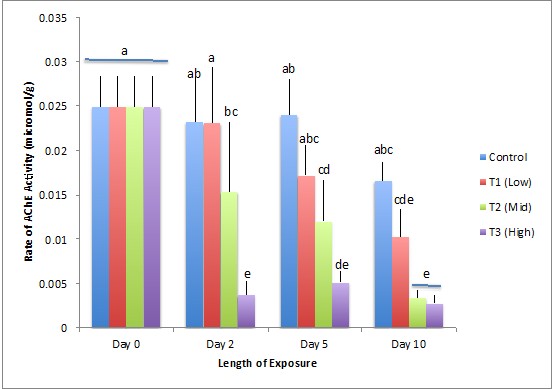
Effects of the organophosphate pesticide (OP) profenofos on acetylcholinesterase enzyme (AChE) activity inhibition were investigated using brain samples from Japanese medaka (Oryzias latipes Temminck and Schlegel, 1846). River water samples from six sampling sites along the Dalaguete River, Cebu, Philippines were tested for pesticide concentrations, the results of which were used as the basis for the Range-Finding and Exposure Tests. Japanese medaka of approximately the same weight and length were grouped into five (n=6 per group) for the RFT and were exposed to different concentrations of profenofos. For the exposure test, a total of 96 medaka were used, grouped into four groups (n=24 per group). Profenofos showed a positive, dose-dependent, and exposure-time-dependent relationship in inhibiting AChE activity. The highest concentration was already causing significant inhibition of AChE activity on Day 2. On Day 5, all concentrations were significantly different from Control. Increasing the concentration of profenofos leads to greater bioaccumulation of the pesticide in fish tissues, reaching a point of equilibrium on Day 5. The amount of pesticide accumulation declined in the fish tissues with longer exposure periods. Periodic water sampling is recommended to establish levels of profenofos and other pesticides in the river, with due consideration for the wet and dry seasons. Further studies on degradation, fate, and transport are also recommended.
Article Details

This work is licensed under a Creative Commons Attribution-NonCommercial-NoDerivatives 4.0 International License.
References
Zhou, W.; Li, M.; Achal, V. A comprehensive review on environmental and human health impacts of chemical pesticide usage. Emerg. Contam. 2025, 11(1), Article 100410. https://doi.org/10.1016/j.emcon.2024.100410
Navarro, I.; Royano, S.; Alonso, C.; de la Torre, A.; Martínez, M. Á. Environmental exposure and risk assessment of pesticide mixtures in aquatic organisms from the Tagus River Basin. Ecotoxicol. Environ. Saf. 2025, 305, 119221. https://doi.org/10.1016/j.ecoenv.2025.119221
Leyson, J. J. C.; Villegas, L. M. G.; Velasco, L. M.; Alburo, H. M.; Alburo, R. P. Trace metal contamination and biomarker responses in fish from a mining-impacted river basin in Cebu, Philippines. ASEAN J. Sci. Technol. Rep. 2025, 28(6), 1–20. https://doi.org/10.55164/ajstr.v28i6.257772
Muñoz-Bautista, J. M.; Bernal-Mercado, A. T.; Martínez-Cruz, O.; Burgos-Hernández, A.; López-Zavala, A. A.; Ruiz-Cruz, S.; Ornelas-Paz, J. d. J.; Borboa-Flores, J.; Ramos-Enríquez, J. R.; Del-Toro-Sánchez, C. L. Environmental and health impacts of pesticides and nanotechnology as an alternative in agriculture. Agronomy 2025, 15(8), 1878. https://doi.org/10.3390/agronomy15081878
Li, H.; Jiao, Y.; Li, L.; Jiao, X. Research progress and trend of effects of organophosphorus pesticides on aquatic organisms in the past decade. Comp. Biochem. Physiol., Part C: Toxicol. Pharmacol. 2023, 271, 109673. https://doi.org/10.1016/j.cbpc.2023.109673
Chauhan, A.; Jyoti, S.; Pandey, S. P.; Maurya, P. K. A review on aquatic ecotoxicity of organophosphorus insecticide profenofos with reference to environmental fate and impact on fish. J. Appl. Nat. Sci. 2025, 17(3), 961–972. https://doi.org/10.31018/jans.v17i3.6775
Rai, S. K.; Kumar, R.; Tiwari, P. K.; Kshatri, A. S.; Sinha, A.; Choudhary, R.; Chourasia, S.; Yadav, K. K. Pesticide contamination in aquatic environments: Implications for biodiversity and ecosystem health. Int. J. Adv. Biochem. Res. 2025, 9(11), 635–641. https://doi.org/10.33545/26174693.2025.v9.i11i.6396
Min, K. J.; Cha, C. G. Determination of the bioconcentration of phosphamidon and profenofos in zebrafish (Brachydanio rerio). Bull. Environ. Contam. Toxicol. 2000, 65(5), 611–617. https://doi.org/10.1007/s0012800167
Ellman, G. L.; Courtney, K. D.; Andres, V., Jr.; Featherstone, R. M. A new and rapid colorimetric determination of acetylcholinesterase activity. Biochem. Pharmacol. 1961, 7(2), 88–95. https://doi.org/10.1016/0006-2952(61)90145-9
Khalil, F.; Kang, I. J.; Undap, S.; Tasmin, R.; Qiu, X.; Shimasaki, Y.; Oshima, Y. Alterations in social behavior of Japanese medaka (Oryzias latipes) in response to sublethal chlorpyrifos exposure. Chemosphere 2013, 92(1), 125–130. https://doi.org/10.1016/j.chemosphere.2013.02.042
Añasco, N.; Uno, S.; Koyama, J.; Matsuoka, T.; Kuwahara, N. Assessment of pesticide residues in freshwater areas affected by rice paddy effluents in Southern Japan. Environ. Monit. Assess. 2010, 160(1–4), 371–383. https://doi.org/10.1007/s10661-008-0701-z
Li, H.; Cheng, F.; Wei, Y.; Lydy, M. J.; You, J. Global occurrence of chlorpyrifos in sediments, water and biota and their impacts on organisms: A review. Environ. Pollut. 2017, 229, 566–574. https://doi.org/10.1016/j.envpol.2017.05.078
Sánchez-Hernández, J. C.; Sandoval-Herrera, N.; Rico, A. Biomarkers of neurotoxicity in wildlife exposed to organophosphate pesticides. Environ. Res. 2019, 172, 111–123. https://doi.org/10.1016/j.envres.2019.02.016
Park, J. H.; Lee, J. S.; Kang, J. C. Neurobehavioral toxicity of organophosphate pesticides in fish: Linking acetylcholinesterase inhibition to behavioral alterations. Chemosphere 2021, 263, 128208. https://doi.org/10.1016/j.chemosphere.2020.128208
Muñoz-Bautista, J. M.; Martínez-Jerónimo, F.; Cruz-Hernández, A. Sublethal pesticide exposure affects behavior and neurophysiology of freshwater fish. Sci. Total Environ. 2022, 807, 150796. https://doi.org/10.1016/j.scitotenv.2021.150796
Colović, M. B.; Krstić, D. Z.; Lazarević-Pašti, T. D.; Bondžić, A. M.; Vasić, V. M. Acetylcholinesterase inhibitors: Pharmacology and toxicology. Curr. Neuropharmacol. 2013, 11(3), 315–335. https://doi.org/10.2174/1570159X11311030006
Kumar, N.; Sharma, R.; Gaur, V. K. Organophosphate-induced alterations in acetylcholinesterase kinetics in freshwater fish. Ecotoxicol. Environ. Saf. 2018, 148, 407–414. https://doi.org/10.1016/j.ecoenv.2017.10.034
El-Shenawy, N. S.; Al-Eisa, R. A.; El-Sayed, E. S. M. Toxic impacts of profenofos on physiological, biochemical, and histological parameters of fish. Environ. Sci. Pollut. Res. 2020, 27, 35610–35621. https://doi.org/10.1007/s11356-020-09556-9
Abdel-Tawwab, M.; Adeshina, I.; Monier, M. N. Neurotoxic effects of organophosphate pesticides on fish: A focus on acetylcholinesterase inhibition and behavioral alterations. Aquat. Toxicol. 2021, 236, 105850. https://doi.org/10.1016/j.aquatox.2021.105850
Sloman, K. A.; McNeil, P. L. Using behaviour to assess sublethal toxicity in fish. J. Fish Biol. 2016, 88(1), 38–55. https://doi.org/10.1111/jfb.12728
Hellou, J. Behavioural ecotoxicology, an “early warning” signal to assess environmental quality. Environ. Sci. Pollut. Res. 2011, 18(1), 1–11. https://doi.org/10.1007/s11356-020-12252-8
Zahwar, A.T.; Sabour, A.N. Berberine ameliorates methionine-induced hyperhomocysteinemia and biochemical alterations in male rats. ASEAN J. Sci. Technol. Rep. 2026, 29(3). https://doi.org/10.55164/ajstr.v29i3.262094
