
Diversity and Abundance of Spiders (Araneae) in Different Habitats in Mt. Lantoy, Cebu, Philippines
Article Sidebar
Main Article Content
Abstract
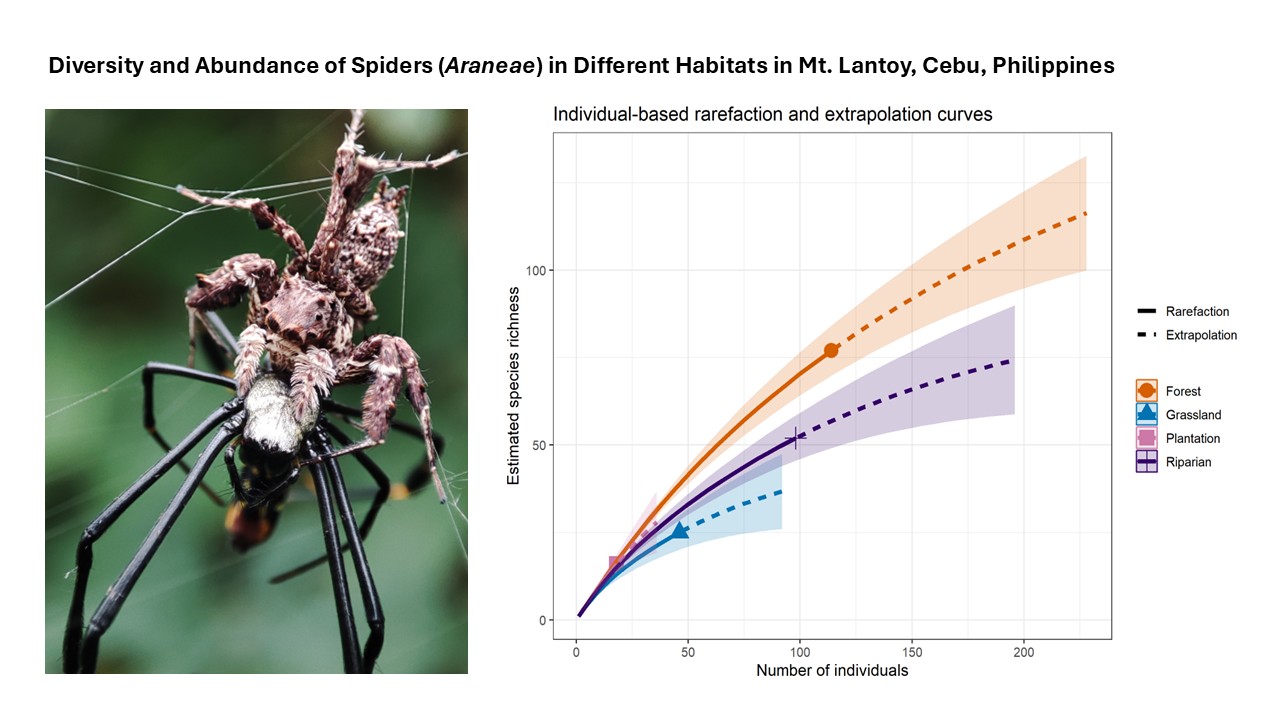
Spiders are essential Tecological regulators that help maintain ecosystem stability through their roles as both predators and prey in food webs. Despite their importance, information on their diversity and distribution is still scarce, especially in regions that remain poorly explored. This study aims to assess the abundance and diversity of spiders across different habitats at Mt. Lantoy: Forest, Riparian, Plantation, and Grassland. A combination of search-and-capture techniques and beat-sheet methods was employed during a 160-man-hour sampling period. The study documented 276 individuals across 101 species in 20 families. Among the families, Araneidae exhibited the highest species richness with 35 species, while Tetragnatha cf. ceylonica was the most abundant species, with 16 individuals. Nine recorded species are Philippine endemics (Acusilas dahoneus, Gasteracantha parangdiadesmia, Chrysso tiboli, Neoscona facundoi, Neoscona aldinei, Nusatidia luzonica, Phlogiellus baeri, Phintella piatensis, and Lepidemathis sericea) and eight species are classified as threatened under DENR Administrative Order 2019-09 (Cytophora exanthematica, Eriovixia laglaizei, Neoscona punctigera, Neoscona aldinei, Neoscona vigilans, Parawixia dehaani, Poltys illepidus, and Phlogiellus baeri); two species — Neoscona aldinei and Phlogiellus baeri — carry both endemic and threatened status, yielding 15 unique conservation-priority species in total. Forest and riparian had significantly higher plot-level abundance and species richness than plantation and grassland; forest and riparian were not significantly different from each other. These findings highlight Mt. Lantoy as a key habitat for spider populations, underscoring its value for future conservation initiatives and biodiversity management.
Article Details

This work is licensed under a Creative Commons Attribution-NonCommercial-NoDerivatives 4.0 International License.
References
Rajeevan, S.; Kunnath, S. M.; Varghese, T.; Kandambeth, P. P. Spider Diversity (Arachnida: Araneae) in Different Ecosystems of the Western Ghats, Wayanad Region, India. Sarhad J. Agric. Life Sci. 2019, 7(2). https://doi.org/10.17582/journal.sajls/2019/7.2.29.39
Ramos, D.; Hartke, T. R.; Buchori, D.; Dupérré, N.; Hidayat, P.; Lia, M.; Harms, D.; Scheu, S.; Drescher, J. Rainforest Conversion to Rubber and Oil Palm Reduces Abundance, Biomass and Diversity of Canopy Spiders. PeerJ 2022, 10, e13898. https://doi.org/10.7717/peerj.13898
Shabnam, F. P.; K, S. M.; Rajeevan, S.; Prasadan, P. K.; Sudhikumar, A. V. Spider Diversity (Arachnida; Araneae) in Different Plantations of Western Ghats, Wayanad Region, India. Eur. J. Ecol. 2021, 7(1). https://doi.org/10.17161/eurojecol.v7i1.14612
Griotti, M.; Muñoz-Escobar, C.; Ferretti, N. E. Linking Vegetation Structure and Spider Diversity in Riparian and Adjacent Habitats in Two Rivers of Central Argentina: An Analysis at Two Conceptual Levels. Environ. Entomol. 2017, 46(4), 794–803. https://doi.org/10.1093/ee/nvx094
Laborda, Á.; Montes De Oca, L.; Pérez-Miles, F.; Useta, G.; Simó, M. The Spider Fauna from Uruguay River Islands: Understanding Its Role in a Biological Corridor. Biodivers. Data J. 2018, 6, e27319. https://doi.org/10.3897/BDJ.6.e27319
Avalos, G.; Achitte-Schmutzler, H. C.; De Los Santos, M. E. Caracterización de la fauna de Arañas en monocultivos de Eucalyptus y Pinus de la Reserva del Iberá, Corrientes, Argentina. Rev. Mex. Biodivers. 2018, 89(1). https://doi.org/10.22201/ib.20078706e.2018.1.1910
Pinto, C. M.; Santoandré, S.; Zurita, G.; Bellocq, M. I.; Filloy, J. Conifer Plantations in Grassland and Subtropical Forest: Does Spider Diversity Respond Different to Edge Effect? J. For. Res. 2018, 23(5), 253–259. https://doi.org/10.1080/13416979.2018.1506248
Quijano, I. P.; Flores, M. J. L.; Malaki, A. B. Geospatial Ecological Forest Corridor Modelling in the Mount Lantoy Key Biodiversity Area. Int. Arch. Photogramm. Remote Sens. Spatial Inf. Sci. 2019, XLII-4/W19, 347–352. https://doi.org/10.5194/isprs-archives-XLII-4-W19-347-2019
Lillo, E. P.; Malaki, A. B.; Alcazar, S. M. T.; Nuevo, R. U.; Rosales, R. Native Trees on Mount Lantoy Key Biodiversity Areas (KBA), Argao, Cebu, Philippines. Philipp. J. Sci. 2019, 148(2), 359–371.
Rosales, R.; Lillo, E.; Alcazar, S. M.; Colita, L.; Caballero, J.; Malaki, A. B. Species Composition, Relative Abundance, and Distribution of Land Snail Species in Mt. Lantoy Key Biodiversity Area, Cebu, Philippines. Biodiversitas 2020, 21(11). https://doi.org/10.13057/biodiv/d211152
Pinkus-Rendón, M. A.; León-Cortés, J. L.; Ibarra-Núñez, G. Spider Diversity in a Tropical Habitat Gradient in Chiapas, Mexico. Divers. Distrib. 2006, 12(1), 61–69. https://doi.org/10.1111/j.1366-9516.2006.00217.x
Achacoso, S. C.; Walag, A. M. P.; Saab, L. L. A Rapid Assessment of Foliage Spider Fauna Diversity in Sinaloc, El Salvador City, Philippines. Biodiversity 2016, 17(4), 156–161. https://doi.org/10.1080/14888386.2016.1258331
Philippine Atmospheric, Geophysical and Astronomical Services Administration. Climate of the Philippines; DOST-PAGASA. https://www.pagasa.dost.gov.ph/information/climate-philippines (accessed 2026-05-25).
Barrion-Dupo, A. L. A.; Lit, I. L., Jr.; Abenis, K. O.; Lucañas, C. C.; Eusebio, O. L. Spiders of Mt. Makiling, Philippines; UPLB Museum of Natural History: Los Baños, Philippines, 2021.
Gloor, D.; Nentwig, W.; Blick, T.; Kropf, C. World Spider Catalog; Natural History Museum Bern, 2017. https://doi.org/10.24436/2
Global Biodiversity Information Facility. GBIF Home Page; Global Biodiversity Information Facility. https://www.gbif.org/ (accessed 2026-05-25).
Metzner, H. Jumping Spiders (Arachnida: Araneae: Salticidae) of the World. https://www.jumping-spiders.com/ (accessed 2026-05-25).
Barrion, A. T.; Litsinger, J. A. Riceland Spiders of South and Southeast Asia; CAB International; International Rice Research Institute: Wallingford, UK; Manila, Philippines, 1995.
R Core Team. R: A Language and Environment for Statistical Computing; R Foundation for Statistical Computing: Vienna, Austria, 2026.
Oksanen, J.; Simpson, G. L.; Blanchet, F. G.; et al. vegan: Community Ecology Package; Version 2.7-3, 2026. https://doi.org/10.32614/CRAN.package.vegan
Fox, J.; Weisberg, S. An R Companion to Applied Regression, 3rd ed.; SAGE: Los Angeles, 2019.
Hsieh, T. C.; Ma, K. H.; Chao, A. iNEXT: An R Package for Rarefaction and Extrapolation of Species Diversity (Hill Numbers). Methods Ecol. Evol. 2016, 7(12), 1451–1456. https://doi.org/10.1111/2041-210X.12613
Chao, A.; Gotelli, N. J.; Hsieh, T. C.; et al. Rarefaction and Extrapolation with Hill Numbers: A Framework for Sampling and Estimation in Species Diversity Studies. Ecol. Monogr. 2014, 84(1), 45–67. https://doi.org/10.1890/13-0133.1
Cardoso, P.; Pekár, S.; Jocqué, R.; Coddington, J. A. Global Patterns of Guild Composition and Functional Diversity of Spiders. PLoS One 2011, 6(6), e21710. https://doi.org/10.1371/journal.pone.0021710
Wickham, H. ggplot2: Elegant Graphics for Data Analysis; Use R!; Springer International Publishing: Cham, 2016. https://doi.org/10.1007/978-3-319-24277-4
Milano, F.; Blick, T.; Cardoso, P.; et al. Spider Conservation in Europe: A Review. Biol. Conserv. 2021, 256, 109020. https://doi.org/10.1016/j.biocon.2021.109020
Oxbrough, A.; Ziesche, T. Spiders in Forest Ecosystems. In Integrative Approaches as an Opportunity for the Conservation of Forest Biodiversity; Kraus, D.; Krumm, F., Eds.; European Forest Institute: Germany, 2013; pp 186–193.
Koneri, R.; Nangoy, M. J. The Distribution and Diversity of Spiders (Arachnida: Aranae) in Sahendaruman Mountain, Sangihe Islands, North Sulawesi, Indonesia. Appl. Ecol. Environ. Res. 2017, 15 (3), 797–808. https://doi.org/10.15666/aeer/1503_797808
Deeleman-Reinhold, C. L. Forest Spiders of South East Asia: With a Revision of the Sac and Ground Spiders (Araneae: Clubionidae, Corinnidae, Liocranidae, Gnaphosidae, Prodidomidae and Trochanteriidae); Brill: Leiden, Netherlands, 2001. https://doi.org/10.1163/9789004475588
Graf, N.; Battes, K. P.; Cimpean, M.; et al. Relationship between Agricultural Pesticides and the Diet of Riparian Spiders in the Field. Environ. Sci. Eur. 2020, 32(1), 1. https://doi.org/10.1186/s12302-019-0282-1
Middendorf, F.; Bundschuh, M.; Eitzinger, B.; Entling, M. H.; Schirmel, J. Review of the Importance of Aquatic Prey for Riparian Arthropod Predators. Basic Appl. Ecol. 2025, 86, 1–10. https://doi.org/10.1016/j.baae.2025.04.007
Uetz, G.; Halaj, J.; Cady, A. Guild Structure of Spiders in Major Crops. J. Arachnol. 1999, 27, 270–280
