
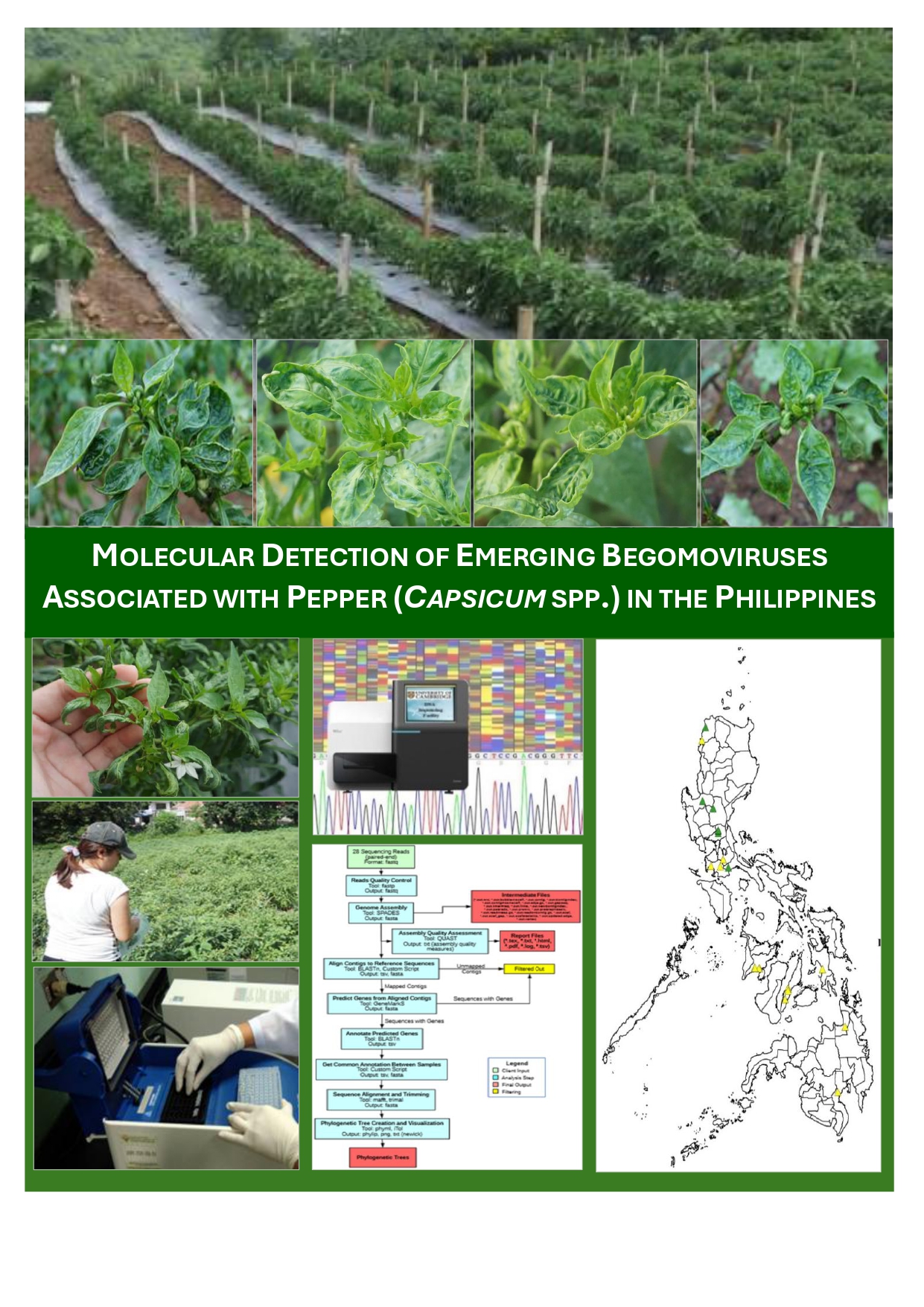
Molecular Detection of Emerging Begomoviruses Associated with Pepper (Capsicum spp.) in the Philippines
Article Sidebar
Main Article Content
Abstract
Several Begomovirus have become significant plant viruses affecting pepper crops worldwide. In the Philippines, begomoviruses infecting pepper were first documented in 2011 but since then no other studies have been done. As new and emerging begomoviral diseases continue to threaten and hamper crop production, it is important to deal them proactively to mitigate losses. Here, begomoviruses associated with pepper in the country were successfully detected and identified through the combined application of conventional molecular methods and next-generation sequencing (NGS) technologies. Pepper leaf samples exhibiting disease symptoms were gathered from various locations across the country. Presence of begomovirus infection was initially detected through visual observation of its characteristic symptoms (leaf curling/cupping/crinkling, interveinal yellowing of leaves and apical leaf size reduction) and subsequently verified through polymerase chain reaction (PCR) using begomovirus-specific degenerate primers, together with rolling circle amplification (RCA). Emerging begomoviruses in pepper were not detected by restriction enzymes digestion but were identified through NGS-derived sequences. Two known and five unknown begomoviruses were identified from NGS sequences and provided evidence of the presence of emerging known begomoviruses in new areas as well as new begomoviruses of pepper in the Philippines. This is the first study to employ Illumina-NGS technology for the molecular surveillance of begomoviruses infecting pepper in the Philippines.
Keywords: Bioinformatics; next-generation sequencing; phylogenetic analysis, polymerase chain reaction, rolling circle amplification
Article Details

This work is licensed under a Creative Commons Attribution-NonCommercial-NoDerivatives 4.0 International License.
References
Hernández-Pérez, T.; Gómez-García, M. del R.; Valverde, M. E.; Paredes-López, O. Capsicum annuum (Hot Pepper): An Ancient Latin American Crop with Outstanding Bioactive Compounds and Nutraceutical Potential. A Review. Compr. Rev. Food Sci. Food Saf. 2020, 19(6), 2972–2993. https://doi.org/10.1111/1541-4337.12634
Batiha, G. E.-S.; Alqahtani, A.; Ojo, O. A.; Shaheen, H. M.; Wasef, L.; Elzeiny, M.; Ismail, M.; Shalaby, M.; Murata, T.; Zaragoza-Bastida, A.; et al. Biological Properties, Bioactive Constituents, and Pharmacokinetics of Some Capsicum spp. and Capsaicinoids. Int. J. Mol. Sci. 2020, 21(15), 5179. https://doi.org/10.3390/ijms21155179
Peppers: Vegetable and Spice Capsicums, 2nd ed.; Bosland, P. W.; Votava, E. J., Eds.; CABI: Wallingford, UK, 2012. https://doi.org/10.1079/9781845938253.0000.
Philippine Statistics Authority. Home. https://psa.gov.ph/ (accessed Apr 6, 2026).
Parisi, M.; Alioto, D.; Tripodi, P. Overview of Biotic Stresses in Pepper (Capsicum spp.): Sources of Genetic Resistance, Molecular Breeding and Genomics. Int. J. Mol. Sci. 2020, 21(7), 2587. https://doi.org/10.3390/ijms21072587
Kenyon, L.; Kumar, S.; Tsai, W.-S.; Hughes, J. d'A. Virus Diseases of Peppers (Capsicum spp.) and Their Control. In Advances in Virus Research; Academic Press, 2014; Vol. 90; pp 297–354. https://doi.org/10.1016/B978-0-12-801246-8.00006-8
Hanssen, I. M.; Lapidot, M.; Thomma, B. P. H. J. Emerging Viral Diseases of Tomato Crops. Mol. Plant-Microbe Interact. 2010, 23(5), 539–548. https://doi.org/10.1094/MPMI-23-5-0539
Jones, R. A. C. Global Plant Virus Disease Pandemics and Epidemics. Plants 2021, 10(2), 233. https://doi.org/10.3390/plants10020233
Savary, S.; Willocquet, L.; Pethybridge, S. J.; Esker, P.; McRoberts, N.; Nelson, A. The Global Burden of Pathogens and Pests on Major Food Crops. Nat. Ecol. Evol. 2019, 3(3), 430–439. https://doi.org/10.1038/s41559-018-0793-y
Food and Agriculture Organization of the United Nations. Home. https://www.fao.org/home/en (accessed Apr 6, 2026).
Moriones, E.; Navas-Castillo, J. Tomato Yellow Leaf Curl Virus, an Emerging Virus Complex Causing Epidemics Worldwide. Virus Res. 2000, 71(1), 123–134. https://doi.org/10.1016/S0168-1702(00)00193-3
Simmonds, P.; Adriaenssens, E. M.; Lefkowitz, E. J.; Oksanen, H. M.; Zerbini, F. M.; Alfenas-Zerbini, P.; Aylward, F. O.; Dempsey, D. M.; Freitas-Astúa, J.; Hendrickson, R. C.; et al. Changes to Virus Taxonomy, the International Code of Virus Classification and Nomenclature, and the ICTV Statutes Ratified by the International Committee on Taxonomy of Viruses (2025). Arch. Virol. 2026, 171(1), 23. https://doi.org/10.1007/s00705-025-06485-1
Brown, J. K.; Zerbini, F. M.; Navas-Castillo, J.; Moriones, E.; Ramos-Sobrinho, R.; Silva, J. C. F.; Fiallo-Olivé, E.; Briddon, R. W.; Hernández-Zepeda, C.; Idris, A.; et al. Revision of Begomovirus Taxonomy Based on Pairwise Sequence Comparisons. Arch. Virol. 2015, 160(6), 1593–1619. https://doi.org/10.1007/s00705-015-2398-y
Zerbini, F. M.; Briddon, R. W.; Idris, A.; Martin, D. P.; Moriones, E.; Navas-Castillo, J.; Rivera-Bustamante, R.; Roumagnac, P.; Varsani, A.; ICTV Report Consortium. ICTV Virus Taxonomy Profile: Geminiviridae. J. Gen. Virol. 2017, 98(2), 131–133. https://doi.org/10.1099/jgv.0.000738
Fiallo-Olivé, E.; Navas-Castillo, J. Molecular and Biological Characterization of a New World Mono-/BipartiteBegomovirus/Deltasatellite Complex Infecting Corchorus siliquosus. Front. Microbiol. 2020, 11, 1755. https://doi.org/10.3389/fmicb.2020.01755
Brown, J. K. A Whitefly-Transmitted Geminivirus from Peppers with Tigré Disease. Plant Dis. 1989, 73(7), 610. https://doi.org/10.1094/PD-73-0610E
Brown, J. K. Serrano Golden Mosaic Virus: A Newly Identified Whitefly-Transmitted Geminivirus of Pepper and Tomato in the United States and Mexico. Plant Dis. 1990, 74(9), 720. https://doi.org/10.1094/PD-74-0720C
Khan, A. J.; Al-Saady, N.; Al-Mahruki, M. S.; Al-Oufi, M.; Al-Subhi, A. M. Molecular Characterization of Begomovirus Infecting Sweet Pepper in Oman. 2007.
Varma, A.; Malathi, V. G. Emerging Geminivirus Problems: A Serious Threat to Crop Production. Ann. Appl. Biol. 2003, 142(2), 145–164. https://doi.org/10.1111/j.1744-7348.2003.tb00240.x
Dolores, L. M.; Pissawin, C. Detection of Leaf Curl Virus in Pepper by Using Non-Radioactive DNA Probe. Philipp. J. Crop Sci. 1994, 19, 80.
Tsai, W.-S.; Shih, S.-L.; Sengoda-Gounder, V.; Aquino, M. U.; Green, S. K.; Kenyon, L.; Jan, F.-J. Distribution and Genetic Diversity of Begomoviruses Infecting Tomato and Pepper Plants in the Philippines. Ann. Appl. Biol. 2011, 158, 275–287. https://doi.org/10.1111/j.1744-7348.2011.00462.x
Accotto, G. P.; Navas-Castillo, J.; Noris, E.; Moriones, E.; Louro, D. Typing of Tomato Yellow Leaf Curl Viruses in Europe. Eur. J. Plant Pathol. 2000, 106, 179–186. https://doi.org/10.1023/A:1008736023293
Rojas, M. R.; Jiang, H.; Salati, R.; Xoconostle-Cázares, B.; Sudarshana, M. R.; Lucas, W. J.; Gilbertson, R. L. Functional Analysis of Proteins Involved in Movement of the Monopartite Begomovirus, Tomato Yellow Leaf Curl Virus. Virology 2001, 291(1), 110–125. https://doi.org/10.1006/viro.2001.1194
Dellaporta, S. L.; Wood, J.; Hicks, J. B. A Plant DNA Minipreparation: Version II. Plant Mol. Biol. Rep. 1983, 1(4), 19–21. https://doi.org/10.1007/BF02712670
Haible, D.; Kober, S.; Jeske, H. Rolling Circle Amplification Revolutionizes Diagnosis and Genomics of Geminiviruses. J. Virol. Methods 2006, 135(1), 9–16. https://doi.org/10.1016/j.jviromet.2006.01.017
Chen, S.; Zhou, Y.; Chen, Y.; Gu, J. Fastp: An Ultra-Fast All-in-One FASTQ Preprocessor. bioRxiv 2018. https://doi.org/10.1101/274100
Bankevich, A.; Nurk, S.; Antipov, D.; Gurevich, A. A.; Dvorkin, M.; Kulikov, A. S.; Lesin, V. M.; Nikolenko, S. I.; Pham, S.; Prjibelski, A. D.; et al. SPAdes: A New Genome Assembly Algorithm and Its Applications to Single-Cell Sequencing. J. Comput. Biol. 2012, 19(5), 455–477. https://doi.org/10.1089/cmb.2012.0021
Besemer, J.; Borodovsky, M. GeneMark: Web Software for Gene Finding in Prokaryotes, Eukaryotes and Viruses. Nucleic Acids Res. 2005, 33 (Web Server issue), W451–W454. https://doi.org/10.1093/nar/gki487
Katoh, K.; Standley, D. M. MAFFT Multiple Sequence Alignment Software Version 7: Improvements in Performance and Usability. Mol. Biol. Evol. 2013, 30(4), 772–780. https://doi.org/10.1093/molbev/mst010
Capella-Gutiérrez, S.; Silla-Martínez, J. M.; Gabaldón, T. TrimAl: A Tool for Automated Alignment Trimming in Large-Scale Phylogenetic Analyses. Bioinformatics 2009, 25(15), 1972–1973. https://doi.org/10.1093/bioinformatics/btp348
Guindon, S.; Lethiec, F.; Duroux, P.; Gascuel, O. PHYML Online—A Web Server for Fast Maximum Likelihood-Based Phylogenetic Inference. Nucleic Acids Res. 2005, 33 (Web Server issue), W557–W559. https://doi.org/10.1093/nar/gki352
Letunic, I.; Bork, P. Interactive Tree of Life (iTOL) v3: An Online Tool for the Display and Annotation of Phylogenetic and Other Trees. Nucleic Acids Res. 2016, 44, gkw290. https://doi.org/10.1093/nar/gkw290
Koeda, S.; Kesumawati, E.; Tanaka, Y.; Hosokawa, M.; Doi, M.; Kitajima, A. Mixed Infection of Begomoviruses on Pepper Plants at Northern Sumatra, Indonesia. Trop. Agric. Dev. 2016, 60(2), 59–64. https://doi.org/10.11248/jsta.60.59
Jeevalatha, A.; Singh, B.; Kaundal, P.; Kumar, R.; Raigond, B. RCA-PCR: A Robust Technique for the Detection of Tomato Leaf Curl New Delhi Virus-Potato at Ultra Low Virus Titre. Potato J. 2014, 41, 76–80.
Rocha, C. S.; Castillo-Urquiza, G. P.; Lima, A. T. M.; Silva, F. N.; Xavier, C. A. D.; Hora-Júnior, B. T.; Beserra-Júnior, J. E. A.; Malta, A. W. O.; Martin, D. P.; Varsani, A.; et al. Brazilian Begomovirus Populations Are Highly Recombinant, Rapidly Evolving, and Segregated Based on Geographical Location. J. Virol. 2013, 87(10), 5784–5799. https://doi.org/10.1128/JVI.00155-13
Reina, J.; Morilla, G.; Bejarano, E. R.; Rodríguez, M. D.; Janssen, D. First Report of Capsicum annuum Plants Infected by Tomato Yellow Leaf Curl Virus. Plant Dis. 1999, 83(12), 1176. https://doi.org/10.1094/PDIS.1999.83.12.1176D
Quiñones, M.; Fonseca, D.; Martinez, Y.; Accotto, G. P. First Report of Tomato Yellow Leaf Curl Virus Infecting Pepper Plants in Cuba. Plant Dis. 2002, 86(1), 73. https://doi.org/10.1094/PDIS.2002.86.1.73A
Polston, J. E.; Cohen, L.; Sherwood, T. A.; Ben-Joseph, R.; Lapidot, M. Capsicum Species: Symptomless Hosts and Reservoirs of Tomato Yellow Leaf Curl Virus. Phytopathology 2006, 96(5), 447–452. https://doi.org/10.1094/PHYTO-96-0447
Barboza, N.; Blanco-Meneses, M.; Esker, P.; Moriones, E.; Inoue-Nagata, A. Distribution and Diversity of Begomoviruses in Tomato and Sweet Pepper Plants in Costa Rica. Ann. Appl. Biol. 2018, 172(2), 200–210. https://doi.org/10.1111/aab.12398
