
Chitosan and Plant Extract-Based Edible Coatings in Postharvest Life of Bell Pepper (Capsicum Annuum L.) Under Tropical Ambient Conditions
Article Sidebar
Main Article Content
Abstract
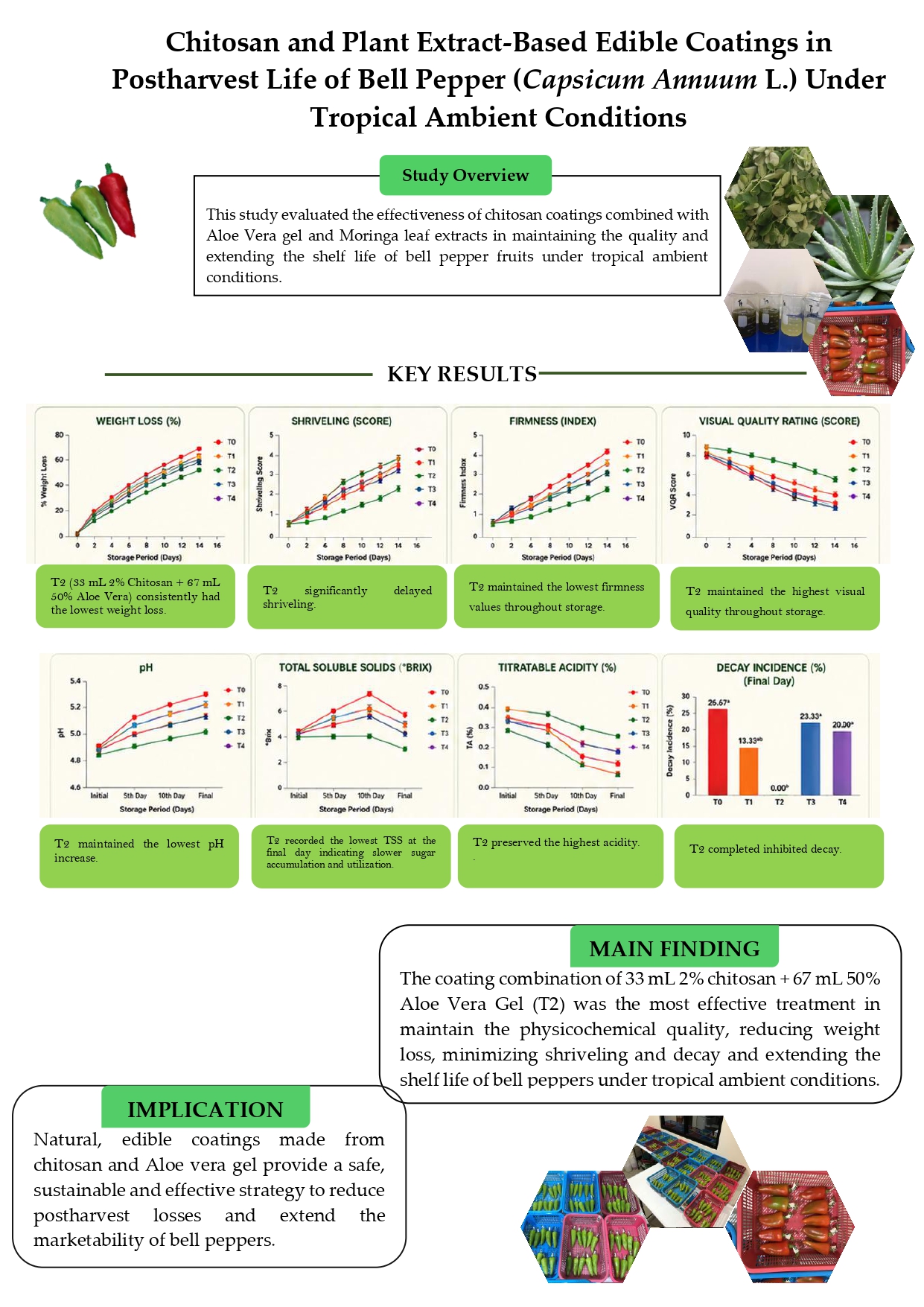
Growing concerns over food sustainability and postharvest losses have made eco-friendly preservation strategies essential. Edible coatings offer an alternative to refrigeration, helping maintain fruit quality during storage. This study evaluated chitosan and plant extract–based coatings on the postharvest quality of bell pepper under ambient conditions. The research was conducted in two phases. Study 1 tested chitosan at 1%, 2%, 3%, and 4% concentrations against an uncoated control, and Study 2 combined the most effective concentration with Aloe vera and Moringa leaf extracts. In Study 1, 2% chitosan was most effective in reducing weight loss and shriveling while maintaining firmness and visual quality. Building on this result, Study 2 applied five treatments: T0 (2% chitosan), T1 (50 mL of 2% chitosan + 50 mL of 50% Aloe vera), T2 (33 mL of 2% chitosan + 67 mL of 50% Aloe vera), T3 (50 mL of 2% chitosan + 50 mL of 50% Moringa leaf extract), and T4 (33 mL of 2% chitosan + 67 mL of 50% Moringa leaf extract). Among these, the Aloe vera–enriched coating T2 best reduced weight loss, delayed shriveling, and extended marketable shelf life, whereas the Moringa–chitosan treatments better preserved firmness but showed earlier visual deterioration. Overall, 2% chitosan alone delayed postharvest deterioration, but combining it with a higher proportion of Aloe vera was most effective, underscoring the potential of natural coatings as sustainable alternatives to refrigeration.
Article Details

This work is licensed under a Creative Commons Attribution-NonCommercial-NoDerivatives 4.0 International License.
References
Pavlath, A. E.; Orts, W. Edible Films and Coatings: Why, What, and How? In Edible Films and Coatings for Food Applications; Embuscado, M. E.; Huber, K. C., Eds.; Springer: New York, NY, 2009; pp 1–23. https://doi.org/10.1007/978-0-387-92824-1_1
Shafique, M.; Rashid, M.; Ullah, S.; Rajwana, I. A.; Naz, A.; Razzaq, K.; Hussain, M.; Abdelgawad, M. A.; El-Ghorab, A. H.; Ghoneim, M. M.; Shaker, M. E.; Imran, M.; Jbawi, E. A. Shelf Life of Strawberry Affected by Edible Coatings. Int. J. Food Prop. 2023, 26(2), 2995–3012. https://doi.org/10.1080/10942912.2023.2267794
Sharma, S.; Krishna, H.; Barman, K.; Kole, B.; Singh, S. K.; Behera, T. K. Polyamine and Chitosan Effects on Bell Pepper Senescence. S. Afr. J. Bot. 2022, 151, 175–184. https://doi.org/10.1016/j.sajb.2022.10.016
Park, S. I.; Stan, S. D.; Daeschel, M. A.; Zhao, Y. Antifungal Coatings on Strawberries during Cold Storage. J. Food Sci. 2005, 70 (4), M202–M207. https://doi.org/10.1111/j.1365-2621.2005.tb07163.x
Worawut, K.; Phungpis, B.; Kaewkumsan, P.; Noppawan, P. Film Development of Chitosan from Mussel Shells and Pacific White Shrimp Shells. ASEAN J. Sci. Technol. Rep. 2024, 27(4), e254066. https://doi.org/10.55164/ajstr.v27i4.254066
Worawut, K.; Phungpis, B.; Noppawan, P. Valorization of White Shrimp Shell Waste: Development of Chitosan-Based Pellet Feed for Enhanced Nile Tilapia (Oreochromis niloticus) Nutrition. ASEAN J. Sci. Technol. Rep. 2026, 29(2), e260098. https://doi.org/10.55164/ajstr.v29i2.260098
Kahramanoglu, I.; Chen, C.; Chen, J.; Wan, C. Chemical Constituents and Antimicrobial Activity of Aloe vera Gel. Agronomy 2019, 9, 831. https://doi.org/10.3390/agronomy9120831
[8] Muthmainnah, N.; Solichatun, S. Postharvest Application of Chitosan and Gum Arabic Edible Coating for Chilli. IOP Conf. Ser.: Mater. Sci. Eng. 2019, 633, 012028. https://doi.org/10.1088/1757-899X/633/1/012028
Mahmood, K. T.; Mugal, T.; Haq, I. U. Moringa oleifera: A Natural Gift—A Review. J. Pharm. Sci. Res. 2010, 2(11), 775–781.
Hernandez-Muñoz, P.; Almenar, E.; Ocio, M. J.; Gavara, R. Effect of Calcium Dips and Chitosan Coatings on Postharvest Life of Strawberries. Postharvest Biol. Technol. 2006, 39(3), 247–253. https://doi.org/10.1016/j.postharvbio.2005.11.006
Cruzada, B. S.; Benitez, M. M. Impact of Edible-Based Coatings on Physicochemical Properties of Bitter Gourd. Sci. Humanit. J. 2024, 20, 57–72. https://doi.org/10.47773/shj.1998.201.4
Kasolo, J. N.; Bimenya, G. S.; Ojok, L.; Ochieng, J.; Ogwal-Okeng, J. W. Phytochemicals and Uses of Moringa oleifera Leaves. J. Med. Plants Res. 2010, 4(9), 753–757. https://doi.org/10.5897/JMPR10.128
Acedo, A. L., Jr. Postharvest Physiology of Perishable Crops. In Laboratory Manual in Horticulture 111; Department of Horticulture, College of Agriculture, Visayas State University: Visca, Baybay, Leyte, Philippines, 1999.
Falcão-Rodrigues, M. M.; Moldão-Martins, M.; Beirão-da-Costa, M. L. Effect of Edible Coatings on Postharvest Quality of Strawberry. Food Rev. Int. 2007, 23(4), 347–367. https://doi.org/10.1080/87559120701224843
Bautista-Baños, S.; Hernández-López, M.; Bosquez-Molina, E.; Wilson, C. L. Effects of Chitosan and Plant Extracts on Growth of Colletotrichum gloeosporioides and Quality of Papaya Fruit. Crop Prot. 2003, 22(9), 1087–1092. https://doi.org/10.1016/S0261-2194(03)00121-0
Elsabee, M. Z.; Abdou, E. S. Chitosan-Based Edible Films and Coatings: A Review. Mater. Sci. Eng. C 2013, 33(4), 1819–1841. https://doi.org/10.1016/j.msec.2013.01.010
Ali, A.; Maqbool, M.; Alderson, P. G.; Zahid, N. Effect of Gum Arabic as an Edible Coating on Antioxidant Capacity of Tomato (Solanum lycopersicum L.) Fruit during Storage. Postharvest Biol. Technol. 2013, 76, 119–124. https://doi.org/10.1016/j.postharvbio.2012.09.011
Ali, A.; Maqbool, M.; Ramachandran, S.; Alderson, P. G. Gum Arabic as a Novel Edible Coating for Enhancing Shelf Life and Improving Postharvest Quality of Tomato (Solanum lycopersicum L.) Fruit. Postharvest Biol. Technol. 2010, 58(1), 42–47. https://doi.org/10.1016/j.postharvbio.2010.05.005
Valencia-Chamorro, S. A.; Palou, L.; del Río, M. A.; Pérez-Gago, M. B. Antimicrobial Edible Coatings for Fresh Produce. Crit. Rev. Food Sci. Nutr. 2011, 51(9), 872–900. https://doi.org/10.1080/10408398.2010.485705
Kumar, L.; Ramakanth, D.; Akhila, K.; Gaikwad, K. K. Edible Films and Coatings for Food Packaging: A Review. Environ. Chem. Lett. 2022, 20, 875–900. https://doi.org/10.1007/s10311-021-01339-z
Romanazzi, G.; Feliziani, E.; Bautista-Baños, S.; Sivakumar, D. Shelf Life Extension of Fresh Produce by Chitosan Treatment. Crit. Rev. Food Sci. Nutr. 2017, 57(3), 579–601. https://doi.org/10.1080/10408398.2014.900474
El-Mohamedy, R. S. R.; Rady, M. M. Extending Shelf Life and Maintaining Quality of Sweet Pepper Fruits Using Chitosan and Carboxymethyl Cellulose. Middle East J. Agric. Res. 2015, 4(1), 19–29. https://doi.org/10.33687/mejar.004.01.0848
Jati, I. R. A.; Setijawaty, E.; Utomo, A. R.; Darmoatmodjo, L. M. Y. Application of Aloe vera Gel as Coating Agent to Maintain Tomato Quality. Coatings 2022, 12(10), 1480. https://doi.org/10.3390/coatings12101480
Dhall, R. K. Advances in Edible Coatings for Fresh Fruits and Vegetables: A Review. Crit. Rev. Food Sci. Nutr. 2013, 53(5), 435–450. https://doi.org/10.1080/10408398.2010.541568
Wang, F.; Xie, C.; Tang, H.; Hao, W.; Wu, J.; Sun, Y.; Sun, J.; Liu, Y.; Jiang, L. Chitosan Nanofiber Films with Anthocyanins for Active Food Packaging. Food Hydrocoll. 2023, 139, 108496. https://doi.org/10.1016/j.foodhyd.2023.108496
[26] Ghafoor, K.; Al-Juhaimi, F. Y.; Mohamed Ahmed, I. A.; Babiker, E. E.; Shahzad, S. A.; Alsawmahi, O. N. Effects of Functional Coatings Containing Chitosan, Orange Peel and Olive Cake Extracts on the Quality Attributes of Cucumber during Cold Storage. Plants 2022, 11(14), 1895. https://doi.org/10.3390/plants11141895
Zarandona, I.; Minh, N. C.; Trung, T. S.; de la Caba, K.; Guerrero, P. Bioactive Release from Chitosan Films with Aloe vera. Int. J. Biol. Macromol. 2021, 182, 1331–1338. https://doi.org/10.1016/j.ijbiomac.2021.04.200
Hemmami, H.; Amor, I. B.; Amor, A. B.; Zeghoud, S.; Ahmed, S.; Alhamad, A. A. Chitosan and Its Derivatives: Sources, Preparation, and Applications. J. Turk. Chem. Soc. A 2024, 11(1), 341–364. https://doi.org/10.18596/jotcsa.1336313
Chiabrando, V.; Giacalone, G. Shelf-Life Extension of Sweet Cherries Treated with Chitosan and Calcium Chloride. Postharvest Biol. Technol. 2011, 60(3), 162–168. https://doi.org/10.1016/j.postharvbio.2010.12.004
Serrano, M.; Valverde, J. M.; Guillén, F.; Castillo, S.; Martínez-Romero, D. Use of Aloe vera Gel Coating Preserves the Functional Properties of Table Grapes. Postharvest Biol. Technol. 2006, 39(2), 151–155. https://doi.org/10.1016/j.postharvbio.2005.11.006
Darma, R.; Herliana, O.; Rakhmawati, R. Chitosan Coating in Reducing Postharvest Losses. J. Agric. Postharvest Res. 2020, 17(3), 211–220. https://doi.org/10.21082/jtidp.v17n3.2020.p211-220
Benítez, S.; Achaerandio, I.; Sepulcre, F.; Pujolà, M. Aloe Vera-Based Edible Coatings Improve the Quality of Minimally Processed Kiwifruit. Postharvest Biol. Technol. 2015, 110, 86–93. https://doi.org/10.1016/j.postharvbio.2015.07.014
Manoj, H. G.; Sreenivas, K. N.; Shankarappa, T. H.; Krishna, H. C. Effect of Chitosan and Aloe vera Coatings on Shelf Life and Quality of Bell Pepper (Capsicum annuum L.). Int. J. Curr. Microbiol. Appl. Sci. 2016, 5(1), 399–405. https://doi.org/10.20546/ijcmas.2016.501.040
Anwar, F.; Latif, S.; Ashraf, M.; Gilani, A. H. Moringa oleifera: A Food Plant with Multiple Medicinal Uses. Phytother. Res. 2007, 21(1), 17–25. https://doi.org/10.1002/ptr.2023
Maan, A. A.; Nazir, A.; Khan, M. K. I.; Ahmad, T.; Zia, R.; Murid, M.; Abrar, M. The Therapeutic Properties and Applications of Aloe vera: A Review. J. Herb. Med. 2018, 12, 1–10. https://doi.org/10.1016/j.hermed.2018.01.002
El Ghaouth, A.; Arul, J.; Ponnampalam, R.; Boulet, M. Chitosan Coating Effect on Storability and Quality of Fresh Strawberries. J. Food Sci. 1992, 57(6), 1618–1622. https://doi.org/10.1111/j.1365-2621.1992.tb08209.x
Boudreau, M. D.; Beland, F. A. An Evaluation of the Biological and Toxicological Properties of Aloe vera. J. Environ. Sci. Health C Environ. Carcinog. Ecotoxicol. Rev. 2006, 24(1), 103–154. https://doi.org/10.1080/10590500600614303
Ali, A.; Muhammad, M. T. M.; Sijam, K.; Siddiqui, Y. Potential of Aloe vera Gel Coating for Delaying Postharvest Browning and Extending Shelf Life of Fresh-Cut Fruits and Vegetables: A Review. Food Rev. Int. 2009, 25(2), 114–128. https://doi.org/10.1080/87559120802682104
Ali, S.; Nawaz, A.; Naz, S.; Ejaz, S.; Maqbool, M.; Siddiqui, M. H.; Kalaji, H. M.; Wróbel, J.; Telesiński, A.; Auriga, A. Hydrogen Sulfide Mitigates Chilling Injury of Postharvest Banana Fruits by Regulating γ-Aminobutyric Acid Shunt Pathway and Ascorbate–Glutathione Cycle. Front. Plant Sci. 2022, 13, 941246. https://doi.org/10.3389/fpls.2022.941246
Zhang, D.; Quantick, P. C. Antifungal Effects of Chitosan Coating on Fresh Strawberries and Raspberries during Storage. J. Hortic. Sci. Biotechnol. 1998, 73(6), 763–767. https://doi.org/10.1080/14620316.1998.11511025
